Saudi Arabia has rejected an Iraqi claim that the Kingdom purchased 25 oil tankers worth an estimated $4.5 billion, opening a public dispute over what is driving extraordinary crude shipping costs in the Gulf.
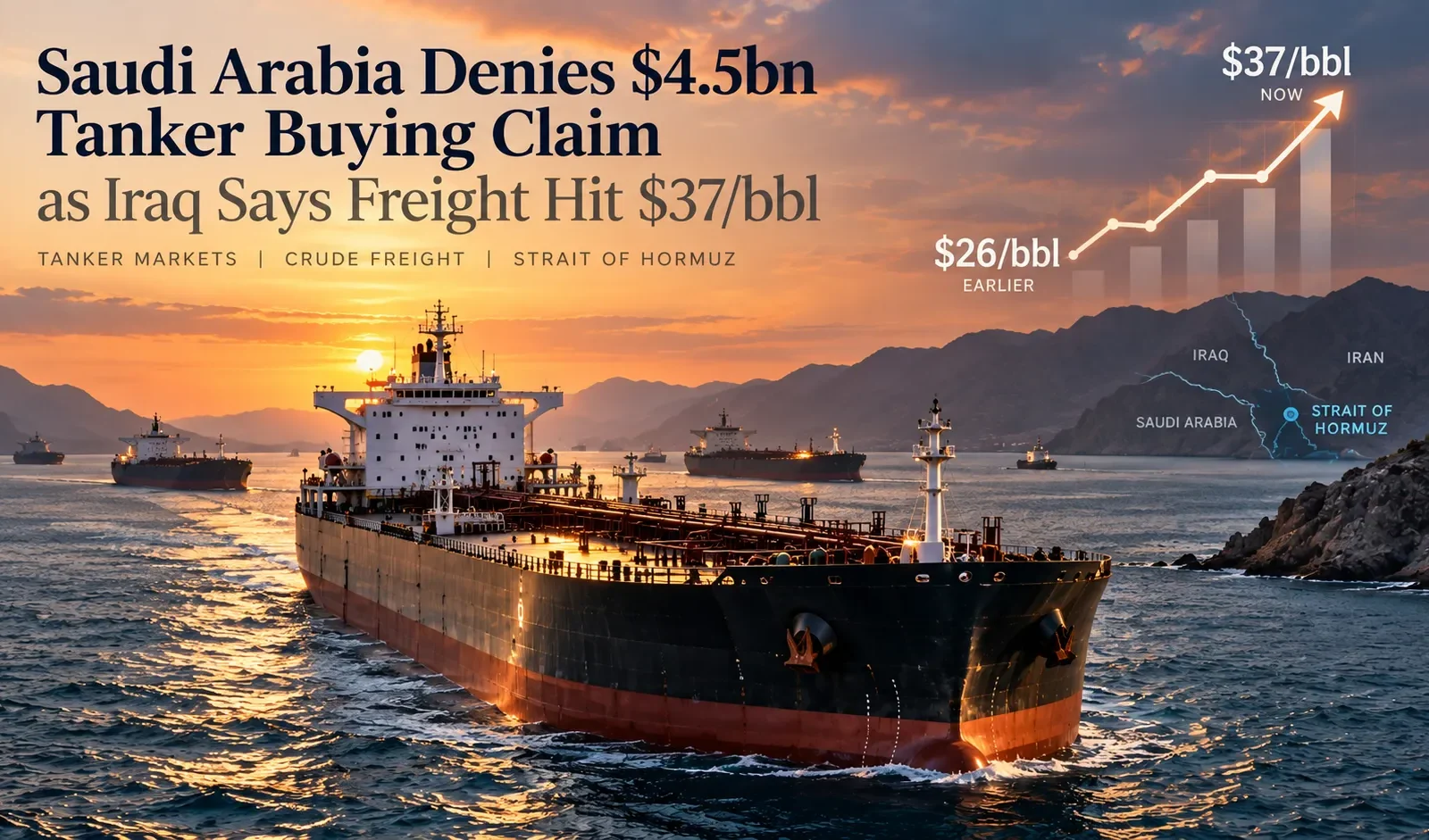
Iraq’s oil minister said the alleged tanker acquisitions contributed to the cost of transporting Iraqi crude rising from approximately $26 to $37 per barrel. Saudi Arabia’s Ministry of Energy says the 25-tanker purchase claim is incorrect and instead points to regional military escalation, Strait of Hormuz disruption, higher shipping and insurance risk, and fewer tankers willing to operate in the region.
Saudi Arabia Denies Buying 25 Oil Tankers
The dispute began after Iraqi Oil Minister Basim Mohammed Khudair Al-Abbadi and SOMO Chairman and Director General Ali Nizar Al-Shatari discussed tanker availability and oil transportation costs during a session of Iraq’s Council of Representatives.
According to Reuters, the Iraqi oil minister said Saudi Arabia had purchased 25 oil tankers with an estimated value of approximately $4.5 billion.
He linked the alleged purchases to a sharp rise in the cost of transporting Iraqi crude, citing an increase from approximately $26 per barrel to $37 per barrel.
Saudi Arabia’s Ministry of Energy subsequently rejected the allegation.
In an official statement published by the Saudi Press Agency, the ministry said the Kingdom had not purchased the 25 tankers referred to and said the information was incorrect.
Iraqi claim
- Saudi Arabia allegedly purchased 25 oil tankers.
- The alleged acquisitions were valued at around $4.5 billion.
- Iraq linked the claim to tighter tanker availability.
- The Iraqi minister cited transport costs rising from $26/bbl to $37/bbl.
Saudi response
- Saudi Arabia says it did not purchase the 25 tankers.
- The Energy Ministry says the purchase allegation is incorrect.
- It points instead to regional military escalation.
- It cites Hormuz disruption, higher risk, insurance costs and fewer willing tankers.
Why the $37-per-Barrel Shipping Figure Matters
Even apart from the disagreement over the alleged tanker purchase, the $37-per-barrel transport cost cited by Iraq is an extraordinary number.
The difference between the two figures cited by Iraq is $11 per barrel.
For a simplified two-million-barrel crude cargo — broadly consistent with the scale of a typical VLCC lifting — an additional $11 per barrel would correspond to approximately $22 million in extra transportation cost if the same per-barrel increase applied across the full cargo.
That calculation is illustrative. It is not a reported fixture and should not be interpreted as the freight bill for a specific voyage.
Actual tanker economics depend on cargo quantity, route, Worldscale terms, vessel positioning, bunkers, port costs, waiting time, insurance, security exposure and other voyage expenses.
For a real example of how extreme this market has become, Tide Signal previously examined the $25 million VLCC voyage that repriced Iraqi crude freight during the Hormuz crisis.
Saudi Arabia Says Hormuz Risk Is Driving Freight Higher
Saudi Arabia’s explanation focuses on the wider operating environment rather than the disputed tanker purchase.
The Energy Ministry said the sharp increase in transportation costs reflected factors including:
- military escalation in the region;
- attacks on commercial vessels;
- disruption to navigation through the Strait of Hormuz;
- sharply higher shipping risk;
- higher insurance costs; and
- a decline in the number of tankers willing to operate in the region.
That position is set out directly in the Saudi Ministry of Energy clarification.
The commercial mechanism behind that argument is important.
A ship can exist physically but still be unavailable for a Gulf cargo because the owner rejects the voyage, war-risk terms become unattractive, insurance approval is difficult, the charterer rejects the exposure, or the vessel is positioned for different employment.
Effective Tanker Supply Is the Real Freight Constraint
Shipping markets are priced on the vessels that are actually available, acceptable and willing to perform a voyage.
That distinction becomes especially important during a security crisis.
A global fleet may contain hundreds of crude tankers, yet the position list for one high-risk Gulf cargo can become extremely short.
When that happens:
- charterers compete for fewer commercially workable ships;
- owners gain negotiating leverage;
- Worldscale levels can rise rapidly;
- war-risk premiums become more significant;
- waiting and positioning costs increase; and
- the delivered cost of crude rises.
For readers who want to understand the benchmark behind many tanker fixtures, Tide Signal’s Worldscale in Shipping guide explains how WS100, Worldscale points and tanker voyage rates work.
The Baltic Exchange tanker chartering guide also explains why tanker fixtures are commonly expressed through the Worldscale system.
Strait of Hormuz Traffic Has Collapsed From Normal Levels
The Saudi–Iraq disagreement is occurring against an exceptionally disrupted Gulf shipping environment.
Reuters reported on 22 September that preliminary data showed only two commodity vessels crossing the Strait of Hormuz on Monday, down from ten the previous day and dramatically below the pre-conflict level of around 125 large commercial ships per day.
The figures need to be interpreted cautiously because ships operating in hazardous areas may switch off or manipulate AIS transmissions.
Nevertheless, the decline in visible traffic demonstrates the scale of the disruption.
Read the latest Reuters Hormuz traffic report or follow Tide Signal’s permanent Strait of Hormuz live shipping traffic and risk hub.
Why Hormuz Has Such a Powerful Effect on Tanker Freight
The Strait of Hormuz is not simply another shipping lane.
It is one of the world’s most important energy chokepoints.
The U.S. Energy Information Administration estimated that crude oil and petroleum liquids moving through Hormuz averaged around 21.6 million barrels per day in the fourth quarter of 2025.
By the second quarter of 2026, EIA estimated those flows had fallen to approximately 4.9 million barrels per day amid severe regional disruption.
That drop illustrates why even partial disruption can reshape global tanker economics.
When a route carrying enormous oil volumes becomes difficult to use, the impact spreads through:
- tanker availability;
- crude differentials;
- refinery sourcing;
- insurance;
- voyage duration;
- ship positioning;
- alternative export routes; and
- global oil pricing.
Iraq Is Particularly Exposed to Gulf Freight Costs
Iraq depends heavily on maritime crude exports through the Gulf.
When owners demand substantially higher freight to accept regional exposure, the effect does not remain confined to shipowners and charterers.
It can change the economics of the crude itself.
Higher tanker freight can influence:
- the delivered cost of Iraqi barrels;
- the crude discount required to attract buyers;
- refinery margins;
- cargo scheduling;
- ship size selection;
- charterer appetite;
- trade-route selection; and
- seller-buyer negotiations over freight responsibility.
That is why the dispute over the causes of the freight surge matters commercially even though the 25-tanker acquisition claim is contested.
The $25 Million VLCC Voyage Already Showed the Same Market Pressure
The current $37-per-barrel discussion is not occurring in isolation.
Earlier in the disruption, Tide Signal analysed a reported Iraqi crude fixture where the freight cost for a single VLCC voyage reached as much as $25 million.
That case illustrated the same underlying market mechanism:
When only a limited pool of ships is willing and able to perform a voyage, charterers can face extraordinary freight even though the vessels themselves have not disappeared from the global fleet.
VLCC Rates Have Already Reached Extreme Levels
The wider crude-tanker market confirms the severity of the repricing.
Tide Signal recently tracked the Gulf of Oman-to-China VLCC benchmark at around WS450 during the latest freight surge.
That route is particularly useful because it reflects tanker-market stress outside the conventional Persian Gulf loading pattern.
It demonstrates how disruption can affect the broader pool of ships available across the Gulf of Oman and Middle East tanker market.
Saudi Arabia Is Competing for Tankers Too
Saudi Arabia itself is exposed to the same constrained market.
The Kingdom has continued moving significant crude volumes while shipping conditions remain highly disrupted.
Tide Signal’s analysis of Saudi crude exports and Hormuz tanker traffic shows why vessel counts alone can be misleading.
A relatively small number of VLCCs can move enormous cargo volumes because a single large crude carrier can transport roughly two million barrels depending on vessel particulars and loading conditions.
This means tanker demand can remain intense even when the number of ships visibly crossing a chokepoint falls sharply.
Saudi Arabia’s Alternative Export System Has Also Been Under Pressure
Saudi Arabia has a major strategic advantage over some Gulf producers: its East-West pipeline can move crude toward the Red Sea and reduce dependence on the Strait of Hormuz.
But alternative routes are not immune to disruption.
Recent attacks and operational disruption affecting the East-West system and Yanbu export chain forced Saudi Arabia to adapt how crude was moved toward international buyers.
Tide Signal’s Saudi East-West Pipeline analysis tracks how the disruption pushed the Kingdom toward more complex tanker and ship-to-ship arrangements.
The larger lesson is important: when pipeline alternatives are constrained at the same time as Hormuz shipping, tanker capacity becomes even more strategically valuable.
Does Buying Tankers Automatically Push Freight Higher?
Not necessarily.
Even if a large buyer acquired 25 tankers, the freight impact would depend on exactly what was purchased and how the ships were employed.
Several scenarios would produce very different outcomes.
| Possible Scenario | Potential Freight Effect |
|---|---|
| Existing ships removed from open market | Could tighten effective tanker availability if vessels move into captive employment. |
| Existing ships remain commercially traded | Ownership changes, but effective market supply may change little. |
| Newbuildings ordered | Little immediate supply impact because delivery can take years. |
| Secondhand fleet redeployed | Impact depends on previous and new trading patterns. |
This is why the public allegation alone does not demonstrate that an alleged Saudi tanker acquisition caused the freight increase.
Saudi Arabia also denies that the 25-vessel acquisition occurred in the first place.
The Alleged $4.5 Billion Purchase Would Be a Huge Tanker Investment
The scale of the allegation explains why it immediately attracted shipping-market attention.
A $4.5 billion fleet transaction would rank as a very large capital commitment to crude transportation.
But without a verified vessel list, ship types, ages, specifications, transaction dates or financing details, the figure cannot be converted reliably into a per-vessel market valuation.
That distinction matters because a newbuilding VLCC, an older secondhand VLCC, a Suezmax and an Aframax represent very different assets and market values.
The wider tanker investment cycle is already exceptionally strong.
Tide Signal’s 217 VLCC Orders in 2026 analysis examines the more than $20 billion newbuilding boom already reshaping future crude-tanker supply.
Why Buying New Ships Does Not Solve Today’s Freight Shortage
One of the most important distinctions in the current tanker market is the difference between today’s availability problem and tomorrow’s fleet supply.
A ship ordered today does not immediately appear in the position list.
Newbuildings require shipyard capacity, construction time, financing, equipment, class approval and delivery.
That means a market can simultaneously experience:
- record tanker ordering;
- very high asset values;
- strong owner earnings; and
- a shortage of ships available for immediate high-risk voyages.
This apparent contradiction is central to understanding the 2026 tanker market.
War-Risk Costs Add Another Layer to the Freight Bill
The freight rate itself is only one part of the voyage economics.
When a ship enters a high-risk area, owners and charterers may also face additional insurance premiums, security requirements, operational restrictions and contractual negotiations.
Those costs can feed directly or indirectly into the freight demanded for the voyage.
For a detailed explanation, see Tide Signal’s War Risk Premiums: The Hidden Cost Behind High-Risk Voyages.
Why Worldscale Does Not Tell the Entire Story
Worldscale is the standard nominal freight framework used across much of the tanker market.
As the Baltic Exchange explains, market levels are commonly expressed as a percentage of a published nominal route rate.
WS100 represents the applicable Worldscale flat rate, while a fixture at WS200 would represent 200% of that nominal rate.
But a reported $37-per-barrel transportation cost is not the same thing as a Worldscale quotation.
The delivered transportation burden can also reflect:
- cargo quantity;
- bunker prices;
- port costs;
- waiting time;
- insurance;
- war-risk premiums;
- route deviation;
- ship-to-ship operations;
- positioning costs;
- commissions; and
- other voyage-specific expenses.
For that reason, Tide Signal treats the $26/bbl and $37/bbl figures as transport-cost figures attributed to Iraqi officials, not as universal tanker benchmarks.
What Higher Freight Means for Crude Buyers
At sufficiently high levels, tanker freight can change the relative attractiveness of different crude grades.
A refinery does not buy only the barrel.
It ultimately pays for a delivered barrel.
If transportation becomes dramatically more expensive, buyers can respond by:
- demanding a wider crude discount;
- switching to another producing region;
- changing cargo size;
- using different loading locations;
- accepting longer voyages from lower-risk regions;
- altering refinery crude slates; or
- delaying or restructuring cargo programmes.
That is why extreme tanker freight can influence physical oil pricing far beyond the shipping market itself.
What Higher Freight Means for Tanker Owners
For owners with acceptable vessels and a willingness to trade in the region, constrained tanker supply can create unusually strong earnings.
But the headline freight rate should not be confused with pure profit.
Owners must still account for:
- bunkers;
- port expenses;
- commissions;
- insurance;
- war-risk exposure;
- waiting time;
- off-hire risk;
- future vessel positioning; and
- the commercial risk of entering a disrupted region.
For comparisons between voyage and period employment, see Tide Signal’s VLCC Time Charter Rates: Spot vs Period Market.
Saudi–Iraq Tanker Claim: What Is Confirmed and What Is Not?
| Issue | Status |
|---|---|
| 25 tanker purchase | Iraqi officials alleged Saudi Arabia bought 25 tankers. Saudi Arabia denies the purchase. |
| $4.5bn value | Figure attributed to the Iraqi claim. No verified transaction list accompanied the public allegation. |
| $26/bbl transport cost | Figure cited by Iraq’s oil minister as the earlier level. |
| $37/bbl transport cost | Figure cited by Iraq’s oil minister as the higher current level. |
| Hormuz disruption | Confirmed by multiple shipping datasets and reporting; traffic remains far below normal levels. |
| Higher insurance and risk | Cited by Saudi Arabia as key drivers of regional shipping costs. |
| Reduced willing tanker supply | Cited by Saudi Arabia and consistent with the wider extreme Gulf freight environment. |
What to Watch Next in the Tanker Market
The commercial importance of this story will ultimately be determined less by the disagreement itself and more by whether tanker-market conditions begin to normalize.
The key indicators are:
- Hormuz vessel traffic: whether commercial tanker transits begin recovering.
- Owner participation: whether more owners are willing to accept Gulf voyages.
- War-risk insurance: whether premiums and underwriting restrictions ease.
- VLCC Worldscale rates: whether benchmark crude tanker routes retreat from extreme levels.
- Saudi export infrastructure: whether alternative Red Sea routes reduce pressure on Gulf tanker demand.
- Iraqi export economics: whether crude transport costs remain near the figures cited by Baghdad.
- Verified tanker transactions: whether any independently verifiable information emerges relating to the disputed 25-vessel claim.
Frequently Asked Questions
Did Saudi Arabia buy 25 oil tankers?
Iraqi officials said Saudi Arabia had purchased 25 oil tankers worth an estimated $4.5 billion. Saudi Arabia’s Ministry of Energy denies the claim and says the Kingdom did not purchase the 25 tankers referred to.
Why did Iraq blame Saudi Arabia for higher tanker freight?
Iraq’s oil minister argued that the alleged tanker acquisitions reduced available shipping capacity and contributed to higher crude transportation costs.
How much does Iraq say oil transportation now costs?
The Iraqi oil minister cited an increase from approximately $26 per barrel to $37 per barrel.
Why does Saudi Arabia say tanker costs have increased?
Saudi Arabia’s Ministry of Energy points to regional military escalation, attacks on vessels, navigation disruption through the Strait of Hormuz, higher shipping and insurance risk, and fewer tankers willing to operate in the region.
What is causing tanker rates to rise in the Gulf?
The effective supply of commercially available vessels has tightened as security risk, insurance conditions, voyage approvals and owner willingness reduce the number of ships competing for individual Gulf cargoes.
What does $37 per barrel freight mean?
The $37-per-barrel figure is a transportation-cost figure cited by Iraq’s oil minister. It should not be treated as a universal Worldscale rate or a benchmark applying to every Iraqi crude cargo.
Can buying tankers cause freight rates to rise?
Potentially, but only if acquisitions remove a meaningful number of vessels from the open commercial market. The effect depends on which ships are purchased, their previous employment and how the buyer deploys them.
Why is the Strait of Hormuz important to tanker freight?
Hormuz is one of the world’s most important oil transit chokepoints. Disruption can restrict effective tanker supply, complicate insurance, alter vessel positioning and increase the cost of moving crude from Gulf producers.
How much oil normally moves through the Strait of Hormuz?
The U.S. Energy Information Administration estimated crude oil and petroleum liquids flows through Hormuz at about 21.6 million barrels per day in the fourth quarter of 2025. Severe disruption reduced estimated flows significantly during 2026.
Are VLCC rates also extremely high?
Yes. Tide Signal has tracked exceptional VLCC freight levels during the 2026 Gulf disruption, including a Gulf of Oman-to-China assessment around WS450 and a reported Iraqi crude voyage costing as much as $25 million.
Key Takeaways
- Iraqi officials alleged that Saudi Arabia purchased 25 oil tankers worth approximately $4.5 billion.
- Saudi Arabia has formally denied that it purchased the 25 tankers referred to.
- Iraq’s oil minister cited crude transportation costs rising from approximately $26 to $37 per barrel.
- Saudi Arabia says the increase reflects regional conflict, Hormuz disruption, higher shipping and insurance risk, and fewer tankers willing to operate in the region.
- The public information currently available does not establish that an alleged 25-vessel purchase caused the increase in freight.
- The wider tanker market is nevertheless experiencing exceptional freight because the supply of commercially available Gulf tonnage has tightened sharply.
- The dispute highlights a wider 2026 shipping reality: tanker availability has become a major component of crude-oil pricing and energy security.
Official Sources and Further Reading
- Reuters — Saudi Arabia denies buying oil tankers after Iraq blames it for higher shipping costs
- Saudi Press Agency — Ministry of Energy clarification on the 25-tanker claim and Iraqi oil transport costs
- Reuters — Hormuz vessel traffic falls to two
- U.S. Energy Information Administration — Energy security and global oil chokepoint flows
- U.S. Energy Information Administration — World Oil Transit Chokepoints
- Baltic Exchange — Tanker Chartering and Worldscale
Editorial note: Tide Signal reports the 25-tanker and $4.5 billion figures as claims made by Iraqi officials, not as confirmed Saudi tanker acquisitions. Saudi Arabia’s Ministry of Energy has formally denied the purchase. The $26-per-barrel and $37-per-barrel figures are also attributed to the Iraqi oil minister and should not be interpreted as universal tanker-market benchmarks. This article may be updated as additional shipping, transaction or official information becomes available.