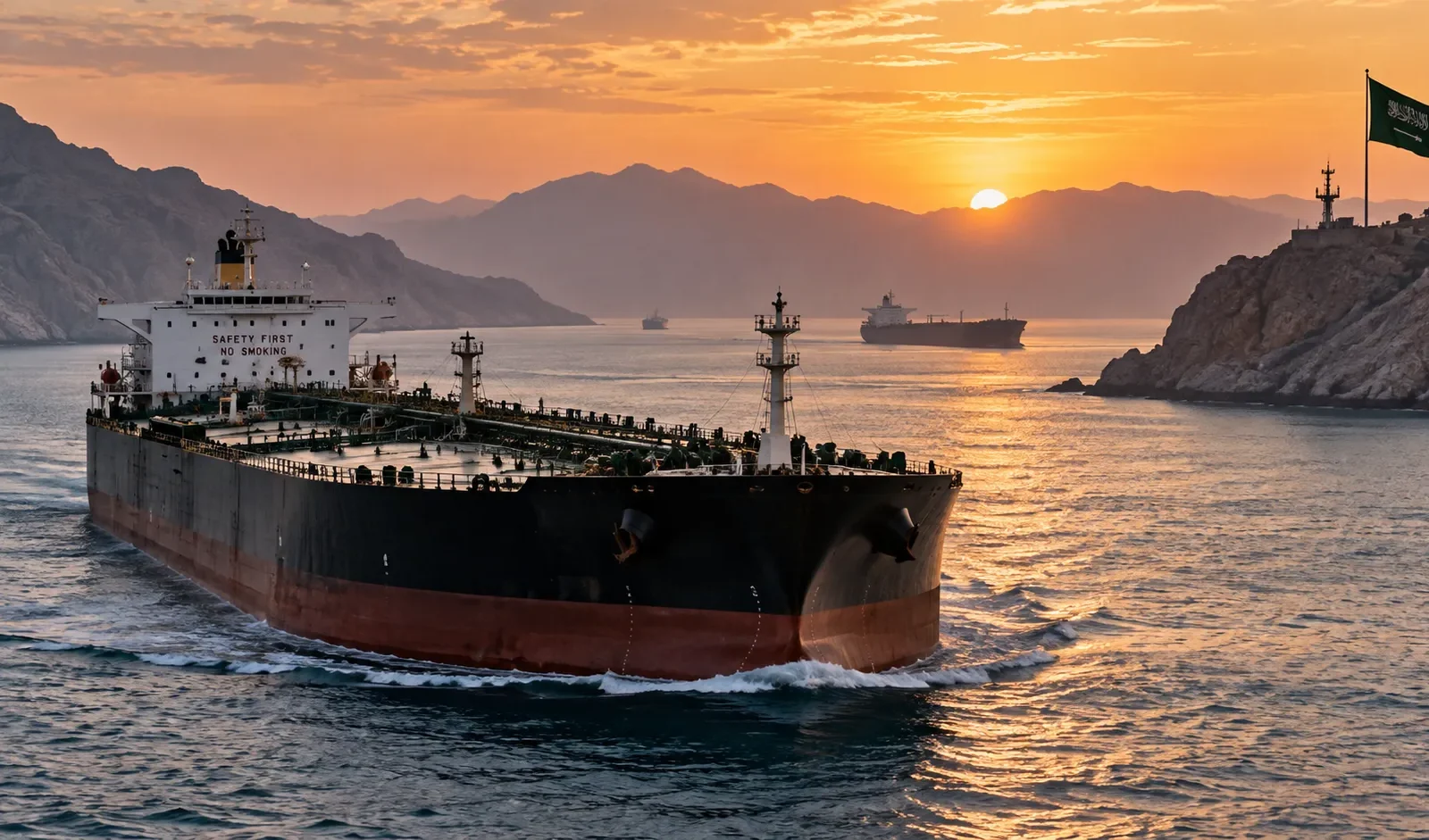
Saudi crude exports have recovered to more than 4 million barrels per day in September even as visible commercial traffic through the Strait of Hormuz remains severely disrupted — creating an unusual tanker market in which oil volumes are recovering faster than vessel-count data alone would suggest.
Saudi crude exports are recovering sharply even though the Strait of Hormuz remains far from normal commercial operation.
Reuters reporting on 21 September, citing preliminary Kpler data, showed just 12 trackable commodity vessels passing through the Strait over the weekend, down from 35 during the previous weekend. Before the regional conflict began in February, the waterway typically handled roughly 125 large commercial vessels per day across tankers, gas carriers, bulkers and container ships.
Yet the same shipping data tells another story beneath the headline vessel count: Saudi Arabia has managed to lift crude exports back above 4 million barrels per day so far in September after exports dropped to around 2.4 million b/d in August.
That divergence matters for tanker markets. Hormuz is still operating under extraordinary risk, but low visible vessel traffic does not mean Gulf oil exports have stopped. Instead, cargoes are moving through a more complex combination of selective tanker movements, reduced AIS visibility, Gulf loadings, offshore transfers and alternative routing.
Saudi Crude Exports Rebound From the August Low
Saudi crude exports have emerged as one of the clearest examples of how Gulf energy flows are adapting to the disruption.
Provisional Kpler figures indicate Saudi exports have risen above 4 million b/d in September after falling to around 2.4 million b/d in August, the lowest level reported since at least 2013.
The more striking shift is occurring through the Strait itself.
Satellite-based estimates cited by JPMorgan indicated that Saudi oil moving through Hormuz averaged about 2.9 million b/d over a recent six-day period, compared with roughly 700,000 b/d during August. Those estimates were also reported in the 21 September Reuters market update.
In other words, Saudi Arabia is again accepting greater exposure to the Gulf shipping corridor because another major export option has become less reliable.
The background is the disruption to the kingdom’s East-West Pipeline and the resulting pressure on Red Sea exports through Yanbu. Tide Signal has examined that rerouting in detail in its coverage of the Saudi East-West Pipeline disruption and the shift toward Oman.
Why Aramco Is Sending More Barrels Back Through Hormuz
Saudi Arabia normally has an important strategic advantage over several other Gulf exporters: it can move large volumes of crude westward across the country and load tankers from its Red Sea coast rather than relying entirely on the Strait of Hormuz.
In its official first-quarter 2026 results, Saudi Aramco said the East-West Pipeline had reached its maximum capacity of 7.0 million barrels per day, supporting exports via the kingdom’s west coast.
But a bypass route is valuable only when the infrastructure and the maritime route at the other end remain available.
Damage to the East-West system and security pressure around Saudi Red Sea infrastructure have reduced that flexibility. As Yanbu-linked movements came under pressure, Aramco increased the importance of Gulf exports again.
Reuters reported on 18 September that Saudi Arabia planned to export roughly 60 million barrels of crude from Ras Tanura during September and October, with barrels intended for ship-to-ship transfers near Sohar in Oman.
The flow associated with those sales was estimated at roughly 1 million to 1.5 million b/d on average, with Chinese and South Korean refiners among the principal buyers and additional cargoes moving toward India and Japan.
Operationally, the structure is important: crude can leave Saudi Gulf terminals, pass through the Strait at Saudi export risk, and then be transferred outside the Gulf before continuing toward Asian refiners.
Hormuz Traffic Is Low — But Oil Is Still Moving
The latest traffic numbers would look almost incompatible with the crude-export data if both datasets were interpreted literally.
| Indicator | Latest reported level | What it tells shipping |
|---|---|---|
| Tracked weekend Hormuz transits | 12 commodity vessels | Visible commercial traffic remains severely reduced. |
| Previous weekend | 35 commodity vessels | The latest weekend was roughly two-thirds lower. |
| Pre-war traffic | About 125 large commercial vessels per day | The current environment is nowhere near normal navigation levels. |
| Saudi September crude exports | More than 4m b/d | Export recovery is much stronger than visible vessel counts imply. |
| Saudi August crude exports | About 2.4m b/d | September represents a significant rebound. |
| Recent Saudi Hormuz flow | About 2.9m b/d over six days | Saudi Arabia has materially increased use of the Strait again. |
This is why the most useful question is no longer simply: How many ships crossed Hormuz?
Operators, charterers and commodity desks increasingly need to ask three separate questions: how many vessels are visibly transiting, how much cargo is actually moving, and how much additional cost or operational risk is required to keep those barrels moving?
Tide Signal’s permanent Strait of Hormuz shipping status hub tracks the broader operating picture: the waterway may remain physically passable, but that does not mean it is functioning as a normal commercial shipping corridor.
Thirteen Tankers Carried 34 Million Barrels Out in One Week
Cargo-level data provides a clearer picture of the scale still moving through the region.
Kpler data reported by Reuters showed 13 tankers — predominantly VLCCs — carrying approximately 34 million barrels of crude out through the Strait during the week of 13 September.
Saudi Arabia accounted for around half of that export volume, while Iraq represented about 35%.
That concentration is significant because a relatively small number of large tankers can move an enormous quantity of oil. A VLCC commonly carries around 2 million barrels, which means vessel counts can collapse while aggregate crude volumes remain commercially meaningful if the vessels that do sail are large and heavily laden.
This is one reason the tanker market can simultaneously experience low traffic visibility, high freight rates and substantial crude export volumes.
The Real Bottleneck Is Becoming Tanker Capacity and Risk Appetite
For charterers, the story is increasingly less about whether a physical sea lane exists and more about the price of obtaining a ship willing and able to trade through the region.
Freight markets have already reflected that constraint.
The 18 September Reuters report said the cost of chartering a VLCC to load approximately 2 million barrels for an early-October Fujairah-to-Asia voyage had reached around WS800.
That is an extraordinary freight environment.
Importantly, Fujairah sits outside the Strait of Hormuz. The freight spike therefore shows that the risk premium is no longer confined to ships physically loading inside the Persian Gulf. Vessel availability, positioning, insurance exposure, owner approvals and uncertainty across the wider Gulf of Oman are all affecting the effective supply of tankers.
For readers unfamiliar with tanker pricing, Tide Signal’s Worldscale in Shipping guide explains how Worldscale works and why a move from WS100 to several hundred Worldscale points can radically alter voyage economics.
The recent freight surge also follows the sharp move previously examined in Tide Signal’s coverage of record VLCC rates on the Gulf of Oman–China route.
Why the Saudi Recovery Matters Most to Asian Refiners
The Asian connection is central to the commercial significance of the Saudi export rebound.
According to the U.S. Energy Information Administration’s Strait of Hormuz chokepoint analysis, total oil flows through the Strait averaged 20.9 million b/d in the first half of 2025. The EIA estimated that 89% of crude oil and condensate moving through Hormuz went to Asian markets.
China, India, Japan and South Korea were the four largest destinations, together accounting for 74% of Hormuz crude and condensate flows in the first half of 2025.
The latest Saudi sales follow the same trade logic. Chinese and South Korean refiners were reported among the major buyers of the additional Gulf barrels, while India and Japan were also expected to receive cargoes.
For these refiners, Saudi Arabia’s ability to restore export volumes matters not only because of physical supply but because it changes the marginal barrel available to the market.
More Saudi crude reaching Asia can reduce immediate fears of outright shortage. But if the additional barrels require expensive VLCC tonnage, war-risk cover, STS handling and unusual voyage structures, the delivered cost may remain far above normal.
Oman STS Transfers Are Becoming Part of the New Export Chain
The reported use of ship-to-ship transfers near Sohar is particularly important from an operational perspective.
A cargo does not have to remain on the same tanker from Saudi loading terminal to final discharge port. Moving crude through Hormuz and transferring it outside the Gulf can separate the highest-risk leg of the voyage from the longer Asia-bound transportation leg.
Commercially, that may give cargo interests more flexibility over vessel selection and onward transportation. Operationally, however, it creates additional interfaces.
STS operations require compatible vessels, suitable weather, fendering and hose arrangements, experienced personnel, agreed transfer procedures, pollution-prevention precautions and careful coordination between owners, operators and cargo interests.
Each additional operational step may preserve cargo flow, but it does not make the original disruption disappear. It redistributes the risk and cost through the logistics chain.
Middle East Oil Flows Are Holding Up Better Than Vessel Traffic
Another important signal comes from aggregate Middle East flows.
JPMorgan analysts cited by Reuters estimated that total regional oil flows averaged about 17.1 million b/d over a recent ten-day period despite the East-West Pipeline disruption and extremely weak visible Hormuz traffic.
The figure was still below the 2025 average, but it demonstrates why headline shipping counts should not automatically be translated into equivalent percentage losses in oil exports.
Large tankers, low-visibility voyages, inventory buffers, alternative terminals, offshore transfers and temporary routing solutions can keep significant volumes moving even when the maritime network is operating far below normal efficiency.
The Saudi export recovery reduces the immediate risk of a complete physical supply freeze, but it does not represent a return to normal shipping.
The market is effectively paying to preserve flow through a damaged transport system. Higher freight, insurance exposure, owner reluctance, additional STS activity and constrained vessel availability are the mechanisms through which that disruption is being absorbed.
That distinction is critical: a barrel reaching the buyer does not mean the logistics chain behind it is healthy.
What This Means for VLCC Chartering
For the VLCC market, the current configuration creates several simultaneous pressures.
First, ships willing to operate in or around the Gulf command greater commercial leverage when owners have fewer acceptable alternatives.
Second, ships can become operationally tied up for longer if voyages require additional security planning, waiting time, changed load arrangements or offshore transfer activity.
Third, the effective fleet can become smaller than the nominal fleet. A tanker may technically exist in the global VLCC fleet but still be unavailable for a specific Gulf cargo because of owner policy, insurance restrictions, charterparty constraints or crew considerations.
That is why extraordinary Worldscale numbers can emerge even when the physical number of ships in the global fleet has not suddenly changed.
For a deeper look at how freight, bunkers, port costs, voyage duration and TCE interact, see Tide Signal’s Voyage Estimation in Shipping guide.
War-Risk Cost Still Sits Behind the Freight Number
Freight is only one layer of the economics.
A Gulf voyage can also be affected by additional insurance premiums, crew-related considerations, deviation risk, waiting time, security requirements, charterparty negotiations and the possibility that a fixture becomes operationally unattractive after it has been discussed.
These costs do not always appear cleanly in headline spot-rate reports, but they shape the minimum return an owner may require before accepting exposure.
Tide Signal’s War Risk Premiums in Shipping guide explains how geopolitical risk moves from the insurance market into actual freight negotiations, charterparty terms and voyage economics.
What Shipping Should Watch Next
The Bottom Line
Saudi Arabia has demonstrated that crude exports can recover even while the Strait of Hormuz remains severely disrupted.
Saudi crude exports have climbed back above 4 million b/d in September, while large crude carriers are continuing to move substantial volumes through the Gulf. At the same time, trackable commercial traffic remains only a fraction of normal levels, ship availability is constrained and tanker freight has reached extreme levels on key regional routes.
The result is not a normalisation of Hormuz. It is a market adapting around disruption.
For shipowners, charterers and refiners, the central question is therefore shifting from whether oil can move to how much operational complexity, freight and risk premium must be absorbed to keep it moving.
- Reuters — Strait of Hormuz vessel traffic and Saudi crude export recovery, 21 September 2026
- Reuters — Aramco Gulf exports, Ras Tanura, Sohar STS transfers and VLCC freight, 18 September 2026
- U.S. Energy Information Administration — World Oil Transit Chokepoints / Strait of Hormuz
- Saudi Aramco — First-quarter 2026 results and East-West Pipeline capacity