Reliance Industries has reportedly agreed to pay as much as $25 million to move two million barrels of Iraqi crude. The fixture shows how security risk, vessel scarcity and discounted oil can overturn conventional tanker economics.
A single tanker fixture has provided one of the clearest illustrations yet of how geopolitical risk is reshaping the economics of crude shipping.
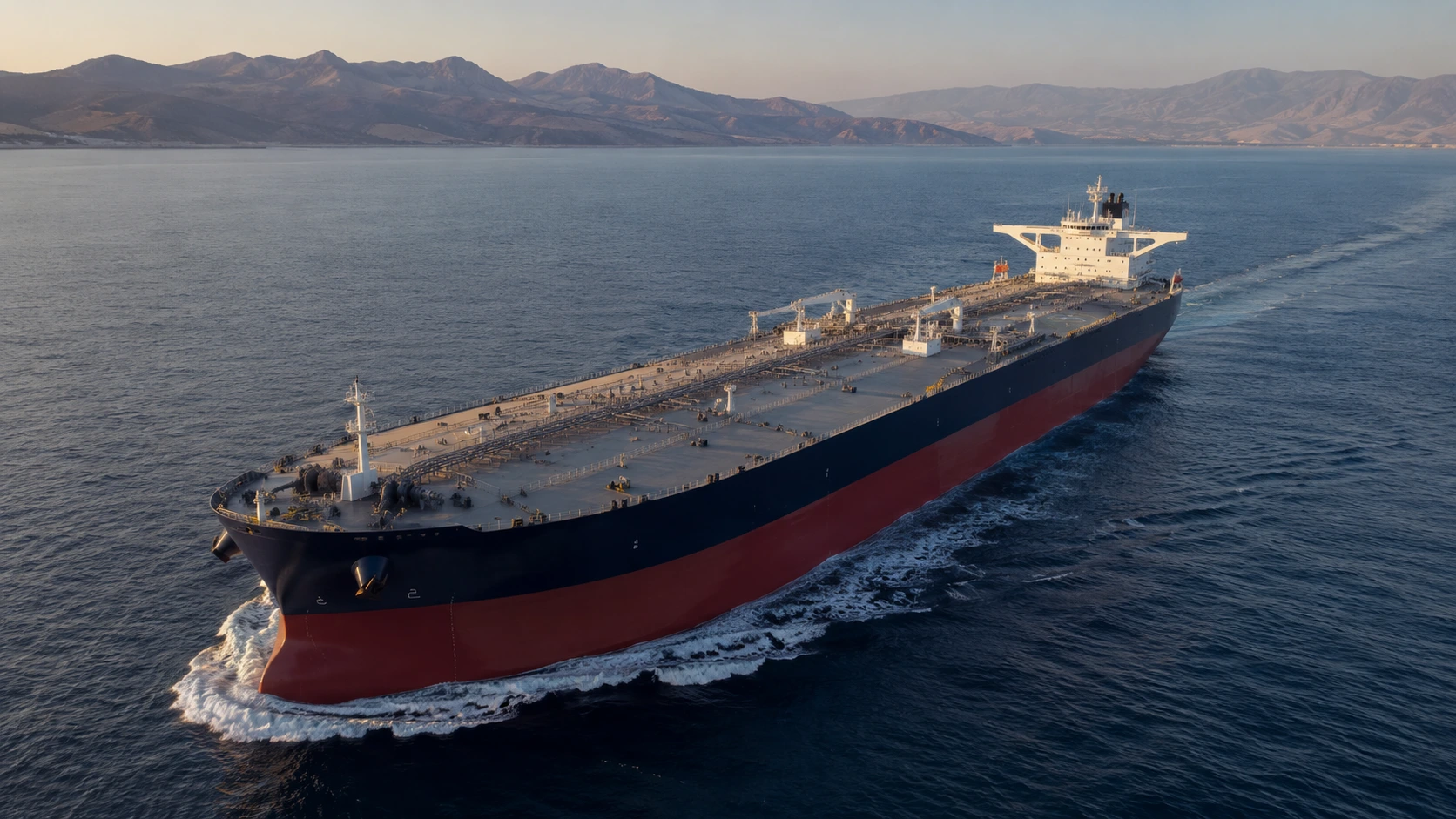
India’s Reliance Industries reportedly booked a Very Large Crude Carrier, or VLCC, to lift approximately two million barrels of Iraqi crude at a total freight cost of between $23 million and $25 million.
The reported fixture was concluded at approximately Worldscale 1,200, around 12 times the applicable benchmark freight rate. Before the current disruption, a comparable voyage reportedly cost close to $2 million.
On the surface, paying more than ten times the previous freight cost appears commercially extreme. But the economics become more understandable when the price of the cargo, the availability of vessels and the risks surrounding the Strait of Hormuz are considered together.
The forward tanker-supply picture is also changing. See Tide Signal's VLCC orderbook analysis for 2026.
A freight bill of more than $11 per barrel
At the upper end of the reported range, moving two million barrels for $25 million produces a freight cost of approximately $12.50 per barrel.
By comparison, a $2 million voyage would represent roughly $1 per barrel. The additional freight exposure alone may therefore approach $11.50 per barrel, before considering war-risk insurance, security measures, waiting time, operational disruption and other voyage-related costs.
The freight calculation
$25 million ÷ 2 million barrels = $12.50 per barrel
Reported pre-disruption equivalent: approximately $1 per barrel.
The reported rate is therefore more than an unusually expensive charter. It represents the market price of securing scarce tanker capacity for a voyage that many owners may be unwilling or unable to perform.
Reliance, which operates the world’s largest refining complex at Jamnagar in western India, reportedly secured a VLCC supplied by South Korea’s Sinokor for the lifting. Neither Reliance nor Sinokor publicly confirmed the reported commercial terms when approached by Reuters.
Why would a buyer accept such an expensive voyage?
The answer lies partly in the price of the crude itself.
Iraq’s State Oil Marketing Organization, SOMO, has reportedly offered substantial discounts to encourage buyers to lift Basrah crude from terminals located inside the Strait of Hormuz.
The reported discounts ranged from $25 to $27 per barrel for Basrah Medium and approximately $27.80 to $29.80 per barrel for Basrah Heavy, depending on the loading window.
Across a two-million-barrel cargo, a $25-per-barrel discount would represent a gross price difference of approximately $50 million. At a discount close to $30 per barrel, the difference could approach $60 million.
That does not mean the buyer automatically earns a $25 million to $35 million profit after paying freight. Crude quality, refining yields, insurance, financing, timing, contractual terms and additional operating costs all affect the final economics.
However, the calculation explains why a record-level freight bill may still be commercially acceptable. The crude discount can be large enough to absorb extraordinary transportation costs while potentially leaving a meaningful economic advantage for a refinery capable of processing the cargo.
The fixture is not simply the price of moving oil. It is the price of accessing a constrained and high-risk trade.
Hormuz risk has reduced the effective supply of VLCCs
The Strait of Hormuz remains one of the most important energy chokepoints in the world. For Iraqi crude exported through Basrah, it is also the route vessels must navigate to reach open sea.
The problem is not simply whether a tanker can physically complete the voyage. Owners, charterers, insurers and crews must assess:
- The risk of an attack or detention
- War-risk insurance availability and cost
- Possible delays entering or leaving the Gulf
- Restrictions imposed by insurers, lenders or flag states
- Crew safety and welfare
- Potential disruption to the vessel’s following employment
- The risk of a rapid change in trading conditions
As these risks increase, the number of vessels commercially available for the voyage can fall sharply—even if ships remain physically present in the wider region.
This distinction is important. A freight market can become extremely tight without a global shortage of vessels. What matters is the number of ships that are available, approved and willing to perform a particular voyage at a particular time.
That reduced pool of acceptable tonnage gives participating owners considerable pricing power.
What Worldscale 1,200 really signals
Worldscale is the standard system used to quote many tanker freight rates.
A rate of WS100 corresponds to the published Worldscale flat rate for a specified route. A fixture at WS1200 is therefore equivalent to 1,200% of that flat-rate reference, although the owner’s final earnings depend on voyage duration, bunker costs, port expenses, waiting time and other variables.
The reported WS1200 level should not be interpreted as a new normal for the wider VLCC market. It is better understood as the price of an exceptional voyage involving three overlapping factors:
- A high-risk loading region
- A limited number of willing vessels
- A cargo discount large enough to support extraordinary freight
Remove any one of those conditions and the commercial equation could change quickly.
Tanker markets are pricing access, not only distance
Traditional tanker analysis often concentrates on cargo volumes, fleet supply and tonne-mile demand. Those fundamentals remain essential, but the Reliance fixture demonstrates that another variable has become increasingly important: access.
A vessel may be geographically positioned for a cargo but commercially unavailable because of security restrictions. A cargo may be attractively priced but difficult to lift because suitable tonnage cannot be secured. A route may remain technically open while insurance and operational constraints make normal trading impossible.
In that environment, freight becomes the price of access to a constrained trade—not simply the cost of transporting oil from one location to another.
This can produce sharp differences between routes, vessels and charterers. Companies with strong trading capabilities, access to insurance and the ability to evaluate refinery margins may continue fixing ships when other buyers withdraw.
Owners prepared to accept the exposure may earn exceptional returns, but they also assume risks that extend well beyond ordinary voyage performance.
The implications for owners and charterers
For tanker owners, the fixture shows the value of optionality during severe market disruption. A vessel with the necessary approvals, insurance and commercial availability can command a substantial premium.
But the headline freight number should not be confused with pure profit. Owners must account for:
- Higher insurance premiums
- Possible additional crew compensation
- Delays and uncertain voyage duration
- Diversion or cancellation risk
- Increased bunker consumption
- Exposure to sanctions and compliance requirements
- Potential difficulties securing the next employment
For charterers, the case highlights the importance of analysing the complete delivered cost of a cargo rather than looking at freight in isolation.
An unusually high freight rate can remain rational when the underlying commodity is sufficiently discounted. Conversely, cheap freight cannot rescue a cargo whose price, quality or timing no longer suits the refinery.
A warning about the fragility of oil flows
The reported Reliance fixture is commercially significant because it shows that Iraqi crude can still move when the price incentive is large enough. But it also exposes the fragility of that trade.
If only a small group of owners is willing to enter the region, a single operational incident, insurance restriction or diplomatic setback could remove capacity and push freight even higher.
There are already signs that market participants are searching for ways to reposition Iraqi crude outside the Strait of Hormuz. TotalEnergies’ trading arm Totsa has reportedly offered Iraqi barrels for loading outside the strait, illustrating the premium buyers may place on avoiding the constrained route altogether.
The issue is no longer simply the market price of crude. It is where the cargo can be delivered, which vessels can access it and who is prepared to carry the associated risk.
The wider lesson for maritime markets
The $25 million VLCC voyage is an extreme fixture, but the market mechanism behind it is increasingly familiar across shipping.
Congested canals place a premium on transit slots. Security threats increase the value of vessels willing to enter high-risk regions. Port disruption turns time into a commercial commodity. Sanctions and insurance restrictions reduce effective fleet availability.
In each case, the physical asset may still exist, and the route may remain technically navigable. What disappears is reliable, insurable and commercially acceptable access.
That is why the Reliance fixture matters beyond one cargo or one charterer. It demonstrates how quickly freight can move from being a transportation cost to becoming the decisive factor determining whether a commodity trade remains viable.