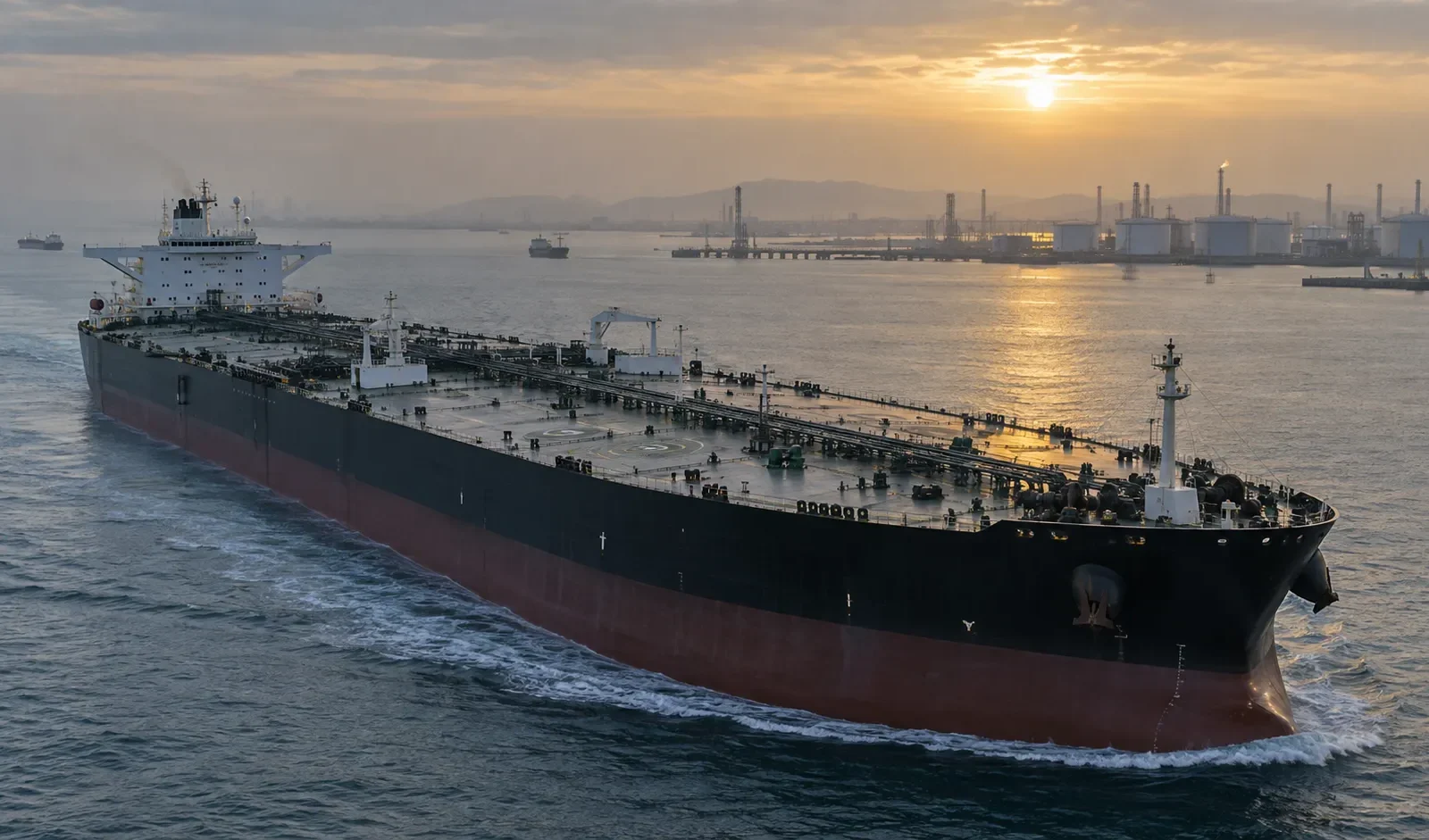
VLCC time charter rates have moved into six-figure territory even as spot fixtures in the same market are being reported at multiples of that level. DHT Holdings has fixed the 2016-built DHT Panther for three years at $100,000 per day, while Seatrade Maritime reported the 2022-built Nissos Kea fixed for an Arabian Gulf–East Coast India voyage loading in the Gulf of Oman at an estimated $619,000 per day.
At first glance, the comparison looks irrational. Why would an owner accept $100,000 per day for three years when the spot market can produce more than $600,000 per day?
The answer is that spot and time charter rates price different risks.
A spot fixture gives an owner maximum exposure to today’s market — including today’s upside. A multi-year time charter converts part of that market risk into contractual income, transfers voyage-cost exposure to the charterer, reduces earnings volatility and gives the owner visibility over future cash flow.
That makes the current VLCC market one of the clearest real-world examples of a fundamental chartering principle:
the highest rate today is not automatically the highest-value contract over time.
Important: the $619,000/day figure is a reported spot-market TCE estimate for a specific voyage, while $100,000/day is a contractual time-charter hire rate. They are not economically identical measures and should not be compared as if both parties pay the same costs.
VLCC Time Charter Rates: Why $100,000/Day Can Make Sense in a $600,000 Spot Market
DHT announced on 14 September 2026 that the DHT Panther, a 2016-built VLCC, had secured a three-year time charter at $100,000 per day beginning in October. The counterparty was described as a global energy company.
One day later, Seatrade Maritime highlighted how extraordinary the spot market had become. The 2022-built Nissos Kea was reported fixed to BP for an Arabian Gulf–East Coast India voyage, loading in the Gulf of Oman, at an estimated $619,000 per day, citing Tankers International.
Those two fixtures illustrate two completely different commercial strategies.
| Employment | Owner receives | Owner keeps | Owner gives up |
|---|---|---|---|
| Spot / voyage exposure | Freight revenue for individual voyages | Maximum exposure to a rising market | Future income certainty |
| Time charter | Daily hire over an agreed period | Stable contracted revenue and lower voyage-cost exposure | Much of the upside if spot rates rise further |
The owner of a spot VLCC is effectively saying: I want the market.
The owner fixing a three-year period is saying: I want a guaranteed slice of the market for longer.
Spot Rate vs Time Charter Rate: They Are Not the Same Number
The first analytical mistake is to divide $619,000 by $100,000 and conclude that the time charter is “six times worse”.
That is not how tanker economics work.
Under a voyage charter, the owner normally receives freight and pays the principal voyage expenses, including bunkers, port costs and other voyage-specific costs, subject to the charterparty.
Under a time charter, the charterer normally pays for bunkers and most voyage expenses while the owner continues to pay the vessel’s operating costs, such as crew, maintenance, stores and insurance.
That means a spot TCE is already an attempt to convert voyage revenue into an equivalent daily earnings figure after specified voyage costs.
A time-charter hire rate is the contractual daily payment before the owner’s vessel operating costs but without the same exposure to bunker price and route-specific voyage expenses.
Tide Signal’s guide to charterparty types explains how voyage, time, bareboat and COA structures allocate costs, control and commercial risk between owner and charterer.
What Is a VLCC Time Charter?
A VLCC time charter is an agreement under which a charterer hires a Very Large Crude Carrier for a defined period rather than for one individual voyage.
The owner remains responsible for operating the ship technically.
The charterer obtains commercial use of the vessel within the agreed trading limits and normally determines where the ship trades and what permitted cargoes it carries.
The basic allocation is generally:
| Owner typically pays | Charterer typically pays |
|---|---|
| Crew and wages | Bunkers |
| Technical maintenance | Port charges related to employment |
| Stores and lubricants | Canal and voyage expenses |
| Hull and machinery / P&I costs subject to terms | Commercial employment costs |
The exact allocation depends on the charterparty, additional clauses and the nature of extraordinary costs such as war-risk premiums.
The DHT Panther Fixture Is Not an Isolated Strategy
DHT’s own fleet results show that the company deliberately combines spot-market exposure with fixed-income contracts.
For the second quarter of 2026, DHT estimated:
- $162,600/day for VLCCs operating in the spot market;
- $90,800/day for VLCCs operating on time charter; and
- $126,700/day across the fleet overall.
In July, DHT also fixed the 2015-built DHT Jaguar for three years at $75,000 per day.
Two months later, DHT Panther fixed at $100,000 per day.
That progression itself is a market signal: period charterers are paying materially more for long-term access to VLCC capacity as the spot market becomes more expensive and unpredictable.
Why an Owner May Prefer $100,000/Day for Three Years
1. The contract can generate more than $100 million of gross hire
At a simple 365-day annual assumption, $100,000 per day equates to approximately $36.5 million per year.
Over three years, that is roughly $109.5 million in gross contractual hire before off-hire, commissions, operating expenses and other deductions.
That is not a forecast of net profit. But it explains the attraction of locking a high nominal rate for a long period.
2. Spot rates can fall much faster than ship costs
Today’s spot market can feel permanent when fixtures are setting records every week.
Shipping history repeatedly shows otherwise.
A VLCC purchased, financed and operated over decades will experience multiple freight cycles.
Spot earnings can move from exceptional levels to weak levels far faster than debt, crew costs or drydock commitments can adjust.
A three-year charter transfers a large part of that rate risk to the charterer.
3. The owner gives up upside but also gives up downside
If VLCC spot TCE remains at $500,000 or $600,000 per day for years, the period fixture will look cheap.
If the market falls to $40,000 per day, the same $100,000 fixture will look exceptional.
The owner is not predicting one precise outcome.
The owner is choosing a risk distribution.
A three-year charter at $100,000/day is not a bet that spot rates will fall tomorrow. It is a decision that three years of certainty has enough value to justify selling part of the upside.
The owner receives a high contractual floor. The charterer buys the possibility that the vessel will be worth much more than $100,000/day during the charter period.
The Charterer Is Making the Opposite Bet
If the owner is selling volatility, the charterer is buying it.
A global energy company fixing a VLCC at $100,000 per day for three years is effectively paying for long-term transport capacity.
The charterer benefits if future spot rates remain far above $100,000 per day.
The charterer loses relative value if spot rates fall significantly below the agreed hire.
That means the contract embeds a market view even if neither party describes it as speculation.
The charterer may also value:
- guaranteed access to tonnage;
- reduced dependence on volatile spot fixtures;
- better planning of crude supply chains;
- greater control over vessel scheduling;
- the ability to optimise multiple cargoes over time; and
- protection against further tightening in Middle East tanker availability.
Why Today’s Spot VLCC Market Is So Extreme
The current spot market is not a normal cyclical upswing.
Security concerns around the Strait of Hormuz and Bab el-Mandeb have reduced the number of ships owners are willing to expose to certain voyages.
Seatrade reported on 14 September that Arabian Gulf–Asia spot fixtures had exceeded $600,000 per day, while benchmark Gulf earnings had reached the $800,000-per-day area.
Lloyd’s List has separately reported Middle East Gulf–China benchmark VLCC earnings near $1 million per day, with Oman–China and West Africa–China routes also at historic levels.
Tide Signal has been tracking the same repricing through its VLCC rates and WS450 analysis and the $25 million Iraqi crude VLCC voyage.
The important point for period chartering is that extraordinary spot earnings create uncertainty in both directions.
The higher the market moves, the more valuable a guaranteed ship becomes to a charterer — and the more difficult it becomes for an owner to decide how much upside to surrender.
Spot Exposure Is Not Free Upside
Spot-market exposure brings higher potential revenue, but it also brings more variables under the owner’s control or account.
Depending on the employment structure, the owner may need to manage:
- bunker prices;
- ballast positioning;
- port costs;
- waiting time;
- voyage commissions;
- war-risk premiums;
- security costs;
- canal expenses;
- sanctions screening;
- charterer credit risk;
- cargo availability; and
- the commercial risk of the next fixture.
Tide Signal’s war-risk premiums guide explains why security costs can materially alter voyage economics even when the headline freight rate is exceptionally high.
The Value of Positioning: A Spot Ship Must Still Find the Next Cargo
A spot tanker does not earn the headline rate every calendar day.
It needs cargoes.
After discharge, the vessel may need to ballast hundreds or thousands of miles toward the next loading area.
That ballast leg consumes:
- time;
- fuel;
- crew resources;
- insurance; and
- commercial opportunity.
Spot TCE calculations attempt to normalise this by converting voyage economics into a daily benchmark, but no benchmark perfectly predicts the realised annual result of an individual ship.
A time charter removes much of the owner’s cargo-finding and positioning exposure because the charterer controls the vessel’s commercial employment within the contractual limits.
Why War Risk Makes Period Coverage More Valuable
When the market is stable, the value of certainty is easier to quantify.
When ships are being attacked, sanctioned, delayed or rerouted, certainty becomes more strategic.
Tide Signal’s Hormuz shipping analysis has shown how physical transit, sanctions compliance, insurance and owner willingness are all reducing effective tanker capacity.
This produces two opposing incentives:
- owners want exposure to the very high rates created by scarcity;
- charterers want long-term control of ships before scarcity becomes even more expensive.
A $100,000/day three-year VLCC charter is where those two views meet.
VLCC Time Charter Rates Can Influence Asset Values
Period rates also matter to the sale-and-purchase market.
A vessel with a strong multi-year charter has a visible contracted revenue stream.
That can affect:
- asset valuation;
- debt capacity;
- loan-to-value calculations;
- cash-flow forecasting;
- buyer appetite; and
- the value of the ship with or without the charter attached.
Tide Signal’s latest VLCC asset-values analysis shows how prompt secondhand tanker prices have already risen to historically unusual levels, with current broker indications placing 10-year-old ships above newbuilding prices.
A strong period charter can reinforce that asset support because buyers can model contracted cash flow rather than relying entirely on a spot-rate forecast.
Why $100,000/Day Is Historically Significant Even Without the Spot Comparison
The DHT Panther rate would be notable even if the spot market were less spectacular.
A three-year charter at $100,000 per day locks a six-figure rate across a long duration.
For context, DHT fixed the DHT Jaguar for three years at $75,000 per day in July 2026.
The increase from $75,000 to $100,000 in only a few months suggests that period-market expectations have moved sharply higher alongside spot rates.
TradeWinds reported in early September that Clarksons Securities had raised its tanker forecasts and expected second-half VLCC spot earnings around $155,000 per day — itself an exceptionally strong number by historical standards.
The current spot crisis has since pushed voyage benchmarks far above even those bullish expectations.
Spot vs Period: The Break-Even Question
For an owner, the relevant question is not:
“Is $619,000 bigger than $100,000?”
The relevant question is:
“What average net spot TCE do I expect over the next three years, after downtime, positioning, costs and future market cycles?”
Suppose a ship earns extraordinarily high rates for six months and then spends the next two and a half years in a much weaker market.
The three-year average may be much closer to the period rate than today’s headline suggests.
Conversely, if geopolitical disruption keeps spot rates above $200,000 or $300,000 per day for years, the charterer may capture enormous value from a $100,000/day contract.
That uncertainty is exactly what the charter rate prices.
A Simple Illustrative Comparison
The following example is deliberately simplified and does not represent a forecast.
| Three-year scenario | Illustrative average market TCE | $100k/day period result |
|---|---|---|
| Spot stays extraordinary | $250,000/day | Owner gives up major upside |
| Market normalises | $90,000/day | Period charter outperforms market |
| Deep downturn | $50,000/day | Period charter becomes extremely valuable |
The actual calculation would need to include off-hire, commissions, OPEX, drydock, financing, bunker exposure and the detailed cost allocation in the charterparty.
The purpose is simply to show why one day’s spot market cannot determine the value of a three-year contract.
What a Charterer Is Really Buying at $100,000/Day
The charterer is not only buying a hull.
It is buying:
- transport capacity;
- schedule control;
- future optionality;
- protection from spot scarcity;
- reduced exposure to freight spikes;
- the right to optimise multiple cargoes around the ship; and
- greater certainty over the cost of its maritime logistics.
For an energy major moving large crude volumes, those strategic benefits can matter as much as the theoretical difference between current spot and period rates.
What an Owner Is Really Selling at $100,000/Day
The owner is selling:
- future market upside;
- commercial control of the vessel;
- the ability to switch between spot cargoes; and
- the option to reposition the ship into the strongest future basin.
In exchange, the owner buys:
- revenue visibility;
- reduced exposure to bunker prices;
- reduced voyage-market volatility;
- less cargo-finding risk;
- better cash-flow planning; and
- potentially stronger financing visibility.
The VLCC Market Is Becoming a Portfolio-Management Problem
Large tanker companies rarely choose between “all spot” and “all period”.
They manage a portfolio.
Some vessels stay exposed to spot upside.
Others secure multi-year charters that create a cash-flow floor.
The result is similar to risk management in other commodity-linked businesses: the company decides how much of its future earnings it wants to leave open to the market.
DHT explicitly describes its business approach as combining market exposure and fixed-income contracts.
That makes the Panther fixture a strategic allocation decision, not a rejection of the strong spot market.
Why This Matters for Shipping Investors
Investors often look at spot-rate charts first because the numbers move dramatically and are easy to compare.
But period coverage can be equally important for company valuation.
A tanker owner with high spot exposure may produce extraordinary earnings during a spike but can also experience a sharp fall when freight normalises.
A company with substantial period coverage may report less spectacular peak earnings but retain cash-flow resilience during a downturn.
Important questions include:
- What percentage of fleet days are fixed?
- At what average charter rate?
- For how long?
- Which ships remain open to spot?
- When do existing charters expire?
- What are the counterparties?
- How much debt does the company carry?
- What is the company’s break-even cost?
The spot-vs-period mix can be as important as the headline freight index.
Why This Matters for Charterers
Charterers face the mirror-image decision.
When spot rates are high, fixing long-term tonnage may appear expensive.
But if the company has predictable cargo demand, the cost of being forced into an even tighter future spot market can be greater.
Long-term coverage can therefore function as a hedge against freight inflation.
This is particularly relevant when effective vessel supply is being reduced by security constraints rather than simple fleet size.
Could VLCC Time Charter Rates Move Even Higher?
Yes.
Period rates could continue rising if:
- spot VLCC earnings remain historically high;
- charterers become more concerned about future availability;
- Hormuz and Red Sea disruption persists;
- owners refuse to lock ships away cheaply;
- asset values remain elevated;
- crude tonne-mile demand increases; and
- the forward fleet balance stays tight.
But the reverse is also true.
If security conditions normalise quickly and spot rates fall sharply, charterers may become unwilling to pay six-figure multi-year rates.
What Could Collapse the Spot–Period Spread?
The enormous gap between today’s reported spot fixtures and three-year charter rates is unlikely to remain unchanged forever.
It could narrow through:
- a fall in spot rates;
- a rise in period rates;
- or both.
The spot side could weaken if:
- Hormuz traffic normalises;
- owners return more ships to Gulf trading;
- war-risk costs fall;
- attacks on commercial shipping decline;
- oil flows weaken; or
- position lists become less tight.
The period side could strengthen if charterers decide current disruption will persist long enough to justify paying more for long-term capacity.
What to Watch Next in VLCC Time Charter Rates
- New three-year fixtures: one $100,000/day deal is significant; several would establish a clearer period-market benchmark.
- One-year and five-year rates: the shape of the period curve reveals how long charterers expect tightness to last.
- Spot VLCC benchmarks: especially MEG–China and Oman–China.
- War-risk costs: lower risk premiums can release ships back into the market.
- VLCC asset values: expensive secondhand ships can raise the minimum return owners demand.
- Newbuilding deliveries: future fleet growth matters more to multi-year charters than to one spot voyage.
- Charterer identity: energy majors, traders and NOCs can have very different reasons for locking in tonnage.
VLCC Time Charter Rates FAQ
What is the current VLCC time charter rate?
There is no single VLCC time charter rate because hire depends on vessel age, specification, duration, delivery area and market conditions. On 14 September 2026, DHT fixed the 2016-built DHT Panther for three years at $100,000 per day.
What is the difference between a VLCC spot rate and a time charter rate?
A spot or voyage rate covers an individual cargo movement and leaves the owner more exposed to voyage costs and the next fixture. A time charter pays the owner daily hire for an agreed period while the charterer normally pays bunkers and voyage expenses and controls the vessel’s commercial employment.
Why would a VLCC owner accept $100,000/day when spot rates are above $600,000/day?
Because the spot figure applies to a specific current voyage and can change rapidly, while a three-year charter provides contractual revenue certainty. The owner gives up some potential upside in exchange for protection against a future freight downturn and reduced voyage-market exposure.
Is $619,000/day a guaranteed VLCC spot rate?
No. The $619,000/day figure refers to a reported fixture/TCE estimate for the Nissos Kea on a specific Gulf of Oman–East Coast India voyage. Spot earnings differ by ship, route, timing, costs and fixture terms.
How much gross hire does a $100,000/day three-year charter generate?
On a simple 365-day annual basis, it equates to about $109.5 million over three years before off-hire, commissions, OPEX and other costs. It should not be interpreted as net profit.
Who pays bunkers under a time charter?
The charterer normally pays for bunkers and other voyage-related costs, while the owner remains responsible for the ship’s operating costs, subject to the specific charterparty terms.
What is TCE in tanker shipping?
Time Charter Equivalent converts voyage-charter economics into an indicative daily earnings figure after specified voyage costs. It helps compare spot voyages with time-charter employment, although it does not make the two contract structures identical.
Are VLCC time charter rates rising?
Recent DHT fixtures suggest a significant increase in period pricing: the company fixed DHT Jaguar for three years at $75,000/day in July and DHT Panther at $100,000/day in September.
Sources and Further Reading
- DHT Holdings — DHT Panther three-year charter at $100,000/day
- DHT Holdings — Q2 2026 spot and time-charter TCE, plus DHT Jaguar fixture
- Seatrade Maritime — DHT charter and reported $619,000/day Nissos Kea spot fixture
- Seatrade Maritime — Gulf VLCC spot fixtures above $600,000/day
- Lloyd’s List — Record VLCC spot-rate analysis
- TradeWinds — Clarksons Securities raises tanker-rate forecasts