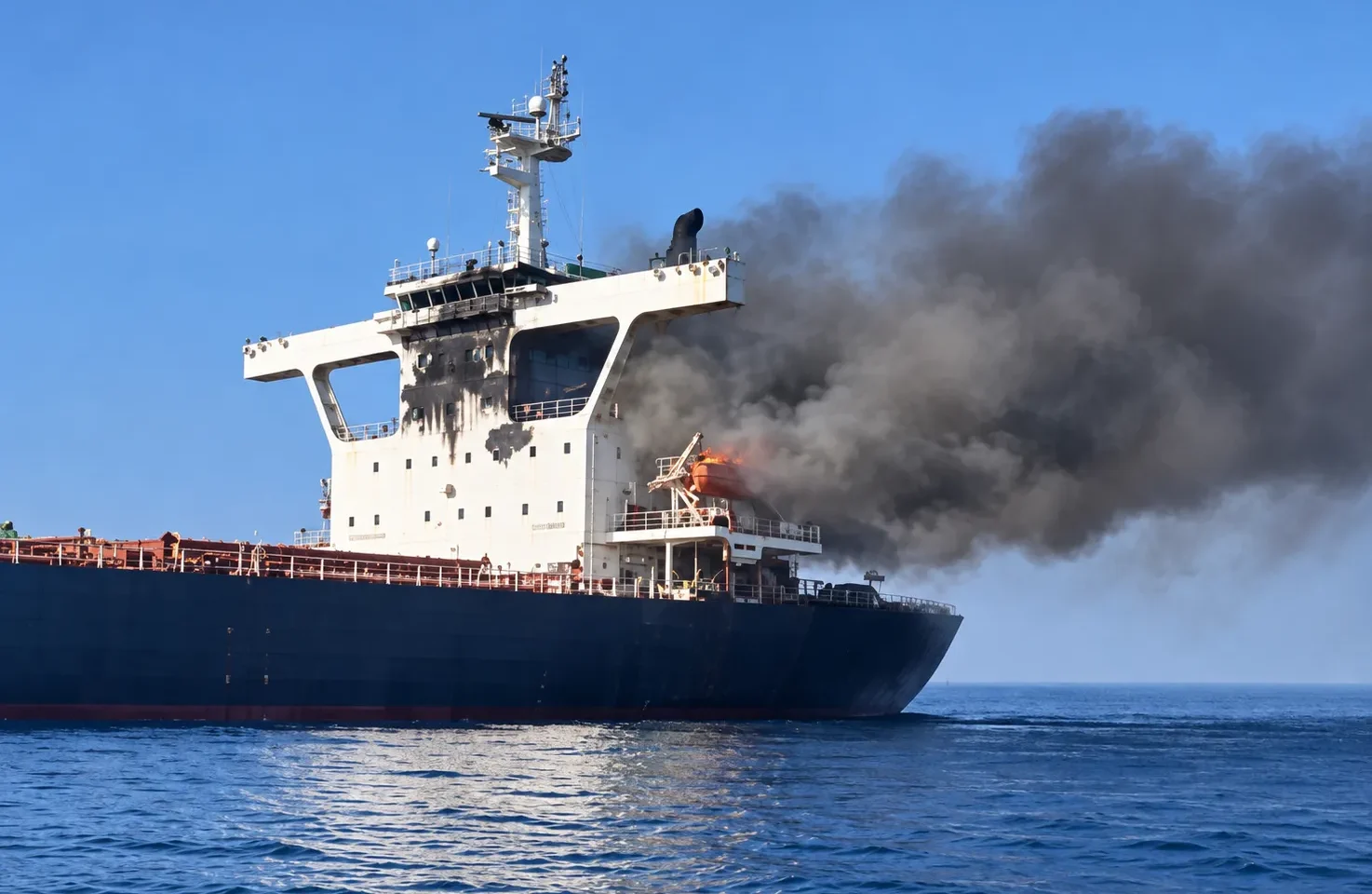
Cape Dao attack in the Strait of Hormuz has left one seafarer dead and forced the evacuation of 27 crew members after the Antigua and Barbuda-flagged bulk carrier was struck near Oman’s Musandam coast, caught fire and was left adrift.
The incident was reported on 23 September at approximately 06:30 UTC. UK Maritime Trade Operations said the vessel’s Company Security Officer reported that the cargo ship had been struck by an unknown projectile, after which the vessel was reported on fire and adrift.
Oman’s Maritime Security Centre later identified the vessel as Cape Dao and confirmed that a Royal Navy of Oman vessel evacuated 27 surviving crew members. One crew member died following the attack.
What happened to Cape Dao? The bulk carrier was attacked while transiting near the Strait of Hormuz, suffered a fire in its engine-room area and was left adrift. Twenty-seven crew members were evacuated by the Royal Navy of Oman. One Indian seafarer was killed.
Cape Dao Attack: What Happened in the Strait of Hormuz?
The Cape Dao attack was reported during the morning of 23 September as the bulk carrier was transiting near the Strait of Hormuz.
UK Maritime Trade Operations said it received a report from the vessel’s Company Security Officer that the ship had been hit by an unidentified projectile.
The initial security notice stated that the vessel was on fire and adrift and that all crew had been evacuated, with two casualties reported.
Oman’s Maritime Security Centre subsequently named the ship as the Antigua and Barbuda-flagged CAPE DAO.
According to the Omani statement, the attack caused a fire in the ship’s engine room and resulted in the death of one crew member.
A Royal Navy of Oman vessel then carried out an evacuation operation in coordination with the relevant authorities.
Twenty-seven surviving crew members were evacuated and provided with medical assistance.
One Seafarer Killed, 27 Crew Members Evacuated
The attack produced a fatality among Cape Dao’s crew.
The Indian Embassy in Oman confirmed that the seafarer who died was an Indian national.
India’s Ministry of External Affairs said there had been 20 Indian seafarers aboard the vessel, with one losing his life and the others rescued.
The Forward Seamen’s Union of India identified the deceased seafarer as Suraj Yadav, a wiper from Deoria in Uttar Pradesh.
Oman’s authorities confirmed that the remaining 27 people were evacuated from the ship and given necessary medical care.
The casualty puts the human cost of the deteriorating Strait of Hormuz security environment back at the centre of the shipping crisis.
Commercial shipping may be measured in freight rates, vessel supply and energy flows, but vessels transiting a high-risk area still depend on civilian crews accepting and managing the operational exposure.
Was Cape Dao Hit by Two Torpedoes?
Reports about the weapon used in the Cape Dao attack require careful distinction.
The Forward Seamen’s Union of India said the ship was hit by two torpedoes, with one reportedly striking the port-side accommodation area and another affecting the port-side hull near the engine room.
Some regional reporting repeated that account.
However, the principal UK maritime security notice described the attack only as a strike by an unknown projectile.
Oman’s Maritime Security Centre confirmed the attack and the resulting engine-room fire but did not, in its publicly reported statement, identify the weapon as a torpedo.
The attack is confirmed. The death and evacuation are confirmed. The “two torpedoes” description remains attributed reporting rather than an independently established fact.
What Is the Cape Dao?
Cape Dao, IMO 9219020, is a large dry bulk carrier sailing under the flag of Antigua and Barbuda.
VesselFinder lists the ship at approximately 289 metres length overall and about 45 metres beam, with a gross tonnage of around 84,448.
The vessel was built in 2002.
Vessel database records identify Peonies Shipmanagement FZE in the United Arab Emirates as the ship’s manager / ISM manager.
The vessel previously operated under the name Cape Qingdao, according to vessel-history records.
| Cape Dao | Detail |
|---|---|
| IMO | 9219020 |
| Vessel type | Large bulk carrier / Capesize |
| Flag | Antigua and Barbuda |
| Year built | 2002 |
| Length | Approximately 289 m |
| Beam | Approximately 45 m |
| IMO number | 9219020 |
| Manager / ISM manager | Peonies Shipmanagement FZE, UAE |
| Former name | Cape Qingdao |
Published sources currently disagree on the ship’s exact deadweight figure. Multiple vessel databases list approximately 170,089 dwt, while one contemporary maritime report described Cape Dao as 191,074 dwt.
Tide Signal therefore does not use the disputed deadweight number as a central fact in this report.
Where Was Cape Dao Attacked?
Oman’s Maritime Security Centre reported that Cape Dao was targeted approximately 2.5 nautical miles off Musandam Governorate.
Musandam forms the southern side of the Strait of Hormuz, placing the incident within one of the world’s most strategically important maritime chokepoints.
The narrow waterway connects the Persian Gulf with the Gulf of Oman and the Arabian Sea.
For vessels entering or leaving Gulf ports, there is no equivalent alternative sea route around Hormuz. That gives any sustained security disruption in the strait an outsized commercial impact.
For the broader operating picture, see Tide Signal’s continuously updated Is the Strait of Hormuz Open? Live Shipping Traffic, Attacks and Risk Update.
Cape Dao Is the Latest Attack in an Escalating Hormuz Security Crisis
The Cape Dao incident did not occur in isolation.
Seatrade Maritime described the fatal attack as the third reported vessel incident in the Strait of Hormuz within five days.
Other commercial vessels had been struck or affected by projectiles in the days immediately before the Cape Dao attack.
That pattern matters because shipping companies do not assess each security event independently.
Risk accumulates.
A single isolated incident can produce a temporary voyage review. A sequence of attacks changes:
- owner willingness to accept the voyage;
- charterer routing assumptions;
- war-risk insurance pricing;
- crew risk assessments;
- security procedures;
- vessel availability;
- and ultimately freight economics.
The Cape Dao attack is particularly significant because it affected a dry bulk carrier, reinforcing that current Strait of Hormuz risk cannot be treated purely as a tanker-market issue.
Why a Bulk Carrier Attack Matters Beyond the Tanker Market
Discussion of Hormuz usually focuses on crude oil, product tankers and LNG because of the huge energy flows passing through the strait.
Cape Dao shows why the risk is wider.
A bulk carrier may be carrying iron ore, coal, grain or other commodities rather than oil, but its exposure to a projectile, navigation restriction or security closure is fundamentally the same while passing through a high-risk corridor.
For dry-bulk operators, the commercial consequences can include:
- owners refusing Gulf employment;
- higher premiums for high-risk voyages;
- additional security requirements;
- route delays;
- crew-change complications;
- higher charter rates for ships willing to trade into the region;
- and reduced effective vessel availability.
That last point matters particularly in the Capesize market.
If a portion of the fleet becomes operationally unavailable for a trade because owners, insurers or crews will not accept the risk, the commercially available fleet becomes smaller even though no vessel has physically disappeared from the world fleet.
That effective-supply mechanism is tracked in Tide Signal’s Baltic Dry Index 2026 coverage, including current Capesize, Panamax and Supramax freight conditions.
What the Cape Dao Attack Means for Shipping
The immediate effect is a maritime safety and security response.
The wider effect depends on how owners, charterers, insurers and authorities respond to the latest incident.
1. Voyage approvals become harder
High-risk trading commonly requires additional internal approval by owners, charterers, insurers and security teams.
A fatal attack can move a route from “heightened monitoring” toward a much more restrictive risk posture.
2. Crews become a central commercial factor
A vessel cannot perform the voyage simply because a charterer is willing to pay.
Companies must also consider crew safety, employment terms, security procedures and whether seafarers can reasonably be asked to transit an area where commercial ships are being struck.
3. Vessel supply can tighten
If owners decline Gulf calls or demand stronger contractual protections, the pool of ships available to charterers can shrink.
That can raise freight rates independently of cargo demand.
4. Insurance costs can increase
Underwriters respond to incident frequency, severity and location.
A sequence of attacks — especially one resulting in a fatality — can materially change how a voyage is priced or whether cover is offered on normal terms.
5. Delay becomes part of voyage economics
Ships may slow, wait for security instructions, hold outside the highest-risk area or alter sailing schedules.
Every additional day affects bunker consumption, hire, cargo delivery and the timing of the next employment.
For the commercial calculation behind time, fuel, hire and voyage profitability, see Tide Signal’s Voyage Estimation in Shipping.
War-Risk Insurance After the Cape Dao Attack
The Cape Dao incident strengthens the case for viewing war-risk insurance as a core voyage-economics issue rather than a separate administrative line item.
When a trading area becomes more dangerous, owners may face additional premiums or special terms before entering the region.
The commercial decision therefore becomes:
Does the freight justify the security, insurance and operational exposure?
That calculation can vary dramatically between vessel classes, charter parties, cargo values and individual owners.
Tide Signal’s War Risk Premiums in Shipping explains how additional insurance costs can alter voyage profitability and chartering decisions.
What Does “On Fire and Adrift” Mean Operationally?
UKMTO’s initial description that Cape Dao was “on fire and adrift” carries two distinct operational concerns.
Fire indicates an active casualty onboard, with the potential for damage to machinery, electrical systems, accommodation or cargo-related spaces depending on its location and spread.
Adrift means the vessel was not under normal navigational control and was moving under the influence of wind, current and sea conditions.
For a large bulk carrier, loss of propulsion near a strategically sensitive and heavily trafficked chokepoint can create a secondary navigation hazard even after the crew has been evacuated.
Tide Signal’s Port Delays in Shipping explains how waiting time, disruption and loss of schedule integrity can develop into wider operational and commercial exposure.
The subsequent response can therefore involve:
- fire monitoring;
- tug or salvage support;
- pollution assessment;
- navigation warnings;
- traffic management;
- towage planning;
- and assessment of hull and machinery damage.
Was There Any Pollution From Cape Dao?
Initial UKMTO-linked reporting said that no environmental impact had been reported at that stage.
That does not eliminate future risk.
A large bulk carrier carries substantial quantities of bunker fuel, lubricants and other oils even when its main cargo is non-oil bulk cargo.
An engine-room fire or hull damage can therefore create pollution exposure if tanks, piping or machinery systems are compromised.
Any environmental assessment should be updated as authorities gain access to the vessel.
Who Attacked Cape Dao?
At the time of publication, the publicly available maritime security reporting reviewed by Tide Signal had not established responsibility for the attack.
UKMTO referred to an unknown projectile.
Neither the immediate Omani confirmation nor the initial Reuters reporting identified the attacker.
Some commentary and social-media accounts attributed the incident to Iran, but those claims should not be treated as confirmed simply because they circulated rapidly after the strike.
Not confirmed in the initial authoritative reporting: the identity of the attacker and the precise weapon used.
Why the Strait of Hormuz Remains Critical to Global Trade
The strategic importance of the Strait of Hormuz comes from the concentration of shipping that must pass through a relatively narrow waterway.
Much of the world’s Gulf crude, refined products, LPG and LNG trade depends on the route.
But the shipping exposure is not limited to energy cargoes.
Bulk carriers, containerships, general cargo vessels and support vessels also use Gulf ports and therefore depend on safe access through or around the strait.
Repeated attacks can affect the wider market through three channels. Tide Signal’s Tanker Markets and Hormuz Risk tracks how security pressure can change owner acceptance, vessel availability and freight economics across Gulf trades.
- physical risk — vessels and crews can be hit;
- commercial risk — freight, insurance and voyage costs rise;
- effective capacity risk — fewer owners may be willing to trade in the area.
What Shipowners and Operators Should Watch Next
The next phase of the Cape Dao incident will depend on both the casualty response and the wider security situation.
- Vessel condition: whether the fire is extinguished and the ship can be stabilised or towed.
- Salvage response: whether commercial tugs or specialist salvage assistance are deployed.
- Casualty investigation: further evidence about the impact point and weapon used.
- Crew medical status: updates on the second casualty initially reported by UKMTO.
- Pollution status: whether any bunker leakage or environmental damage is identified.
- Security advisories: any new warnings from UKMTO or regional authorities.
- Owner response: whether more operators restrict or suspend Hormuz voyages.
- Insurance response: whether additional war-risk costs increase further.
- Traffic levels: whether vessel transits through Hormuz fall after the attack.
Cape Dao Attack Timeline
Why the Cape Dao Attack Could Matter to Dry-Bulk Freight
One casualty does not automatically move the Baltic dry-bulk market.
But a sustained pattern of attacks can change vessel supply and voyage acceptance.
For Capesize owners, the key question is whether high-risk Gulf employment begins to require a materially larger freight premium.
If fewer ships are willing or commercially able to accept the voyage, charterers may need to compete for a smaller pool of available tonnage.
The transmission from security incident to freight market therefore looks like this:
higher risk → higher insurance / operating cost → fewer willing ships → tighter effective supply → potential freight premium.
Whether that mechanism produces a measurable market move will depend on the frequency of further attacks and the response of the shipping and insurance industries.
Cape Dao Attack: Frequently Asked Questions
What happened to Cape Dao?
Cape Dao was struck while transiting near the Strait of Hormuz on 23 September 2026. The vessel caught fire and was reported adrift. One seafarer died and 27 surviving crew members were evacuated.
Where was Cape Dao attacked?
Oman’s Maritime Security Centre reported that the ship was targeted approximately 2.5 nautical miles off Musandam Governorate, on the southern side of the Strait of Hormuz.
How many Cape Dao crew members were killed?
One crew member was confirmed dead. UKMTO initially reported two casualties, meaning at least one additional person was injured or otherwise classed as a casualty.
How many crew were rescued from Cape Dao?
The Royal Navy of Oman evacuated 27 surviving crew members from the vessel.
Was the Cape Dao crew Indian?
The crew was multinational, but India said 20 Indian seafarers were aboard. One Indian national was killed and the remaining Indian crew members were rescued.
Who was the seafarer killed on Cape Dao?
The Forward Seamen’s Union of India identified the deceased as Suraj Yadav, an Indian wiper from Deoria in Uttar Pradesh.
Was Cape Dao hit by torpedoes?
The Forward Seamen’s Union of India reported two torpedo strikes. However, UKMTO described the vessel as having been struck by an unknown projectile. The precise weapon has therefore not been independently confirmed in the authoritative maritime security reporting reviewed at publication.
Who attacked Cape Dao?
No attacker had been conclusively identified in the initial authoritative reporting. UKMTO and Omani authorities confirmed the incident without publicly establishing responsibility.
What type of ship is Cape Dao?
Cape Dao is a large Antigua and Barbuda-flagged bulk carrier, IMO 9219020, built in 2002 and managed by UAE-based Peonies Shipmanagement FZE according to vessel databases.
Is Cape Dao still on fire?
The initial UKMTO report described the vessel as on fire and adrift. Its subsequent condition should be treated as developing until confirmed by authorities or salvage responders.
Is the Strait of Hormuz still open?
Commercial traffic continues under severe security risk, but operating conditions can change rapidly. Tide Signal maintains a separate live Hormuz shipping-status page covering vessel traffic, attacks and operational risk.
Sources and Verification
- Seatrade Maritime News — Seafarer dead in attack on UAE-managed bulker — current maritime reporting on the Cape Dao attack, vessel status and wider Hormuz security context.
- The Maritime Executive — Cape Dao attack and crew evacuation — reporting based on UKMTO, Omani rescue information and the seafarers’ union account.
- The Indian Express — Indian seafarer killed in Cape Dao attack — Indian Embassy statements and the Forward Seamen’s Union of India account concerning the deceased seafarer and reported weapon type.
- UK Maritime Trade Operations — official maritime security reporting and incident-warning service for vessels operating in the region.
- VesselFinder — CAPE DAO, IMO 9219020 — vessel type, flag, year built, dimensions, gross tonnage, deadweight and vessel-name history.