The Saudi East-West Pipeline disruption has entered a new phase. Saudi Aramco is offering additional crude to Asian refiners through ship-to-ship transfers off Sohar, Oman, after attacks damaged the kingdom’s strategic Petroline system and halted crude loadings at Yanbu on the Red Sea.
The latest workaround allows Saudi Arabia to move more Arab Light, Arab Medium and Arab Heavy toward Asian buyers while keeping the long-haul receiving tanker outside the Strait of Hormuz. It does not eliminate Hormuz exposure, however: crude loaded at Saudi Arabia’s eastern Gulf terminals still has to cross the strait on a shuttle vessel before being transferred outside the Gulf.
Saudi Arabia is replacing a damaged pipeline route with a tanker-and-STS network.
That keeps crude moving, but it uses more vessel interfaces, more coordination and more commercially acceptable tanker capacity than a conventional direct loading programme.
Saudi East-West Pipeline Disruption: What Changed Today?
The Saudi East-West Pipeline, also known as Petroline, was already one of the most strategically important oil-export assets in the Middle East because it allows Saudi crude to move from the kingdom’s eastern production system to Yanbu on the Red Sea without passing through the Strait of Hormuz.
That bypass became even more important during the severe disruption to Gulf shipping in 2026. The pipeline had reportedly been moving around 4–5 million barrels per day before attacks on 10 September forced a shutdown while technical teams assessed and repaired the system.
The situation has now moved beyond a precautionary pipeline closure. Reuters reports that Yanbu crude loading has halted, some Asian September cargoes have been delayed or rescheduled and some European customers have been notified of cancelled September-loading cargoes.
At the same time, Saudi Arabia is increasing crude movement through eastern export terminals and expanding an offshore transfer structure outside Hormuz.
This means the market is no longer dealing with only one question — when will Petroline restart?
It is now dealing with another:
How the New Saudi Crude Route via Oman Works
The reported workaround moves crude from Saudi Arabia’s eastern Gulf terminals to waters off Sohar in Oman, where the cargo is transferred ship-to-ship to a second vessel for onward delivery.
oil terminals
inside Gulf
Hormuz transit
off Sohar
to Asia
The key commercial advantage is that the long-haul receiving tanker does not necessarily need to enter the Persian Gulf. Instead, a shuttle vessel takes the highest-risk segment of the transport chain and transfers the crude after clearing Hormuz.
This does not create a complete bypass of the strait. The crude still crosses Hormuz. What changes is which vessel carries the exposure and for how long.
Why Sohar Has Become Important to Saudi Crude Exports
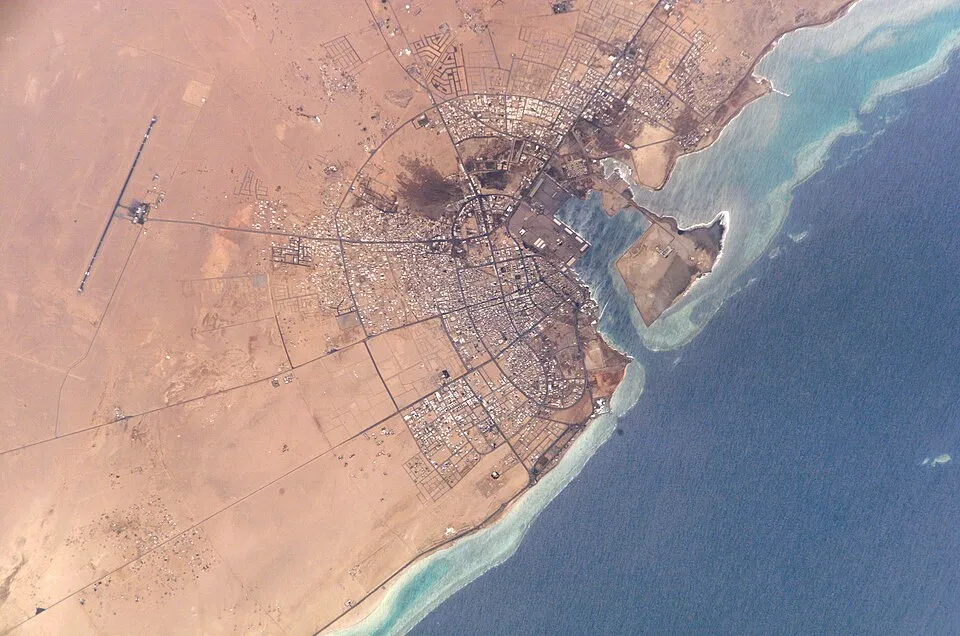
Sohar sits on Oman’s Gulf of Oman coast, outside the Strait of Hormuz. That geographic position makes it commercially useful when owners, charterers or insurers are reluctant to commit a long-haul VLCC to the full Gulf exposure.
A tanker receiving crude off Sohar can proceed toward China, India, South Korea, Japan or Southeast Asia without entering the Persian Gulf.
For the receiving vessel, this can reduce:
- time spent inside the highest-risk Gulf zone;
- exposure to Hormuz-linked security restrictions;
- uncertainty around Gulf loading windows;
- the duration of war-risk exposure;
- and the operational complexity of a full Gulf port call.
The shuttle vessel still carries those risks. The logistics chain therefore does not remove the exposure — it redistributes it between different ships.
Aramco Was Already Using Offshore STS Before the Latest Pipeline Attack
The Sohar structure did not appear for the first time this week.
Reuters reported in August that Saudi Aramco had already offered crude for ship-to-ship loading outside Hormuz, including offshore transfers near Sohar in Oman and Fujairah in the UAE.
At least two VLCC cargoes carrying a combined approximately 4 million barrels of Saudi crude were reported transferred off Sohar for onward delivery to China.
That history matters because the current response is not an untested emergency concept. It is an expansion of a logistics model that Aramco had already begun using as Hormuz traffic became more difficult.
The difference now is urgency.
Before the East-West Pipeline disruption, offshore STS was an additional option.
With Yanbu loading constrained, it has become significantly more important.
Saudi East-West Pipeline vs Hormuz vs Sohar STS
| Export route | Main advantage | Current weakness | Shipping effect |
|---|---|---|---|
| Eastern terminals → Hormuz | Direct route to Asian markets | Security, insurance and owner-approval constraints | High-value Gulf-approved tanker capacity |
| East-West Pipeline → Yanbu | Bypasses Hormuz completely | Pipeline damaged; Yanbu loading disrupted | Red Sea crude programme constrained |
| Gulf shuttle → Sohar STS | Long-haul tanker can remain outside Gulf | Still requires Hormuz shuttle + additional transfer | More vessel interfaces and tanker employment |
Yanbu Loadings Halt as the Pipeline Disruption Moves Into Physical Trade
The first version of this report, published on 12 September, focused on the strategic importance of the Saudi East-West Pipeline shutdown and the possibility that an extended outage could affect tanker routing.
That risk has now moved further into physical cargo programmes.
Reuters reported that crude loadings at Yanbu had been suspended and that at least one Asian buyer was told that September-loading cargoes would be delayed and rescheduled.
Some European customers were also informed that late-September Saudi cargoes would be cancelled.
This distinction matters because a pipeline outage does not automatically mean crude production is lost.
The oil can still exist.
The commercial problem is getting it from the Saudi production system to the customer.
The disruption therefore sits across several different layers:
- production availability;
- pipeline transport capacity;
- terminal loading capacity;
- tanker availability;
- route security;
- insurance;
- and final refinery delivery.
Ras Tanura and Juaymah Are Carrying More of the Export Burden
As the Red Sea route remains constrained, Saudi Arabia has been pushing more crude through its eastern Gulf terminals.
Reuters, citing Energy Aspects satellite tracking, reported that daily crude loading activity at Ras Tanura and Juaymah had doubled compared with the previous week to an equivalent of about two VLCC cargoes per day, or roughly 4 million barrels.
Kpler data cited in the same reporting showed four VLCCs with combined capacity of about 8 million barrels loading at Ras Tanura on Wednesday.
Why This Can Increase Tanker Demand Without Increasing Oil Demand
The most important shipping consequence is easy to miss.
The same barrel can now require more maritime work.
Under a normal direct structure:
Saudi loading terminal → Asian refinery = one primary tanker employment.
Under the current offshore-transfer structure:
Saudi terminal → shuttle vessel → Sohar STS → receiving tanker → Asian refinery.
The amount of crude has not doubled.
But the transport chain can now require:
- a Gulf-approved shuttle vessel;
- a second receiving tanker;
- STS equipment and service capacity;
- additional waiting and coordination time;
- more marine assurance;
- and more operational interfaces.
A Simple Ship-Day Example
Assume, purely for illustration, that a conventional direct tanker movement occupies one vessel for 25 voyage days.
An STS structure might instead use:
- 3 days of regional shuttle employment;
- 1 day for rendezvous, preparation and cargo transfer;
- 22 days on the receiving long-haul tanker.
Total illustrative ship-time:
3 + 1 + 22 = 26 vessel-days across two separate employments.
This is not a forecast of an actual Aramco voyage. Ballast time, waiting, weather, loading and discharge operations would change the real calculation.
The point is structural: cargo can continue moving while effective tanker capacity becomes tighter.
STS Operations Add Real Operational Friction
Ship-to-ship transfer is a mature tanker operation, but it is not simply “two ships meeting at sea”.
A properly controlled STS operation may involve:
- STS planning and risk assessment;
- vessel compatibility checks;
- fender positioning;
- mooring configuration;
- weather and sea-state limits;
- communications procedures;
- cargo compatibility;
- pollution-prevention arrangements;
- emergency shutdown readiness;
- surveyors and cargo inspectors;
- and safe separation after transfer.
Every one of those steps introduces time and coordination requirements.
A workaround can therefore restore physical crude movement while remaining less efficient than a conventional direct loading programme.
Saudi East-West Pipeline Disruption and Asian Refiners
The latest offers reportedly include Arab Light, Arab Medium and Arab Heavy for Asian term buyers.
Those grades matter because Asian refineries cannot always replace one Middle Eastern crude with another barrel on a one-for-one basis.
Refinery economics depend on:
- API gravity;
- sulfur content;
- refinery configuration;
- product yields;
- crude slate optimisation;
- freight;
- and delivered cost.
That means Saudi delivery delays can tighten the market for similar sour crude even when global headline oil supply appears adequate.
European Buyers Face a Different Problem
The geographic impact is different for Europe.
A cargo loaded at Yanbu can sail north through the Red Sea and Suez Canal toward Europe without transiting Bab el-Mandeb.
That made Yanbu particularly useful as a western-facing Saudi export outlet during Hormuz disruption.
If Yanbu loading is unavailable, replacement barrels originating from eastern Saudi terminals face a different route structure.
This helps explain why the latest reporting includes both:
- additional Oman-based options for Asian buyers;
- and cancelled or delayed Red Sea cargoes for some European customers.
Oil Prices Fell Even as Tanker Logistics Became More Complex
The development produced an important market paradox.
Reuters reported Brent at approximately $105.64 per barrel and WTI near $102.10 in early Asian trading on 17 September after both benchmarks had already fallen sharply in the previous session.
The reason was that additional Saudi crude offered through Oman reduced fears that all disrupted Yanbu barrels would disappear from the market.
But easing oil-supply fears does not mean tanker logistics have normalised.
Oil prices and tanker freight are pricing different things:
| Market | Main question | Effect of Oman workaround |
|---|---|---|
| Crude oil | Will enough physical barrels reach refiners? | Partly eases supply concerns |
| Tanker freight | How much acceptable vessel capacity is required? | Can increase employment and operational complexity |
| Insurance | Which vessel carries the high-risk exposure? | Risk shifts toward shuttle leg |
A workaround can therefore be bearish for crude prices while still being supportive for tanker utilisation.
Could the Oman STS Structure Support VLCC Rates?
Potentially, but the effect depends on scale.
The basic freight mechanism is:
The tanker market has already shown how sensitive freight can become when the number of ships willing and able to perform Gulf-linked employment falls.
Tide Signal’s VLCC rates analysis tracks the extraordinary repricing of Gulf of Oman–China crude freight as available tonnage tightened.
Earlier in the same crisis, a reported Iraqi crude VLCC voyage reached an extraordinary commercial value. See Tide Signal’s analysis of the $25 million VLCC voyage.
The common mechanism is not simply oil demand.
It is the availability of ships that are simultaneously:
- positioned correctly;
- approved by the charterer;
- insured on workable terms;
- compliant with sanctions and counterparty requirements;
- operationally suitable;
- and willing to accept the security exposure.
War-Risk Insurance Still Sits Inside the Saudi Crude Equation
The receiving ship may stay outside Hormuz, but the shuttle vessel does not.
That vessel still needs an acceptable combination of:
- owner approval;
- war-risk insurance;
- crew acceptance;
- security assessment;
- charterparty agreement;
- and commercially acceptable compensation.
This is why an STS structure can redistribute risk without removing its cost.
For the commercial mechanics, read Tide Signal’s War Risk Premiums in Shipping.
Hormuz Remains the Central Constraint
The Strait of Hormuz remains physically passable to some traffic but far from normal commercial operation.
That distinction matters.
A ship can be technically capable of transiting while still being commercially unavailable because the owner, insurer, charterer, crew or bank will not accept the exposure.
Tide Signal continues to track that distinction on its Strait of Hormuz live shipping status page.
The Saudi Oman structure depends on some crude still crossing Hormuz. If even the short shuttle leg becomes materially more difficult, the workaround itself loses capacity.
Why AIS Data Cannot Show the Entire Saudi Shuttle Picture
Visible vessel-tracking data are useful, but they are not complete.
Reuters and other shipping sources have documented tanker movements in the region where AIS visibility is incomplete or deliberately interrupted because of security concerns.
That means public counts should be treated as a minimum visible picture rather than a full census of:
- Saudi shuttle voyages;
- Hormuz crossings;
- STS operations;
- and total crude volumes in motion.
Saudi Arabia’s Export Network Has Changed Three Times
The sequence shows why energy-security redundancy is never absolute.
One bypass can itself become vulnerable.
Saudi Arabia is now creating redundancy inside the redundancy.
Why Bab el-Mandeb Still Matters
The original version of this report focused heavily on Bab el-Mandeb because the East-West Pipeline feeds the Red Sea export system.
That analysis remains relevant.
A Yanbu cargo sailing north toward Suez and Europe does not need to pass Bab el-Mandeb.
A Yanbu cargo heading south toward Asia normally does.
That means the Saudi export system faces different chokepoint exposure depending on destination:
- Europe via Yanbu: avoids Hormuz and Bab el-Mandeb.
- Asia via Yanbu: avoids Hormuz but generally requires Bab el-Mandeb.
- Asia via eastern Gulf terminals: requires Hormuz.
- Asia via Sohar STS: shuttle crosses Hormuz; receiving vessel remains outside.
This is why the current crisis is better understood as a problem of route optionality than as one single blocked chokepoint.
The Saudi East-West Pipeline Is Still the Best Large-Scale Hormuz Bypass
The new STS workaround is commercially useful, but it should not be confused with the scale and simplicity of a functioning land pipeline.
A pipeline can move millions of barrels every day without requiring a separate ship for every movement across the Arabian Peninsula.
An offshore STS network depends on:
- shuttle tanker supply;
- receiving tanker supply;
- safe transit windows;
- weather;
- STS service capacity;
- owner approval;
- insurance;
- and precise scheduling between two vessels.
The East-West Pipeline therefore remains strategically superior as a high-volume Hormuz bypass if it can be operated reliably.
Can Sohar STS Fully Replace Yanbu?
There is currently no evidence that it can.
Analysts cited by Reuters expect the additional Oman flows to replace only part of the export disruption associated with Yanbu.
The maximum practical replacement volume will depend on:
- the duration of the pipeline outage;
- available Ras Tanura and Juaymah loading capacity;
- the number of shuttle ships willing to transit Hormuz;
- STS availability off Oman;
- long-haul tanker positioning;
- and Asian refinery nominations.
What Happens if the Saudi East-West Pipeline Restarts Quickly?
If repairs are completed rapidly and Yanbu loading resumes, some of the current tanker-and-STS pressure could unwind.
Saudi Arabia would regain a major land-based route around Hormuz and would no longer need to push as much crude through eastern Gulf terminals.
That could:
- reduce shuttle demand;
- reduce the need for Oman STS operations;
- restore some European cargo programmes;
- and increase route flexibility.
What Happens if the Outage Lasts Weeks?
A longer outage creates a different shipping market.
The more persistent the disruption becomes, the more likely it is that temporary logistics become semi-structural.
That can mean:
- more repeated STS fixtures;
- dedicated Gulf shuttle tonnage;
- greater demand for Oman and UAE offshore transfer capacity;
- more Asian refinery scheduling changes;
- continued pressure on Gulf-approved VLCC availability;
- and larger differences between crude supply and crude logistics.
Could Sohar and Fujairah Become Semi-Permanent Crude Transfer Hubs?
Potentially, if Hormuz remains commercially constrained for a long period.
Emergency logistics can become standardised when:
- owners gain operating experience;
- insurers develop repeatable terms;
- STS service providers add capacity;
- charterers incorporate the structure into nominations;
- and cargo buyers become comfortable with the additional transfer.
But under normal security conditions, a direct terminal-to-refinery voyage remains operationally simpler.
What Tanker Owners and Charterers Should Watch Next
| Signal | Why it matters |
|---|---|
| East-West Pipeline restart | The single biggest factor determining how long the Oman workaround remains necessary. |
| Yanbu loading status | Confirms whether Red Sea crude programmes can resume. |
| Sohar STS frequency | Shows whether the workaround is tactical or becoming structural. |
| Ras Tanura / Juaymah loadings | Measures how much export volume is being pushed back toward the Gulf. |
| VLCC position list | Reveals whether additional shuttle and receiving demand is tightening available tonnage. |
| War-risk terms | Determines how many ships remain commercially willing to perform the Gulf leg. |
| Asian refinery nominations | Shows whether the workaround is maintaining physical crude delivery. |
| Oil prices | Shows whether the market is pricing physical shortage or successful logistical adaptation. |
Related Tide Signal Analysis
The Strategic Lesson: Bypass Routes Also Need Redundancy
The Saudi East-West Pipeline exists because concentrating crude exports through one chokepoint creates strategic risk.
The 2026 disruption has demonstrated the next layer of that problem.
A bypass route can itself become vulnerable.
Saudi Arabia’s export system is now evolving from:
one main maritime route
to:
a network of pipelines, Gulf terminals, shuttle tankers, Red Sea terminals and offshore transfer points.
That improves resilience.
But resilience has a cost.
It requires more infrastructure, more ships, more coordination and more risk capital.
Saudi Arabia is no longer managing one export route. It is managing a network of fallback routes.
The latest Oman STS structure shows how crude supply can recover faster than shipping efficiency. Barrels can keep moving while the transport chain consumes more ships, more time and more operational complexity.
Saudi East-West Pipeline FAQ
What is the Saudi East-West Pipeline?
The Saudi East-West Pipeline, also known as Petroline, carries crude oil from Saudi Arabia’s eastern oil system across the kingdom to Yanbu on the Red Sea. Its strategic purpose is to allow large crude volumes to bypass the Strait of Hormuz.
Is the Saudi East-West Pipeline operating normally?
No. The pipeline was shut after attacks damaged infrastructure on 10 September 2026. The latest reporting indicates that repairs and assessments are continuing and a firm full-restart date has not been publicly confirmed.
Are Yanbu crude loadings suspended?
Reuters reported that crude loadings at Yanbu were suspended following the East-West Pipeline disruption. Some September Asian cargoes have been delayed or rescheduled, while some European cargoes have reportedly been cancelled.
How is Saudi Arabia rerouting crude through Oman?
Crude loads at Saudi Arabia’s eastern Gulf terminals, moves through Hormuz on a shuttle vessel and is then transferred ship-to-ship to a second tanker off Sohar, Oman, outside the strait.
Which Saudi crude grades are being offered via Sohar?
Reuters reported that Aramco offered Arab Light, Arab Medium and Arab Heavy to Asian term buyers through the offshore Sohar loading structure.
Does Sohar allow Saudi crude to bypass Hormuz completely?
No. The receiving long-haul tanker can remain outside Hormuz, but the shuttle vessel carrying crude from eastern Saudi terminals still needs to cross the strait.
Why use two tankers instead of one?
The structure can limit full Gulf exposure to a shorter shuttle leg while allowing the long-haul tanker to receive crude outside the Strait of Hormuz and sail directly toward Asia.
Has Saudi Aramco used Sohar STS before?
Yes. Reuters reported similar Saudi ship-to-ship transfers near Sohar and Fujairah in August 2026, including crude transferred to VLCCs for onward delivery to China.
Can Oman STS fully replace Yanbu exports?
Current reporting does not indicate that it can fully replace Yanbu at present. Analysts cited by Reuters expect additional Oman flows to compensate for only part of the disrupted Red Sea export volume.
Could the Saudi East-West Pipeline disruption increase tanker rates?
Potentially. Higher Gulf loading, shuttle demand, additional STS operations and scarce owner-approved tonnage can absorb more tanker capacity. The actual freight effect depends on how much crude is rerouted and how long the pipeline remains unavailable.
Why did oil prices fall after the Oman loading news?
The additional Saudi crude offers reduced concern that all disrupted Yanbu volumes would disappear from global supply. That eased some oil-market risk even though the shipping chain became more complicated.
What is the most important development to watch next?
The East-West Pipeline restart remains the key variable. A rapid restart would restore Saudi Arabia’s main large-scale Hormuz bypass, while a prolonged outage would increase dependence on eastern terminals, offshore transfers and tanker-based fallback routes.
Primary Sources & Further Reading
- Reuters — Saudi offers more crude via Oman loading after pipeline attacks
- Reuters — Oil prices extend losses as Saudi Oman flows ease supply fears
- U.S. Energy Information Administration — Saudi Arabia energy infrastructure and export routes
- Tide Signal — Strait of Hormuz live shipping status
- Tide Signal — War Risk Premiums in Shipping
- Tide Signal — VLCC Rates and Gulf of Oman–China Freight