VLCC freight from the Gulf of Oman to China has surged to around WS450 — roughly $11.50 per barrel — setting a record for the Baltic Exchange route as escalating Middle East security risk sharply reduces the pool of tanker capacity willing to trade around the Gulf.
For related Tide Signal market analysis, see Venezuela Oil Shipping Costs Surge 159% as Aframax.
For related Tide Signal market analysis, see shipping stocks 2026.
The cost of securing a Very Large Crude Carrier on the Gulf of Oman-to-China trade has moved into record territory as the Middle East conflict feeds directly into tanker availability, voyage risk and crude transportation economics.
According to Reuters, citing Baltic Exchange data, the route reached around Worldscale 450 on 11 September, equivalent to roughly $11.50 per barrel.
The level is the highest recorded for the Gulf of Oman-to-China assessment since the benchmark was introduced earlier in 2026.
It represents another dramatic repricing of tanker risk around the Gulf — and shows how quickly geopolitical pressure can remove commercially available tonnage even when the global VLCC fleet itself has not physically disappeared.
For related Tide Signal market analysis, see Volare Shipping.
Gulf of Oman–China VLCC rate jumps to WS450
The Baltic Exchange created the Gulf of Oman-to-China route, known as TD34, during the severe disruption to conventional Middle East Gulf tanker trading earlier this year.
The benchmark is based on a 270,000-metric-ton dirty cargo from Mina Al Fahal to Ningbo, according to the Baltic Exchange route specification.
TD34 went live on 5 May after an earlier public trial designed to provide greater transparency for crude movements outside the Strait of Hormuz disruption zone.
Just one week before the latest record, the Baltic Exchange’s 4 September tanker report assessed TD34 at WS272.5, with an indicative round-trip TCE above $261,800 per day.
The move from WS272.5 to around WS450 represents an increase of approximately 65%.
The comparison illustrates the speed of the repricing rather than a normal cyclical tanker-market move.
What does WS450 actually mean?
Worldscale is the standard freight-rate system used across much of the tanker market.
A rate of WS100 represents 100% of the applicable Worldscale flat rate for a specified voyage. WS450 therefore means the negotiated freight level is approximately 450% of that route’s nominal Worldscale flat-rate reference.
It does not mean the owner earns 4.5 times a normal daily TCE.
Actual earnings depend on voyage duration, bunker consumption, port costs, waiting time, commissions, insurance, security costs and positioning.
For a full explanation of the mechanism, see Tide Signal Academy’s guide: Worldscale in Shipping: How WS100 and Tanker Freight Rates Really Work.
The figure is strikingly close to the extreme freight economics already seen earlier in the disruption.
In August, Tide Signal examined a reported Iraqi crude lifting where freight for a VLCC cargo reached as much as $25 million for a single voyage.
Why are VLCC freight rates rising?
The immediate driver is not simply stronger crude demand.
It is a reduction in effective tanker supply.
Reuters reported that renewed attacks between Iran and the United States have increased the perceived risk of operating in and around the Gulf, causing the available pool of tankers to thin as owners assess security exposure and potential retaliation.
Iran said it attacked 10 ships near the Strait of Hormuz after U.S. forces struck Iranian oil tankers, while the security situation around other regional shipping routes has also deteriorated.
When owners become unwilling to offer vessels into a region, or require substantially higher returns before doing so, the freight market can tighten even without a global shortage of ships.
| Market factor | Effect on VLCC freight |
|---|---|
| Security risk | Owners require higher compensation for regional exposure. |
| Reduced willing tonnage | Charterers compete for a smaller commercially available vessel pool. |
| War-risk insurance | Higher insurance exposure raises total voyage economics. |
| Operational uncertainty | Potential waiting, rerouting and delays add pricing risk. |
| Positioning risk | Owners price the possibility that a vessel becomes commercially trapped or difficult to redeploy. |
| Replacement crude flows | Longer-haul sourcing can increase tonne-mile demand elsewhere. |
Tide Signal’s guide to war-risk premiums in shipping explains why geopolitical risk rarely appears as one isolated insurance cost. It can flow directly into freight negotiations, voyage margins, charterparty exposure and owner approval.
Why the TD34 benchmark matters
The distinction between TD34 and the traditional Middle East Gulf-to-China benchmark is important.
The Baltic Exchange introduced TD34 specifically as an alternative Gulf of Oman-to-China assessment following the disruption to conventional trading patterns through the Strait of Hormuz.
Its introduction reflects a structural market problem: a freight benchmark becomes less representative when the underlying voyage is no longer being performed normally.
TD34 therefore provides a market reference for a trade originating outside the Strait.
On 4 September, Baltic data placed the conventional TD3C Middle East Gulf-to-China route at WS677.22, corresponding to a round-trip TCE just below $704,000/day.
TD34, by comparison, stood at WS272.5 at that time.
This is why the latest WS450 figure should be described specifically as a record for the Gulf of Oman-to-China route, rather than as the highest VLCC Worldscale rate across all routes.
Tanker risk is spreading beyond one route
The move is not isolated to TD34.
Reuters reported that the rise in Middle East freight had begun spilling into other tanker routes, with West Africa-to-Asia VLCC rates also reaching record highs.
That matters because freight disruption can migrate.
If Gulf cargoes become harder or more expensive to lift, refiners may seek crude from alternative regions. That can increase sailing distances and absorb ships for longer periods.
The resulting rise in tonne-mile demand can tighten tanker availability far beyond the original conflict zone.
In other words:
↓
Fewer willing Gulf tankers
↓
Higher Gulf freight
↓
Alternative crude sourcing
↓
Longer voyages / more tonne-miles
↓
Pressure spreads into global tanker rates
The freight bill is becoming part of the crude-price equation
At normal freight levels, transportation is one component of a much larger crude-oil economics calculation.
At roughly $11.50 per barrel, freight becomes far more significant.
A refinery comparing two crude grades must now consider not only the cargo purchase price and quality differential but also the cost and reliability of physically delivering the barrels.
A discounted crude cargo can cease to look cheap if extraordinary freight, insurance and delay costs consume the discount.
That creates a commercial threshold at which:
- alternative crude origins become more attractive;
- refiners alter purchasing programmes;
- charterers compete earlier for tonnage;
- owners demand larger risk premiums;
- long-haul crude trades become economically viable;
- regional disruption affects global refinery margins.
Why available tonnage matters more than fleet size
One of the most important lessons from the current market is the distinction between physical fleet supply and commercially available fleet supply.
A VLCC can exist in the fleet but still be effectively unavailable for a particular cargo.
The vessel may be:
- outside the required position window;
- unwilling to enter the trading area;
- restricted by insurance;
- unacceptable to the charterer;
- affected by sanctions or compliance concerns;
- committed to another cargo;
- priced above the charterer’s workable level.
When those constraints remove enough vessels from the position list, rates can move extremely quickly.
Hormuz traffic remains a critical signal
The tanker market continues to watch the Strait of Hormuz closely.
Shipping through the waterway has remained severely disrupted, dramatically reducing the normal pattern of Gulf crude and LNG movements.
Tide Signal has been tracking the operational consequences in its continuing coverage of the Strait of Hormuz shipping disruption.
The situation matters for TD34 even though the route itself begins outside the Strait.
Security risk is not bounded neatly by a shipping-lane coordinate. Owner confidence, insurance appetite and regional escalation can affect vessels operating across the wider Gulf of Oman and Arabian Sea.
A second shipping chokepoint is now adding pressure
The risk picture has also widened toward the Red Sea.
Reuters reported that Houthi forces reached the strategic island of Perim in the Bab el-Mandeb Strait, while Saudi Arabia temporarily shut its East-West oil pipeline following an attack.
The pipeline is particularly important because it provides an alternative route for Saudi crude that can bypass the Strait of Hormuz.
Pressure simultaneously affecting Gulf shipping, alternative pipeline infrastructure and the Bab el-Mandeb route would make crude-export logistics increasingly difficult to isolate from the broader tanker market.
The latest development is covered by Reuters.
What owners and charterers should watch next
- TD34: whether Gulf of Oman-to-China remains near WS450 or retraces.
- TD3C: whether conventional Middle East Gulf pricing remains dislocated.
- Tonnage lists: how many owners remain willing to offer Gulf exposure.
- Hormuz traffic: any meaningful recovery or further decline in vessel transits.
- War-risk pricing: changes in insurance cost and trading-area restrictions.
- West Africa–Asia: whether record freight persists outside the Gulf.
- Crude differentials: whether buyers shift toward alternative barrels.
- Saudi export routes: availability of Red Sea and East-West Pipeline capacity.
- Bab el-Mandeb: whether security conditions disrupt additional tanker routes.
- Oil prices: whether freight and physical supply disruption reinforce each other.
What WS450 means for owners
For VLCC owners able and willing to participate, current freight levels can produce extraordinary gross voyage economics.
But headline Worldscale does not equal profit.
Owners must still price:
- bunkers;
- war-risk insurance;
- crew exposure;
- waiting time;
- port and agency expenses;
- commissions;
- ballast positioning;
- possible disruption to the vessel’s next employment.
A voyage that looks exceptional on a headline freight basis can carry materially different risk-adjusted economics.
Tide Signal’s Voyage Margin Calculator provides a simple framework for examining how freight revenue changes after commissions and voyage costs.
What WS450 means for charterers and refiners
For charterers, the problem is almost the inverse.
The issue is no longer only finding the cheapest ship.
It is securing reliable tonnage before the freight premium or regional risk increases further.
That can change fixing behaviour.
Charterers may:
- enter the market earlier;
- accept older or less ideally positioned tonnage;
- split or restructure cargo programmes;
- source crude from alternative regions;
- use smaller ship classes where commercially viable;
- accept higher freight to protect refinery supply.
VLCC rates: frequently asked questions
What is the latest Gulf of Oman-to-China VLCC rate?
Reuters reported on 11 September that Baltic Exchange data put the Gulf of Oman-to-China VLCC freight rate at around WS450.
Is WS450 a record?
Yes, for the Gulf of Oman-to-China assessment referenced by Reuters. It is the highest level since that route was introduced earlier in 2026. It is not necessarily the highest Worldscale level across every VLCC route.
How much is WS450 in dollars per barrel?
The reported WS450 level was equivalent to approximately $11.50 per barrel.
What is TD34?
TD34 is the Baltic Exchange’s 270,000-metric-ton dirty tanker route from Mina Al Fahal in the Gulf of Oman to Ningbo, China.
Why did the Baltic Exchange introduce TD34?
The route was introduced to improve market transparency following disruption to traditional Middle East Gulf crude trading and severely constrained Strait of Hormuz movements.
Why are VLCC rates rising?
Escalating security risk has reduced the number of owners willing to expose vessels to the region. The resulting shortage of commercially available tonnage has increased charterers’ competition for suitable ships.
What does Worldscale 450 mean?
WS450 represents approximately 450% of the applicable Worldscale flat-rate reference for the voyage. It should not be interpreted directly as the owner’s profit or TCE.
How much crude can a VLCC carry?
A typical VLCC can transport roughly two million barrels of crude oil, although the actual cargo depends on vessel characteristics, crude density, draft restrictions and voyage requirements.
Can higher tanker freight affect oil prices?
Yes. If freight remains elevated, transportation costs can influence crude differentials, refinery economics, sourcing decisions and ultimately the delivered cost of energy.
- Reuters — Oil tanker rates hit record highs following Iran, US shipping attacks
- Baltic Exchange — TD34 Gulf of Oman to China route specification
- Baltic Exchange — Tanker Report, Week 36
- Baltic Exchange — Tanker Chartering and Worldscale
- S&P Global Commodity Insights — Middle East crude and tanker market context
Methodology: market levels are based on published Baltic Exchange data and reporting available on 11–12 September 2026. Freight assessments can change rapidly and should not be treated as live executable fixtures. Dollar-per-barrel and cargo-value calculations are indicative unless explicitly identified as reported market data.
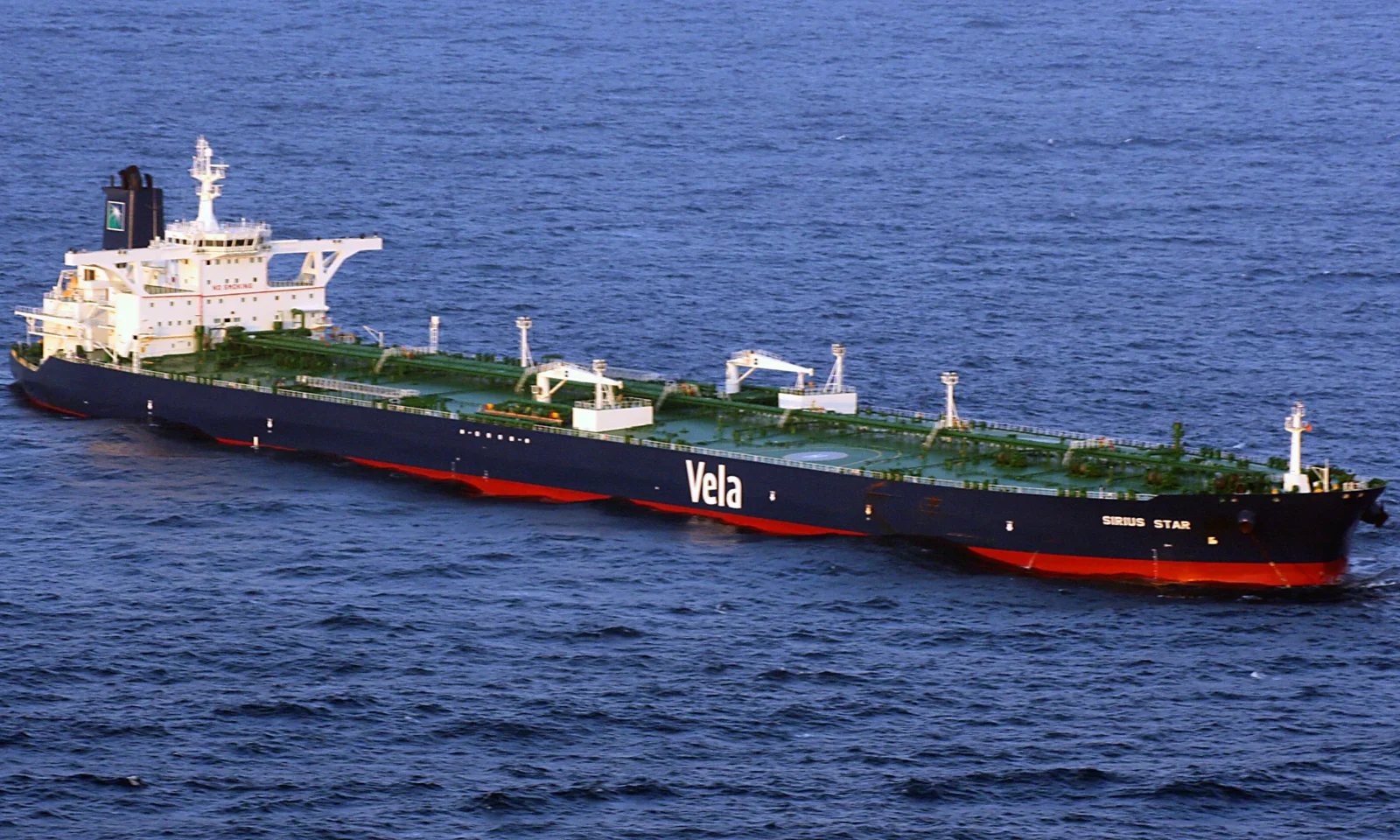
File photo: VLCC Sirius Star. U.S. Navy photo by William S. Stevens / Wikimedia Commons / Public Domain.