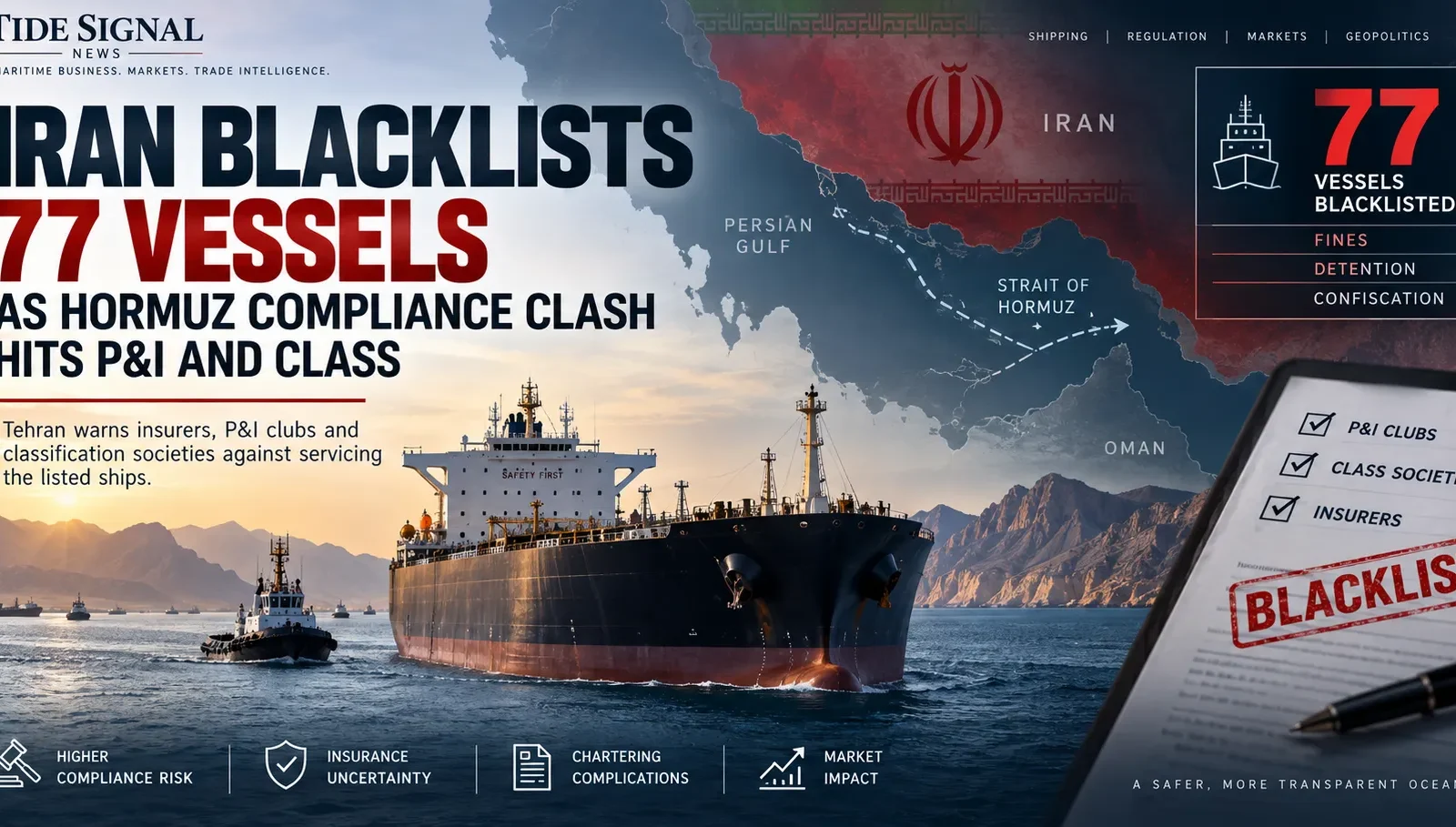
The Iran vessel blacklist has expanded to 77 ships, adding a new compliance layer to an already dangerous Strait of Hormuz market. Iran’s Persian Gulf Strait Authority (PGSA) said the vessels breached its transit protocols and warned that listed ships could face fines, detention or confiscation on future passages. The authority also urged insurers, P&I clubs and classification societies to stop serving the listed vessels.
The immediate problem for shipowners is bigger than the list itself. The PGSA is already designated by the United States, and OFAC has warned both U.S. and non-U.S. persons that engaging with the authority — including accepting services or responding to safe-passage demands — can create sanctions exposure.
Shipping companies are therefore facing a compliance conflict with no simple operational answer: ignore the Iranian regime and risk enforcement at the strait, or engage with a U.S.-sanctioned authority and potentially create sanctions exposure elsewhere.
Reuters reported on 14 September that the PGSA had released the updated list of 77 vessels and said ships cooperating with listed vessels could themselves be added. The authority also called on insurance companies, Protection & Indemnity clubs and classification societies to stop providing services to ships on the list.
The list appears to be part of Iran’s expanding attempt to control passage through the Strait of Hormuz through a national compliance regime. It should not be confused with an OFAC, EU or UN sanctions list. The legal and commercial consequences are different — and that distinction is central to understanding the risk.
Iran Vessel Blacklist: What Changed on 14 September?
The latest update raises the PGSA list to 77 vessels, according to Reuters. Iran alleges that the ships violated transit protocols established for passage through the Strait of Hormuz.
The threatened consequences include:
- financial penalties;
- detention;
- possible confiscation;
- blacklisting of ships that cooperate with listed vessels;
- pressure on insurers and P&I clubs to withdraw services; and
- pressure on classification societies to stop servicing the listed ships.
The most important operational point is that the Iranian action is not simply a naming exercise. If enforced, the list could influence whether a vessel is considered commercially acceptable for a Gulf voyage even when the ship remains physically available and technically fit.
That is the same mechanism Tide Signal has tracked throughout the current crisis: the effective supply of tonnage can shrink long before the physical fleet does. A ship can exist, be in position and still become commercially unusable because an owner, charterer, bank, insurer, flag, class society or port service provider will not accept the exposure.
That pattern is already visible in Tide Signal’s coverage of the Strait of Hormuz shipping standstill and U.S. sanctions risk, where compliance restrictions have become almost as important as physical passage.
The Bigger Problem: The Iranian Authority Is Itself U.S.-Sanctioned
The compliance trap begins with the status of the PGSA itself.
On 27 May 2026, the U.S. Treasury designated the Persian Gulf Strait Authority. OFAC described the entity as part of an Iranian effort to control and monetise shipping passage through the Strait of Hormuz.
OFAC has subsequently warned that both U.S. and non-U.S. persons may face sanctions exposure by engaging with the PGSA or related designated entities, including through safe-passage arrangements, insurance products, information requests or other forms of cooperation.
That creates a direct conflict for a ship operator.
| Decision | Possible Iran-side risk | Possible U.S. sanctions risk |
|---|---|---|
| Ignore PGSA requirements | Possible blacklisting, detention, fines or other enforcement | Lower direct PGSA-engagement risk, but transaction-specific screening still required |
| Engage with PGSA | May satisfy Iranian transit demands | Potential sanctions exposure because PGSA is designated |
| Defer or reroute voyage | Avoids some direct enforcement exposure | May reduce sanctions interaction but creates delay, cost and contractual consequences |
This is why a ship’s Hormuz decision can no longer be handled only by the Master, operator or security department. Legal, sanctions, insurance, chartering and senior management may all need to be involved before the voyage is accepted.
Why the Warning to P&I Clubs Matters
The Iranian statement is especially significant because it directly brings P&I insurance into the dispute.
P&I clubs cover major third-party maritime liabilities such as pollution, collision liabilities, cargo claims, crew injury and other risks that can be financially catastrophic for an owner.
For a commercial ship, the question is therefore not merely whether cover technically exists. It is whether:
- the voyage remains within the club’s sanctions rules;
- the club can lawfully provide services connected with the voyage;
- war-risk arrangements remain available;
- the club requires prior notification or approval;
- reinsurers remain comfortable with the exposure;
- the ship’s counterparties accept the insurance position; and
- banks and charterers treat the vessel as commercially acceptable.
West of England P&I has already warned members not to engage in arrangements involving the designated PGSA for Hormuz transit, noting potential sanctions exposure for both U.S. and non-U.S. persons.
The Iranian demand therefore places insurers in an impossible-looking position: Tehran is telling them to stop servicing listed ships, while U.S. sanctions guidance restricts how insurers can interact with the Iranian authority making the demand.
Tide Signal’s war risk premiums guide explains why this kind of uncertainty can move directly into voyage cost, owner approval and freight negotiations even before a formal claim occurs.
Why Classification Societies Are Now in the Crossfire
Iran’s call for classification societies to withdraw services is another major escalation because class sits at the centre of a ship’s technical acceptability.
A classification society verifies that a vessel complies with its technical rules and, in many cases, performs statutory surveys on behalf of the flag administration.
Class status can influence:
- statutory certification;
- insurance;
- flag-state acceptance;
- charterer vetting;
- port entry;
- financing covenants;
- sale and purchase transactions; and
- whether a ship remains commercially employable.
Iran cannot automatically order an international class society to withdraw class from a foreign vessel simply by publishing a national blacklist. The actual legal position depends on jurisdiction, contractual obligations, sanctions rules, flag authority and the society’s own rules.
But the warning still matters commercially.
If a class society, insurer or flag administration begins reviewing a vessel because of the list, that review alone can delay fixtures, approvals, surveys or port calls. Shipping markets price uncertainty quickly — often before a final legal conclusion exists.
The most dangerous part of the 77-ship blacklist may not be the list itself. It is the possibility that one vessel identity becomes unacceptable to different parts of the maritime system for different legal reasons at the same time.
A ship can be technically seaworthy, commercially available and still become unusable if an insurer, class society, bank, charterer, port or sanctions team refuses the exposure.
Iran’s 77-Ship List Is Not the Same as an OFAC Sanctions List
This distinction needs to remain clear.
The PGSA list is an Iranian non-compliant vessel / sanctions-style enforcement list connected with Iran’s transit regime.
It is not automatically equivalent to:
- an OFAC Specially Designated Nationals list;
- an EU restrictive-measures designation;
- a UN Security Council sanctions list; or
- a flag-state detention list.
Being named by the PGSA does not by itself mean that a vessel is U.S.-sanctioned.
Likewise, a ship that is not on the Iranian list may still have separate U.S., EU, UK or other sanctions exposure through ownership, management, cargo, financing, port history or counterparties.
Shipping companies therefore need two separate screening questions:
- What does the Iranian list mean for physical and operational access through Hormuz?
- What do U.S. and other sanctions regimes permit the owner, insurer, bank and service providers to do?
Those questions can produce different answers.
What the Iran Vessel Blacklist Means for Charterers
The chartering impact could be immediate even before any vessel is detained.
A charterer evaluating a tanker, bulker, gas carrier or containership for Gulf employment now needs to ask whether the vessel appears on the Iranian list and what that could mean for the proposed route.
The commercial problem is not theoretical.
A vessel may be:
- cheap on freight;
- open in the correct position;
- technically suitable;
- acceptable on age and specification; and
- fully capable of carrying the cargo;
but still be rejected if the charterer believes the ship could face detention, delay or service withdrawal in the strait.
This is how sanctions and security risk reduce effective tonnage supply.
Tide Signal’s analysis of the $25 million VLCC voyage from the Gulf showed how a small pool of vessels willing and able to accept exceptional regional risk can push freight far beyond normal benchmarks.
The latest blacklist could reinforce that mechanism if owners and charterers begin excluding listed or potentially exposed vessels from Gulf business.
Could the Blacklist Push Freight Higher?
Potentially — but the effect will depend on enforcement.
A blacklist does not automatically remove 77 ships from the world fleet. Some may not be trading the Gulf. Some owners may assess the practical enforcement risk as limited. Others may seek clarification or removal.
But freight does not need all 77 vessels to disappear for the market to tighten.
What matters is whether the pool of ships that are simultaneously:
- geographically available;
- acceptable to charterers;
- acceptable to insurers;
- bankable;
- class-compliant;
- sanctions-cleared; and
- willing to transit Hormuz
becomes smaller.
The Gulf tanker market is already operating under extraordinary risk. Tide Signal’s VLCC rate analysis recently tracked record-level pricing on the Gulf of Oman–China route.
If the Iranian list creates another layer of vessel rejection or voyage refusal, the freight impact could extend beyond the 77 named ships.
The Timing Is Especially Dangerous
The blacklist arrives while Hormuz traffic is already heavily depressed.
Reuters reported that preliminary commodity-vessel transit data fell to single digits per day over the weekend, below a 10-day average of around 14 vessels per day. Those figures do not capture every transit because ships operating with AIS disabled or unavailable may not appear in public tracking datasets.
That means the market is already dealing with a limited and imperfect operating picture.
At the same time, Tide Signal reported a fresh Strait of Hormuz ship attack on 13 September, while regional energy flows are also under pressure from the Saudi East-West Pipeline outage and rising Bab el-Mandeb risk.
The result is a multi-layer crisis:
- physical attack risk;
- Iranian transit enforcement;
- U.S. sanctions exposure;
- insurance uncertainty;
- class and service-provider pressure;
- reduced visible traffic;
- high tanker freight; and
- alternative export-route disruption.
Each layer can amplify the others.
The P&I Problem Is Not the Same as War Risk
Another important distinction is between ordinary mutual P&I cover and separate war-risk arrangements.
Regional war-risk cover has already been heavily repriced and, in some structures, cancelled and reinstated subject to exclusions or buyback terms during the 2026 Gulf crisis.
But the Iranian blacklist adds a different question: whether an insurer can continue providing ordinary services to a listed ship while also avoiding prohibited engagement with designated Iranian entities.
Those are related but separate issues.
An owner should therefore avoid assuming that “the vessel has P&I” means every Hormuz-related service, guarantee or sanctions-sensitive transaction is automatically covered.
What Owners Should Check Before a Hormuz Fixture
- Check the vessel identity against the latest PGSA list. Confirm name, IMO number and any recent name or ownership changes.
- Screen the full ownership chain. Registered owner, beneficial owner, manager, operator and any controlling entities.
- Review PGSA exposure separately from OFAC exposure. Do not treat the Iranian list as equivalent to a Western sanctions designation.
- Contact P&I before fixture where necessary. Confirm whether notice, approval or sanctions review is required.
- Check war-risk terms. Premium, excluded areas, cancellation notices and buyback requirements may have changed.
- Confirm class position. Review whether any class service, survey or statutory certification issue could arise from the voyage.
- Check bankability. A legally possible voyage can still fail if the payment chain is rejected.
- Review charterparty clauses. Sanctions, war risks, safe port, deviation, delay and cancellation provisions all matter.
- Verify route and security instructions. Use current flag, company security, UKMTO/JMIC and coastal-state information.
- Record the decision. The compliance file should show what information was available and why the voyage was approved, rejected or modified.
Could a Listed Vessel Be Removed?
Earlier versions of the Iranian non-compliant vessel regime reportedly allowed owners to approach Iranian authorities and provide explanations or documentation in connection with removal.
However, any attempt to engage with the PGSA now raises a separate sanctions question because the authority is U.S.-designated.
That means an owner should not treat a removal application as a routine administrative process.
Qualified sanctions advice may be necessary before any communication, payment, information submission, guarantee request or service arrangement involving the authority.
What About Ships That Trade With a Blacklisted Vessel?
The Iranian warning reportedly extends beyond the 77 named vessels.
Ships that cooperate with listed vessels may themselves be added to the list.
That could create particular concern around:
- ship-to-ship transfers;
- lightering;
- transshipment;
- tug and offshore support;
- bunker supply;
- towage;
- agency or husbandry services; and
- other direct vessel-to-vessel operations.
The operational significance depends on how Iran defines “cooperation” and how aggressively that standard is enforced.
Until clearer legal or official guidance emerges, companies should avoid assuming that only direct passage by one of the 77 vessels is relevant.
What Has Not Yet Been Confirmed
There are several limits to what can be stated at this stage.
- The full commercial effect of the 77-vessel list is not yet known.
- The degree to which Iran will enforce fines, detention or confiscation against every listed vessel is not yet clear.
- The precise legal basis Iran will use against foreign insurers or classification societies requires case-specific analysis.
- A PGSA listing does not automatically mean a vessel has been sanctioned by OFAC, the EU or the UN.
- Public AIS data does not provide a complete picture of Hormuz transit activity.
- As of publication, Tide Signal has not identified a major public industry statement specifically accepting Iran’s demand that international P&I clubs or class societies withdraw services from all 77 ships.
Those distinctions are essential. The story is serious without overstating what has legally happened.
Why This Could Become a Bigger Shipping Story Than the 77 Ships
The headline number is 77.
The market risk is much larger.
If owners begin avoiding certain counterparties, charterers begin rejecting ships, insurers require additional approvals, banks tighten screening and class societies reassess services, the effect can spread far beyond the vessels named on the Iranian list.
This is how maritime compliance shocks propagate.
They move through networks.
A vessel’s status affects the charterer. The charterer affects the cargo. The cargo affects the bank. The bank affects payment. The insurer affects voyage approval. Class affects technical acceptance. The port affects physical access.
The ship at the centre of the chain does not need to be physically stopped for trade to slow down.
Hormuz is becoming a two-sided compliance corridor.
Iran is trying to impose consequences on vessels that do not follow its transit regime. Washington is warning companies against dealing with the Iranian authority administering that regime.
For shipowners, the most important question is no longer simply whether the strait is open. It is whether the voyage can be performed without the vessel becoming operationally unacceptable on one side of the compliance divide or the other.
Iran Vessel Blacklist FAQ
How many vessels are on Iran’s latest Hormuz blacklist?
Reuters reported on 14 September 2026 that Iran’s Persian Gulf Strait Authority had released an updated list containing 77 vessels accused of violating its transit protocols.
What penalties has Iran threatened?
The authority has warned of penalties including fines, detention or confiscation for listed vessels on future passages. It has also warned that vessels cooperating with listed ships could be added to the list.
Has Iran asked P&I clubs to stop covering the ships?
The PGSA has urged insurers, P&I clubs and classification societies to stop providing services to the listed vessels. Whether and how international service providers respond will depend on their legal, sanctions and contractual obligations.
Are the 77 vessels now sanctioned by the United States?
Not simply because they appear on the Iranian list. The PGSA list is separate from U.S. OFAC designations. Each vessel and transaction must be screened against the relevant sanctions regimes independently.
Why is the PGSA itself a sanctions issue?
The U.S. Treasury designated the Persian Gulf Strait Authority in May 2026. OFAC has warned U.S. and non-U.S. persons about sanctions exposure from engaging with the authority or related designated entities in connection with Hormuz passage.
What should shipowners do before a Hormuz transit?
Owners should review vessel-list exposure, sanctions screening, P&I and war-risk cover, class status, charterparty rights, bankability, security guidance and the company’s internal approval process before committing the ship.
Could the blacklist affect freight rates?
Yes, if it reduces the number of ships owners and charterers consider commercially workable for Gulf voyages. The effect will depend on enforcement, vessel types, geographic positioning and how insurers, banks and charterers respond.
Official Sources and Further Reading
- Reuters — Iranian Strait Authority issues updated list of 77 vessels
- U.S. Treasury — Persian Gulf Strait Authority designation, 27 May 2026
- West of England P&I — OFAC warning on Strait of Hormuz passage
- West of England P&I — Increased secondary sanctions risk for Iranian shipping
- Skuld — Regional conflicts, sanctions and charterparty implications