The SOLAS Convention is the backbone of international merchant-ship safety. It reaches from hull subdivision, machinery and fire protection to lifeboats, GMDSS, bridge equipment, cargo securing, dangerous goods, safety management, maritime security, bulk-carrier structure, polar operations and offshore industrial personnel.
Tide Signal Academy · Ship Safety & Regulation · Technical review: 20 September 2026
The International Convention for the Safety of Life at Sea establishes minimum international standards for the construction, equipment and operation of ships compatible with their safety.
What Is the SOLAS Convention?
The International Convention for the Safety of Life at Sea, usually shortened to SOLAS, is the central international treaty governing the safety of merchant ships. IMO describes it as generally the most important international treaty concerning merchant-ship safety.
The current instrument is SOLAS 1974, as amended. It was adopted on 1 November 1974 and entered into force on 25 May 1980. Its main objective is to specify minimum standards for ship construction, equipment and operation that are compatible with safety.
The official convention overview is available from the International Maritime Organization — SOLAS 1974.
SOLAS does not operate by giving one universal checklist to every vessel. Applicability depends on the regulation, ship type, gross tonnage, construction date, voyage, cargo and other defined criteria. A passenger ship, bulk carrier, containership, chemical tanker and 300-GT cargo ship can all be affected by SOLAS in different ways.
The Convention also works through mandatory codes and associated instruments. Examples include the LSA Code, FSS Code, ISM Code, ISPS Code, IMDG Code, HSC Code, Polar Code, IBC Code, IGC Code, IMSBC Code and International Grain Code.
↓
Mandatory technical code or standard
↓
Ship-specific design / equipment / procedure
↓
Survey, certification and onboard records
↓
Flag-State and Port State verification
Why Titanic Led to SOLAS
The first SOLAS Convention was adopted in 1914 in response to the sinking of the Titanic in 1912. The disaster exposed the need for international standards covering matters such as life-saving appliances, radio watchkeeping and ship safety.
SOLAS was subsequently revised in 1929, 1948 and 1960. The 1960 version was the first major SOLAS instrument adopted under the organization that became today’s IMO.
The decisive change came with the 1974 Convention. Earlier amendment procedures were too slow for a technical industry that kept evolving. SOLAS 1974 therefore introduced the tacit acceptance procedure: amendments can enter into force on a specified date unless sufficient objections are received before that date.
That mechanism is one reason SOLAS can continue evolving without being replaced every few decades by an entirely new convention.
International ship safety often develops after accidents reveal weaknesses in design, equipment, procedures or regulation. SOLAS turns those lessons into common minimum standards so that safety does not depend entirely on the practices of one company or one flag State.
SOLAS Chapters Explained at a Glance
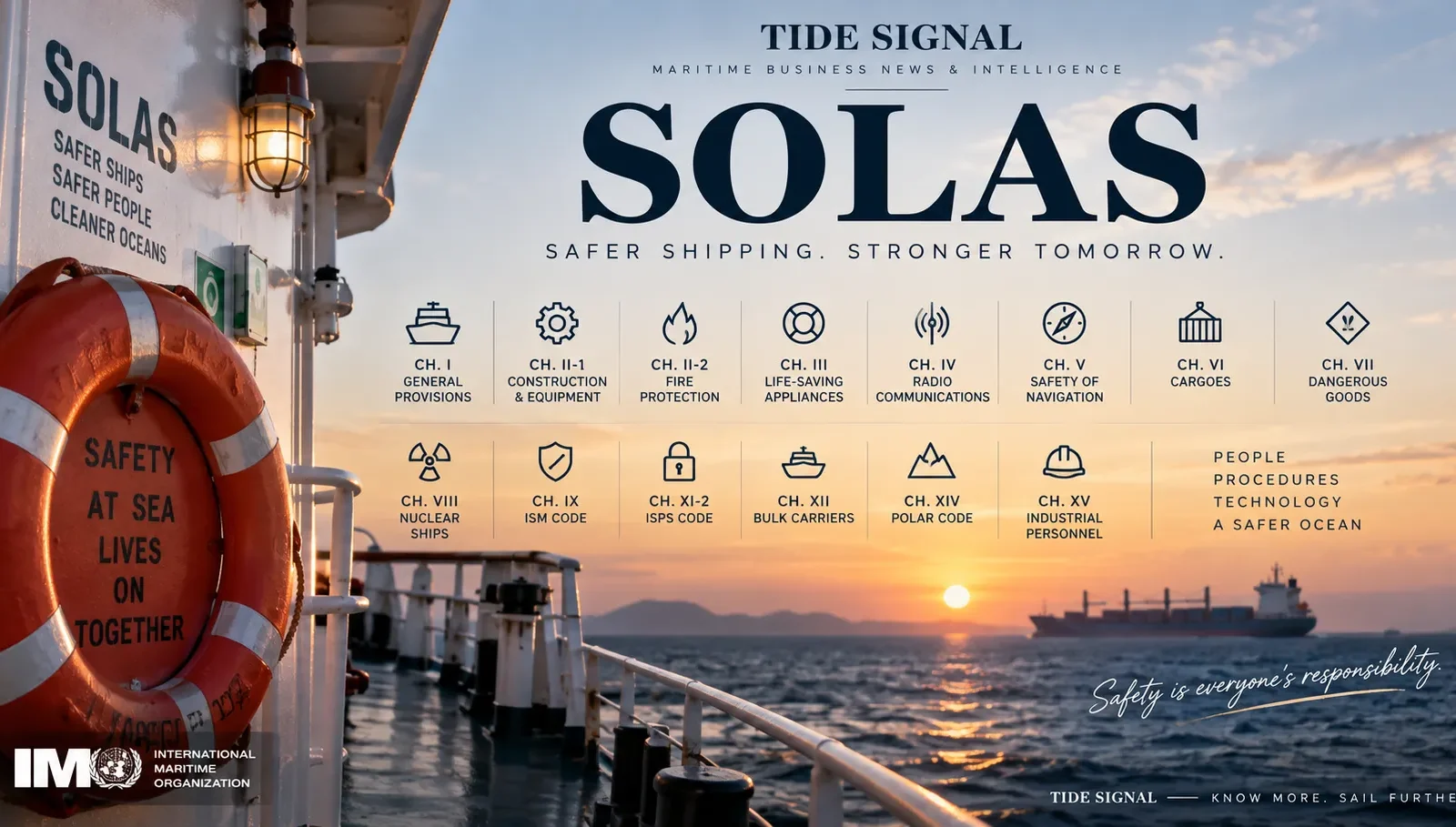
The modern SOLAS structure runs from Chapters I to XV. Chapter II is divided into II-1 and II-2, while Chapter XI is divided into XI-1 and XI-2. IMO’s current chapter overview can therefore be read as a series of major safety domains rather than simply a numbered list.
| Chapter | Main subject | Typical shipboard connection |
|---|---|---|
| I | General Provisions | Surveys, certificates, casualty provisions, Port State Control |
| II-1 | Construction, subdivision, stability, machinery, electrical | Watertight integrity, emergency power, steering, bilge systems, structural safety |
| II-2 | Fire protection, detection and extinction | Fire divisions, detection, extinguishing systems, escape, fuel fire safety |
| III | Life-saving appliances and arrangements | Lifeboats, liferafts, rescue boats, lifejackets, drills, muster lists |
| IV | Radiocommunications | GMDSS, distress alerting, EPIRB, SART/AIS-SART, safety information |
| V | Safety of navigation | AIS, VDR, bridge equipment, voyage planning, distress assistance |
| VI | Carriage of cargoes | Cargo information, stowage, securing, grain, solid bulk cargo safety |
| VII | Dangerous goods | IMDG, chemical tankers, gas carriers, dangerous bulk solids |
| VIII | Nuclear ships | Nuclear-powered merchant ship safety |
| IX | Management for safe operation | ISM Code and Safety Management System |
| X | High-speed craft | Mandatory HSC Code |
| XI-1 | Special measures to enhance maritime safety | IMO number, enhanced surveys, recognized organizations, operational PSC |
| XI-2 | Special measures to enhance maritime security | ISPS Code, ship security plan, security alert system |
| XII | Additional safety measures for bulk carriers | Structural safety requirements for defined bulk carriers |
| XIII | Verification of compliance | IMO Member State Audit Scheme |
| XIV | Ships operating in polar waters | Mandatory Polar Code safety provisions |
| XV | Ships carrying industrial personnel | Offshore workers, wind-farm personnel, IP Code |
What Changed Under SOLAS in 2026?
A strong evergreen SOLAS guide still needs a current regulatory layer. Several important amendments entered into force on 1 January 2026, and they show how widely SOLAS reaches across modern ship operations.
- Lost containers: Chapter V now contains mandatory reporting requirements when freight containers are lost overboard, including notification of ships in the vicinity, the nearest coastal State and the flag State.
- Lifting appliances and anchor handling winches: new regulation II-1/3-13 introduces requirements for design, construction, testing, examination, operation, inspection and maintenance.
- Oil-fuel flashpoint: Chapter II-2 now requires specified supplier declarations before bunkering to support compliance with the 60°C oil-fuel flashpoint requirement.
- Electronic inclinometers: new containerships and bulk carriers of 3,000 GT and above within the defined scope must carry an electronic inclinometer or equivalent means to determine, display and record roll motion.
- PFOS firefighting media: SOLAS II-2 amendments prohibit use or storage of extinguishing media containing PFOS under the new application provisions.
- Vehicle and ro-ro fire safety: enhanced detection, patrol and video-monitoring measures entered into force for vehicle, special-category and ro-ro spaces and relevant weather decks.
- Polar navigation: associated SOLAS/Polar Code amendments extended certain navigation and voyage-planning requirements to additional vessel categories operating in polar waters.
IMO’s January 2026 summary is available at Raft of shipping rules in force from 1 January 2026. The official January 2026 supplement to the SOLAS 2024 Consolidated Edition lists the amendments incorporated after the publication was issued.
Chapter I contains the general survey and certification architecture of SOLAS. It sets out how relevant passenger ships and cargo ships are surveyed and how statutory certificates are issued as evidence that the ship complies with the applicable requirements.
It also provides the legal foundation for inspection by other Contracting Governments when there are clear grounds to believe that a foreign ship or its equipment does not substantially comply with SOLAS. That is a core part of Port State Control.
Why Chapter I matters onboard
The ship may be technically well designed, but SOLAS relies on periodic survey and documentary proof. Certificates therefore connect regulation with physical condition.
Surveyors and Port State Control officers can examine whether the vessel still matches the condition on which certification was issued. Serious defects, unauthorized modifications, inoperative equipment or poor maintenance can undermine that assumption.
For practical arrival preparation, see Tide Signal’s Port State Control Inspection: What Ships Must Prepare Before Arrival.
A cargo ship presents valid statutory certificates, but a major item of safety equipment is inoperative and the defect has not been properly reported or managed. A valid certificate does not make the operational deficiency disappear. The ship’s actual condition remains part of compliance.
Chapter II-1 covers some of the most fundamental ship-safety questions: Will the ship remain afloat and stable after defined damage? Can flooding be controlled? Will essential machinery and electrical services remain available under emergency conditions?
It includes requirements dealing with subdivision, watertight integrity, stability, bilge arrangements, machinery, steering gear, electrical installations, emergency power and related construction matters.
Subdivision and damage stability
Passenger ships are subdivided into watertight compartments so that defined hull damage does not automatically cause the vessel to sink or lose unacceptable stability. Modern requirements also include damage-stability standards for cargo ships within their defined application.
The practical bridge and engine-room lesson is that watertight integrity is not simply a naval-architecture calculation. Open doors, defective closing appliances, poor maintenance, unauthorized penetrations or incorrect operating practice can defeat the assumptions used in the approved stability design.
Machinery and electrical systems
The chapter requires essential services for ship, crew and passenger safety to remain available under relevant emergency conditions. This is why emergency generators, emergency switchboards, steering arrangements and essential auxiliaries are treated as statutory safety systems rather than ordinary equipment.
New 2026 lifting-appliance requirements
From 1 January 2026, new SOLAS regulation II-1/3-13 addresses onboard lifting appliances and anchor handling winches. Within its scope, it establishes requirements for design, construction, installation, load testing, thorough examination, marking, maintenance, operational testing and inspection.
For installed equipment that predates the new rule, transitional requirements apply through the first relevant renewal survey on or after 1 January 2026. Operators should therefore not assume the amendment applies only to future newbuildings.
A deck crane may be operational in everyday cargo work, but SOLAS now places defined safety expectations around the appliance itself, its safe working load evidence, testing and examination. Commercial usefulness and statutory readiness have to exist together.
Chapter II-2 is the core SOLAS fire-safety chapter. Its requirements are built around a system of defence rather than one extinguisher or one alarm.
The underlying principles include:
- dividing the ship with structural and thermal fire boundaries;
- restricting combustible materials;
- detecting fire in the space of origin;
- containing fire and smoke;
- extinguishing the fire as early as possible;
- protecting escape routes and access for firefighters;
- ensuring fire-extinguishing appliances are available;
- reducing the probability of ignition, including flammable-vapour ignition.
The Fire Safety Systems Code
Many technical requirements are contained in the mandatory International Code for Fire Safety Systems (FSS Code). SOLAS provides the regulatory requirement; the FSS Code supplies detailed standards for systems such as fixed gas extinguishing, sprinkler systems, fire detection, fire pumps and other equipment.
Fire plans, drills and operational readiness
A compliant fire system is not only a design feature. Chapter II-2 includes operational-readiness and maintenance requirements. Fire doors, dampers, detection loops, extinguishing systems, fire pumps, breathing apparatus and escape arrangements must be maintained so that they work in the actual emergency.
2026 oil-fuel flashpoint controls
From 1 January 2026, amendments to regulation II-2/4 strengthen control over oil fuel with respect to the general 60°C flashpoint requirement. Ships carrying oil fuel are required before bunkering to receive a declaration from the fuel supplier representative confirming conformity with the SOLAS flashpoint requirement and identifying the test method used.
This creates an important bridge between bunkering documentation and SOLAS fire safety. For the wider transfer, sampling and BDN workflow, see Tide Signal’s Bunkering Operations guide.
PFOS and ro-ro fire protection in 2026
New rules also prohibit use or storage of fire-extinguishing media containing PFOS under the applicable implementation dates. Separate amendments strengthen fire detection, patrol and monitoring in vehicle, special-category and ro-ro spaces.
These changes are commercially important because vehicle fires, including fires involving electrically powered vehicles, can develop in spaces where early detection, heat release, smoke and access create difficult firefighting conditions.
Alternative-fuel safety is also increasingly connected with Chapter II-2 and the mandatory IGF framework. Tide Signal’s IMO methanol and fuel-cell safety briefing tracks that developing regulatory layer.
SOLAS Chapter III governs life-saving appliances and arrangements. The mandatory International Life-Saving Appliance Code contains detailed technical requirements for equipment such as lifeboats, liferafts, rescue boats, lifejackets and associated launching arrangements.
IMO’s Chapter III summary also shows how the chapter extends beyond equipment to emergency training, drills, operational readiness, maintenance, muster lists and instructions.
Equipment is only half the system
A lifeboat that exists but cannot be launched safely is not an effective lifesaving arrangement. A rescue boat with overdue maintenance is not merely a paperwork issue. A crew that cannot organize a real abandon-ship response has not converted equipment into survival capability.
That is why Chapter III combines:
- carriage requirements;
- technical standards;
- stowage and launching arrangements;
- inspection and maintenance;
- muster lists;
- emergency training;
- abandon-ship and fire drills;
- recovery of persons from the water.
Lifeboat maintenance
The SOLAS system has developed specific mandatory requirements for maintenance, thorough examination, operational testing, overhaul and repair of lifeboats, rescue boats, launching appliances and release gear. Changes connected with this framework also entered into force in 2026.
Chapter IV incorporates the Global Maritime Distress and Safety System (GMDSS). Its purpose is to improve the probability that a ship in distress can alert rescue authorities and other vessels and receive maritime safety information.
All passenger ships and cargo ships of 300 gross tonnage and above on international voyages are within the core GMDSS carriage framework. The exact equipment depends on the ship and its sea areas.
Typical GMDSS-related equipment can include:
- VHF DSC;
- MF/HF DSC where required;
- recognized mobile satellite service equipment;
- EPIRB;
- SART or AIS-SART depending on the arrangement;
- NAVTEX / maritime safety information reception;
- portable survival-craft radios.
Modernized GMDSS
IMO completed a major modernization of the GMDSS framework, and revised SOLAS requirements entered into force in 2024. The modernization removed obsolete provisions and makes the framework more technology-neutral so newer communication systems can be incorporated.
The current official background is available from IMO Radiocommunications.
GMDSS is operational, not decorative
The radio installation needs power, correct configuration, valid identities, functioning antennas, batteries and competent operators. A bridge team should know how distress alerts are initiated, cancelled and acknowledged and how MSI is received and acted upon.
Digital communications also create a cyber-resilience dimension. Tide Signal’s Maritime Cyber Security guide explains why connected bridge, satellite and operational systems should be treated as part of safe ship operation rather than office IT alone.
Chapter V is unusual because many of its operational provisions apply generally to all ships on all voyages, rather than only to a particular SOLAS ship category on an international voyage.
It covers navigation safety services and shipboard operational requirements including:
- meteorological services;
- ice patrol;
- ships’ routeing;
- search and rescue;
- safety manning;
- voyage planning;
- AIS;
- VDR;
- navigation-system carriage requirements.
The master’s duty to assist persons in distress
Chapter V contains the longstanding obligation concerning assistance to persons in distress at sea. That principle sits at the heart of maritime safety culture: a commercial voyage does not erase the master’s international safety obligations.
AIS and VDR
Automatic Identification System and Voyage Data Recorder requirements sit within the Chapter V framework. Both systems support safety, but they do different jobs. AIS broadcasts and receives identity/navigation information; VDR preserves selected data that can assist casualty investigation.
Radar, ECDIS and independent cross-checking
Bridge systems should not be treated as independent boxes. Radar, GNSS, AIS, ECDIS, speed inputs, gyro heading and other sensors increasingly share data. The navigator therefore needs to understand both the strengths and failure modes of each input.
For radar fundamentals, see Tide Signal’s X-Band vs S-Band Radar guide.
Electronic inclinometer requirement from 2026
SOLAS V/19 amendments now require defined new containerships and bulk carriers of 3,000 GT and above constructed on or after 1 January 2026 to carry an electronic inclinometer or other means to determine, display and record roll motion, subject to the stated scope and exceptions.
Lost-container reporting from 2026
Chapter V regulations 31 and 32 were amended to introduce mandatory reporting of lost freight containers. The master must communicate required information concerning container losses to ships in the vicinity and the nearest coastal State, with flag-State reporting also forming part of the framework.
A containership loses containers in heavy weather. The incident is not only a cargo-claim issue. Lost containers can become hazards to navigation, so SOLAS now establishes a specific reporting chain intended to warn other ships and authorities.
Chapter VI covers the carriage of cargoes other than liquids and gases in bulk where their particular hazards to ships or persons may require special precautions. It includes requirements around cargo information, loading, stowage and securing.
Cargo Securing Manual
Cargo units need to be stowed and secured so that they do not create unacceptable risk to the ship or persons onboard. The approved Cargo Securing Manual is therefore a practical safety document, not simply a survey requirement.
Solid bulk cargoes and the IMSBC Code
The mandatory International Maritime Solid Bulk Cargoes Code is central to dry-bulk cargo safety. It addresses hazards including liquefaction, chemical hazards, self-heating, oxygen depletion, gas generation, cargo distribution and structural loading.
Tide Signal’s IMSBC Code 2027 guide explains Amendment 08-25, which becomes mandatory on 1 January 2027.
Grain
Cargo ships carrying grain in bulk must comply with the mandatory International Grain Code. Grain can shift and create a heeling moment, so stability and loading arrangements are a direct safety issue.
Pre-stowage and cargo intake
SOLAS cargo safety reaches the commercial planning stage. A cargo quantity can be commercially attractive but still unacceptable if draft, stability, longitudinal strength, ballast condition or cargo hazards are not properly controlled.
See Tide Signal’s Pre-Stowage Planning guide for the connection between cargo intake, draft, ballast, trim and structural limits.
Chapter VII connects SOLAS with some of the most important mandatory cargo codes in shipping.
| Part | Cargo type | Main mandatory code / framework |
|---|---|---|
| A | Dangerous goods in packaged form | IMDG Code |
| A-1 | Dangerous goods in solid form in bulk | SOLAS + IMSBC dangerous-goods provisions |
| B | Dangerous liquid chemicals in bulk | IBC Code |
| C | Liquefied gases in bulk | IGC Code |
| D | Packaged irradiated nuclear fuel / plutonium / high-level radioactive waste | INF Code |
IMDG Code
The International Maritime Dangerous Goods Code regulates classification, packing, marking, labelling, placarding, documentation, stowage and segregation of dangerous goods in packaged form.
The updated IMDG Code incorporating Amendment 42-24 became mandatory from 1 January 2026. That makes dangerous-goods compliance another area where an old onboard edition can create immediate risk.
Why documentation matters
Dangerous goods must be correctly identified before loading. The vessel’s stowage and emergency response depend on the declared hazard. A misdeclared cargo can invalidate the safety assumptions behind segregation, firefighting, temperature control and emergency response.
SOLAS Chapter VII also overlaps with environmental regulation. If a packaged dangerous substance is a marine pollutant, MARPOL Annex III may also apply. See Tide Signal’s MARPOL Annexes Explained for the environmental side of the same cargo chain.
Chapter VIII is rarely encountered in ordinary merchant operations, but it remains part of SOLAS. It establishes basic requirements for nuclear-powered ships and refers to the Code of Safety for Nuclear Merchant Ships.
Its presence in SOLAS is important conceptually: the Convention is designed to create a safety framework even for highly specialized technologies where ordinary ship arrangements are not sufficient.
Chapter IX makes the International Safety Management (ISM) Code mandatory. The ISM Code requires the responsible company to establish a Safety Management System that translates international requirements and company policy into controlled shipboard and shore-based processes.
The key idea is that safe operation cannot depend only on individual experience. The company needs a system for:
- safety and environmental policy;
- defined authority and responsibility;
- procedures for key shipboard operations;
- emergency preparedness;
- reporting non-conformities, accidents and hazardous occurrences;
- maintenance of ship and equipment;
- documentation control;
- internal audits and management review.
Document of Compliance and Safety Management Certificate
ISM certification is split between the company and the ship. A Document of Compliance is issued to the company for applicable ship types, while the individual ship carries a Safety Management Certificate when its onboard SMS has been verified.
Cyber risk sits inside safety management
Modern SMS scope increasingly includes cyber risk because cyber incidents can affect navigation, machinery, cargo and communications. Tide Signal’s Maritime Cyber Security pillar explains IMO cyber-risk management and shipboard IT/OT controls.
Chapter X makes the International Code of Safety for High-Speed Craft mandatory. High-speed craft use design and operating concepts that differ from conventional displacement ships, so the HSC Code provides an integrated safety framework for structure, machinery, fire safety, lifesaving, navigation and operational limitations.
The chapter is an example of a recurring SOLAS approach: where a specialized vessel cannot be regulated efficiently through ordinary prescriptive rules alone, a dedicated mandatory code supplies the technical safety system.
Chapter XI-1 — Maritime safety
XI-1 covers special safety measures including recognized-organization requirements, enhanced surveys, ship identification numbers and Port State Control on operational requirements.
The IMO ship identification number is intended to provide a permanent identity for the vessel that remains with the ship despite changes of name or flag.
Chapter XI-2 — Maritime security
XI-2 embeds the International Ship and Port Facility Security Code (ISPS Code). Part A is mandatory, while Part B provides guidance for implementing the mandatory provisions.
The security system can include:
- ship security assessment;
- approved Ship Security Plan;
- Company Security Officer;
- Ship Security Officer;
- security levels;
- access control;
- restricted areas;
- security drills and exercises;
- Ship Security Alert System;
- International Ship Security Certificate.
The master’s security authority
SOLAS XI-2 explicitly protects the master’s professional judgement in security decisions necessary to maintain the safety and security of the ship. The company, charterer or other person should not constrain that authority where the regulation applies.
This distinction is important: commercial instructions may influence where the ship trades, but the master retains defined safety and security responsibilities under international law.
Bulk carriers face specific structural risks because dense cargoes, alternate-hold loading, corrosion, water ingress and high local loads can produce severe consequences. Chapter XII adds dedicated safety measures for the sector.
The chapter includes structural requirements for bulk carriers over 150 metres in length within its defined scope. It sits alongside the Enhanced Survey Programme and cargo-safety requirements in Chapter VI and the IMSBC Code.
For operators, structural safety and cargo safety cannot be separated. A cargo may comply chemically with the IMSBC Code but still create unsafe loading if hold distribution, local tanktop limits, shear forces or bending moments are not controlled.
That is why Tide Signal’s Pre-Stowage Planning and IMSBC Code guides belong in the same bulk-carrier safety cluster.
Chapter XIII shifted the compliance discussion beyond individual ships. From 1 January 2016, it made the IMO Member State Audit Scheme mandatory under SOLAS.
The principle is important: international rules only work if States implement and enforce them effectively. Flag States issue certificates and oversee ships; port States inspect foreign ships; coastal States exercise defined responsibilities in their waters. The audit scheme evaluates how Member States perform those treaty obligations.
Chapter XIV makes the Introduction and Part I-A of the International Code for Ships Operating in Polar Waters mandatory. The Polar Code addresses hazards that ordinary ship design and operating rules may not fully capture.
These include:
- ice loading and low temperatures;
- icing;
- high-latitude navigation;
- limited hydrographic data;
- remoteness from search-and-rescue capability;
- survival in extreme conditions;
- communications limitations;
- voyage planning in ice.
From 1 January 2026, associated amendments extend specified Polar Code safety-of-navigation and voyage-planning provisions to additional ships including certain fishing vessels, pleasure yachts and smaller cargo ships not previously within the main SOLAS application.
The key lesson is that “non-SOLAS ship” does not always mean “outside every SOLAS-linked safety requirement”. New amendments can deliberately extend selected protections to other vessel categories.
Chapter XV entered into force on 1 July 2024 together with the mandatory International Code of Safety for Ships Carrying Industrial Personnel (IP Code).
It addresses ships carrying people who are not ordinary passengers or crew but travel offshore to perform industrial work. Examples include personnel involved in:
- offshore wind construction and maintenance;
- oil and gas installations;
- aquaculture;
- ocean mining;
- offshore construction and decommissioning.
The framework recognizes that industrial personnel may be regularly transferred at sea and may carry specialized equipment. That creates a different risk profile from ordinary passenger carriage.
SOLAS Certificates Explained
SOLAS compliance is evidenced through statutory surveys, certificates and documents. The exact package depends on ship type, size, voyage and regulatory scope. IMO’s Surveys, Verifications and Certification page lists the main certificates and documents across IMO instruments.
| Certificate / document | Typical purpose | Common applicability note |
|---|---|---|
| Passenger Ship Safety Certificate | Combined SOLAS passenger-ship safety certification | Passenger ships in SOLAS scope |
| Cargo Ship Safety Construction Certificate | Construction, machinery and related compliance | Cargo ships generally 500 GT and above within scope |
| Cargo Ship Safety Equipment Certificate | LSA, fire/safety equipment and relevant navigation requirements | Cargo ships generally 500 GT and above within scope |
| Cargo Ship Safety Radio Certificate | Chapter IV radio/GMDSS compliance | Cargo ships generally 300 GT and above within scope |
| Cargo Ship Safety Certificate | Combined alternative under HSSC framework | May replace separate cargo safety certificates where issued |
| Safety Management Certificate | Shipboard ISM/SMS verification | Ships within ISM application |
| Document of Compliance | Company ISM verification | Issued to company for relevant ship types |
| International Ship Security Certificate | ISPS / ship security verification | Ships within SOLAS XI-2 / ISPS application |
| Minimum Safe Manning Document | Safe manning requirement | Flag-State document under the applicable safety framework |
| Dangerous Goods Document of Compliance | Evidence ship construction/equipment is suitable for dangerous goods within scope | Relevant ships/cargo spaces under SOLAS II-2/VII provisions |
Survey and certification rules are detailed and should be checked against the ship’s specific statutory regime. A vessel’s certificate matrix should be controlled by both ship and company so renewal, endorsement and survey windows are not managed reactively.
Electronic certificates
IMO permits electronic certificates under approved guidance. An electronic certificate is not simply a scanned PDF; it needs to meet the relevant authenticity and verification framework. Port State inspectors must be able to verify it.
Which SOLAS Chapter Applies? Practical Decision Table
| Situation | Main SOLAS chapter | What to check first |
|---|---|---|
| Watertight door / flooding risk | II-1 | Approved arrangement, integrity, operation and damage-stability assumptions |
| Emergency generator failure | II-1 | Essential-service and emergency-power requirements |
| Fire detection fault | II-2 | Required coverage, redundancy, defect management and fire patrol arrangements |
| Low-flashpoint / non-compliant bunker concern | II-2 | Fuel flashpoint documentation and approved fuel-safety arrangements |
| Lifeboat release-gear defect | III | Operational readiness, maintenance and approved service requirements |
| EPIRB / GMDSS fault | IV | Sea-area carriage requirement, redundancy and radio survey status |
| AIS / VDR / bridge equipment issue | V | Carriage requirement, performance standard and defect management |
| Lost freight container | V | 2026 reporting requirements under regulations 31/32 |
| Bulk cargo liquefaction risk | VI | IMSBC schedule, cargo declaration, moisture/TML and loading controls |
| Grain in bulk | VI | International Grain Code |
| Dangerous goods in containers | VII | IMDG classification, declaration, segregation and stowage |
| Chemical tanker construction | VII | IBC Code / certification |
| Gas carrier construction | VII | IGC Code / certification |
| SMS non-conformity | IX | ISM Code, SMS procedure and corrective-action system |
| Ship security issue | XI-2 | ISPS Code, SSP and security level |
| Bulk-carrier structural safety | XII | Chapter XII + ESP / structural requirements |
| Polar voyage | XIV | Polar Code applicability and Polar Ship Certificate / operational limitations where applicable |
| Offshore wind technicians carried by ship | XV | Industrial Personnel Code application |
SOLAS and Port State Control
SOLAS allows Contracting Governments to inspect foreign ships when the treaty’s control provisions apply. Port State Control officers can move from documents to equipment and then to crew familiarity.
A SOLAS inspection can involve:
- statutory certificates and survey status;
- fire detection and firefighting systems;
- lifeboats, liferafts and launching appliances;
- emergency generator and emergency lighting;
- steering gear and alarms;
- GMDSS and radio batteries;
- AIS, VDR, ECDIS and bridge equipment;
- navigation publications and voyage plan;
- cargo securing;
- dangerous-goods documentation;
- ISM records and crew knowledge;
- ISPS security arrangements;
- drills and emergency preparedness.
The most damaging deficiencies are often not isolated pieces of paperwork. They expose a system problem: equipment is defective, the defect was not reported, the SMS was not followed, temporary measures are unclear and the crew cannot explain how safety is being maintained.
That is why SOLAS, ISM and Port State Control should be treated as one operational chain rather than separate audit topics.
Who Is Responsible for SOLAS Compliance Onboard?
The exact distribution of duties comes from the ship’s SMS, flag requirements, safe-manning arrangements and job descriptions. But SOLAS affects nearly every senior operational role.
| Role | Typical SOLAS responsibilities |
|---|---|
| Master | Overall command, safe navigation, emergency organization, statutory readiness, security authority and voyage decisions |
| Chief Officer | Deck safety, lifesaving appliances, cargo stowage/securing, stability, emergency organization and many fire-safety controls |
| Chief Engineer | Machinery, emergency power, steering support, fire pumps, fuel safety, engineering alarms and maintenance |
| Second Officer / navigation officers | Passage planning, charts/ECDIS, bridge equipment, GMDSS duties where assigned, publications and navigational readiness |
| Electrical / technical officers | Electrical safety, alarms, emergency systems, communications and automation depending on ship organization |
| Company | ISM system, technical support, surveys, maintenance, training, defect control and statutory compliance |
| All crew | Emergency duties, drills, muster knowledge and following the vessel’s approved safety procedures |
The master is not expected to personally maintain every safety system. But the command team must know the ship’s limitations, defects, emergency arrangements and statutory status. SOLAS is ultimately expressed through the ship’s actual operating condition.
SOLAS vs MARPOL, STCW, COLREG and Load Line
Maritime regulation becomes much easier to understand when each major convention is given a clear job.
| Instrument | Main purpose | Simple distinction |
|---|---|---|
| SOLAS | Safety of ships | Is the ship designed, equipped and operated safely? |
| MARPOL | Prevention of pollution from ships | How does the ship prevent or control environmental pollution? |
| STCW | Seafarer training, certification and watchkeeping | Are the people operating the ship properly trained and certified? |
| COLREG | Collision prevention | How should vessels navigate in relation to one another? |
| Load Line Convention | Freeboard and watertight/weathertight integrity | How deeply may the ship load and what integrity standards support that freeboard? |
| MLC, 2006 | Seafarer working and living conditions | What minimum labour and welfare standards apply onboard? |
These instruments overlap operationally. A bunker operation can involve SOLAS II-2 fire safety and MARPOL Annex VI fuel documentation. A bridge watch involves SOLAS V equipment, COLREG navigation rules and STCW competence/watchkeeping requirements. A dangerous container can involve SOLAS VII, the IMDG Code and MARPOL Annex III.
For the environmental side, see Tide Signal’s MARPOL Annexes Explained pillar.
Autonomous Ships: SOLAS Is Still the Base Layer
SOLAS is not frozen in the era of conventional bridge teams. In May 2026 IMO adopted the first global non-mandatory MASS Code for Maritime Autonomous Surface Ships. The code took effect on 1 July 2026 and provides a goal-based framework for remotely controlled and autonomous cargo ships.
Importantly, autonomous ships do not escape SOLAS. IMO states that MASS covered by the code must also comply with SOLAS and other applicable mandatory instruments.
The non-mandatory code is intended to build experience before development of a future mandatory MASS Code. IMO’s current roadmap envisages work toward a mandatory code and associated SOLAS amendments later in the decade.
This is a useful example of how SOLAS evolves: new technology first creates a regulatory gap, interim or voluntary standards generate practical experience, and that experience can later feed into mandatory international rules.
The current framework is explained in the official IMO Autonomous Shipping FAQ.
Practical SOLAS Readiness Checklist
- Confirm SOLAS certificates, endorsements and survey windows.
- Review open defects affecting statutory safety equipment.
- Verify emergency generator, emergency lighting and steering tests.
- Check fire detection, fire doors, dampers, extinguishing systems and fire pumps.
- Review lifeboat, liferaft, rescue boat and launching-appliance status.
- Check GMDSS equipment, batteries, EPIRB and radio records.
- Verify bridge equipment alarms and required publications.
- Confirm voyage plan and navigational warnings are current.
- Review Cargo Securing Manual and dangerous-goods records where applicable.
- Confirm drills and muster lists reflect the actual crew.
- Review ISM non-conformities, overdue maintenance and risk assessments.
- Check ISPS records and security equipment where applicable.
- Confirm the ship is within approved stability, draft and structural limits.
- Verify cargo is stowed and secured for the expected voyage.
- Confirm dangerous goods are declared, segregated and documented correctly.
- Check bridge and steering systems are operational.
- Confirm radio and distress equipment readiness.
- Review weather, routeing and safety information.
- Ensure safety-critical defects have approved controls or have been rectified.
- Confirm the crew understands emergency duties and critical operational limitations.
- Inform the master / responsible senior officer immediately.
- Assess the safety impact rather than treating the defect as a maintenance-only issue.
- Follow the SMS defect-reporting and risk-control process.
- Check flag, class and statutory notification requirements.
- Establish compensating measures where accepted and appropriate.
- Document the defect, actions, limitations and repair plan accurately.
- Do not conceal or normalize a statutory defect because the ship still appears operational.
SOLAS Convention: Frequently Asked Questions
What does SOLAS stand for?
SOLAS stands for the International Convention for the Safety of Life at Sea.
Why was SOLAS created?
The first SOLAS Convention was adopted in 1914 following the Titanic disaster, which highlighted the need for international ship-safety standards.
What is the current SOLAS Convention?
The current legal framework is SOLAS 1974, as amended. It was adopted on 1 November 1974 and entered into force on 25 May 1980.
What is the main purpose of SOLAS?
Its main objective is to specify minimum standards for the construction, equipment and operation of ships compatible with their safety.
How many SOLAS chapters are there?
The current structure runs from Chapters I to XV, with Chapter II divided into II-1 and II-2 and Chapter XI divided into XI-1 and XI-2. Different IMO summaries count the grouped structure differently, so professionals should identify chapters by their exact designation rather than relying only on a total number.
What is SOLAS Chapter I?
Chapter I contains general provisions on surveys, certification and control of ships, including the basis for Port State Control under the Convention.
What does SOLAS Chapter II-1 cover?
Chapter II-1 covers construction, subdivision and stability, machinery and electrical installations, including essential systems needed to keep the ship safe under normal and emergency conditions.
What does SOLAS Chapter II-2 cover?
Chapter II-2 regulates fire protection, fire detection and fire extinction, including prevention of ignition, containment, means of escape and firefighting systems.
Which SOLAS chapter covers lifeboats?
Chapter III covers life-saving appliances and arrangements. Detailed technical requirements are contained in the mandatory LSA Code.
Which SOLAS chapter covers GMDSS?
Chapter IV covers radiocommunications and incorporates the Global Maritime Distress and Safety System.
Which SOLAS chapter covers navigation?
Chapter V covers safety of navigation, including AIS, VDR, routeing, search and rescue, navigational equipment and operational requirements.
Does SOLAS Chapter V apply to all ships?
Many Chapter V provisions apply generally to all ships on all voyages, unlike much of SOLAS which applies according to defined ship and voyage categories.
Which SOLAS chapter covers cargoes?
Chapter VI covers carriage of cargoes, including cargo information, stowage, securing, grain and mandatory solid-bulk cargo requirements through the IMSBC framework.
Which SOLAS chapter makes the IMDG Code mandatory?
Chapter VII makes the IMDG Code mandatory for dangerous goods in packaged form within its application.
What is SOLAS Chapter IX?
Chapter IX makes the International Safety Management Code mandatory and requires companies and ships within scope to operate an approved Safety Management System.
Is the ISPS Code part of SOLAS?
Yes. SOLAS Chapter XI-2 makes Part A of the ISPS Code mandatory and establishes the international ship and port-facility security framework.
What is SOLAS Chapter XII?
Chapter XII contains additional structural safety measures for bulk carriers, including defined requirements for bulk carriers over 150 metres in length.
What is SOLAS Chapter XIV?
Chapter XIV makes the safety provisions of the Polar Code mandatory for ships operating in polar waters within its application.
What is SOLAS Chapter XV?
Chapter XV covers ships carrying industrial personnel and works with the mandatory IP Code. It entered into force on 1 July 2024.
What are the main SOLAS cargo ship certificates?
Depending on the ship and certification system, principal certificates include the Cargo Ship Safety Construction Certificate, Cargo Ship Safety Equipment Certificate, Cargo Ship Safety Radio Certificate or a combined Cargo Ship Safety Certificate.
What is a Safety Management Certificate?
It is the ship-specific certificate demonstrating that the vessel’s Safety Management System has been verified under the ISM Code framework.
What changed in SOLAS in 2026?
Key changes entering into force in 2026 include lost-container reporting, lifting-appliance and anchor-handling requirements, oil-fuel flashpoint supplier declarations, electronic inclinometers for defined new bulk carriers and containerships, PFOS firefighting-media restrictions, strengthened ro-ro fire protection and Polar Code extensions.
Does SOLAS regulate bunker fuel?
SOLAS addresses fuel from a safety perspective, including oil-fuel flashpoint and fire-safety requirements. MARPOL separately regulates environmental issues such as sulphur content and fuel documentation under Annex VI.
Can a ship be detained for SOLAS deficiencies?
Yes. Serious deficiencies affecting SOLAS compliance can lead to Port State Control action, including detention where the applicable PSC criteria are met.
Is SOLAS the same as STCW?
No. SOLAS primarily regulates ship safety, while STCW establishes international standards for seafarer training, certification and watchkeeping.
Is SOLAS the same as COLREG?
No. COLREG establishes collision-prevention rules between vessels. SOLAS covers the wider construction, equipment and operational safety framework.
Are autonomous ships exempt from SOLAS?
No. IMO’s 2026 non-mandatory MASS Code is supplementary; autonomous and remotely operated ships remain subject to applicable SOLAS requirements.
How often is SOLAS updated?
SOLAS is amended regularly through the IMO Maritime Safety Committee and related processes. The 1974 tacit-acceptance mechanism allows amendments to enter into force without replacing the entire Convention.
- MARPOL Annexes Explained — the parallel international pollution-prevention framework.
- Port State Control Inspection — vessel preparation, documents, equipment and crew readiness.
- IMSBC Code 2027 — mandatory solid-bulk cargo safety and Amendment 08-25.
- Pre-Stowage Planning — cargo intake, draft, stability, ballast and safe loading assumptions.
- X-Band vs S-Band Radar — practical navigation-system differences for bridge teams.
- Maritime Cyber Security — cyber risk inside bridge, machinery and Safety Management Systems.
- Bunkering Operations — shipboard fuel transfer, documentation and new SOLAS flashpoint controls.
- Methanol & Fuel-Cell Safety Rules — the developing alternative-fuel safety framework.
- Ammonia as Marine Fuel — safety, training, bunkering and future-fuel regulation.
- IMO — International Convention for the Safety of Life at Sea (SOLAS), 1974
- IMO — History of SOLAS
- IMO — Surveys, Verifications and Certification
- IMO — Summary of SOLAS Chapter III
- IMO — Radiocommunications and GMDSS
- IMO — Maritime Security / SOLAS XI-2 / ISPS
- IMO — Shipping Rules in Force from 1 January 2026
- IMO — SOLAS 2024 Consolidated Edition, January 2026 Supplement
- IMO — Autonomous Shipping / MASS Code FAQ
Compliance note: This Tide Signal Academy guide is intended for professional education and operational awareness. SOLAS applicability depends on ship type, size, construction date, voyage, cargo, equipment and other regulatory definitions. Always verify the current requirement against the Convention as amended, mandatory codes, IMO resolutions and circulars, flag-State instructions, recognized-organization/class requirements, Port State guidance and the vessel’s approved manuals and Safety Management System.