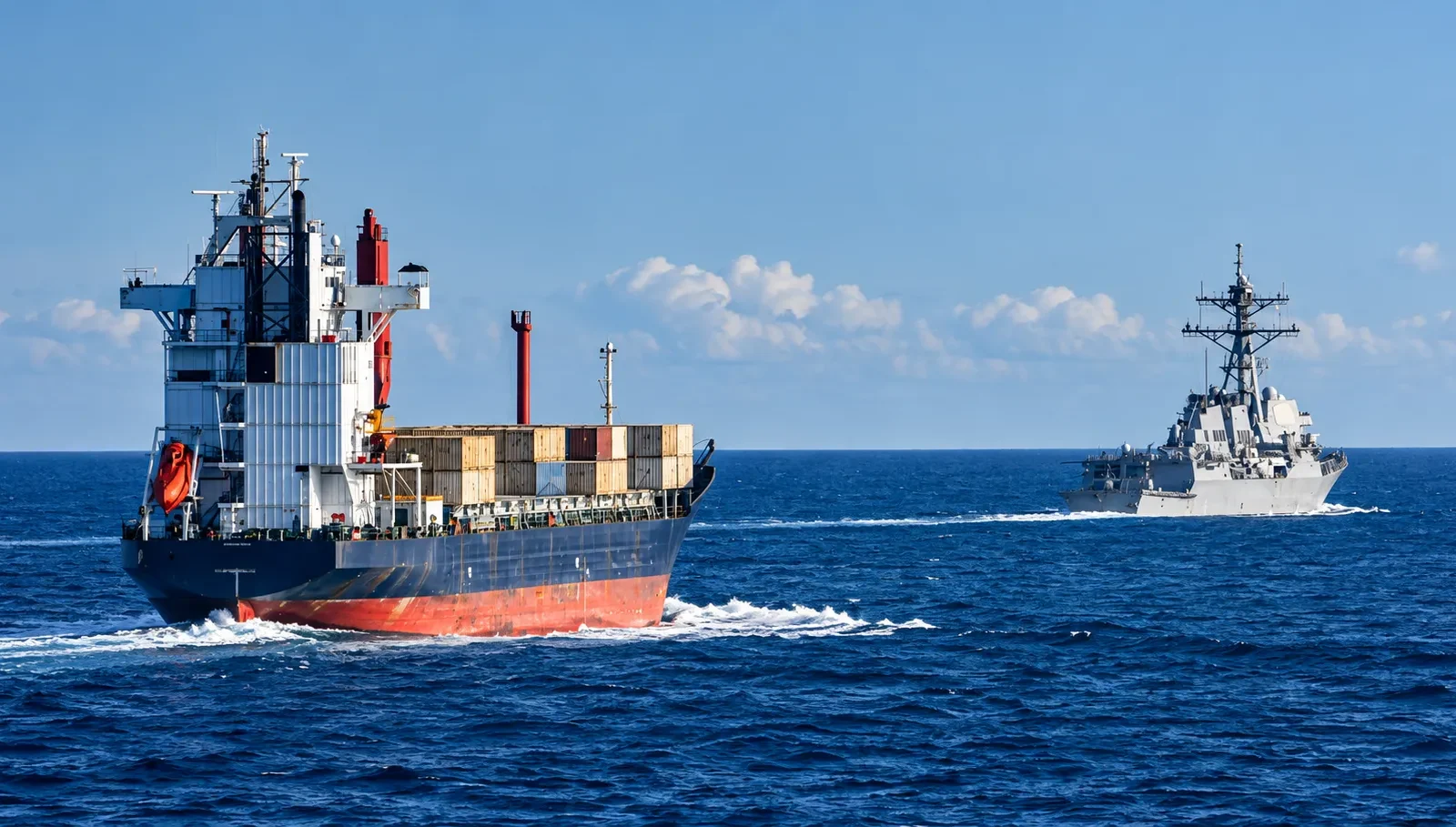
A vessel transiting the Strait of Hormuz was struck by an unidentified projectile on Sunday, triggering a fire and forcing the evacuation of those onboard as attacks on commercial shipping continue to raise the operational and financial risk of using the world’s most important oil chokepoint.
UK Maritime Trade Operations reported that a projectile struck a vessel while it was transiting the Strait of Hormuz. A fire subsequently broke out and local authorities assisted in evacuating those onboard. The identity of the attacker and full extent of the damage had not been publicly confirmed at the time of publication.
The latest Strait of Hormuz ship attack adds another incident to an already severe maritime-security crisis that has sharply reduced commercial traffic, lifted tanker freight and war-risk costs and complicated the movement of crude oil, LNG and other cargoes through the Gulf.
Reuters, citing the British navy-linked UK Maritime Trade Operations agency, reported that the vessel was hit while moving through the Strait.
The projectile type, identity of the attacker and complete damage assessment remained unknown.
- What happened in the Strait of Hormuz today?
- What is confirmed — and what is not?
- Iran reports separate vessel strike near Qeshm
- Is the Strait of Hormuz open to shipping?
- Why the security environment remains severe
- The growing risk to seafarers
- What the attack means for tanker markets
- Why Worldscale and war-risk costs matter
- Oil supply implications
- Saudi pipeline and Bab el-Mandeb add pressure
- Oman talks unlikely to reopen Hormuz immediately
- What owners and charterers should watch next
- Strait of Hormuz attack FAQ
What happened in the Strait of Hormuz today?
The UKMTO received a report on Sunday that a vessel transiting the Strait of Hormuz had been struck by an unidentified projectile.
A fire broke out following the strike.
Local authorities subsequently assisted in evacuating those onboard.
At the time of writing, public reporting had not established:
- the identity of the vessel;
- the flag state;
- the exact projectile used;
- the party responsible;
- the full extent of structural damage;
- whether pollution occurred.
No immediate claim of responsibility had been reported.
↓
PROJECTILE IMPACT
↓
FIRE BREAKS OUT
↓
LOCAL AUTHORITIES RESPOND
↓
EVACUATION
↓
DAMAGE / CAUSE ASSESSMENT
What is confirmed — and what remains unknown?
- A vessel was struck while transiting the Strait of Hormuz.
- An unidentified projectile was involved.
- A fire broke out after the impact.
- Local authorities assisted with evacuation.
- The attacker.
- The projectile type.
- The complete vessel identity.
- The full damage extent.
- Any pollution impact.
- Whether the vessel will remain operable.
This distinction is particularly important during a fast-moving security incident.
Early reports often change as maritime authorities, flag states, owners and military agencies verify vessel identity, position, damage and casualty information.
Iranian media separately report vessel strike near Qeshm Island
Iranian state media also reported on Sunday that an Iranian commercial vessel was struck near Qeshm Island, close to the Strait of Hormuz.
The report said one crew member was killed and several others were wounded.
Associated Press reported that Iranian authorities had not identified the projectile involved.
However, the Iranian report and the separate UKMTO incident should not yet be treated as definitively the same casualty.
The location and timing make the reports potentially related, but publicly available information was insufficient at publication time to merge them into a single confirmed incident.
Until vessel identity or official cross-confirmation emerges, Tide Signal is treating them separately.
Is the Strait of Hormuz open to shipping?
The Strait of Hormuz is not operating under normal pre-war conditions.
Some commercial vessels continue to transit, but traffic remains heavily reduced and security conditions highly unstable.
For the latest operational status, Tide Signal maintains a separate continuously updated guide:
Is the Strait of Hormuz Open? Latest Shipping Traffic and Operational Status.
That page tracks the status of vessel movements and the wider question of whether commercial shipping can transit.
This article covers the specific 13 September attack.
Hormuz was already one of the world’s highest-risk shipping areas
The latest incident occurred against the backdrop of months of attacks on commercial ships.
The International Maritime Organization had recorded 75 confirmed maritime incidents in the region by 10 September, before Sunday’s latest report.
Its incident list includes repeated ship damage, fatalities and injuries across the Strait of Hormuz and surrounding Gulf waters.
See the IMO’s confirmed Middle East incident register.
Tide Signal has tracked the deterioration through its broader Hormuz shipping disruption coverage.
The human cost of the Hormuz crisis is growing
The maritime-security discussion often focuses on oil flows and freight rates.
But the immediate exposure falls on crews.
The IMO says approximately 20,000 seafarers, port workers and offshore personnel are affected across the region.
As of late August, the organisation said as many as 400 ships carrying around 6,000 seafarers had been unable to leave the Persian Gulf safely since the conflict began.
The IMO has repeatedly warned owners and operators against exposing crews to unnecessary danger where credible security guarantees do not exist.
Its current regional hub is available at the IMO Middle East / Strait of Hormuz information page.
What the latest Hormuz ship attack means for tanker markets
The tanker market had already repriced Gulf exposure before Sunday’s attack.
Gulf of Oman-to-China VLCC freight recently reached around WS450, approximately 65% above the Baltic Exchange level seen only a week earlier.
The reason is not simply the number of tankers physically present in the global fleet.
Owners and charterers care about the number of ships that are:
- available;
- in the correct position;
- acceptable to the charterer;
- insured for the trade;
- compliant;
- and willing to accept Gulf exposure.
Another confirmed attack can reduce that effective tanker supply further.
Why attacks can raise freight even if cargo volume falls
A security shock can simultaneously reduce Gulf cargoes and increase freight rates.
That may appear contradictory.
But freight is determined by the availability of suitable ships for a specific voyage, not merely by global crude production.
↓
FEWER WILLING / INSURABLE VESSELS
↓
SMALLER EFFECTIVE POSITION LIST
↓
CHARTERERS COMPETE FOR TONNAGE
↓
HIGHER FREIGHT
Worldscale and war-risk costs are moving together
The freight headline alone does not capture the full cost of Gulf exposure.
Charterers and owners may also face:
- additional war-risk premiums;
- crew-related premiums or bonuses;
- security requirements;
- waiting time;
- routing uncertainty;
- insurance restrictions;
- higher owner approval thresholds;
- potential deviation costs.
Tide Signal Academy’s Worldscale in Shipping guide explains how tanker WS rates translate into freight economics.
For insurance and security exposure, see War Risk Premiums in Shipping.
The extraordinary economics were already visible earlier in the crisis when one Gulf VLCC voyage was reported at as much as $25 million.
Why another ship attack matters for global oil supply
Before the war, the Strait of Hormuz was one of the world’s most important energy corridors.
Its disruption has already contributed to severe reductions in Gulf oil exports, higher crude prices and shrinking global inventories.
Tide Signal’s latest analysis of the IEA global oil supply outlook shows why restoring reliable Gulf shipping matters to the wider physical market.
Each new security incident can affect:
- owner willingness to transit;
- insurance availability;
- loading programmes;
- effective tanker capacity;
- refinery crude sourcing;
- delivered oil costs.
Reuters noted that the new attack arrived after a week in which Brent crude had moved back above $100 per barrel.
The problem is spreading beyond Hormuz
The latest Hormuz attack comes only a day after Saudi Arabia temporarily shut its strategic East-West crude pipeline following a drone attack.
The pipeline has been moving approximately 4–5 million barrels per day and serves as a major route allowing Saudi crude to reach Yanbu on the Red Sea without using Hormuz.
At the same time, Houthi forces have advanced around the Bab el-Mandeb Strait, placing another critical Middle East shipping route under pressure.
Read Tide Signal’s full analysis:
Saudi East-West Pipeline Shut as Bab el-Mandeb Shipping Risk Rises.
The strategic risk is now broader than one waterway.
Hormuz remains severely constrained. Saudi Arabia’s principal crude bypass has been attacked. Bab el-Mandeb risk is rising.
For shipping, that means the region is losing route optionality at exactly the time owners and charterers need alternatives most.
Oman talks are not expected to deliver an immediate reopening
Iran is due to participate in a meeting with Gulf states in Oman on Monday to discuss regional issues including arrangements for the Strait of Hormuz.
However, a senior Iranian official told Reuters that the meeting is not expected to produce a signed Hormuz agreement.
Iran wants any arrangement to recognise a role allowing it to collect fees from vessels using the Strait, an idea opposed by Oman and rejected by Washington.
Read the latest Reuters report on the Oman talks and Hormuz negotiations.
The implication for shipping is that operators should not assume Sunday’s attack will be followed by an immediate political breakthrough.
Why this incident could matter beyond one vessel
Not every ship attack produces a lasting market reaction.
What matters is the cumulative effect.
A single incident may temporarily affect one vessel.
A repeated pattern affects:
- fleet deployment;
- charterparty negotiations;
- insurance pricing;
- crew willingness;
- vessel-routing decisions;
- crude differentials;
- refinery procurement;
- global freight economics.
The market therefore responds not just to physical damage, but to the probability of the next attack.
What owners, charterers and operators should watch next
- Vessel identity: confirmation of the attacked ship’s name, flag and type.
- Damage: whether the fire caused major structural or machinery damage.
- Crew condition: any confirmation of casualties or injuries.
- Pollution: whether fuel or cargo entered the sea.
- Responsibility: any verified claim or government attribution.
- Traffic: whether owners cancel or delay further Hormuz transits.
- War risk: changes in insurance pricing after the attack.
- VLCC freight: whether TD34 and other Gulf rates move higher.
- Oman meeting: any practical outcome from Monday’s negotiations.
- Saudi pipeline: timing of the East-West Pipeline restart.
- Bab el-Mandeb: whether the Houthi advance changes Red Sea routing.
Strait of Hormuz ship attack: frequently asked questions
Was a ship attacked in the Strait of Hormuz today?
Yes. UKMTO reported on 13 September 2026 that a vessel transiting the Strait of Hormuz was struck by an unidentified projectile.
What happened to the vessel?
A fire broke out after the projectile strike, and local authorities assisted in evacuating those onboard.
What ship was attacked?
The full vessel identity had not been publicly confirmed in the initial UKMTO reporting available at publication time.
Who attacked the ship?
No attacker had been publicly confirmed and there was no immediate claim of responsibility in the initial reports.
Was anyone killed in the attack?
No casualties were confirmed in the initial UKMTO report. Iranian media separately reported a commercial ship strike near Qeshm in which one crew member was killed, but it was not yet confirmed that the two reports referred to the same vessel.
Is the Strait of Hormuz open?
Some vessels continue to transit, but shipping remains severely constrained and security conditions are far from normal. Commercial passage should not be treated as equivalent to a fully reopened and secure waterway.
Is it safe for ships to transit Hormuz?
The IMO has repeatedly described the regional situation as highly volatile and has urged owners, operators and flag states to avoid unnecessary exposure of seafarers where credible security assurances are unavailable.
How many ship attacks have occurred around Hormuz?
The IMO had recorded 75 confirmed incidents in the Middle East maritime-security crisis by 10 September 2026, before Sunday’s latest UKMTO report.
Why is the Strait of Hormuz important?
It is one of the world’s most important maritime energy chokepoints, linking Gulf oil and LNG exporters with international markets.
Can ships bypass Hormuz?
Some regional oil exports can use pipeline and alternative terminal infrastructure, but capacity is limited. Saudi Arabia’s East-West Pipeline is one of the most important bypass systems, although it has itself recently been temporarily shut after an attack.
Will the attack raise tanker rates?
Potentially. If the incident causes more owners to avoid Gulf exposure or increases insurance restrictions, the commercially available tanker pool could tighten further.
- Reuters — New report of attack on Strait of Hormuz shipping
- Associated Press — Iranian commercial ship struck near Strait of Hormuz
- International Maritime Organization — Strait of Hormuz / Middle East shipping hub
- IMO — Confirmed maritime incidents in the Middle East
- Reuters — No signed Hormuz agreement expected from Oman meeting
Reporting status: Updated 13 September 2026. This is a developing maritime-security incident. Vessel identity, projectile type, responsibility, damage and pollution status may change as UKMTO, flag-state authorities, owners and regional governments release further information.