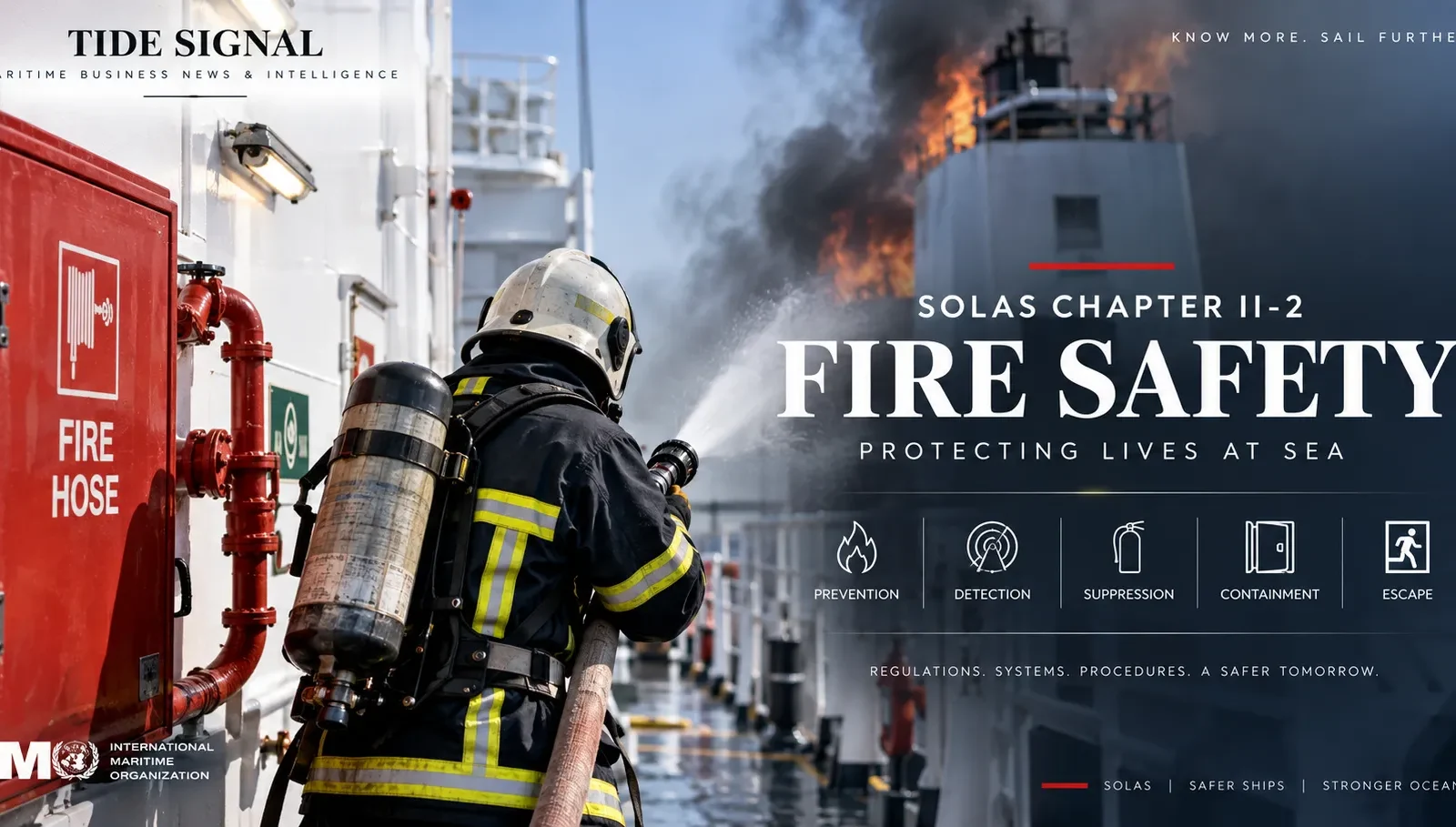
SOLAS Chapter II-2 is not simply the chapter that tells ships where to place extinguishers. It is a complete fire-safety architecture designed to prevent ignition, detect a fire early, contain it in the space of origin, suppress it, protect escape routes and keep the crew capable of fighting the casualty when prevention fails.
Tide Signal Academy · SOLAS Safety Cluster · Technical review: 20 September 2026
The chapter establishes the international fire-protection, fire-detection, fire-extinction and escape requirements that turn ship design, fixed systems, portable equipment and crew response into one layered defence against fire.
What Is SOLAS Chapter II-2?
SOLAS Chapter II-2 is the fire-safety chapter of the International Convention for the Safety of Life at Sea. Its formal subject is Construction — Fire protection, fire detection and fire extinction.
IMO’s current fire-protection overview explains that the modern revised chapter entered into force on 1 July 2002. The revision reorganized the rules around a fire scenario: prevent ignition, detect the fire, contain it, suppress it and provide safe escape.
The official background is available from IMO — Fire Protection.
This structure matters because shipboard fire safety does not depend on one barrier. A machinery-space fire may defeat the first line of defence. The design therefore assumes layers:
↓
Detect early
↓
Contain fire and smoke
↓
Suppress with the correct system
↓
Protect escape and firefighting access
↓
Maintain crew command and emergency response
This makes SOLAS Chapter II-2 relevant to naval architects, shipyards, class societies, equipment manufacturers, owners, managers, masters, deck officers, engineers and every crew member assigned a fire emergency duty.
For the wider convention structure, see Tide Signal’s SOLAS Convention Explained parent guide.
The Five Fire-Safety Objectives Behind SOLAS Chapter II-2
Regulation 2 sets the logic for the entire chapter. The fire-safety objectives can be summarized as:
- prevent fire and explosion from occurring;
- reduce the risk to life caused by fire;
- reduce the risk of damage to the ship, cargo and environment;
- contain, control and suppress a fire or explosion in the space of origin;
- provide adequate and accessible means of escape.
Those objectives are translated into functional requirements such as structural fire divisions, separation of accommodation, restrictions on combustible materials, fire detection, containment, firefighting access and ready availability of extinguishing appliances.
How SOLAS Chapter II-2 Is Structured
The modern chapter is divided into parts that move from general fire-safety principles into prevention, suppression, escape, operational requirements and alternative designs.
| Part | Subject | Practical meaning |
|---|---|---|
| A | General | Application, fire-safety objectives and definitions |
| B | Prevention of fire and explosion | Ignition control, fuel systems, combustible materials and related risks |
| C | Suppression of fire | Detection, structural containment, firefighting systems and appliances |
| D | Escape | Protection and arrangement of means of escape |
| E | Operational requirements | Maintenance, instructions, training, drills and operations |
| F | Alternative design and arrangements | Risk-based approval pathway for novel solutions |
| G | Special requirements | Specific shipboard facilities and fire-risk situations |
This explains why “fire safety” cannot be reduced to regulation 10 on firefighting. Regulations on ignition prevention, detection, structural integrity, escape, training and maintenance are equally important.
FSS Code vs FTP Code: What Is the Difference?
Two mandatory codes support SOLAS Chapter II-2 and are often confused.
FSS Code — Fire Safety Systems
The International Code for Fire Safety Systems contains detailed engineering specifications for systems required by Chapter II-2. IMO’s 2026 edition incorporates fire-safety standards and guidelines, including the most recent requirements that entered into force on 1 January 2026.
The FSS Code covers systems and arrangements including:
- international shore connections;
- personnel protection;
- fire extinguishers;
- fixed gas systems;
- fixed foam systems;
- pressure water-spray and water-mist systems;
- sprinkler and fire-alarm systems;
- fixed fire detection and alarm;
- sample-extraction smoke detection;
- low-location lighting;
- emergency fire pumps;
- means of escape;
- deck foam systems;
- inert gas systems.
FTP Code — Fire Test Procedures
The International Code for Application of Fire Test Procedures establishes fire-test and approval methods for materials and components. It is the basis for proving that products such as structural divisions, doors, surface materials, deck coverings and other items have the required fire performance.
| Question | FSS Code | FTP Code |
|---|---|---|
| What does it mainly govern? | Engineering of fire-safety systems | Fire testing and approval of materials/components |
| Typical example | Fixed CO₂ system or emergency fire pump | A-class division or fire door test |
| Relationship to SOLAS | Technical specification supporting Chapter II-2 | Standardized proof of required fire performance |
Fire Prevention: Stop the Fire Before Firefighting Starts
The most successful shipboard fire is the one that never starts. SOLAS fire safety therefore begins with ignition prevention rather than extinguishing capacity.
Common prevention layers include:
- control of fuel-oil leakage and spray;
- protection of hot surfaces;
- safe routing and shielding of flammable-liquid piping;
- remote fuel shut-offs and quick-closing arrangements where required;
- ventilation shutdown capability;
- control of combustible materials;
- safe electrical installations;
- galley fire controls;
- cargo-specific ignition precautions;
- control of smoking, hot work and temporary ignition sources through shipboard procedures.
Oil spray and hot surfaces
Machinery spaces combine fuel, lubricating oil, hot surfaces, electrical equipment and ventilation. A small pressurized fuel leak can become a fine spray and ignite rapidly if it contacts a sufficiently hot surface.
Good fire safety therefore depends on practical housekeeping: leaks should not be normalized, insulation should remain intact, spray shields should be maintained and temporary repairs should not create uncontrolled ignition exposure.
Quick-closing valves and remote stops
Many shipboard systems are designed so the crew can isolate fuel or stop ventilation from a position that remains accessible during a fire. These controls matter because an engine-room fire can become far more difficult to extinguish if fuel continues feeding the casualty or fans continue supplying oxygen.
A fire team can attack flames for several minutes and still lose the space if the fuel source remains open. Firefighting begins with controlling energy and fuel, not only pointing an extinguisher at the visible flame.
Structural Fire Protection: A, B and C Class Divisions
SOLAS does not assume every fire will be immediately extinguished. Ships are therefore divided using structural fire boundaries intended to slow the spread of flame, smoke and heat.
The familiar terms A-class, B-class and C-class describe different types of fire divisions under the Chapter II-2 definitions and the FTP Code. Ratings such as A-60, A-30, A-15 and A-0 identify required structural fire performance and insulation duration under standardized fire testing.
The exact fire integrity required depends on the spaces on each side of the division. An accommodation corridor next to a cabin is not treated the same way as a machinery space next to an accommodation boundary. The ship’s approved structural fire protection plan therefore matters.
Penetrations are part of the boundary
A fire-rated bulkhead can be weakened by poorly controlled cable, pipe or ventilation penetrations. The boundary is only as effective as its weakest opening.
After modifications, cable work or piping alterations, ships should verify that approved penetration systems and insulation have been restored correctly. “Temporary” openings can become permanent vulnerabilities if modification control is weak.
Fire doors
Fire doors preserve the integrity of fire divisions while allowing normal access. Depending on arrangement, they may be self-closing, remotely operated or held open by approved systems that release on alarm.
Wedges, hooks or unofficial restraints that keep a required fire door open defeat the containment strategy. What looks like a crew-convenience issue can become a direct SOLAS deficiency.
Fire Dampers, Ventilation and Smoke Control
Ventilation can support life and machinery in normal operation, but in a fire it can also transport smoke and feed combustion. SOLAS therefore integrates ventilation control into the fire-safety system.
Important controls can include:
- fire and smoke dampers;
- remote fan shutdowns;
- closure of ventilation openings;
- fire-rated duct penetrations;
- galley exhaust-duct protection;
- machinery-space ventilation isolation.
A damper that has not moved for years may not close when needed. A remote shutdown cable or actuator can seize. Position indicators can become unreliable. These are reasons Chapter II-2 operational-readiness requirements matter as much as original design approval.
Fire Detection and Alarm Systems
Early detection gives the crew time. The longer a hidden fire develops, the more likely it is to overwhelm portable attack and require fixed-system release, evacuation or abandonment.
SOLAS requires fixed fire detection and fire alarm systems in defined spaces and ship types. The technical details are supported by the FSS Code. Systems may use smoke, heat, flame or other approved detection technologies depending on the protected risk.
What a detection system must achieve operationally
The bridge or continuously manned control position needs to receive an identifiable alarm that allows the crew to determine the affected zone and initiate the correct response.
Good operational readiness means more than a green “power” light:
- detectors are not obstructed or painted over;
- zones are correctly identified;
- faults are acted upon;
- manual call points are accessible;
- crew understand alarm indications;
- tests are recorded and defects controlled.
Cargo hold smoke detection
Some cargo spaces use sample-extraction smoke detection rather than ordinary point detectors. The system draws air samples through piping to a central detector. Its effectiveness depends on clean lines, correct valves, working fans and proper testing.
Fire Pumps, Fire Main, Hydrants, Hoses and Nozzles
Water remains the most universal shipboard firefighting medium. SOLAS regulation 10 requires applicable ships to have fire pumps, fire mains, hydrants and hoses arranged so water can be delivered where it is needed.
Main fire pumps
The required number and capacity depend on ship type and size. The larger principle is redundancy: a single fire in one space should not make the entire water firefighting system unavailable where SOLAS requires independent capability.
Emergency fire pump
Where the main fire pumps can be disabled by a fire in the machinery space, an independently located emergency source of fire water may be required. The FSS Code contains detailed engineering requirements for fixed emergency fire pumps.
Operationally, crews should know:
- where the emergency fire pump is;
- how it is started;
- where its sea suction is;
- which valves need to be open;
- whether priming is required;
- what pressure it should produce;
- how it behaves in cold weather or after long periods without use.
Fire main isolation
Isolation valves allow a damaged section of the fire main to be separated while keeping other sections supplied. That matters if pipework in the machinery space is damaged during the fire.
International shore connection
Ships within the relevant SOLAS scope carry an international shore connection so shore-based water can be connected to the ship’s fire main using a standardized flange arrangement. It is a simple device with major emergency value.
Hoses and nozzles
Hoses should be positioned for immediate use, in serviceable condition and fitted with suitable nozzles. A hose box full of corroded couplings or a nozzle that cannot switch correctly from jet to spray is not operational readiness.
A meaningful test is not “the motor runs.” The crew should verify that the pump actually takes suction, delivers water through the required system and produces usable pressure at the relevant hydrants.
Fixed Fire-Extinguishing Systems
Some fire risks can become too intense or inaccessible for manual hose attack. SOLAS therefore requires fixed extinguishing systems for defined machinery spaces, cargo spaces, tanker areas and other hazards.
Depending on the application, systems can include:
- fixed gas systems such as CO₂;
- high-expansion foam;
- pressure water spray;
- water mist;
- sprinkler systems;
- deck foam systems;
- local-application systems;
- inert gas systems for tanker cargo safety.
The correct extinguishing medium depends on the fire class, protected space, fuel, ventilation condition and system design. More extinguishing agent is not automatically better. The system must be the approved system for that hazard.
Fixed CO₂ Systems: Powerful but Dangerous
Fixed carbon-dioxide systems are widely used to protect machinery spaces and some cargo spaces. CO₂ suppresses fire primarily by reducing oxygen concentration in the protected space. That same mechanism makes it dangerous to people.
Before release
A CO₂ release into an occupied space can be fatal. Shipboard procedures therefore require positive control before discharge. The exact sequence follows the approved system and SMS, but typically the command team must ensure the space is evacuated and account for personnel before the system is released.
Other actions may include:
- stopping machinery as required;
- isolating fuel;
- stopping ventilation;
- closing openings and dampers;
- confirming the protected space is sealed as designed;
- raising the correct alarms;
- operating the approved release controls.
Why sealing matters
CO₂ concentration must be retained long enough to suppress the fire. Opening the space too early can admit oxygen, dilute the extinguishing concentration and allow re-ignition.
Re-entry after fixed-gas release is therefore a controlled emergency decision requiring atmosphere assessment, breathing apparatus and command authorization under the vessel’s procedures.
Water Mist, Sprinklers, Foam and Local Application
Water mist
Water-mist systems use fine droplets to cool flames and hot gases, reduce radiant heat and influence the fire environment using much less water than traditional deluge arrangements. Applications vary with approved system design.
Automatic sprinklers
Passenger and accommodation fire protection can use automatic sprinkler, detection and alarm arrangements. Automatic response is particularly valuable where a fire can begin in an unoccupied cabin or enclosed accommodation space.
Local-application systems
High-risk machinery components may be protected by fixed local-application systems designed to attack a fire before a total machinery-space flooding system becomes necessary. Examples can include areas around engines, boilers, incinerators or fuel-oil equipment depending on the ship.
Foam
Foam is used where separating fuel from oxygen and suppressing vapour is important, particularly for flammable-liquid fires. Tankers can use fixed deck foam arrangements as part of their cargo-area fire protection.
Foam chemistry has also become an environmental and health issue. The 2026 PFOS prohibition discussed later in this guide is an important example.
Portable Fire Extinguishers: The First Attack Tool
Portable extinguishers are intended for fast first response while a fire remains small enough to control safely. The extinguisher type must match the hazard.
Common media include:
- water-based extinguishers for suitable ordinary combustible materials;
- foam for applicable flammable-liquid and solid-material fires;
- dry chemical powder for a broad range of fire hazards;
- CO₂ for selected electrical and flammable-liquid risks.
The practical danger is choosing a familiar extinguisher rather than the correct one. Water on energized electrical equipment or certain burning materials can worsen the casualty. Crew training should therefore emphasize hazard recognition, escape position and the limitations of portable attack.
Portable does not mean maintenance-free
Extinguishers need correct location, seals, pressure condition, inspection and servicing. An extinguisher hidden behind stores or discharged during a previous drill is not emergency equipment anymore.
SCBA, Firefighter’s Outfits and EEBD
Fire response eventually becomes a human operation. SOLAS therefore requires personal protective equipment for firefighters and emergency escape equipment for persons trapped by smoke.
SCBA
A self-contained breathing apparatus supplies breathable air independently of the surrounding atmosphere. It allows trained fire teams to enter smoke-filled or oxygen-deficient areas under controlled conditions.
SCBA use requires more than knowing how to put on the set. Fire teams need to understand:
- cylinder pressure and expected duration;
- low-pressure alarms;
- face-seal checks;
- entry control and team communication;
- heat stress and workload;
- withdrawal margin;
- spare-cylinder and compressor arrangements where applicable.
Firefighter’s outfit
A firefighter’s outfit combines protective clothing and required equipment so the wearer can approach the casualty with controlled thermal and physical protection. Its exact content is defined by the relevant SOLAS/FSS requirements.
EEBD
An Emergency Escape Breathing Device is for escape from a dangerous atmosphere. It is not a firefighting breathing apparatus and should not be used as a substitute for SCBA during fire entry.
Means of Escape
SOLAS fire safety assumes that not every fire will be immediately controlled. People must be able to reach a safe area and abandon ship if necessary.
Means-of-escape requirements therefore address:
- number and arrangement of escape routes;
- protected stairways and corridors;
- escape from machinery spaces;
- door direction and operation where specified;
- low-location lighting on applicable passenger ships;
- accessibility when smoke or power loss affects normal movement.
Escape routes cannot be treated as spare storage. Boxes, ropes, paint drums or temporary work equipment placed in an escape path can create a serious deficiency even if the route “looks wide enough” during normal operations.
Fire Control Plan: The Ship’s Fire-Safety Map
The Fire Control Plan shows the arrangement of fire-related systems and spaces so crew and shore firefighters can understand the ship quickly during an emergency.
Depending on ship arrangement, it can identify:
- fire-control stations;
- fire sections and structural divisions;
- detection systems;
- fixed extinguishing systems;
- fire pumps and hydrants;
- firefighter equipment;
- ventilation controls and dampers;
- escape routes;
- other critical fire-safety information.
A duplicate plan or booklet is typically kept in a clearly marked weather-tight enclosure outside the deckhouse for shore-side firefighting personnel where required.
The plan must match the ship. If equipment has moved, systems have been modified or spaces have changed function, obsolete fire-control information can delay emergency response.
Regulation 14: Operational Readiness and Maintenance
Regulation 14 exists because a system that was approved at delivery can fail years later through corrosion, blocked nozzles, seized valves, discharged cylinders, failed batteries or poor maintenance.
Fire-safety systems and appliances need to remain in good order and readily available for immediate use while the ship is in service.
Maintenance planning can include:
- fire pumps, mains, hydrants, hoses and nozzles;
- fixed detection and alarm systems;
- fixed extinguishing systems;
- sprinkler systems;
- ventilation, fire and smoke dampers;
- fuel emergency shut-offs;
- fire doors and controls;
- general alarm systems;
- EEBDs;
- portable extinguishers;
- firefighter’s outfits.
Why PMS quality matters
A planned-maintenance entry proves little if the task is closed without a meaningful test. The strongest maintenance evidence is a combination of:
- correct task interval;
- clear manufacturer/approved procedure;
- real test result;
- defect reporting when performance is abnormal;
- corrective action and retest;
- traceable service documentation where specialist servicing is required.
This is also why fire-safety deficiencies often become ISM issues. A failed damper can be an equipment problem; repeatedly missing the same defect through weak maintenance becomes a management-system problem.
Regulation 15: Instructions, Training and Fire Drills
SOLAS cannot make an emergency response effective through hardware alone. The crew must know what the alarm means, where to go, what equipment to bring and how command will be organized.
A useful fire drill should test the system rather than simply complete a familiar script. It can examine:
- alarm and announcement;
- muster speed;
- communications;
- fire-team dressing;
- SCBA entry control;
- boundary cooling;
- ventilation shutdown;
- fuel isolation;
- fire-pump operation;
- casualty recovery;
- backup-team readiness;
- bridge/engine-room command;
- post-drill debrief and corrective action.
SOLAS Fuel Flashpoint Rules: What Changed in 2026?
One of the most important recent changes to SOLAS Chapter II-2 concerns oil-fuel flashpoint. IMO’s 2026 amendments are intended to prevent ships being supplied with oil fuel that does not meet the SOLAS flashpoint safety requirement.
The general SOLAS requirement remains associated with a 60°C minimum flashpoint for oil fuel in the normal framework, subject to the Convention’s specific provisions and exceptions.
From 1 January 2026, ships carrying oil fuel must, before bunkering, receive a declaration signed and certified by the supplier’s representative confirming that the fuel supplied conforms to the SOLAS flashpoint requirement and identifying the test method used.
IMO summarizes the amendment in its 2026 shipping-rules update. The UK Maritime and Coastguard Agency also published detailed implementation guidance in MGN 713.
For receiving ships, this makes flashpoint another item that should be verified in the bunker documentation workflow. See Tide Signal’s Bunkering Operations guide for planning, sampling, tank monitoring, BDN review and transfer controls.
Sulphur content is primarily an environmental-compliance issue under MARPOL Annex VI. Flashpoint is a fire-safety property under SOLAS. The same bunker delivery can therefore create two different regulatory questions that should not be confused.
PFOS Firefighting Media Ban from 1 January 2026
Another major 2026 change prohibits the use or storage of extinguishing media containing perfluorooctane sulfonic acid (PFOS).
IMO explains that the change is intended both to protect persons onboard from exposure to harmful substances used in firefighting and to reduce environmental harm from the extinguishing media.
The application is not limited to ships delivered after 2026. For ships constructed before 1 January 2026, compliance is required no later than the first relevant survey on or after that date under the amendment’s application provisions.
Operators therefore need to know what foam concentrate is actually onboard, not simply whether the firefighting system has a valid service sticker. Manufacturer declarations, product documentation and replacement records become important evidence.
Ro-Ro, Vehicle and Special-Category Space Fire Safety in 2026
Vehicle fires have driven a significant strengthening of Chapter II-2. New requirements entering into force in 2026 address vehicle, special-category and ro-ro spaces and weather decks intended for carriage of vehicles.
IMO highlights measures including:
- fixed fire-detection and alarm systems;
- effective fire patrols in special-category spaces;
- video monitoring for continuous observation of relevant spaces;
- camera arrangement intended to support rapid identification of fire location;
- associated FSS Code requirements for engineering and installation.
The amendments are particularly important because a vehicle deck can combine tightly packed vehicles, limited access, smoke accumulation, combustible cargo and difficult manual firefighting. On passenger ro-ro ships, evacuation and muster add another layer of complexity.
Electric vehicles do not create a different SOLAS chapter
Battery-electric vehicles have intensified discussion about detection, thermal runaway, cooling and re-ignition. But the regulatory response is broader than one propulsion technology. SOLAS is strengthening detection, monitoring, containment and suppression across the vehicle-space fire scenario.
The safest operational approach is therefore not to assume every vehicle fire behaves identically, but to understand the cargo, the deck arrangement, the approved systems and the vessel’s emergency procedures.
Methanol, Ammonia and Low-Flashpoint Fuels
Alternative fuels create new fire and toxicity profiles. The core SOLAS fire-safety objectives still matter, but they are supplemented by fuel-specific safety frameworks such as the IGF Code and interim IMO guidance.
Methanol
Methanol is a low-flashpoint fuel. Its fire can be difficult to see in daylight, and system design must address leakage, ventilation, hazardous areas, detection, fuel isolation and firefighting.
Tide Signal’s IMO Methanol and Fuel-Cell Shipping Rules briefing explains the movement from interim guidance toward a more mature mandatory framework.
Ammonia
Ammonia introduces a different risk profile because toxicity is a dominant hazard in addition to fire and explosion concerns. Leak detection, ventilation, protective zones, PPE, emergency response and crew training become critical.
See Tide Signal’s Ammonia as Marine Fuel guide for the safety and regulatory pathway.
SOLAS Chapter II-2 and Port State Control
Fire-safety systems are a major Port State Control focus because they are easy to connect with immediate risk to life. An inspector can move from documents to physical tests quickly.
Common areas of attention can include:
- fire doors wedged open or not closing correctly;
- fire dampers seized or incorrectly identified;
- fire-detection faults;
- portable extinguishers overdue or inaccessible;
- fire pumps failing to take suction or produce pressure;
- emergency fire pump defects;
- blocked or damaged hydrants and hoses;
- CO₂ release arrangements poorly maintained;
- ventilation remote stops inoperative;
- quick-closing valves defective;
- firefighter outfits or SCBA not ready;
- EEBDs missing, expired or incorrectly stowed;
- escape routes obstructed;
- Fire Control Plan not matching actual arrangements;
- crew unable to demonstrate the emergency procedure.
The wider PSC preparation process is covered in Tide Signal’s Port State Control Inspection guide.
One deficiency can reveal three failures
Imagine a fire damper cannot close. That can be:
- a technical deficiency because the damper is defective;
- a maintenance deficiency because the defect should have been detected;
- an ISM deficiency if the SMS failed to report, control or correct it.
This is why Chapter II-2 and SOLAS Chapter IX often meet during a serious PSC inspection.
Five Practical Shipboard Fire Scenarios
1. Fuel sprays onto a hot engine surface
The immediate task is not only extinguishment. Fuel isolation, machinery shutdown where required, ventilation control and boundary assessment are part of the response. If the fire grows beyond safe manual attack, the command team may need to prepare fixed-system release.
2. Smoke alarm in an accommodation corridor at 02:00
Early detection creates the opportunity to contain the fire before smoke spreads through multiple decks. Fire doors, smoke control, rapid investigation and clear communications matter before the size of the flame is even known.
3. Fire in a closed ro-ro vehicle deck
The deck may contain limited visibility, closely packed vehicles and rapidly developing heat. Detection location, video monitoring, fixed suppression and the ability to control smoke become central. A poorly coordinated manual entry can expose crew without improving control of the fire.
4. Machinery-space fire requires CO₂
Before release, the command team must establish that personnel are out, stop fuel and ventilation as required, close the space and use the approved release sequence. After discharge, premature opening can lead to re-ignition.
5. Emergency fire pump starts but no useful pressure reaches deck
The problem may be suction, priming, valve alignment, sea-chest condition, leakage or pump performance. This is why routine tests should verify delivered water, not simply motor operation.
SOLAS Chapter II-2 Readiness Checklist
- Check fuel and lube-oil leaks are corrected, not normalized.
- Inspect hot-surface insulation and spray shielding.
- Verify quick-closing valves and remote fuel stops.
- Confirm ventilation shutdowns and dampers operate correctly.
- Control hot work through permit, gas-testing and fire-watch procedures.
- Review galley exhaust and duct fire controls.
- Check fire-detection panels for faults or isolated zones.
- Test representative detectors and manual call points under the approved routine.
- Verify fire doors close and are not improperly secured open.
- Inspect fire-rated penetrations after cable or piping modifications.
- Operate selected fire/smoke dampers and verify indication.
- Test main and emergency fire pumps with actual water delivery.
- Inspect hydrants, hoses, nozzles and international shore connection.
- Check portable extinguishers are correct type, accessible and in service.
- Verify fixed-system controls, alarms, valves and release arrangements.
- Review foam concentrate documentation for PFOS compliance.
- Confirm SCBA, spare cylinders and firefighter outfits are ready.
- Run realistic drills using different fire locations.
- Practice communications and entry control.
- Verify personnel-accounting procedure before fixed-gas release.
- Train crew on EEBD vs SCBA purpose.
- Review Fire Control Plan and emergency station duties.
- Debrief every drill and close genuine findings.
SOLAS Chapter II-2: Frequently Asked Questions
What is SOLAS Chapter II-2?
SOLAS Chapter II-2 is the international ship fire-safety chapter covering fire prevention, detection, structural protection, extinguishing systems, escape, maintenance, training and related operational requirements.
What are the main fire-safety objectives of SOLAS Chapter II-2?
The objectives are to prevent fire and explosion, reduce risk to life, reduce damage to ship/cargo/environment, contain and suppress fire in the space of origin and provide adequate means of escape.
What is the FSS Code?
The International Code for Fire Safety Systems provides detailed engineering specifications for fire-safety systems required by SOLAS Chapter II-2.
What is the FTP Code?
The Fire Test Procedures Code provides standardized testing and approval procedures for materials and components used to meet SOLAS fire-performance requirements.
What is an A-60 division?
A-60 is an A-class structural fire division meeting the applicable SOLAS/FTP fire-integrity and insulation criteria for the specified 60-minute rating. Exact construction and approval requirements are defined by the Convention and FTP Code.
Why are fire doors important?
Fire doors preserve the fire integrity of structural divisions and help prevent fire and smoke from spreading between spaces.
Can a fire door be wedged open?
A required fire door should not be defeated by unauthorized wedges or restraints. Approved hold-open arrangements, where permitted, are designed to release under the required conditions.
What is the purpose of a fire damper?
A fire damper helps control the spread of fire and smoke through ventilation ducting and supports isolation of the affected zone.
What is an emergency fire pump?
It is an independently arranged source of firefighting water required in defined cases so a fire disabling the main pumps does not eliminate the ship’s entire fire-main capability.
What is an international shore connection?
It is a standardized connection allowing an external shore or other suitable water supply to feed the ship’s fire main during an emergency.
What is a fixed CO₂ system used for?
Fixed CO₂ is commonly used for total-flooding protection of defined machinery and cargo spaces. It suppresses fire by reducing oxygen concentration and is therefore dangerous to personnel.
Can people remain inside a machinery space during CO₂ release?
No. Total-flooding CO₂ release requires evacuation and personnel accounting in accordance with the approved system and emergency procedure because the extinguishing concentration is life-threatening.
Why must ventilation be stopped before CO₂ release?
Ventilation can remove extinguishing gas and supply fresh oxygen, preventing the protected space from achieving or retaining the required extinguishing concentration.
What is the difference between SCBA and EEBD?
SCBA supports trained firefighting entry into a hazardous atmosphere. EEBD is an emergency escape device and is not intended for firefighting entry.
What does SOLAS regulation 14 cover?
Regulation 14 covers operational readiness and maintenance of fire-safety systems and appliances.
What does SOLAS regulation 15 cover?
Regulation 15 covers instructions, onboard training and drills intended to ensure people can carry out emergency fire procedures.
What is the SOLAS bunker flashpoint requirement?
The general oil-fuel framework uses a 60°C minimum flashpoint requirement, subject to the Convention’s specific provisions and exceptions.
What changed for bunker flashpoint documentation in 2026?
From 1 January 2026, ships carrying oil fuel must receive a supplier declaration before bunkering confirming conformity with the SOLAS flashpoint requirement and identifying the flashpoint test method used.
What is PFOS and why does SOLAS prohibit it?
PFOS is a persistent chemical historically associated with some firefighting foams. SOLAS amendments effective in 2026 prohibit use or storage of extinguishing media containing PFOS under the applicable implementation provisions.
What changed for ro-ro fire safety in 2026?
New requirements strengthen fire detection, patrol and video monitoring in vehicle, special-category and ro-ro spaces, with associated FSS Code changes.
Does SOLAS Chapter II-2 cover electric-vehicle fires?
The chapter sets the wider fire-safety framework for vehicle and ro-ro spaces. Specific risk assessment and firefighting response must consider the actual vehicle and battery hazard, ship arrangement and approved systems.
Is methanol fire safety covered only by SOLAS II-2?
No. Chapter II-2 remains part of the overall fire-safety framework, while low-flashpoint fuel installations are also subject to the IGF Code and fuel-specific IMO guidance or mandatory provisions as applicable.
Does ammonia use the same fire response as fuel oil?
No. Ammonia has a distinct hazard profile dominated by toxicity as well as flammability considerations. Emergency response must follow the approved fuel-system design, safety case and procedures.
Can Port State Control test the emergency fire pump?
Yes. PSC inspections can include operational tests of fire-safety equipment where appropriate, not only documentary checks.
What is the Fire Control Plan?
It is the approved plan showing key fire-safety arrangements such as structural divisions, detection, fixed systems, firefighting equipment, ventilation controls and escape information.
Why do fire drills matter if all equipment works?
Because a shipboard fire is a coordinated emergency. Equipment cannot replace command, communication, personnel accounting, entry control, isolation, boundary cooling and correct tactical decisions.
- SOLAS Convention Explained — parent guide to all SOLAS chapters, certificates and ship-safety requirements.
- Bunkering Operations — fuel transfer, sampling, documentation and 2026 flashpoint controls.
- Port State Control Inspection — statutory documents, equipment testing and crew readiness.
- Methanol and Fuel-Cell Shipping Rules — low-flashpoint fuel safety and developing IGF requirements.
- Ammonia as Marine Fuel — toxicity, bunkering, training and alternative-fuel safety.
- MARPOL Annexes Explained — environmental requirements that interact with fuel, waste and pollution response.
- Maritime Cyber Security — resilience of connected shipboard safety and operational systems.
- IMO — Fire Protection
- IMO — History of SOLAS Fire Protection Requirements
- IMO e-Publications — International Code for Fire Safety Systems (2026 edition)
- IMO — Shipping Rules in Force from 1 January 2026
- UK MCA — MGN 713: SOLAS II-2 Amendments in Force from 1 January 2026
Compliance note: SOLAS Chapter II-2 is highly ship-specific. Requirements differ by ship type, gross tonnage, date of construction, protected space, cargo and installed system. This article supports professional understanding but does not replace the current SOLAS text, FSS Code, FTP Code, flag-State instructions, class requirements, approved fire plans, equipment manuals or the vessel’s Safety Management System.