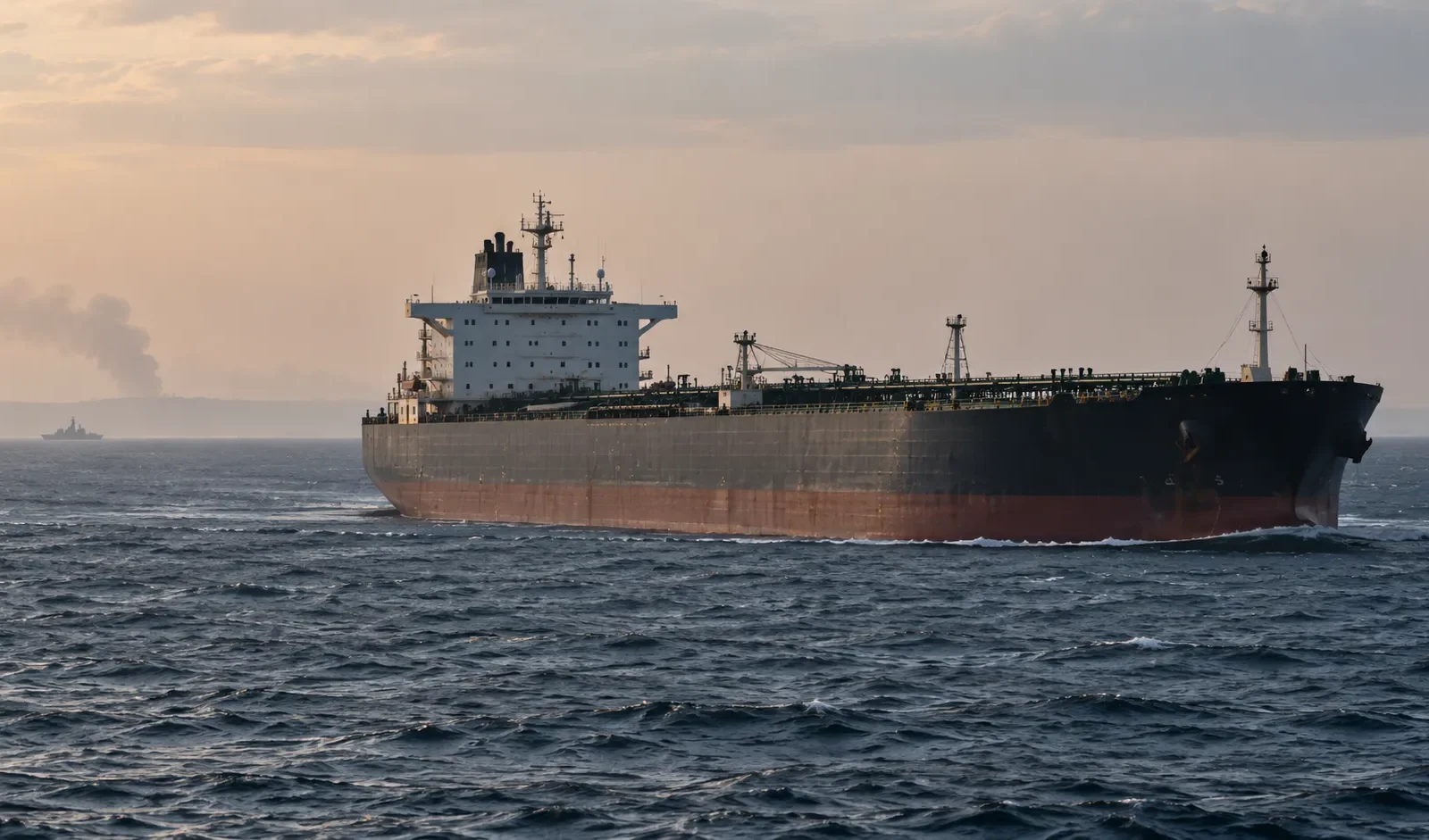
US strikes Iranian oil tankers again as five additional crude carriers are targeted, taking the number of named tankers involved in two U.S. operations within four days to eight while Hormuz traffic remains constrained and VLCC freight benchmarks surge into unprecedented territory.
The latest escalation is no longer only a military-security story. It is directly affecting tanker availability, chartering decisions, war-risk exposure, crude flows and VLCC voyage economics.
US strikes Iranian oil tankers operations are now colliding directly with one of the world’s most important crude-shipping markets.
U.S. forces targeted five additional Iranian crude carriers on September 8, following an earlier operation against three tankers on September 5. The latest named vessels were the Kaviz, Charminar, Horizon 1, Riesco and Derya.
U.S. Central Command said the operation followed attempted attacks against a U.S. Navy warship and that crews were directed to abandon the affected tankers before the vessels were rendered inoperable. The full U.S. military account is available through U.S. Central Command’s September 8 statement .
Three other crude carriers — M/T Downy, M/T Stark 1 and M/T Kylo, also known as Noxen — had already been struck in the earlier September 5 operation.
That means eight named crude carriers have been involved in two announced U.S. tanker operations within four days.
At the same time, freight pricing has entered historic territory. The Baltic Exchange’s Middle East Gulf–China TD3C VLCC assessment reached a theoretical time-charter equivalent of $759,969 per day.
Tanker owners are not simply pricing oil demand. They are increasingly pricing access, vessel scarcity, war-risk exposure and the probability that a voyage can actually be performed.
US Strikes Iranian Oil Tankers Again: Five More Vessels Targeted
The September 8 operation represents a rapid escalation from the U.S. action announced only three days earlier.
According to CENTCOM, four of the latest tankers — Kaviz, Charminar, Horizon 1 and Riesco — were targeted in the Gulf of Oman. The Derya was targeted near Kharg Island.
CENTCOM characterises the vessels as part of a network supporting Iran’s Islamic Revolutionary Guard Corps. That description is an official U.S. attribution and should not be confused with an independently completed beneficial-ownership audit by Tide Signal.
Named vessels and military action attributed directly to CENTCOM.
Baltic Exchange assessments reported through Lloyd’s List.
Preliminary Kpler traffic data reported by Reuters.
Treated as claims unless individual incidents are independently confirmed.
Eight Tankers in Four Days
The latest US strikes Iranian oil tankers operation followed another announced U.S. military action only three days earlier, accelerating the pace of the tanker confrontation around Hormuz.
M/T Downy
M/T Stark 1
M/T Kylo / Noxen
M/T Kaviz
M/T Charminar
M/T Horizon 1
M/T Riesco
M/T Derya
Eight named tankers. Two operations. Four days. The speed of escalation is becoming as important to freight markets as the individual vessels involved.
VLCC Rates Hit a Record $759,969 a Day
The tanker market response has been extraordinary.
Lloyd’s List reported that the Baltic Exchange’s Middle East Gulf–China TD3C VLCC assessment reached $759,969 per day on September 8.
That level is around 26% above the previous peak reached earlier in the Hormuz crisis. Readers can review the latest Lloyd’s List VLCC market analysis .
The figure, however, needs context.
Inside-Hormuz VLCC trading is not functioning like a normal, freely traded Middle East Gulf loading market. A significant amount of crude has shifted toward shuttle movements and ship-to-ship transfers outside the Strait.
The $759,969/day assessment is therefore a benchmark and not evidence that every VLCC owner is literally collecting that amount of cash every day.
Its importance lies elsewhere. The benchmark shows the extraordinary value the market is assigning to scarce, willing and operationally usable VLCC capacity.
Oman–China VLCC Rates Reach $358,201 a Day
The Gulf of Oman market provides a more direct view of physical VLCC employment outside the Strait.
The Oman–China VLCC assessment reached approximately $358,201/day, also the highest level recorded for that route.
West Africa–China stood at approximately $237,259/day, while U.S. Gulf–China reached about $210,307/day.
| VLCC Route | Approx. TCE | Reading |
|---|---|---|
| MEG–China TD3C | $759,969/day | Record but highly theoretical market |
| Oman–China | $358,201/day | Record Gulf of Oman physical-market signal |
| West Africa–China | $237,259/day | Atlantic route strength |
| U.S. Gulf–China | $210,307/day | Close to historic highs |
Hormuz Traffic Falls to Half Its Recent Average
The record freight environment is developing while visible physical traffic remains heavily constrained.
Preliminary Kpler data reported by Reuters showed only six commodity vessels passing through the Strait on Tuesday, down from nine on Monday and versus a 10-day average of 12.
Five of Tuesday’s vessels were inbound and only one was outbound. Read the latest Reuters Hormuz traffic report .
AIS-based datasets do not necessarily capture every movement because vessels operating in conflict zones may reduce or disable transmissions. The figures should therefore be treated as an indicator of visible commercial activity rather than a perfect count of every ship in the region.
For broader context on how sanctions, ship identity, insurance and restricted traffic interact around the chokepoint, read Tide Signal’s Strait of Hormuz shipping and sanctions analysis .
Why Tanker Rates Can Explode While Cargo Volumes Fall
The current market is unusual because the rate surge is not being driven by a conventional cargo boom.
Lloyd’s List, citing Vortexa data, reported Middle East crude exports averaging approximately 11.8 million barrels per day in August, around 36% below the six-month average before the Hormuz crisis.
Normally, a material fall in cargo volumes would place downward pressure on tanker rates.
The present market is behaving differently because effective vessel supply appears to have tightened even faster than cargo demand.
Ships avoiding Gulf exposure, altered loading arrangements, insurance restrictions, vessel positioning and greater reliance on shuttle tankers and offshore transfers all reduce the amount of tonnage available for normal chartering.
This is not a conventional freight boom. It is a scarcity-and-risk market where commercially usable tonnage has become more constrained than the cargo base itself.
Ship-to-Ship Transfers Are Becoming More Important
The disruption has also increased the commercial importance of offshore loading and ship-to-ship arrangements in and around the Gulf of Oman.
STS activity can allow crude to move from shuttle tankers into larger deep-sea vessels outside the most constrained part of the Strait, but the process introduces additional operational planning, transfer risk, scheduling complexity and cost.
It also helps explain why a traditional inside-Hormuz freight index can become increasingly theoretical while Gulf of Oman benchmarks become more representative of the physical market.
War-Risk Costs Are Rewriting Voyage Economics
A spectacular freight rate does not automatically mean a spectacular voyage result.
Owners considering Gulf-linked employment may need to evaluate additional war-risk premiums, cargo insurance exposure, security requirements, waiting time, crew considerations, possible deviations, bunker consumption and changes to the vessel’s next employment.
An Emirates National Oil Company executive told Reuters that combined transit and insurance-related costs for some Hormuz movements can reach approximately $10 million to $20 million.
That figure is not a standard charge applying to every ship or voyage. It illustrates how dramatically the risk component of Middle East oil transport has changed.
See Reuters’ reporting on Hormuz transit and insurance costs .
Tide Signal’s War Risk Premiums in Shipping guide explains why insurance can materially change freight negotiations and final voyage economics.
Record Freight Does Not Equal Record Profit
For owners, the crucial distinction is between headline TCE and actual net voyage contribution.
A voyage may appear extraordinarily attractive at gross freight level but become substantially less impressive after insurance, bunkers, waiting time, operational expenses, commissions and security-related costs are included.
Tide Signal’s Voyage Margin Calculator can be used for indicative freight-revenue and voyage-cost scenarios, while the Voyage ETA Calculator provides a quick estimate of sailing time and optional bunker-cost exposure.
Those tools are indicative only; actual tanker voyage economics depend on fixture terms, vessel performance, insurance requirements, cargo programme and company operating assumptions.
The $25 Million VLCC Voyage Was an Early Warning
The latest rate shock follows an earlier extreme fixture examined by Tide Signal, where a reported Iraqi crude lifting carried a freight bill of as much as $25 million.
That voyage demonstrated how security risk and scarce willing tonnage can turn freight from a routine transportation cost into the decisive factor determining whether a cargo trade remains commercially viable.
Read: The $25 Million VLCC Voyage: How Hormuz Risk Repriced Iraqi Crude Freight .
Oil Prices Move Back Toward $100
Energy markets are also repricing the latest escalation.
Reuters reported Brent crude at approximately $99.22 per barrel early on September 9 as renewed attacks increased concerns over regional supply and transportation risk.
The latest oil-market update is available through Reuters .
For shipping, higher crude prices can influence refinery margins and cargo programmes, while higher bunker prices increase voyage expenditure. At the same time, Middle East supply uncertainty can force buyers toward more distant replacement barrels.
Could Atlantic VLCC Routes Become the Bigger Winner?
The most durable tanker-market effect of the crisis may ultimately emerge outside the Strait of Hormuz.
If Asian refiners need additional crude from West Africa, the United States or other Atlantic suppliers, the average voyage distance increases materially.
That can support tonne-mile demand even without a comparable increase in overall crude consumption.
The current strength in West Africa–China and U.S. Gulf–China VLCC rates suggests the market is already pricing some of that shift.
The most important long-term tanker effect may not be the spectacular rate quoted inside Hormuz. It may be the longer replacement voyages created when Asian buyers are forced to source crude from farther away.
Iran Claims Attacks on 10 Vessels — What Is Confirmed?
The information environment around the Strait is becoming increasingly difficult.
Iran’s Revolutionary Guards said on September 9 that they had attacked two U.S. vessels and eight tankers.
Tide Signal is not treating that figure as an independently confirmed casualty count.
Reuters reported the Iranian statement while also reporting several merchant-vessel incidents in the Gulf and Gulf of Oman. The full picture of damage and casualties remained developing at publication.
See: Reuters’ report on the Iranian claims and Reuters’ report on merchant-vessel incidents .
What the Crisis Means for Shipowners
The current rate environment creates exceptional earning potential for vessels able and willing to accept Gulf-linked employment.
But the decision cannot be based on freight alone.
Owners must consider insurance, crew welfare, flag-state and company guidance, vessel positioning, operational delays, security exposure and the contractual consequences of a changing voyage.
A vessel can be geographically close to the cargo and still be commercially unavailable.
What the Crisis Means for Charterers
Charterers face the opposite side of the scarcity problem.
Cargo may be ready, but commercially acceptable and insurable tonnage may not be. Waiting for conditions to improve could reduce exposure, but it can also increase the risk of competing for an even smaller pool of willing owners.
This is why charterparty risk allocation matters during disrupted markets. For a broader explanation of how voyage, time and other charter structures divide commercial obligations, see Tide Signal’s Types of Charter Parties in Shipping .
What to Watch Over the Next 24–72 Hours
Whether outbound crude movements begin recovering from exceptionally low levels.
Another confirmed military operation could change owner appetite immediately.
More available VLCCs could eventually ease the most extreme rate pressure.
Insurance may determine whether exceptional headline freight is actually workable.
West Africa and U.S. Gulf activity will show whether replacement crude demand is accelerating.
A sustained move higher would deepen the energy-market consequences of the shipping disruption.
The Bigger Shipping Question
Tanker markets are now confronting several extreme conditions at the same time.
One of the world’s most important energy chokepoints remains technically navigable, while visible commodity traffic remains well below recent averages.
Tankers themselves have become direct military targets. Freight benchmarks are reaching historic highs even while regional crude exports remain depressed.
Insurance exposure is rising while owners are simultaneously being offered extraordinary nominal compensation for accepting risk.
As US strikes Iranian oil tankers operations intensify, the consequences are spreading from individual vessels into freight, insurance, vessel positioning and global crude sourcing.
The result is a market where the commercial value of a tanker is increasingly determined not simply by where the vessel is positioned, but by whether the owner is willing and able to trade it.
Hormuz Is Becoming a Tanker-Market Shock
Five additional crude carriers were targeted in the September 8 U.S. operation, following three vessels involved in the September 5 action.
At the same time, visible Hormuz traffic remains constrained and VLCC benchmarks have entered unprecedented territory.
The $759,969/day TD3C assessment is not a normal freight rate generated by a normal functioning market.
That is precisely why it matters.
It is a price signal from a tanker market attempting to value scarcity, operational disruption and geopolitical risk simultaneously.
For owners and charterers, the question is no longer simply how much a VLCC voyage pays. It is whether the voyage can be performed — and what price is sufficient to justify the risk.
Traffic, sanctions and commercial chokepoint risk →
TANKER MARKETS Tanker Markets, Hormuz Risk & Oil FlowsHow route confidence and vessel supply affect freight →
VLCC ECONOMICS The $25 Million VLCC VoyageInside extreme tanker freight economics →
INSURANCE War Risk Premiums in ShippingHow geopolitical exposure enters voyage cost →
COMMERCIAL TOOL Voyage Margin CalculatorTest freight revenue, costs and break-even rates →
VOYAGE TOOL Voyage ETA CalculatorEstimate sailing time and bunker-cost exposure →
Tide Signal separates official military statements, reported market data and unverified claims throughout this article.
September 8 tanker operation →
PRIMARY SOURCE U.S. Central CommandSeptember 5 tanker operation →
MARKET DATA Lloyd’s List / Baltic ExchangeRecord VLCC benchmarks →
TRAFFIC DATA Reuters / KplerLatest Hormuz vessel traffic →
INSURANCE / COST Reuters / ENOCTransit and insurance exposure →
ENERGY MARKET ReutersBrent and latest oil-price reaction →
Methodology: Official military statements are attributed to the issuing authority. Claims lacking independent corroboration are identified as claims. Freight assessments are benchmarks and do not represent guaranteed realised earnings for an individual vessel.