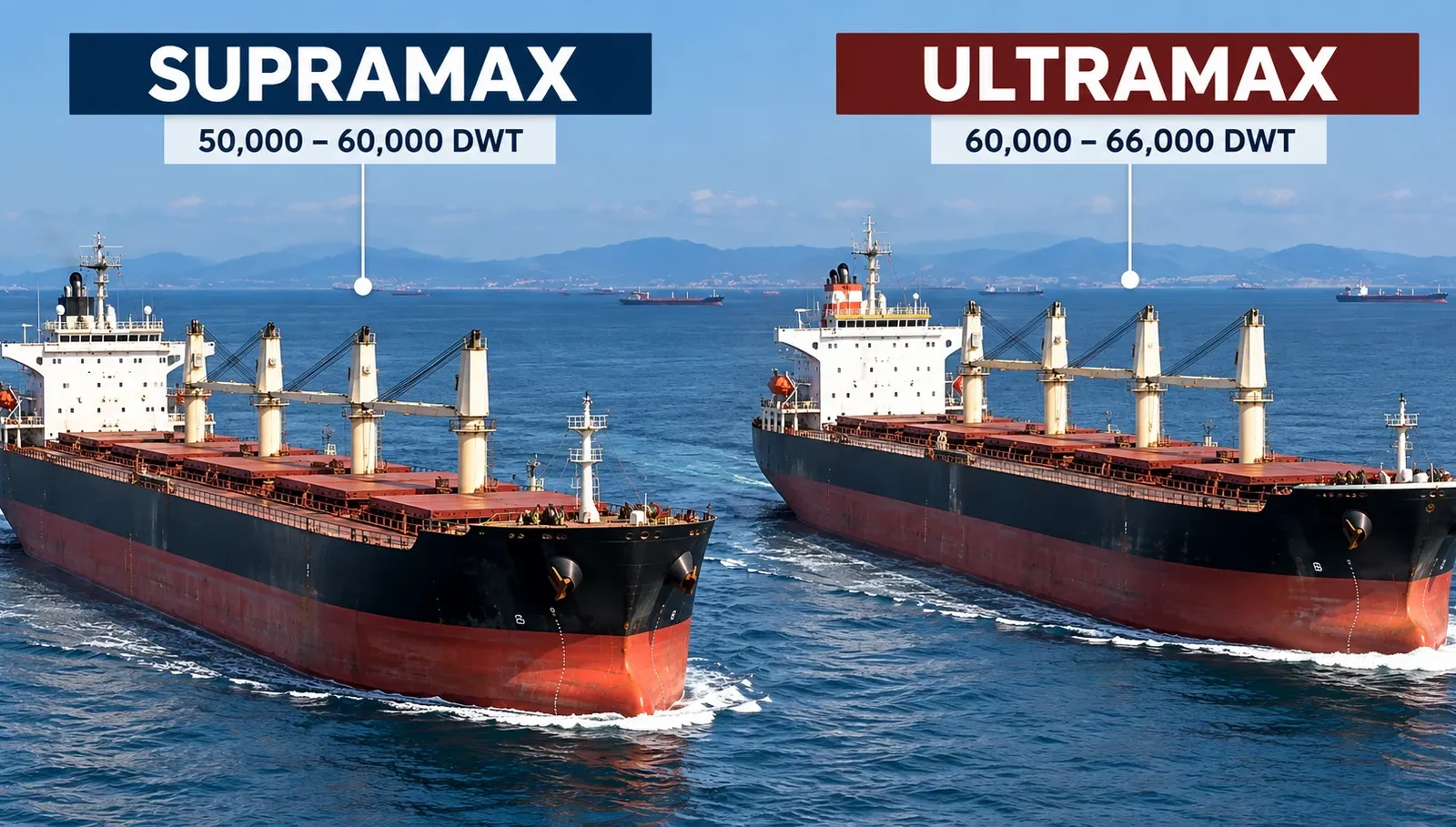
Supramax and Ultramax bulk carriers are among the most versatile ships in the dry-bulk market. Both are typically geared, operate across grain, coal, steel, fertiliser and minor-bulk trades, and can serve ports where larger gearless bulkers cannot. The main difference is scale: Ultramax designs generally carry more cargo while retaining the flexibility that made Supramax tonnage commercially successful.
Supramax vs Ultramax: Quick Comparison
| Feature | Supramax | Ultramax |
|---|---|---|
| Typical DWT | About 50,000–60,000 DWT | About 60,000–66,000 DWT |
| Typical LOA | Often around 185–190 m | Often around 199–200 m |
| Beam | Commonly around 32 m | Usually around 32.2 m |
| Cargo holds | Typically 5 | Typically 5 |
| Cargo gear | Usually 4 cranes | Usually 4 cranes |
| Grabs | Often carried or crane-compatible | Common modern specification includes four grabs |
| Typical cargoes | Grain, coal, fertiliser, steel, cement, minerals, minor bulks | Same broad cargo base with greater intake |
| Main advantage | Flexibility and broad port access | More cargo while retaining geared flexibility |
What Is a Supramax Bulk Carrier?
Supramax bulk carriers developed as larger successors to older Handymax designs.
They generally occupy the market between smaller Handysize vessels and larger Panamax or Kamsarmax ships.
A conventional Supramax commonly falls in the approximate 50,000–60,000 DWT range.
One of the defining commercial features of the class is onboard cargo gear.
Unlike most modern Panamax and Kamsarmax bulkers, Supramax vessels are usually fitted with their own cranes.
That gives them access to terminals where shore cranes are unavailable, limited or commercially inefficient.
What Is an Ultramax Bulk Carrier?
Ultramax represents the larger evolution of the Supramax concept.
Typical ships are around 60,000–66,000 DWT, with many modern designs centred near 63,000–64,000 DWT.
The objective is straightforward:
+
Increase cargo intake
+
Retain geared operation
↓
More tonnes per voyage without moving into Panamax scale
That makes Ultramax attractive on trades where cargo parcels are too large for smaller Supramax vessels but ports do not justify or accommodate Panamax-sized tonnage.
The Baltic Exchange Twist: Today’s “Supramax” Benchmark Is Ultramax-Sized
This is one of the most important details for understanding modern dry-bulk terminology.
The Baltic Exchange’s current standard Supramax benchmark — known as BSI63 — is based on a vessel of 63,500 DWT.
The published Baltic specification is:
- 63,500 DWT;
- 199.98 m LOA;
- 32.24 m beam;
- 13.418 m summer salt-water draft;
- 80,500 m³ grain capacity;
- 76,200 m³ bale capacity;
- five holds / five hatches;
- four 30-tonne cranes;
- and four 12 m³ grabs.
Those dimensions are much closer to what the physical market commonly describes as an Ultramax than to an older conventional 52,000–58,000 DWT Supramax.
The Baltic Exchange adopted the 63,500 DWT vessel as the standard Supramax benchmark, and its current Supramax Index and 11TC weighted average are calculated against that specification. :chatgpt-content-reference{index=”2″}
Supramax vs Ultramax Dimensions
The dimensional difference is smaller than the deadweight difference might suggest.
Beam is commonly similar because both vessel types are designed to maintain broad port compatibility.
The larger Ultramax design typically gains capacity through additional length, hull volume and optimisation of cargo holds.
| Dimension | Traditional Supramax | Modern Ultramax / BSI63 |
|---|---|---|
| DWT | ~50,000–60,000 | ~60,000–66,000 |
| LOA | Often ~185–190 m | ~199–200 m |
| Beam | ~32 m | ~32.24 m |
| Grain capacity | Design dependent; often lower | ~80,500 m³ on Baltic BSI63 benchmark |
| Holds / hatches | Usually 5 / 5 | Usually 5 / 5 |
The Older Baltic Supramax Benchmark Was Smaller
The shift in Baltic specifications shows how the physical fleet has evolved.
An older Baltic Supramax sale-and-purchase benchmark was based on the well-known Tess 58 type at approximately 58,328 DWT.
That vessel was specified at roughly:
- 189.99 m LOA;
- 32.26 m beam;
- 12.80 m draft;
- 72,360 m³ grain capacity;
- five holds and hatches;
- and four 30-tonne cranes with grabs.
By contrast, the current 63,500 DWT benchmark has around 8,000 m³ more grain capacity and approximately 10 metres more length.
That evolution helps explain why “Supramax” increasingly functions as a market-segment label rather than a precise physical definition. :chatgpt-content-reference{index=”3″}
Why Cargo Gear Matters So Much
The defining commercial difference between the Supramax/Ultramax segment and the Panamax/Kamsarmax segment is often not deadweight.
It is cargo-handling independence.
Most Supramax and Ultramax vessels are geared.
A common arrangement is:
- four deck cranes;
- typically around 30 tonnes safe working load each;
- positioned between five cargo holds;
- often combined with grabs for bulk-cargo handling.
The current Baltic benchmark itself specifies four 30-tonne cranes and four 12 m³ grabs. :chatgpt-content-reference{index=”4″}
Why Geared Ships Have Greater Port Flexibility
A geared bulker can load or discharge using its own cranes.
That opens employment at:
- smaller ports;
- developing terminals;
- anchorages;
- facilities with limited shore cranes;
- ports where shore equipment is expensive;
- and trades where cargo is transferred to barges or lightering vessels.
That flexibility can be commercially more valuable than pure scale.
A Kamsarmax can carry more cargo, but it usually depends on shore-based infrastructure.
A geared Ultramax can enter a smaller terminal, discharge with its own cranes and move a wider range of cargoes.
The segment therefore competes on flexibility as much as tonnes carried.
Typical Supramax and Ultramax Cargoes
Grain
Grain is a major employment sector.
The ships can load from smaller export terminals and move parcels that do not justify Panamax-sized tonnage.
Large grain cubic capacity is particularly valuable because grain is less dense than iron ore and can fill cargo holds before a vessel reaches maximum deadweight.
Coal
Both vessel classes carry thermal and metallurgical coal.
They are particularly useful where draft, berth size or cargo parcel limits exclude larger ships.
Steel Products
Coils, billets, slabs, rebar and other steel products are common Supramax/Ultramax cargoes.
Onboard cranes can be especially important in steel trades where terminal lifting capacity is limited.
Fertilisers
Fertiliser cargoes often move in relatively flexible parcel sizes between regional ports.
That suits geared midsize bulkers particularly well.
Cement and Clinker
Cement-related bulk trades frequently involve smaller ports and developing infrastructure, another area where geared vessels can have an advantage.
Minerals and Minor Bulks
Bauxite, alumina, salt, petcoke, aggregates and numerous minor bulks also contribute to employment.
This broad cargo base makes the segment less dependent on a single commodity than Capesize shipping.
Why Ultramax Can Carry More Without Becoming a Panamax
The Ultramax concept pushes the Supramax platform toward the upper limit of the geared midsize bulker segment.
But it generally remains materially smaller than Panamax or Kamsarmax tonnage.
That means it can retain:
- shallower draft;
- shorter overall length;
- greater berth compatibility;
- onboard cargo gear;
- and access to smaller cargo programmes.
The vessel therefore adds cargo intake without sacrificing the commercial identity of the Supramax segment.
Supramax vs Ultramax in Chartering
A charterer does not choose between the two classes on DWT alone.
The decision depends on:
- cargo quantity;
- stowage factor;
- port draft;
- berth length;
- shore equipment;
- vessel position;
- bunker consumption;
- freight level;
- ballast distance;
- laycan;
- loading and discharge rates;
- and whether cranes or grabs are required.
A 64,000 DWT Ultramax may offer better unit economics when its full intake can be used.
But a 56,000 DWT Supramax can still be the better commercial vessel if the cargo parcel, port restriction or vessel position favours the smaller ship.
Why Bigger Does Not Always Mean Better
Imagine a charterer has a 52,000-tonne cargo.
A 64,000 DWT Ultramax may have more capacity, but the extra deadweight creates no benefit if the cargo stem cannot use it.
Meanwhile, the smaller Supramax may:
- be positioned closer;
- consume less fuel;
- fit the berth more easily;
- require less ballast repositioning;
- or quote a more competitive freight rate.
Cargo Cubic Can Matter as Much as Deadweight
Bulk-carrier capacity is not determined by deadweight alone.
Some cargoes are volume-limited before they become weight-limited.
For lighter cargoes such as grain, the vessel’s grain cubic capacity can be commercially important.
The Baltic’s 63,500 DWT benchmark specifies around 80,500 m³ grain capacity.
The older 58,328 DWT benchmark was around 72,360 m³.
That extra volume is one reason Ultramax designs can be attractive in grain and other lower-density bulk trades. :chatgpt-content-reference{index=”5″}
Draft Is Critical to Actual Cargo Intake
A ship’s nominal DWT does not guarantee that all of it can be used.
The actual cargo intake depends on:
+ port draft
+ water density
+ bunker quantity
+ stores + fresh water
+ cargo stowage factor
↓
Actual cargo intake
A shallow discharge port can remove much of the theoretical advantage of an Ultramax.
This is why chartering calculations use the actual vessel particulars rather than relying only on the class name.
Can Supramax and Ultramax Vessels Transit the Panama Canal?
In dimensional terms, most vessels in both segments are far smaller than the maximum dimensions associated with modern Panama Canal locks.
But canal transit should never be assumed from the class name alone.
Actual eligibility depends on:
- beam;
- length;
- draft;
- air draft;
- canal operating restrictions;
- and current booking conditions.
The same principle applies to ports and terminals worldwide.
How the Baltic Supramax Index Works
The Baltic Supramax Index — BSI tracks freight conditions across representative Supramax time-charter routes.
The current index uses the 63,500 DWT standard vessel.
The Baltic’s S11TC weighted time-charter average combines eleven routes across Atlantic, Pacific and Indian Ocean markets.
These include employment linked to:
- US Gulf;
- South America;
- West Africa;
- China;
- Indonesia;
- India;
- Australia;
- the Mediterranean;
- and the Black Sea.
The benchmark therefore reflects the global trading flexibility of the segment rather than one single commodity route. :chatgpt-content-reference{index=”6″}
Why the Baltic Replaced the Older Benchmark
The benchmark change reflects fleet evolution.
As more 63,000–64,000 DWT Ultramax-type vessels entered the world fleet, the older 58,000 DWT reference became less representative of modern trading.
The Baltic introduced the 63,500 DWT benchmark and later incorporated its S11TC basket into the Baltic Dry Index.
The shift is similar to what happened in the Panamax market, where modern benchmark ships became larger than the older vessels historically associated with the class name.
Supramax vs Ultramax vs Panamax
| Feature | Supramax | Ultramax | Panamax / Kamsarmax |
|---|---|---|---|
| Typical DWT | 50–60k | 60–66k | ~75–83k |
| Cargo gear | Usually geared | Usually geared | Usually gearless |
| Holds | Usually 5 | Usually 5 | Usually 7 |
| Port flexibility | High | High | More dependent on shore infrastructure |
| Main advantage | Flexibility | Flexibility + greater cargo intake | Scale |
For the larger segment, see Tide Signal’s Panamax vs Kamsarmax comparison.
Which Vessel Is More Economical?
There is no universal answer.
An Ultramax often has the theoretical advantage when:
- the full additional cargo capacity is used;
- both ports can accept the vessel;
- the voyage is long enough for scale benefits to matter;
- and fuel consumption per tonne remains competitive.
A Supramax can remain more economical when:
- cargo quantity is smaller;
- draft is restricted;
- the vessel is better positioned;
- the berth is shorter;
- or the freight premium for larger tonnage outweighs the additional intake.
Supramax vs Ultramax: Commercial Example
Assume two vessels compete for a grain cargo.
| Vessel | Available intake | Commercial consideration |
|---|---|---|
| 56k Supramax | Approx. 53,000 t | Potentially lower hire/freight and better shallow-port flexibility |
| 64k Ultramax | Approx. 61,000 t | More cargo per voyage if ports and stem allow full utilisation |
The Ultramax may move more tonnes per voyage.
But if the cargo programme is only 50,000 tonnes, much of the larger ship’s theoretical capacity is irrelevant.
Why Ultramax Has Become So Popular
Ultramax has become one of the most attractive modern dry-bulk designs because it combines several advantages:
- strong cargo capacity;
- geared operation;
- five-hold flexibility;
- broad port access;
- relatively shallow draft;
- and compatibility with a wide range of minor-bulk trades.
In commercial terms, it offers more scale without crossing fully into the infrastructure requirements associated with Panamax or Kamsarmax tonnage.
Supramax Has Not Disappeared
The rise of Ultramax does not mean smaller Supramax tonnage has become obsolete.
Existing vessels continue to compete effectively where:
- cargo stems are smaller;
- draft restrictions are tighter;
- ports have limited berth length;
- or vessel position outweighs incremental scale.
The market therefore continues to use both names even though the boundary between them has become increasingly blurred.
Both segments are built around geared flexibility.
What Ultramax adds is more deadweight and cubic capacity while preserving the ability to serve the smaller ports and diverse cargoes that define the Supramax market.
That evolution is so complete that the Baltic’s official “Supramax” benchmark is now itself a 63,500 DWT Ultramax-sized vessel.
Supramax vs Ultramax: Frequently Asked Questions
What is the main difference between Supramax and Ultramax?
Ultramax vessels are generally larger. Traditional Supramax bulkers are commonly around 50,000–60,000 DWT, while Ultramax ships usually fall around 60,000–66,000 DWT.
Are Supramax and Ultramax vessels geared?
Yes. Most ships in both classes carry onboard cranes. A common configuration is four cranes serving five cargo holds.
How many cargo holds does an Ultramax have?
Most modern Ultramax bulk carriers have five cargo holds and five hatch openings.
How large is the Baltic standard Supramax vessel?
The current Baltic BSI63 standard vessel is 63,500 DWT, approximately 199.98 m long and 32.24 m wide, with five holds and four 30-tonne cranes. :chatgpt-content-reference{index=”7″}
Is the Baltic Supramax benchmark actually an Ultramax?
Physically, the 63,500 DWT benchmark sits in the range commonly described by the market as Ultramax. The Baltic continues to call the trading segment Supramax.
What cargoes do Supramax and Ultramax ships carry?
Typical cargoes include grain, coal, fertilisers, steel products, cement, clinker, petcoke, bauxite, minerals and many other minor dry bulks.
Which is better, Supramax or Ultramax?
The better commercial choice depends on the cargo quantity, ports, draft, vessel position, freight rate and whether the extra Ultramax capacity can actually be used.
- Baltic Exchange — Supramax Index and BSI63 vessel specification
- Baltic Exchange — BSI63 vessel description
- Baltic Exchange — S11TC adoption into the Baltic Dry Index
- Baltic Exchange — Introduction of the 63,500 DWT Supramax benchmark
Technical note: Supramax and Ultramax are commercial vessel-class terms rather than strict international legal definitions. Dimensions and capacities vary by ship design. Baltic Exchange specifications are benchmark vessels used for market assessment, not universal limits for every vessel in the segment.