LNG-fuelled shipping is expanding faster than the infrastructure required to keep the fleet supplied. DNV estimates that the global LNG bunker-vessel fleet may need to reach 165–208 ships by 2030, placing growing pressure on bunker vessels, storage terminals, transfer systems, port infrastructure and the operational competence needed to deliver marine LNG safely and reliably.
LNG Bunkering Infrastructure Is Falling Behind Fleet Growth
The adoption of LNG as a marine fuel has moved well beyond the early market dominated by ferries, offshore vessels and LNG carriers. Large containerships, cruise ships, vehicle carriers, tankers and bulk carriers are increasingly being delivered with dual-fuel machinery capable of using LNG.
DNV’s latest analysis warns that this expansion is beginning to outpace the physical network required to supply the fleet. The classification society estimates that approximately 165 to 208 LNG bunker vessels could be needed by 2030 if infrastructure is to keep pace with projected marine-fuel demand.
The challenge is broader than bunker-vessel numbers. DNV says the expansion has to include port infrastructure, fuel storage, transfer equipment, safety systems, operational readiness and qualified personnel.
↓
Higher bunker demand
↓
More simultaneous fuel requirements
↓
Pressure on bunker vessels + terminals
↓
Infrastructure becomes part of fleet economics
Why LNG-Fuelled Shipping Is Expanding
LNG has achieved a level of commercial maturity that several newer alternative fuels have not yet reached.
Shipowners already have access to:
- commercially established dual-fuel engines;
- cryogenic fuel-storage systems;
- classification rules and safety standards;
- experienced equipment suppliers;
- major ports offering LNG bunkering;
- ship-to-ship transfer experience;
- and a growing international fuel-supply network.
DNV’s LNG market-uptake data show that LNG orders have expanded from their original concentration in cruise ships and containerships into tankers, bulk carriers and other deep-sea vessel classes.
The same trend is visible across the wider alternative-fuel orderbook. DNV reported that alternative-fuel ships represented a substantial share of contracted gross tonnage during 2025, with LNG-fuelled containerships particularly important to newbuilding demand.
The Bunker Fleet May Need to More Than Double
The numerical gap is what makes the latest DNV warning significant.
The global gas-bunker fleet is expanding, but DNV expects marine LNG demand to rise more quickly. Its white paper, Gas bunker vessels: facilitating the transition to alternative fuels, examines how these vessels are becoming critical infrastructure rather than a specialist supporting service.
A larger bunker fleet without adequate LNG storage, terminal loading capacity, transfer systems and berth coordination can simply move the bottleneck to another part of the supply chain.
What Is an LNG Bunker Vessel?
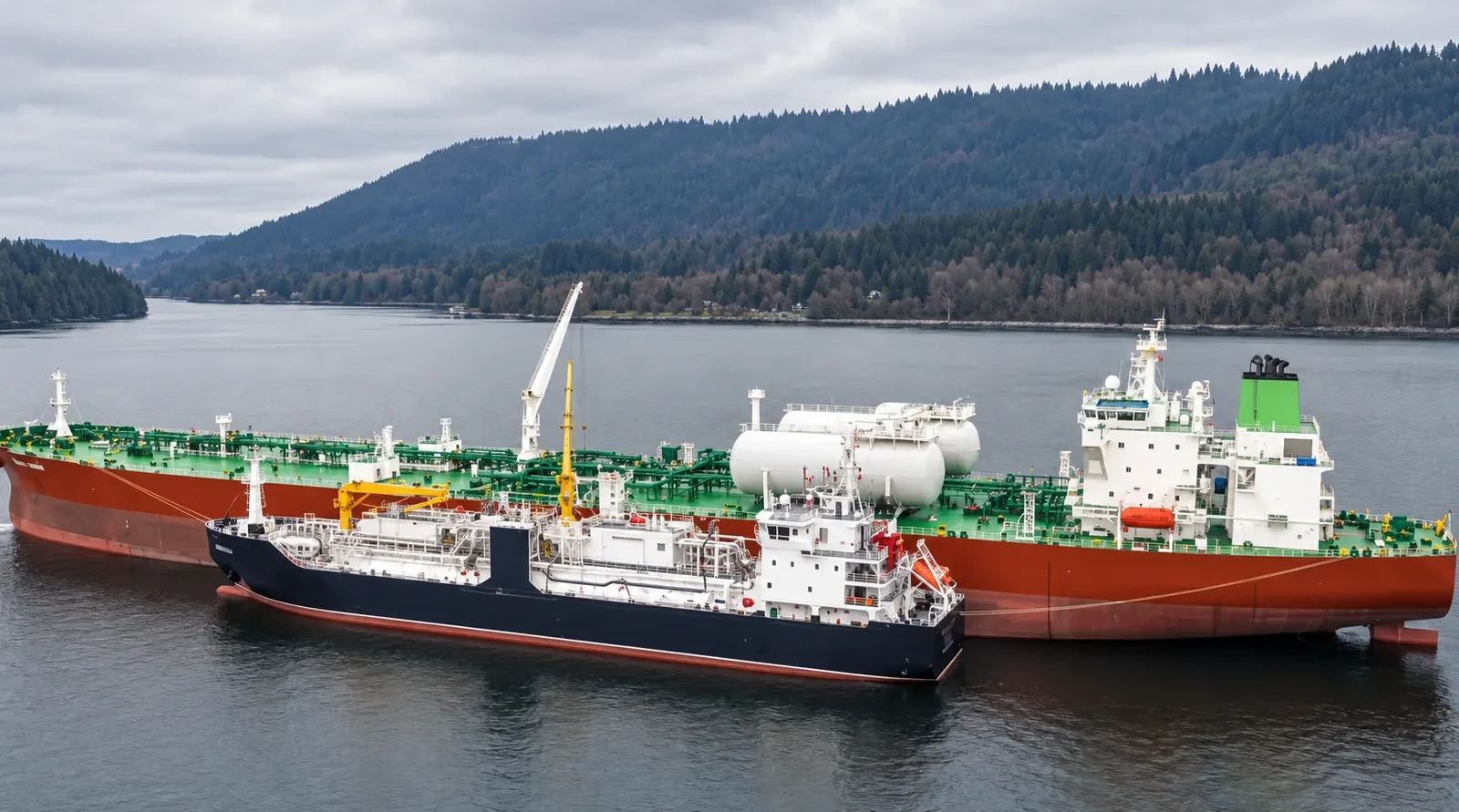
An LNG bunker vessel is a specialised ship designed to carry liquefied natural gas and transfer it directly to vessels using LNG as fuel.
Ship-to-ship LNG bunkering can take place alongside a berth, at an anchorage or within another approved operating area.
The receiving vessel may be loading or discharging cargo at the same time where simultaneous operations are permitted.
For readers looking for the broader operational process, Tide Signal’s Bunkering Operations Explained covers bunker planning, checklists, communication, transfer procedures, sampling and pollution prevention.
Why Ship-to-Ship LNG Bunkering Matters
Ship-to-ship transfer gives fuel suppliers a degree of mobility that a fixed shore connection cannot provide.
A bunker vessel can move between customers and terminals while serving different vessel classes and bunker quantities.
That flexibility is particularly valuable to liner operators.
Large containerships operate under tightly controlled schedules. A bunkering system that adds hours of waiting or forces a vessel to deviate substantially from its normal rotation can reduce the economic benefit of using the fuel.
LNG needs to be available when the ship arrives, in sufficient quantity, with suitable transfer equipment and without creating unacceptable waiting time.
Storage Could Become the Hidden Bottleneck
Every LNG bunker vessel ultimately depends on a shore-based supply chain.
That chain can include:
- an LNG import terminal;
- local storage;
- bunker-vessel loading infrastructure;
- pipelines and pumps;
- truck-to-ship infrastructure;
- loading arms or hoses;
- and digital scheduling systems.
If bunker demand grows faster than storage, the bunker vessel itself can remain idle waiting for product.
The same problem can occur if a port has enough LNG but insufficient loading slots to turn bunker vessels around quickly.
Large Ships Are Changing the Scale of LNG Bunkering
The early marine-LNG market was often associated with comparatively small regional vessels.
The new market is very different.
Large dual-fuel containerships and cruise ships can require substantial bunker quantities. That changes the economics of supply.
Bunker vessels need greater capacity, terminals need stronger transfer capability and ports need to coordinate larger operations without disrupting cargo activity.
The growth of LNG-fuelled containerships is particularly important because their schedules concentrate demand at major gateway ports.
More Ports Offer LNG — But Capacity Depth Matters
DNV says LNG is already available along most major shipping routes, with more than 100 LNG bunkering solutions in operation globally and further projects under development or discussion.
That means the market is increasingly moving beyond a simple question of whether a port can technically supply LNG.
The next question is: how much can it supply and how quickly?
A port may offer LNG bunkering and still encounter congestion if several large vessels require fuel during the same operating window.
Regional Imbalances Could Be More Important Than the Global Fleet Number
A global count of bunker vessels does not describe where those ships are positioned.
Marine-fuel demand is geographically concentrated. Major bunkering regions include Northwest Europe, Singapore, China, South Korea, the Mediterranean, the Middle East and selected US ports.
A surplus bunker vessel in Europe does not solve a shortage in Asia without repositioning.
Regional mismatches can therefore produce:
- higher bunker premiums;
- waiting time;
- route deviations;
- less supplier competition;
- and greater dependence on a limited number of hubs.
Port Coordination Is Becoming Part of the Infrastructure
Physical hardware is only one component of bunker capacity.
Ports also need to coordinate:
- receiving-vessel ETA;
- bunker-vessel ETA;
- berth availability;
- cargo operations;
- fuel quantity;
- weather limitations;
- safety zones;
- pilotage;
- and emergency procedures.
Digital coordination can increase the effective utilisation of existing assets by reducing idle time between operations.
Simultaneous Operations Can Save Vessel Time
One of the most commercially important developments is the use of simultaneous operations, or SIMOPS.
Where approved, a ship may receive LNG while cargo handling is taking place.
+
LNG bunkering
↓
Same port window
↓
Lower additional port time
↓
Higher vessel productivity
The opportunity comes with additional safety requirements. SIMOPS demand robust procedures covering communications, exclusion zones, ignition control, emergency shutdown and the interaction between cargo and bunker operations.
Safety and Competence Have to Grow With the Fleet
LNG is stored at cryogenic temperature and requires specialised handling.
Key risks include:
- cryogenic exposure;
- gas leakage;
- flammable vapour;
- pressure management;
- hose or connection failure;
- emergency disconnection;
- and ignition control.
DNV therefore places operational readiness and competence alongside physical infrastructure in its assessment of what the sector needs to scale.
More bunker vessels mean more demand for appropriately trained officers, engineers, terminal personnel, surveyors and port authorities.
LNG Bunkering Is Also a Voyage-Planning Issue
Alternative-fuel availability can affect where and when a vessel takes bunkers.
An operator may have to evaluate:
- fuel price;
- quantity available;
- bunker-port deviation;
- waiting time;
- transfer rate;
- terminal restrictions;
- weather;
- and the vessel’s next commercial employment.
These variables feed directly into voyage economics. Tide Signal’s Voyage Estimation in Shipping explains how fuel cost, sailing distance, port time and vessel speed ultimately feed into voyage results and TCE.
LNG Infrastructure Could Support Bio-LNG and Synthetic Methane
The strategic case for LNG infrastructure is not necessarily limited to conventional fossil LNG.
Liquefied biomethane can use the same fundamental fuel-storage, engine and bunkering systems, subject to required fuel specifications and certification.
Synthetic methane could potentially follow the same physical pathway.
DNV notes that today’s bunkering infrastructure and operational experience may therefore support future lower-GHG methane fuels as well.
But LNG Is Not a Zero-Emission Fuel
The environmental case remains contested because conventional LNG still contains fossil carbon and methane leakage can significantly affect lifecycle greenhouse-gas performance.
Methane can be released upstream during production and transport, while some marine-engine designs also experience methane slip during combustion.
The emissions outcome depends on engine technology, methane leakage across the supply chain and the future availability of lower-GHG methane fuels.
This wider regulatory context connects directly with Tide Signal’s MARPOL Annexes Explained, including the international framework governing air pollution and ship emissions.
Why Shipowners Continue to Order LNG-Capable Vessels
Despite the methane debate, LNG remains attractive to many owners because the technology is commercially available today.
The main reasons include:
- mature dual-fuel engine technology;
- existing global fuel infrastructure;
- very low sulphur emissions;
- lower particulate emissions;
- potential reductions in NOx depending on engine technology;
- fuel flexibility;
- and potential future use of biomethane or synthetic methane.
DNV’s broader LNG as Marine Fuel resource describes the technology, market uptake and environmental considerations surrounding the fuel.
The Infrastructure Gap Could Affect Newbuilding Decisions
Fuel availability becomes a long-term investment consideration when ships are expected to remain in service for decades.
An owner ordering an LNG-capable vessel today is making assumptions not only about engines and fuel prices, but about the future bunker network.
If the infrastructure scales efficiently, LNG-fuelled vessels gain greater commercial flexibility.
If the network lags, owners could face:
- higher bunker premiums;
- greater port dependence;
- schedule disruption;
- longer deviations;
- reduced supplier competition;
- and greater use of backup conventional fuels.
The Investment Problem: Infrastructure Must Arrive Before Demand Peaks
Bunker vessels and terminals are capital-intensive assets.
Investors need to commit money before the full future demand picture is known.
↓
Ships deliver years later
↓
Fuel demand rises
↓
Infrastructure must already be ready
That timing challenge is one reason DNV is calling for coordinated development across the entire ecosystem rather than relying on bunker-vessel orders alone.
LNG Experience Could Help Future Ammonia Bunkering
DNV’s white paper also looks beyond LNG toward future gaseous fuels.
Ammonia has very different toxicity and fuel-handling characteristics and cannot simply use LNG systems unchanged.
But the institutional experience being developed around LNG can still be useful.
Ports are learning how to manage:
- ship-to-ship alternative-fuel transfer;
- hazardous-area controls;
- emergency shutdown systems;
- simultaneous operations;
- crew competence;
- risk assessment;
- and bunker scheduling.
That experience could provide part of the operational foundation required for future fuels.
The industry has already demonstrated that large commercial ships can operate on LNG at scale.
The next constraint is whether fuel suppliers, ports, bunker vessels, storage terminals and trained personnel can grow quickly enough to support the ships entering service.
A dual-fuel vessel may have sophisticated propulsion technology onboard — but that flexibility has limited commercial value if the fuel network cannot reliably meet its schedule.
What the Market Should Watch Through 2030
- LNG bunker-vessel ordering: does the fleet move toward DNV’s 165–208-vessel requirement?
- Containership deliveries: large LNG dual-fuel liner vessels could become one of the largest sources of bunker demand.
- Storage investment: new bunker vessels need reliable shore-side product supply.
- Singapore and Northwest Europe: the world’s leading bunker hubs will provide an important test of infrastructure scalability.
- China and South Korea: large newbuilding programmes may create greater regional fuel demand.
- Bio-LNG availability: greater supply could strengthen the long-term use case for existing LNG-capable vessels.
- Methane regulation: lifecycle emissions policy could materially affect LNG economics.
- Future-fuel infrastructure: capital will increasingly be divided between LNG, methanol, ammonia and other pathways.
LNG Bunkering Infrastructure FAQ
How many LNG bunker vessels could be needed by 2030?
DNV estimates that the global fleet may need to reach approximately 165–208 LNG bunker vessels by 2030 to meet projected marine LNG demand.
Why is LNG bunkering demand increasing?
More LNG-fuelled containerships, cruise ships, vehicle carriers, tankers, bulk carriers and other vessels are entering service, increasing fuel demand at major maritime hubs.
What is ship-to-ship LNG bunkering?
Ship-to-ship bunkering involves a specialised LNG bunker vessel transferring marine LNG directly to the receiving ship, usually alongside a berth or within another approved operating area.
Is LNG available in major shipping ports?
Yes. DNV says LNG is already available along most major shipping routes and more than 100 LNG bunkering solutions are operating globally. The emerging issue is whether capacity can grow quickly enough to meet increasing demand.
Can LNG infrastructure also handle bio-LNG?
Liquefied biomethane is compatible with the basic LNG fuel pathway and can use much of the same vessel, storage and bunkering infrastructure, subject to fuel specifications and certification requirements.
Is LNG a zero-carbon fuel?
No. Conventional LNG remains a fossil fuel and methane emissions can affect lifecycle greenhouse-gas performance. Bio-LNG and synthetic methane may provide lower-GHG pathways using related infrastructure.
What happens if LNG infrastructure does not keep pace?
Operators could face higher bunker costs, longer waiting times, reduced supplier choice, route deviations, schedule disruption and greater reliance on conventional backup fuel.
- DNV — LNG bunker fleet may need to more than double by 2030
- DNV — Gas bunker vessels: facilitating the transition to alternative fuels
- DNV — LNG as Marine Fuel
- DNV — LNG Market Uptake and Bunkering Infrastructure
- DNV — LNG-Fuelled Container Ships and Alternative-Fuel Orderbook
Reporting status: 28 September 2026. Bunker-vessel counts, newbuilding orders and infrastructure projects change as vessels are delivered, ordered, converted or removed from service. The 165–208 figure is DNV’s estimated global requirement by 2030 rather than a confirmed orderbook total.