Academy · SOLAS · Cargo Operations
SOLAS Chapter VI is the core SOLAS framework for the safe carriage of cargoes. It governs cargo information, loading, stowage and securing, container Verified Gross Mass, solid bulk cargoes and grain, with the aim of preventing structural damage, cargo shift, stability loss, unsafe stowage and hazards to people onboard.
The chapter applies broadly to cargoes other than liquids and gases in bulk where the cargo may require special precautions because of its hazards to the ship or persons onboard. Its requirements connect directly with the Cargo Securing Manual, VGM rules, IMSBC Code, International Grain Code and BLU Code.
What Does SOLAS Chapter VI Cover?
The International Maritime Organization describes SOLAS Chapter VI — Carriage of Cargoes as covering cargoes other than liquids and gases in bulk which, because of their particular hazards to ships or people onboard, may require special precautions.
That makes the chapter relevant to several very different cargo operations:
- containers and other cargo transport units;
- general cargo and project cargo;
- heavy or abnormal cargo units;
- vehicles and ro-ro cargo units;
- solid bulk cargoes such as ore, coal, concentrates and mineral products;
- grain carried in bulk; and
- cargoes requiring gas monitoring, fumigation controls or special securing arrangements.
Chapter VI is not a stand-alone operating manual. It creates the regulatory framework and then connects ship operators to more detailed IMO instruments.
| Operational area | Main SOLAS / IMO instrument | Practical purpose |
|---|---|---|
| Cargo information | SOLAS VI/2 | Give the master sufficient information to plan safe stowage and carriage |
| Packed container mass | SOLAS VI/2 + VGM Guidelines | Prevent stowage decisions based on incorrect container weights |
| General cargo securing | SOLAS VI/5 + Cargo Securing Manual + CSS Code | Prevent shifting, structural damage and cargo loss |
| Solid bulk cargoes | SOLAS VI + IMSBC Code | Control liquefaction, chemical, gas, loading and structural hazards |
| Bulk carrier loading | SOLAS VI/7 + BLU Code | Control loading/unloading sequence and hull stresses |
| Grain in bulk | SOLAS VI Part C + International Grain Code | Control grain shift and stability risk |
SOLAS Chapter VI Structure Explained
Chapter VI is divided into general cargo provisions, special provisions for solid bulk cargoes and provisions for grain carriage.
Defines the scope of the chapter and its relationship with the detailed cargo safety instruments.
Requires the shipper to provide the master or representative with appropriate cargo information sufficiently in advance of loading. This regulation also contains the mandatory packed-container VGM requirements.
Addresses solid bulk cargoes liable to emit toxic or flammable gas or cause oxygen depletion.
Requires appropriate precautions, particularly where cargo spaces are fumigated.
Requires cargo and cargo units to be loaded, stowed and secured so that the ship and people onboard are not put at unacceptable risk.
Includes MSDS requirements relating to oil cargoes and oil fuel within the chapter’s additional provisions.
Prohibits physical blending of bulk liquid cargoes and production processes during sea voyages, subject to specified exceptions.
Forms part of the special provisions for solid bulk cargoes and works together with the IMSBC Code.
Addresses safe cargo handling and the prevention of excessive hull stress during bulk-carrier operations.
Requires ships carrying grain in bulk within the relevant scope to comply with the mandatory International Grain Code.
SOLAS VI/2: Cargo Information Comes Before Loading
SOLAS VI/2 places a fundamental responsibility on the shipper: the master or the master’s representative must receive appropriate information on the cargo sufficiently in advance of loading so that the necessary precautions for safe stowage and carriage can be taken.
For general cargo and cargo units, the information includes the cargo description, gross mass and relevant special properties.
For solid bulk cargoes, the information requirements are linked directly to section 4 of the IMSBC Code.
The important operational principle is simple: the vessel should not be discovering a critical cargo property after loading has started.
- Confirm the cargo name and description match the applicable shipping documents.
- Check gross mass or quantity.
- Identify relevant physical or chemical hazards.
- For solid bulk cargo, check the IMSBC schedule and declaration.
- Confirm required certificates are valid and within the required time limits.
- Check moisture/TML documentation where applicable.
- Confirm stowage factor and cargo density where relevant to the loading plan.
- Resolve discrepancies before commencing loading.
Verified Gross Mass: The SOLAS Container Weight Rule
One of the most widely recognized SOLAS Chapter VI requirements is the Verified Gross Mass (VGM) rule for packed containers.
IMO adopted amendments to SOLAS VI/2 after incidents in which misdeclared container mass contributed to unsafe stowage and operational risk. The mandatory VGM requirements entered into force on 1 July 2016.
Two core requirements apply:
- The shipper is responsible for obtaining and declaring the verified gross mass in the shipping document and providing it to the master or representative and terminal sufficiently in advance for the stowage plan.
- A packed container cannot be loaded onto a SOLAS ship unless the verified gross mass has been provided or obtained in accordance with the rules.
The two VGM methods
The complete packed container is weighed using calibrated and certified equipment.
Packages, cargo items, pallets, dunnage and securing material are weighed and added to the container tare mass using a method approved by the competent authority.
The VGM requirement is not simply administrative. Incorrect weight information can affect:
- ship stability;
- stack weight limits;
- lashing forces;
- structural loading;
- terminal lifting operations;
- stow planning; and
- the risk of container stack collapse or loss overboard.
SOLAS VI/3: Oxygen Analysis and Gas Detection
Some solid bulk cargoes can emit toxic gas, release flammable gas or consume oxygen inside a cargo space.
SOLAS VI/3 requires appropriate equipment for measuring gas concentration or oxygen where such hazards may exist, together with instructions for use. Crew members must also be trained in the use of the equipment.
This requirement connects directly with enclosed-space safety.
A hold that appears normal from the hatch coaming can contain an atmosphere incapable of supporting life. Cargo behaviour, oxidation, decomposition or fumigation may create conditions that are not visually obvious.
SOLAS VI/4: Pesticides and Fumigation
Fumigation can protect agricultural cargoes from infestation, but fumigants can also present serious toxic hazards to crew, stevedores and surveyors.
SOLAS VI/4 requires appropriate precautions when pesticides are used on ships, particularly for fumigation.
Operationally, the vessel should understand:
- which fumigant has been used;
- where it has been applied;
- whether fumigation continues in transit;
- which spaces are restricted;
- what gas-detection equipment is required;
- ventilation and re-entry criteria;
- warning notices and access control; and
- emergency response actions.
SOLAS VI/5: Stowage and Securing
SOLAS VI/5 is one of the chapter’s most operationally important regulations.
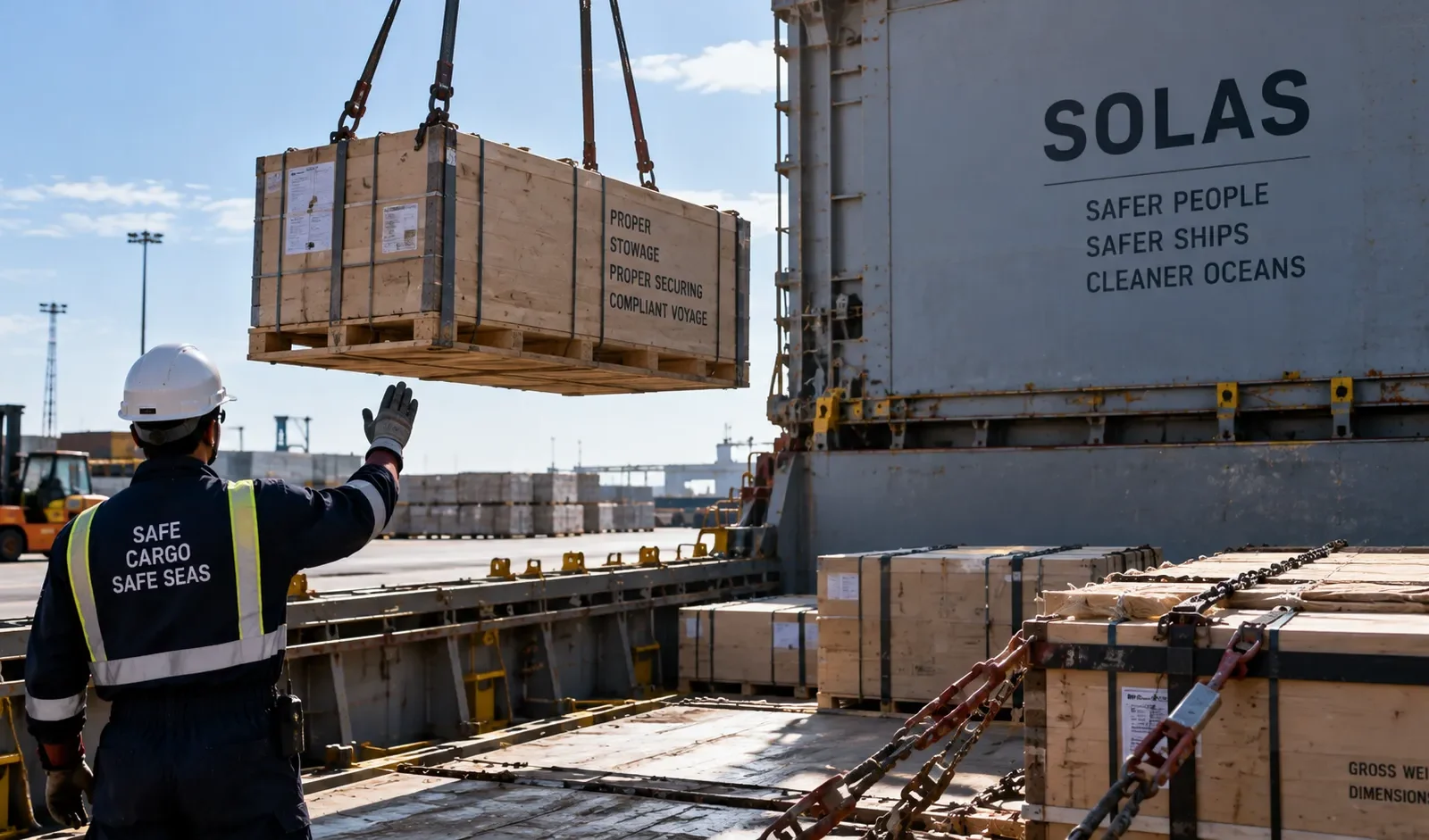
IMO requirements state that cargo, cargo units and cargo transport units carried on or under deck must be loaded, stowed and secured so that, as far as practicable throughout the voyage, they do not create damage or hazard to the ship or persons onboard and do not result in cargo being lost overboard.
The regulation also addresses heavy and abnormal cargoes, ro-ro cargo units, container maximum gross weight and the requirement to follow the approved Cargo Securing Manual.
Why cargo securing fails at sea
The forces acting on cargo are dynamic. A lashing arrangement that appears adequate alongside may experience much higher loads when the ship rolls, pitches, heaves or slams in heavy weather.
Securing therefore depends on:
- cargo mass and centre of gravity;
- stow position;
- ship motions;
- expected weather;
- friction;
- strength and angle of lashings;
- securing-point strength;
- stack or deck limits;
- condition of securing equipment; and
- correct execution of the approved securing arrangement.
The IMO CSS Code emphasizes proper planning, execution and supervision, and requires securing decisions to account for the most severe weather conditions reasonably expected on the intended voyage.
Cargo Securing Manual: What SOLAS Requires
For cargoes other than solid and liquid bulk cargoes, cargo units and cargo transport units are to be loaded, stowed and secured throughout the voyage in accordance with the ship’s approved Cargo Securing Manual (CSM).
The CSM should not be treated as a document produced only for survey.
It is the vessel-specific operating reference that connects:
- approved securing arrangements;
- permissible stack and tier weights;
- deck, tank-top and hatch-cover loading limits;
- lashing patterns;
- securing-device types;
- inspection and maintenance expectations;
- heavy-weather considerations; and
- the cargo arrangement actually onboard.
For the current inspection environment, see Tide Signal’s dedicated Port State Control 2026 Cargo Securing CIC guide.
Solid Bulk Cargoes Under SOLAS Chapter VI
Solid bulk cargoes create a different risk profile from packaged cargoes.
The main hazards can include:
- cargo liquefaction or dynamic separation;
- loss of stability;
- excessive local or longitudinal structural loading;
- self-heating;
- toxic or flammable gas emission;
- oxygen depletion;
- corrosion;
- dust hazards;
- water ingress sensitivity; and
- chemical reactions.
Chapter VI provides the SOLAS foundation, while the detailed mandatory rules for solid bulk cargoes other than grain are contained in the International Maritime Solid Bulk Cargoes Code.
How SOLAS Chapter VI Connects to the IMSBC Code
The IMSBC Code is mandatory under SOLAS Chapter VI for solid bulk cargoes other than grain.
Its purpose is to provide cargo-specific information and procedures so that masters, shippers, terminals and operators can identify hazards before shipment and apply the required precautions.
The Code addresses, among other matters:
- cargo identification;
- Group A, B and C classification;
- moisture and Transportable Moisture Limit;
- sampling and testing;
- cargo declarations;
- trimming;
- ventilation;
- gas hazards;
- segregation;
- weather precautions;
- hold cleanliness; and
- cargo-specific carriage requirements.
The current Tide Signal reference is IMSBC Code 2027: Amendment 08-25 Explained.
SOLAS VI/7 and the BLU Code
SOLAS VI/7 addresses the loading, unloading and stowage of solid bulk cargoes and is closely linked to the BLU Code — Code of Practice for the Safe Loading and Unloading of Bulk Carriers.
The regulatory objective is to prevent unsafe cargo operations from placing excessive stress on the ship’s structure.
For a bulk carrier, the loading sequence is therefore not simply a commercial productivity decision.
The master and terminal need an agreed loading or unloading plan that keeps the ship within:
- permissible shear force;
- permissible bending moment;
- local tank-top limits;
- draft restrictions;
- stability limits;
- ballast-system capability;
- air-draft constraints; and
- the vessel’s approved loading guidance.
Why loading rate matters
A modern terminal may be capable of loading cargo faster than the ship can safely deballast.
If the cargo loading rate exceeds the vessel’s ability to maintain the planned ballast sequence, the ship can depart from the approved loading condition and develop unacceptable structural stresses.
That is why the ship–shore exchange before loading is critical.
- What is the agreed total quantity and cargo distribution?
- What is the loading sequence by hold?
- What is the maximum loading rate?
- What is the deballasting capacity?
- When are draft surveys or pauses required?
- Are shear force and bending moment within limits at every stage?
- What is the agreed topping-off sequence?
- What changes require master–terminal re-agreement?
For the commercial side of the same process, see Tide Signal’s Pre-Stowage Planning in Shipping guide.
SOLAS Chapter VI and the International Grain Code
Grain receives its own mandatory safety framework because bulk grain can shift during a voyage and create a dangerous heeling moment.
The International Grain Code has been mandatory under SOLAS Chapter VI since 1 January 1994.
IMO defines grain broadly to include wheat, maize, oats, rye, barley, rice, pulses, seeds and processed forms with behaviour similar to grain in its natural state.
The Code applies to relevant ships carrying grain in bulk, including ships below 500 gross tonnage where Part C of Chapter VI applies.
Document of Authorization
A ship loaded in accordance with the Grain Code is generally required to carry a Document of Authorization demonstrating that the ship is capable of complying with the Code.
The document is accompanied by, or incorporated into, approved grain loading information that allows the master to demonstrate compliance with the required stability criteria.
Why grain shift is dangerous
A partly filled grain surface can move when the ship rolls.
If enough cargo shifts transversely:
- the ship develops a heeling moment;
- the centre of gravity effectively shifts;
- the available righting lever can decrease;
- list can increase; and
- the ship’s residual stability margin can be reduced.
Grain loading is therefore not simply a question of filling cargo holds. The vessel must demonstrate that the assumed grain-shift moments remain within the Code’s stability criteria for the intended loading condition.
What Changed for Grain in 2026?
Amendments to the International Grain Code entered into force on 1 January 2026.
IMO describes the amendments as introducing a new class of loading conditions for special compartments. The adopted text also introduced a definition addressing a specially suitable compartment partly filled in way of the hatch opening with ends untrimmed and made related amendments to grain stowage provisions.
This matters for operators because grain-loading software, approved manuals and loading calculations need to reflect the current applicable Code and any Administration or class requirements.
Why SOLAS Chapter VI Is Especially Relevant in 2026
Chapter VI is under direct Port State Control attention in 2026.
The Paris MoU and Tokyo MOU launched a joint Concentrated Inspection Campaign on cargo securing running from 1 September to 30 November 2026.
The campaign is conducted together with routine PSC inspections and is designed to assess compliance with SOLAS requirements covering the loading, stowage and securing of cargo units and cargo transport units.
PSCO attention includes areas such as:
- the approved Cargo Securing Manual;
- officer familiarity with securing requirements;
- the actual cargo and lashing arrangement;
- VGM information where applicable;
- fixed and portable securing equipment;
- equipment condition;
- bridge visibility;
- safe access; and
- heavy-weather procedures.
Deficiencies can range from a recorded defect to detention depending on seriousness and the overall safety picture.
Who Is Responsible: Shipper, Master, Terminal or Company?
SOLAS Chapter VI distributes responsibility across the cargo chain rather than placing every obligation on the ship.
| Party | Core responsibility | Typical failure |
|---|---|---|
| Shipper | Provide accurate cargo information and VGM where applicable | Incorrect weight, incomplete declaration or missing hazard information |
| Master / ship | Assess acceptability, stowage, stability, structure and securing | Accepting cargo without resolving inconsistencies or exceeding ship limits |
| Terminal | Execute loading/unloading safely and in accordance with agreed plan | Excessive loading rate or unauthorized deviation from sequence |
| Company | Provide procedures, approved manuals, maintenance and competent support | Outdated CSM, weak training or inadequate cargo-operation controls |
The master’s role remains central because the master is responsible for the safety of the ship and voyage and retains authority over whether cargo can safely be accepted and loaded.
Common SOLAS Chapter VI Deficiencies
Problems usually arise not from one dramatic failure but from gaps between documentation and reality.
- Cargo declaration does not match the actual cargo.
- VGM arrives late or is not reflected in the final stow plan.
- Heavy cargo exceeds deck, tank-top or hatch-cover limits.
- Lashing arrangement does not match the CSM.
- Portable securing devices are damaged, incompatible or insufficient.
- Officers cannot explain the approved securing arrangement.
- Bulk loading sequence is changed without recalculating stresses.
- Moisture or TML documentation is incomplete or questionable.
- Gas-detection equipment is unavailable or crew are unfamiliar with it.
- Fumigation controls are poorly communicated.
- Grain stability calculations are based on the wrong condition or outdated information.
How SOLAS Chapter VI Differs From SOLAS Chapter VII
The two chapters are often confused.
General cargo safety: cargo information, stowage, securing, VGM, solid bulk cargoes and grain.
Dangerous goods: packaged dangerous goods, dangerous solid bulk goods and specialist chemical/gas/INF regimes.
A cargo can therefore engage more than one regulatory framework.
For example, a dangerous solid bulk cargo may require compliance with both the detailed IMSBC provisions and the dangerous-goods requirements that apply to its classification.
How SOLAS Chapter VI Differs From the IMSBC Code
This distinction is important for officers and students.
SOLAS Chapter VI is the Convention-level legal framework.
The IMSBC Code is the detailed mandatory code for solid bulk cargoes other than grain.
If the cargo is iron ore fines, nickel ore, coal, direct reduced iron or another scheduled bulk commodity, the practical operating details will usually be found in the IMSBC Code rather than in the short text of Chapter VI itself.
SOLAS Chapter VI Shipboard Checklist
- Confirm cargo information has been received in writing.
- Verify cargo identity, mass, properties and required certificates.
- Check IMSBC schedule for solid bulk cargoes.
- Confirm VGM for packed containers where applicable.
- Review approved CSM and securing arrangement.
- Verify deck, tank-top, hatch-cover, stack and structural limits.
- Prepare stability and longitudinal-strength calculations.
- For bulk cargoes, agree ship–shore loading/unloading plan.
- Check gas-detection equipment and fumigation controls where applicable.
- For grain, confirm authorization and approved grain calculations.
- Monitor quantities by hold, bay or cargo position.
- Track drafts, stability, shear force and bending moment.
- Confirm loading rate remains within agreed limits.
- Stop and investigate unexpected cargo behaviour or discrepancies.
- Maintain communication with terminal or stevedores.
- Verify securing is carried out as loading progresses.
- Record significant changes to the agreed plan.
- Confirm final cargo distribution matches the approved plan.
- Verify final stability and structural condition.
- Check lashings, twistlocks, chains, wires and securing devices as applicable.
- Confirm hatch covers and access arrangements are secured.
- Review heavy-weather precautions.
- Confirm grain calculations and required documents where applicable.
- Ensure cargo documentation and records are complete and available for inspection.
- Inspect securing arrangements when safe and required.
- Respond to lashing movement, cargo shift or structural concerns immediately.
- Consider cargo securing in routeing and heavy-weather decisions.
- Monitor cargo-space atmosphere where required.
- Follow ventilation, fumigation and cargo-specific IMSBC instructions.
- Record defects and corrective actions.
Operational Example: Heavy Cargo on Deck
A heavy machinery unit is booked for deck carriage.
The commercial booking may state only dimensions and gross weight, but SOLAS Chapter VI requires a broader safety assessment.
The vessel needs to confirm:
- the declared weight and centre of gravity;
- deck permissible loading;
- load distribution through stools or supports;
- securing-point capacity;
- required lashing forces;
- stability impact;
- visibility and access implications;
- weather exposure; and
- that the arrangement is covered by the approved CSM or otherwise properly approved.
The cargo can therefore be commercially acceptable but operationally unacceptable until the securing and structural questions are resolved.
Operational Example: Bulk Carrier Loading Ore
A terminal offers a very high loading rate for a dense bulk cargo.
The vessel’s key question is not how quickly the terminal can load. It is whether the ship can safely maintain the required ballast and loading sequence while staying within allowable shear force, bending moment and local loading limits.
If the terminal deviates from the agreed sequence, the master should not simply continue because the final quantity remains unchanged. Intermediate loading stages can create structural stresses that do not exist in the final condition.
Operational Example: Container Without VGM
A packed container arrives at the terminal without the required VGM.
Under the SOLAS framework, it cannot simply be placed onboard on the basis of an estimated weight.
A contingency exists whereby the terminal and master or representative may arrange for the container to be weighed on behalf of the shipper, subject to the commercial arrangements and applicable national procedures.
Frequently Asked Questions
What is SOLAS Chapter VI?
SOLAS Chapter VI is the chapter of the International Convention for the Safety of Life at Sea dealing with the carriage of cargoes. It covers cargo information, stowage and securing, packed-container VGM, solid bulk cargoes and grain.
What cargoes does SOLAS Chapter VI apply to?
IMO describes the chapter as covering cargoes other than liquids and gases in bulk which may require special precautions because of their hazards to ships or people onboard.
What is SOLAS VI/2?
SOLAS VI/2 is the cargo-information regulation. It requires the shipper to provide appropriate cargo information sufficiently in advance of loading and also contains the packed-container Verified Gross Mass requirements.
What is VGM under SOLAS?
VGM is the Verified Gross Mass of a packed container. The shipper must obtain and communicate the verified mass in accordance with SOLAS VI/2. A packed container without the required VGM cannot normally be loaded onto the ship.
What is SOLAS VI/5?
SOLAS VI/5 covers cargo stowage and securing. It requires cargo and cargo units to be loaded, stowed and secured so they do not create unacceptable danger to the ship or people onboard or result in cargo loss.
Is a Cargo Securing Manual mandatory?
For cargoes within the applicable scope, ships are required to load, stow and secure cargo in accordance with a Cargo Securing Manual approved by the Administration. The manual must reflect the vessel’s approved securing arrangements.
Is the IMSBC Code part of SOLAS Chapter VI?
The IMSBC Code is a separate mandatory IMO Code made applicable through SOLAS Chapter VI for the carriage of solid bulk cargoes other than grain.
Does the IMSBC Code apply to grain?
No. Grain in bulk is governed by the International Grain Code under SOLAS Chapter VI Part C rather than the IMSBC Code.
What is the BLU Code?
The BLU Code is the Code of Practice for the Safe Loading and Unloading of Bulk Carriers. It is linked to SOLAS VI/7 and provides guidance to masters, terminals and others involved in bulk loading and discharge.
What changed for grain carriage in 2026?
Amendments to the International Grain Code entered into force on 1 January 2026, including a new class of loading conditions for special compartments and related changes to the Code.
Why is cargo securing a major PSC issue in 2026?
Paris MoU and Tokyo MOU are running a joint Concentrated Inspection Campaign on cargo securing from 1 September to 30 November 2026, specifically assessing compliance with SOLAS cargo-unit loading, stowage and securing requirements.
Key Takeaways
- SOLAS Chapter VI is the principal SOLAS chapter governing the safe carriage of cargoes.
- It covers cargoes other than liquids and gases in bulk that may require special precautions.
- SOLAS VI/2 requires correct cargo information before loading.
- The same regulation contains the mandatory packed-container VGM framework.
- SOLAS VI/5 governs stowage and securing and links directly to the approved Cargo Securing Manual.
- Solid bulk cargoes other than grain are governed in detail by the mandatory IMSBC Code.
- SOLAS VI/7 and the BLU Code are central to safe bulk-carrier loading and unloading.
- Grain in bulk is governed by the International Grain Code.
- Grain Code amendments entered into force on 1 January 2026.
- Cargo securing is a live PSC focus in 2026 under the joint Paris MoU / Tokyo MOU CIC.
Official Sources and Further Reading
- IMO — International Convention for the Safety of Life at Sea (SOLAS)
- IMO — Verification of the Gross Mass of a Packed Container
- IMO — Code of Safe Practice for Cargo Stowage and Securing
- IMO — Cargo Securing and Packing
- IMO — International Maritime Solid Bulk Cargoes Code
- IMO — International Grain Code
- IMO — BLU Code and BLU Manual
- IMO — Shipping Rules in Force from 1 January 2026
- Paris MoU — 2026 Cargo Securing CIC
Editorial note: This guide explains the operational framework of SOLAS Chapter VI. The applicable consolidated SOLAS text, Flag State requirements, approved ship-specific manuals, class requirements and current IMO Codes remain the controlling references for a particular vessel or cargo.