The Port State Control CIC 2026 on cargo securing is now underway across the Paris MoU and Tokyo MOU regions. From 1 September to 30 November 2026, Port State Control Officers are using dedicated campaign questionnaires during routine inspections to test whether cargo securing requirements are being followed in practice — not merely documented on paper.
For ships preparing for inspection, the Paris MoU CIC 2026 checklist centres on the approved Cargo Securing Manual, the actual cargo and lashing arrangement, officers’ familiarity with vessel limits, VGM data, portable and fixed securing equipment, bridge visibility and heavy-weather procedures.
The official Paris MoU campaign notice confirms that the joint Concentrated Inspection Campaign runs from 1 September to 30 November 2026 and is conducted alongside routine Port State Control inspections. A ship will normally undergo only one CIC inspection during the campaign period in each MoU region.
Any deficiencies identified are recorded by the PSCO. Depending on their seriousness, action may range from recording a deficiency to detention. For operators, Masters and responsible officers, this makes cargo securing a live operational and commercial exposure throughout the campaign period.
Campaign status · active now
The 2026 Paris MoU and Tokyo MOU Cargo Securing CIC is in force from 1 September to 30 November 2026. Use the official questionnaire issued by the authority conducting the inspection. This guide supports shipboard preparation but does not replace the vessel’s approved Cargo Securing Manual, Safety Management System, flag or class requirements, company procedures or the Master’s judgement.
Paris MoU CIC 2026 Checklist: What PSCOs Are Checking Now
The two MoUs use closely aligned questionnaires, although their exact wording and numbering are not identical. The following quick-reference checklist consolidates the main operational areas a ship should be ready to demonstrate during the 2026 cargo securing CIC.
| No. | PSC check | Ship should be ready to show | Typical concern |
|---|---|---|---|
| 1 | Approved Cargo Securing Manual | Current, vessel-specific approved CSM immediately available. | Missing, outdated or generic manual. |
| 2 | Clear securing instructions | Approved instructions covering the cargo arrangement actually onboard. | Actual arrangement not clearly covered by the CSM. |
| 3 | Officer familiarity | Master and responsible officers able to explain relevant limits and procedures. | Inability to locate or explain vessel-specific limits. |
| 4 | Actual CSM compliance | Final stow, securing arrangement and calculations aligned with the approved manual. | Missing lashings, unexplained substitutions or uncontrolled deviations. |
| 5 | VGM and cargo-plan data | Final cargo plan reflects verified gross mass information where applicable. | VGM discrepancies, late changes or restows not reflected in the final condition. |
| 6 | Safe access / CSAP | Applicable access plans and workable physical access arrangements. | Approved plan contradicted by unsafe or obstructed access. |
| 7 | Portable securing devices | Correct quantity, type, approval, compatibility and suitable spares. | Wrong types, insufficient quantity or untraceable equipment. |
| 8 | Condition and maintenance | Fixed and portable securing devices serviceable and supported by maintenance records. | Cracks, deformation, corrosion, seized parts or unauthorised repairs. |
| 9 | Bridge visibility | Cargo stow and actual line of sight consistent with applicable requirements. | Cargo creates an unexplained or non-compliant obstruction. |
| 10 | Heavy weather and voyage securing | Procedures, inspection evidence, voyage decisions and corrective actions. | Generic procedures with little evidence they are followed in practice. |
Important: this is a Tide Signal operational summary of the principal inspection areas, not a substitute for the official questionnaire. Paris MoU and Tokyo MOU forms differ in wording, numbering and treatment of some questions.
2026 Cargo Securing CIC
Regulatory position: the campaign focuses inspection attention on compliance with SOLAS requirements already in force. The risk now is greater scrutiny and a standardised inspection focus, not a new cargo-securing rulebook introduced on 1 September.
What the Port State Control CIC 2026 Changes
The campaign changes the probability and consistency of scrutiny rather than the underlying regulatory requirements. Paris MoU and Tokyo MOU authorities are using dedicated questionnaires during routine PSC inspections to gather comparable information on compliance with current SOLAS requirements for the loading, stowage and securing of cargo units and cargo transport units.
That creates three immediate operational consequences:
- The inspection focus is known in advance. Ships cannot reasonably treat the CSM, securing devices, cargo-plan reconciliation or heavy-weather evidence as unexpected inspection requests.
- Documentation and physical condition will be tested together. A compliant-looking file does not cure damaged, incompatible or incorrectly used equipment.
- Crew familiarity becomes evidence. Responsible officers may need to explain stack and tier limits, structural restrictions, VGM integration, approved securing arrangements and what action is required when the actual condition differs from the plan.
The authorities state that deficiencies identified during the campaign will be recorded and that action can range from recording a deficiency to detention. Campaign results will later be analysed by both MoUs, with a view to possible submission to the International Maritime Organization.
For a broader vessel-arrival review, Tide Signal’s Port State Control inspection preparation guide covers certificates, safety equipment, bridge and engine-room readiness, ISM records and crew preparation. This article focuses specifically on the 2026 Cargo Securing CIC.
Paris MoU vs Tokyo MOU: The Questionnaires Are Not Identical
One of the most important details for operators trading across both regions is that the Paris and Tokyo questionnaires pursue the same campaign objective but are not identical in numbering, wording or treatment of every item.
| Issue | Paris MoU form | Tokyo MOU form |
|---|---|---|
| Applicability | Includes a separate information-only applicability question. | The published form begins directly with approved CSM checks. |
| CSAP | Cargo Safe Access Plan is an information-only question. | The CSAP question is marked with an asterisk. |
| Voyage securing | No separate explicit item using this wording. | Includes a specific question on cargo remaining secured throughout the voyage to prevent loss overboard. |
| Detention-sensitive questions | Several questions are identified as possible detention considerations. | Asterisk-marked questions identify areas where a negative answer may lead the PSCO to consider detention. |
| Operator action | Prepare against the official questionnaire used by the inspecting authority. Do not rely only on an industry summary or retyped checklist. | |
Detention does not follow automatically from one “No”
A negative answer may result in a deficiency. Where the official form identifies a detention-sensitive question, the PSCO may consider detention, but the authority still assesses the seriousness of the deficiency, the vessel’s overall condition and whether the ship can proceed safely.
Which Ships Are Exposed to the Cargo Securing CIC?
The campaign concerns cargo units and cargo transport units and is applied where relevant to the vessel and cargo arrangement. Container ships are the most obvious target, but the CIC should not be treated as a containership-only campaign.
Practical exposure may extend to general cargo ships, multipurpose vessels, ro-ro and vehicle carriers, project-cargo vessels and other ships carrying cargo units requiring approved stowage or securing arrangements.
Applicability will depend on ship type, design, cargo carried, the approved CSM and the actual condition at the time of inspection. Even where VGM or a CSAP is not applicable, questions concerning the CSM, loading limitations, portable securing devices, fixed fittings, equipment maintenance and heavy-weather procedures may still be relevant.
The Four Layers a PSCO Will Try to Reconcile
Manual
What the approved, vessel-specific Cargo Securing Manual requires.
Plan
What the final cargo plan, VGM data, calculations and voyage records show.
Equipment
What is physically fitted, used, maintained and available onboard.
Crew
What the responsible officers can explain and demonstrate without guesswork.
The inspection becomes more serious when these four layers disagree. An approved manual may exist, but the deck may show the wrong equipment. A loading calculation may appear acceptable, but late restows may not be reflected in the final plan. Maintenance records may look complete while turnbuckles or twistlocks are seized, deformed or incompatible.
Likewise, officers may know where the CSM is stored but be unable to explain the vessel-specific limits that govern the cargo actually onboard.
The official Paris questionnaire explicitly warns that a positive answer alone does not establish that the lashing arrangement and equipment comply with their intended design parameters. That is an important signal: paper compliance alone is not enough.
Cargo Securing CIC 2026: What Counts as Strong Evidence?
| Control area | What the PSCO may test | Strong onboard evidence | Red flag |
|---|---|---|---|
| Approved CSM | Approved manual available and applicable to the ship. | Current vessel-specific copy with approval and amendments. | Generic, outdated or difficult-to-locate manual. |
| Clear instructions | Specific stowage situations are covered. | Diagrams, equipment types, limits and alternative arrangements. | Actual cargo configuration has no clear approved instruction. |
| Officer familiarity | Understanding of stack, tier, tank-top, deck and hatch-cover limits. | Practical answers linked to the current plan and CSM. | Memorised phrases or inability to locate limits. |
| CSM compliance | Actual stow and securing match the approved arrangement. | Final plan, calculations, deck condition and records aligned. | Uncontrolled deviations, missing lashings or unexplained substitutions. |
| VGM | Cargo plan reflects verified gross mass information. | Final VGM data consistent with stow plan and loading information. | Late changes or discrepancies not reflected in the final plan. |
| Safe access | CSAP and workable access, where applicable. | Approved plan plus clear, usable physical access. | Paper plan contradicted by obstructed or unsafe routes. |
| Portable devices | Quantity, approval, type and compatibility. | Inventory, identification, suitable spares and correct use. | Mixed types, insufficient spares or untraceable devices. |
| Condition | Fixed and portable devices are serviceable and maintained. | Physical condition consistent with inspection and maintenance records. | Corrosion, cracks, deformation, seized threads or unauthorised repairs. |
| Bridge visibility | Stow complies with applicable visibility requirements. | Assessment, plan and actual line of sight aligned. | Cargo creates an unexplained obstruction. |
| Heavy weather | Procedures exist and are followed in practice. | Forecast review, voyage decisions, inspections, log entries and corrective action. | Generic procedure with no evidence of implementation. |
Which CIC Findings Can Lead to Detention?
The detention-sensitive areas are not presentation details. They concern barriers that determine whether cargo can be transported safely and whether the ship’s securing system is functioning as intended.
- the approved Cargo Securing Manual is onboard and provides usable instructions;
- responsible officers understand the manual and relevant structural limitations;
- the actual cargo arrangement complies with the approved securing requirements;
- the cargo plan reflects applicable VGM information;
- sufficient approved portable securing devices of the correct type are available;
- fixed and portable securing devices are compatible and serviceable;
- cargo stow does not compromise applicable bridge visibility requirements;
- and relevant safe-access, heavy-weather and voyage-securing requirements are addressed where applicable.
A single negative answer does not automatically result in detention. The greater risk is a connected failure.
A weak CSM combined with poor officer familiarity suggests that the approved system may not be controlling the operation. Damaged securing devices combined with incomplete maintenance records suggest defects may not be identified or removed from service. A cargo plan that disagrees with VGM data or actual stowage undermines both the calculation and the physical arrangement.
Highest-risk pattern
Document gap + physical defect + weak officer answer is more serious than an isolated presentation issue because it can indicate that the vessel’s cargo-securing control system is not working effectively in practice.
Cargo Securing Manual: The CIC’s Central Document
The CSM should be approved, vessel-specific, current, legible and immediately available. Responsible officers should be able to locate the instructions relevant to the cargo actually onboard and explain the applicable limitations without searching blindly through the document.
Preparation should verify:
- ship name, IMO number, approval and amendment status;
- container stack and tier weight limits;
- tank-top, deck and hatch-cover permissible loads;
- approved lashing patterns and equipment types;
- standard, semi-standardised and non-standard cargo arrangements;
- inspection, maintenance, rejection and replacement criteria;
- safe-access arrangements for personnel;
- and heavy-weather precautions relevant to the voyage.
Where lashing software is used, officers should understand how its output connects with the approved CSM and actual loading condition. A compliant calculation on a screen is not a substitute for understanding the inputs, operating limits and equipment physically available on deck.
The Deck Will Test the Paperwork
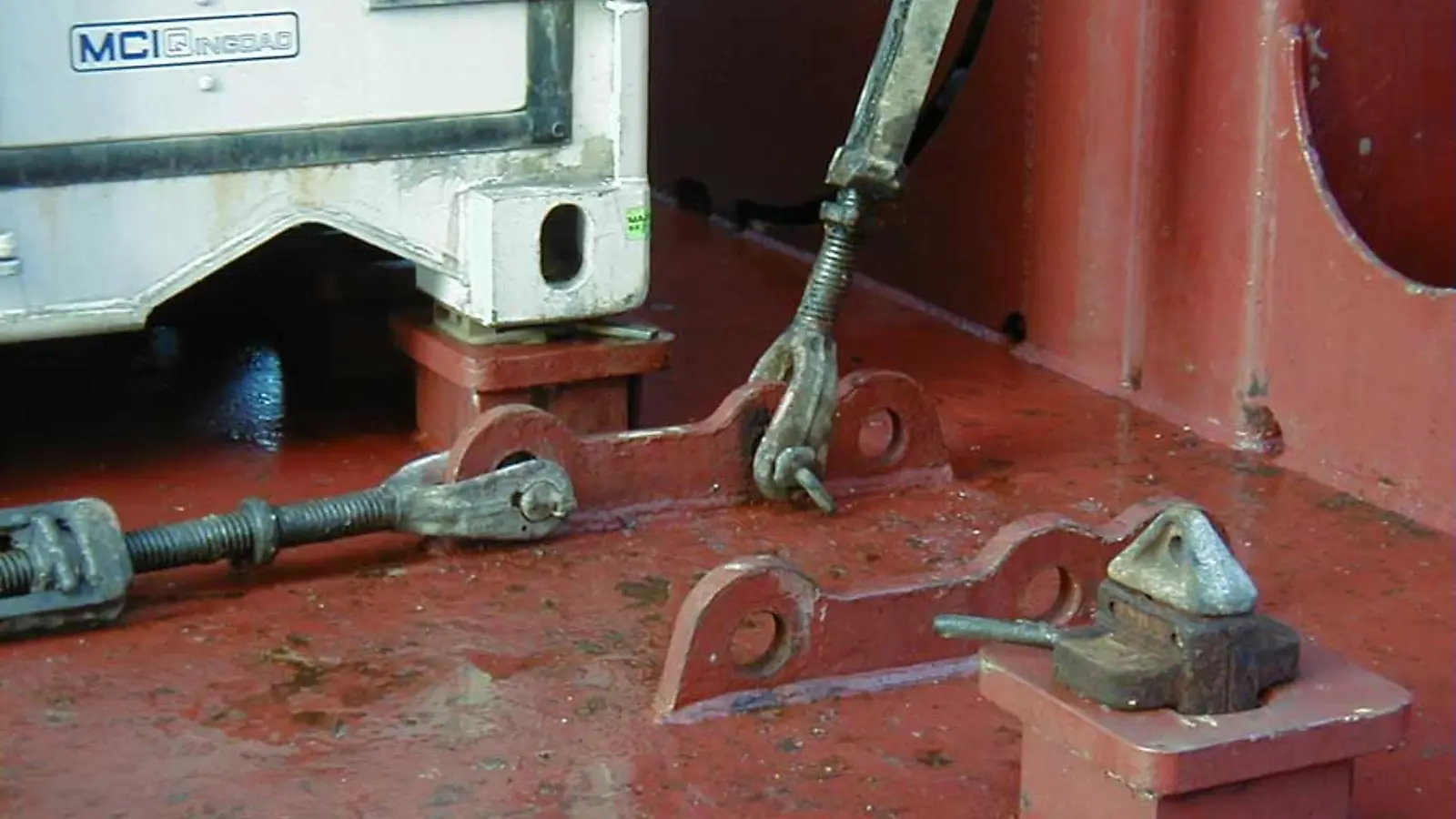
Once documentation has been reviewed, the physical securing arrangement can expose weaknesses quickly. Depending on vessel and cargo, this may include twistlocks, lashing rods, turnbuckles, bridge fittings, sockets, D-rings, chains, wires, tensioning devices, deck foundations and vehicle or project-cargo securing points.
Crews should look for:
- cracks, deformation, heavy corrosion or wastage;
- damaged or seized threads and mechanisms;
- missing pins, locking parts or retaining arrangements;
- mixed brands or types that are not approved as compatible;
- unreadable identification or absent traceability;
- unauthorised repairs or makeshift arrangements;
- incorrect application, poor tensioning or missing components;
- and loose equipment stored in a way that creates damage or deck hazards.
A maintenance record cannot compensate for visibly defective equipment. Conversely, equipment that appears clean may still be unsuitable if it is the wrong type or cannot be connected to the approved CSM arrangement.
The same document-versus-condition principle appears elsewhere in deck operations. Tide Signal’s ship mooring system guide explains why equipment capability, maintenance, arrangement and crew understanding must operate as one safety system.
VGM Is a Securing Input, Not Just an Administrative Number
For packed containers, the CIC questionnaire examines whether the cargo plan reflects verified gross mass information. The reason is operational: inaccurate weight data can affect stowage decisions, stack loads, lashing forces, stability and structural loading.
For a deeper reference, see SOLAS Chapter VI.
The IMO’s VGM guidance confirms that the shipper must provide the verified mass sufficiently in advance for use in the ship stowage plan and that VGM is a condition for loading a packed container.
For PSC preparation, the vessel should be able to show how the information moved from shipper and terminal data into the final cargo plan.
Late changes, restows, shut-outs or discrepancies should be controlled and reflected onboard. A PSCO may become concerned where terminal information, the final stow plan, loading calculations and actual container positions do not tell the same story.
Tide Signal’s guide to pre-stowage planning and cargo intake explains why available cargo space alone never determines what a ship can safely carry.
Heavy Weather: Procedures Must Leave Evidence
The IMO Code of Safe Practice for Cargo Stowage and Securing links securing decisions with the conditions expected during the intended voyage.
A credible SMS procedure should address forecast monitoring, route and speed decisions, weather-routing advice, additional cargo and equipment checks, safe access, reporting of defects, cargo-shift response and precautions against cargo loss.
Evidence may include:
- passage-plan amendments and Master’s decisions;
- weather forecasts and routing information;
- deck inspection records and lashing-check logs;
- bridge, deck or official logbook entries;
- Master’s standing orders and toolbox talks;
- defect reports, photographs and corrective-action records.
Evidence must never be created by exposing crew members to unacceptable risk. Procedures should define when deck access becomes unsafe and how the vessel manages the risk until conditions permit inspection.
15-Minute Pre-PSC Cargo Securing Check
If a PSC inspection is expected imminently, the following short review can help identify obvious gaps before the PSCO boards. It is not a substitute for the full vessel and company preparation process.
Correct vessel, current approval and immediately available.
Final plan and actual stow agree with approved securing instructions.
Applicable VGM data reflected correctly in the final cargo plan.
Correct type, sufficient quantity, compatible and suitable spares available.
No obvious cracks, deformation, seized mechanisms or unauthorised repairs.
Records match the condition actually seen onboard.
Actual stow and relevant assessment remain consistent.
Procedures, inspections and voyage decisions can be demonstrated.
Can explain the current arrangement, limits and required actions.
Outstanding problems are reported, risk-assessed and supported by a credible corrective plan.
The 48-Hour Pre-Arrival Plan
Documents and applicability
Confirm the applicable MoU questionnaire. Verify CSM approval and amendments, relevant CSM instructions, CSAP where applicable, final plan and VGM trail.
Plan-to-deck reconciliation
Compare actual stow and securing with the approved arrangement. Review weights, limits, visibility and late cargo changes.
Physical inspection
Inspect fixed and portable equipment. Isolate defective items, confirm compatible spares and record corrective action.
Officer familiarisation
Run practical questions with responsible officers using the current cargo arrangement and actual CSM.
Inspection evidence
Prepare the CSM, questionnaire, cargo plan, VGM records, inventory, maintenance evidence and relevant heavy-weather records.
Escalate open gaps
Do not conceal unresolved defects. Inform shore management, assess the risk and document the corrective plan before inspection.
Questions Masters and Officers Should Be Ready to Answer
- Where is the approved Cargo Securing Manual and which section governs the cargo currently onboard?
- What are the applicable stack, tier, tank-top, deck and hatch-cover limits?
- How was VGM information incorporated into the final cargo plan?
- How do you confirm portable securing devices are approved and compatible?
- Which defects require a securing component to be removed from service?
- How are securing-equipment inspections, maintenance and replacements recorded?
- How was bridge visibility checked for the current cargo arrangement?
- What actions are required before and during heavy weather?
- When was the securing arrangement last checked and what was found?
- What action would you take if the actual cargo or securing arrangement did not match the approved CSM?
The objective is not rehearsed answers. The people responsible for cargo safety should understand the vessel-specific limits, equipment and actions on which the ship depends.
What Shore Management Should Do During the CIC
The vessel cannot close every gap alone. Shore management should distribute the correct official questionnaire, identify ships and trades exposed to the campaign, review recurring cargo-securing deficiencies across the fleet and provide technical support where the manual, software or equipment arrangement is unclear.
Superintendents should pay particular attention to:
- outstanding CSM amendments or approval issues;
- replacement securing equipment ordered but not yet supplied;
- repeated lashing-equipment defects or inadequate spares;
- software, cargo-plan or VGM data-flow discrepancies;
- previous PSC, flag, class or internal findings involving cargo securing;
- and voyage instructions that may expose the vessel to severe weather.
Shore teams should also avoid producing “perfect” checklist answers that cannot be demonstrated onboard. A pre-arrival report is useful only when it reflects the real condition of the vessel and triggers appropriate support for unresolved gaps.
The Tide Signal view
The Cargo Securing CIC is not primarily a test of whether a ship can produce a manual. It is a test of alignment. The CSM, cargo plan, VGM trail, securing equipment, maintenance history and officers’ answers should describe the same operational reality. Ships are most exposed where those layers have quietly drifted apart.
Download the Official Paris MoU and Tokyo MOU CIC 2026 Questionnaires
Ships should prepare against the questionnaire issued by the authority responsible for the inspection rather than relying solely on an unofficial summary.
Port State Control CIC 2026: Frequently Asked Questions
Is the Paris MoU CIC 2026 currently active?
Yes. The joint Paris MoU and Tokyo MOU Concentrated Inspection Campaign on cargo securing runs from 1 September to 30 November 2026.
What does the Paris MoU CIC 2026 checklist cover?
Principal areas include the approved Cargo Securing Manual, clear securing instructions, officer familiarity, compliance of the actual securing arrangement with the CSM, VGM where applicable, safe access, portable and fixed securing equipment, equipment condition, bridge visibility and heavy-weather procedures.
Where can I download the official Paris MoU CIC 2026 questionnaire?
The official Paris MoU press release and questionnaire can be downloaded directly from the Paris MoU website . Ships trading in the Tokyo MOU region should also review the official Tokyo MOU campaign material .
Is the Cargo Securing CIC a new SOLAS requirement?
No. The campaign examines compliance with cargo loading, stowage and securing requirements already in force. What changes during the CIC is the concentrated and standardised inspection focus.
Can a ship be detained during the Cargo Securing CIC 2026?
Yes. The MoUs state that action on deficiencies may range from recording a deficiency to detention. A negative answer does not automatically mean detention; the seriousness and combination of findings are assessed by the inspecting authority.
Is the 2026 Cargo Securing CIC only for container ships?
No. Applicability depends on the vessel, cargo carried and securing arrangements. Container ships are highly exposed, but relevant questions may also apply to general cargo, multipurpose, ro-ro, vehicle and project-cargo vessels.
What is the most important document during the CIC?
The approved vessel-specific Cargo Securing Manual is the central reference, but possession of the manual alone is not enough. It should align with the actual cargo plan, VGM data where applicable, physical securing arrangement, equipment condition and responsible officers’ knowledge.
Are the Paris MoU and Tokyo MOU CIC questionnaires identical?
No. They are aligned in purpose but differ in numbering, wording and treatment of certain questions. Ships should therefore prepare against the official questionnaire used by the inspecting authority.
What should a vessel check first before a PSC cargo securing inspection?
Confirm which official questionnaire applies, verify the approved CSM, reconcile the final cargo plan with the actual stow, inspect securing equipment physically, verify applicable VGM data and ensure responsible officers can explain the current arrangement and vessel-specific limits.
Official Sources and Further Reading
- Paris MoU: 2026 Concentrated Inspection Campaign on Cargo Securing
- Paris MoU: Official CIC press release and questionnaire
- Tokyo MOU: Official Cargo Securing CIC material
- IMO: Code of Safe Practice for Cargo Stowage and Securing
- IMO: Cargo Securing and Packing
- IMO: Verification of the Gross Mass of a Packed Container
- IMO: International Convention for the Safety of Life at Sea
Updated: 5 September 2026. The Paris MoU and Tokyo MOU Cargo Securing CIC is currently in progress. This article is a general operational guide and does not constitute flag-State, class, legal or vessel-specific advice.
Featured image: Twistlock, lashing rod and turnbuckle fitted at the corner of a container on a containership deck. Photograph by Hervé Cozanet via Wikimedia Commons, licensed under CC BY-SA 3.0. Cropped, resized and converted to WebP by Tide Signal.