VLCC vs Suezmax vs Aframax is one of the most important size comparisons in crude-oil shipping. All three are large tankers, but they carry very different cargo parcels, face different port and draft limitations and produce very different voyage economics.
An Aframax offers flexibility. A Suezmax moves a much larger crude parcel while retaining access to trades that may be impractical for a VLCC. A VLCC is designed around scale: roughly two million barrels of crude can move on one ship when terminals, draft, cargo availability and route economics allow it.
The difference is therefore not simply that one tanker is larger than another.
Size changes the entire commercial equation: cargo intake, freight exposure, port access, ballast positioning, bunker consumption, terminal compatibility, canal transit and the number of barrels moved per voyage.
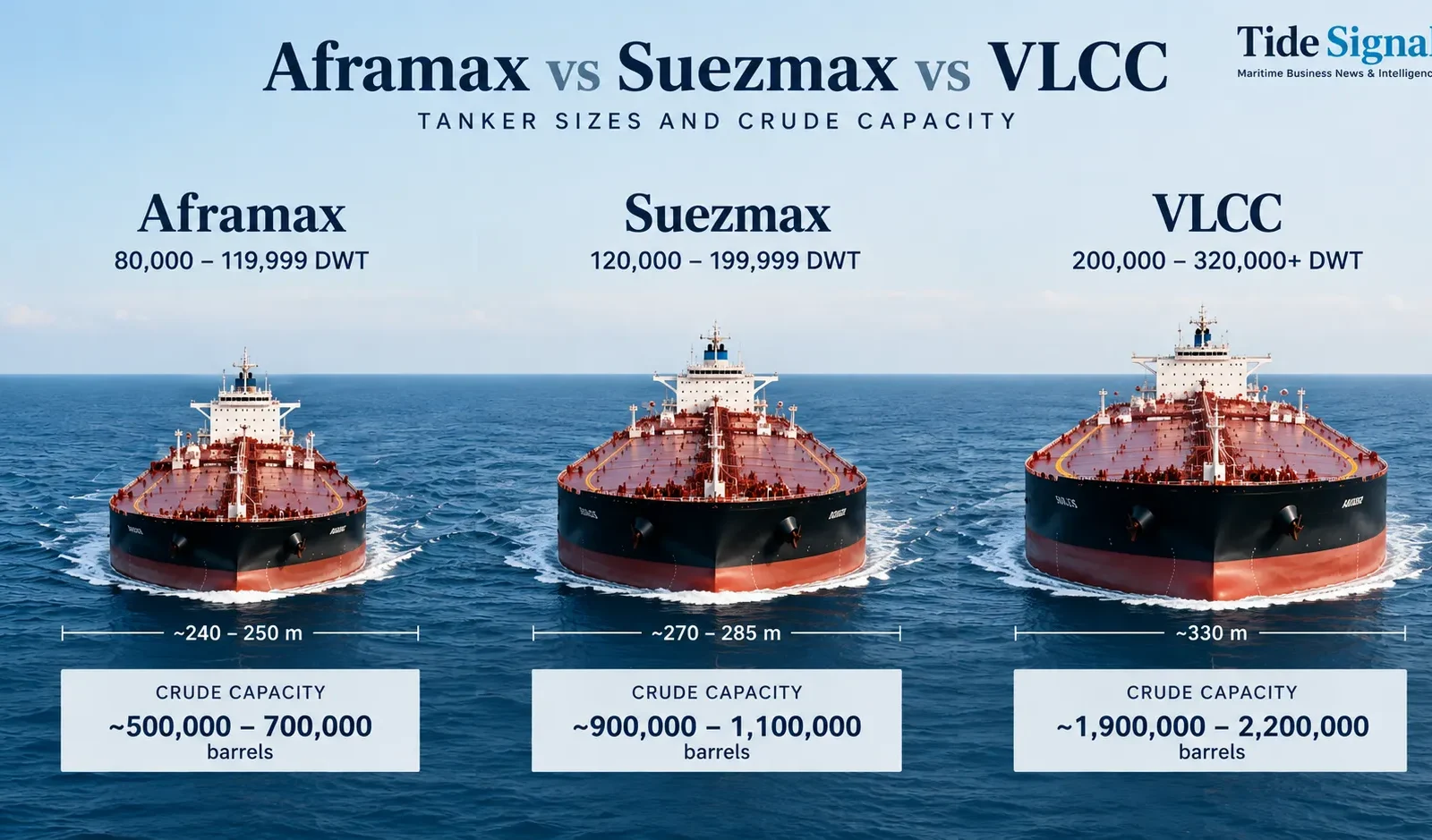
Aframax tankers generally occupy the roughly 80,000–120,000 DWT range and are widely used for flexible regional crude trades. Suezmax tankers sit around 120,000–200,000 DWT and commonly carry close to one million barrels of crude. VLCCs begin around 200,000 DWT and conventional modern VLCCs commonly sit near 300,000 DWT, carrying approximately two million barrels of crude.
VLCC vs Suezmax vs Aframax: Main Differences
| Feature | Aframax | Suezmax | VLCC |
|---|---|---|---|
| Typical DWT class | 80,000–119,999 | 120,000–199,999 | 200,000+ |
| Typical crude parcel | About 500,000–750,000 barrels | About 900,000–1.1 million barrels | About 1.9–2.2 million barrels |
| Typical length | ~240–250 m | ~270–285 m | ~330 m |
| Typical beam | ~42–44 m | ~48–50 m | ~58–60 m |
| Commercial strength | Port and route flexibility | Large parcel with broader access than VLCC | Maximum scale and long-haul economics |
| Typical employment | Regional / medium-haul crude | Atlantic Basin / larger crude parcels | Long-haul crude, especially Gulf–Asia |
| Main limitation | Less scale per voyage | Greater draft and terminal constraints | Requires deepwater terminals or specialised loading arrangements |
These figures are representative rather than universal design limits. Two vessels within the same commercial class can have different length, beam, summer deadweight, draft and cargo capacity.
The U.S. Energy Information Administration’s 2024 vessel classification, using Vortexa Analytics definitions, places Aframax at 80,000–119,999 DWT and Suezmax at 120,000–199,999 DWT. Its dataset groups tankers from 200,000 to 450,000 DWT as VLCCs. In everyday commercial usage, however, conventional VLCC discussion is commonly centred on ships around 300,000 DWT, with the exceptionally large end of the fleet also discussed separately as ULCC tonnage.
What Is an Aframax Tanker?
An Aframax tanker is a large tanker generally falling in the 80,000–120,000 DWT range.
The name is connected to the Average Freight Rate Assessment — AFRA — tanker classification system rather than to a geographic canal or port.
This immediately distinguishes the term from Suezmax.
An Aframax is valuable commercially because it sits in a useful middle ground. It carries a large crude parcel but remains significantly more flexible than a Suezmax or VLCC.
That flexibility can matter where:
- terminal draft is limited;
- berth dimensions restrict larger tankers;
- the available crude parcel does not justify a larger ship;
- voyage distance is relatively short;
- cargoes need to be distributed between several destinations;
- or the economics reward faster regional rotation rather than maximum parcel size.
Aframaxes therefore feature heavily in regional crude trading systems and in trades where port access is more valuable than the absolute lowest transport cost per barrel achievable on a much larger vessel.
What Is a Suezmax Tanker?
A Suezmax tanker is generally placed in the 120,000–200,000 DWT range.
The name historically reflects the concept of the largest practical tanker size associated with transit through the Suez Canal under the relevant dimensional and draft limitations.
That does not mean every ship described as Suezmax can simply arrive fully laden and transit under every operating condition.
Canal restrictions evolve, vessel designs vary, water level and draft matter, and the operational condition of the ship must always be checked against the current Suez Canal Authority rules.
Commercially, a Suezmax occupies an important position between Aframax flexibility and VLCC scale.
It can move a crude parcel around the one-million-barrel level while accessing trades and terminals where a fully laden VLCC would be impractical.
What Is a VLCC?
VLCC stands for Very Large Crude Carrier.
VLCCs sit at the top end of mainstream crude transportation and typically carry around two million barrels of crude on a conventional full cargo, depending on vessel specification, cargo density, bunkers, draft and terminal restrictions.
Modern VLCCs are commonly around 330 metres long and approximately 60 metres in beam.
Their commercial advantage is scale.
If enough crude is available and the terminals can handle the ship, one VLCC can move roughly the cargo carried by around two Suezmaxes or several smaller tankers.
The U.S. Energy Information Administration has previously illustrated the scale difference clearly: two Suezmax cargoes or around four Aframax cargoes may be required to move a crude volume comparable to one VLCC, depending on actual parcel sizes.
That is why VLCCs dominate many long-haul crude trades, particularly where large export terminals connect major producing regions with Asian refining demand.
Tide Signal tracks the commercial side of this market in its analysis of VLCC freight rates on the Gulf of Oman–China trade and its breakdown of the reported $25 million VLCC voyage.
How Much Oil Can VLCC, Suezmax and Aframax Tankers Carry?
Oil cargo capacity is often discussed in barrels because crude trading is widely expressed in barrels, while ship capacity is normally stated in tonnes of deadweight.
The conversion is not fixed.
Different crude grades have different densities. A tonne of a lighter crude can represent more barrels than a tonne of a heavier crude.
Bunkers and other onboard weights also reduce the amount of deadweight available for cargo.
| Tanker | Indicative crude cargo | Commercial shorthand |
|---|---|---|
| Aframax | Approximately 500,000–750,000 barrels | Regional large crude parcel |
| Suezmax | Approximately 900,000–1.1 million barrels | Roughly 1 million barrels |
| VLCC | Approximately 1.9–2.2 million barrels | Roughly 2 million barrels |
Cargo volume depends on crude density, the vessel’s actual summer deadweight, bunkers and consumables, load-line condition, terminal draft, water density, under-keel-clearance requirements and voyage-specific operating limits.
VLCC vs Suezmax vs Aframax Dimensions
Tanker classes are primarily commercial deadweight categories, not rigid naval-architecture templates.
A class name therefore does not guarantee one exact length, beam or draft.
Representative modern dimensions are approximately:
| Class | Length overall | Beam | Typical laden-draft scale |
|---|---|---|---|
| Aframax | ~240–250 m | ~42–44 m | Often around the mid-teens metres |
| Suezmax | ~270–285 m | ~48–50 m | Often approaching ~17–18 m depending on design |
| VLCC | ~330 m | ~58–60 m | Often around ~20 m or more when deeply laden |
These should be treated as representative figures only. The ship’s approved particulars and current condition determine the real operating limit.
Why Deadweight Matters More Than Length Alone
Looking only at ship length can be misleading.
A tanker earns money by transporting cargo, and one of the most important capacity measures is therefore deadweight tonnage.
Deadweight is the difference between the ship’s displacement at its assigned loaded condition and its lightweight. IMO regulations define deadweight in tonnes using the ship’s displacement at the draft corresponding to its assigned summer freeboard.
But not all deadweight becomes cargo.
The remaining cargo quantity must still comply with draft, trim, stability, structural, terminal and voyage requirements.
Why Aframax Tankers Are More Flexible
Aframax does not win the comparison by carrying the most oil.
Its commercial advantage is flexibility.
Smaller dimensions and draft can create access to a larger number of terminals than a VLCC can use fully laden.
That can reduce the need for:
- offshore loading;
- lightering;
- ship-to-ship transfer;
- partial loading;
- or an additional feeder tanker.
On a shorter voyage, this flexibility can outweigh the scale advantage of a VLCC.
The correct commercial comparison is therefore not simply:
A more realistic sequence is:
That broader commercial process is explained in Tide Signal’s Voyage Estimation in Shipping guide.
Why VLCCs Dominate Long-Haul Crude Trades
Long-haul crude shipping rewards scale.
If a cargo travels thousands of nautical miles, a large parcel can spread vessel and voyage costs over more barrels.
A VLCC therefore becomes particularly attractive when three conditions exist:
- a large enough crude parcel is available;
- both ends of the voyage can accommodate the ship or use suitable offshore transfer infrastructure;
- the freight economics reward the larger ship.
This is one reason VLCC employment is closely associated with very large crude flows between the Middle East and Asia.
The commercial market then expresses much of that freight through Worldscale.
Why a Charterer Might Choose Suezmax Instead of VLCC
A VLCC may have better theoretical scale economies, but it is not automatically the right ship.
A charterer might prefer Suezmax because:
- the cargo parcel is close to one million barrels rather than two million;
- the terminal cannot safely handle a laden VLCC;
- draft restrictions make full VLCC intake impossible;
- the destination requires greater flexibility;
- the crude programme does not justify combining two parcels;
- the Suezmax freight market produces the stronger net voyage result;
- or suitable Suezmax tonnage is better positioned.
The last point is important.
Freight markets price ships in the place and time where charterers need them.
A perfectly positioned Suezmax can be commercially preferable to a VLCC that must perform a long ballast voyage before reaching the loading area.
Why a Charterer Might Choose Aframax Instead of Suezmax
The same logic applies one size lower.
An Aframax can be preferable where the parcel, port or voyage does not justify a Suezmax.
For shorter routes, faster cargo turnover and smaller parcels, the larger vessel’s scale advantage can be offset by:
- higher port or terminal constraints;
- greater ballast exposure;
- lower utilisation if the vessel cannot load near its capacity;
- higher absolute bunker consumption;
- and fewer commercially workable terminals.
Port Draft Can Decide the Tanker Before Freight Does
A crude fixture is not workable simply because the vessel has enough cargo-tank volume.
The ship must safely enter, berth, load, sail and discharge within the operational restrictions of the voyage.
Important constraints include:
- maximum arrival and sailing draft;
- under-keel clearance;
- water density;
- tidal windows;
- channel width;
- turning-basin dimensions;
- berth length;
- manifold compatibility;
- mooring arrangement;
- terminal displacement limits;
- and tug or pilot requirements.
This is why the largest ship is not automatically the most efficient ship.
Can VLCCs Use the Suez Canal?
The word Suezmax can create the impression that anything larger cannot use the Suez Canal at all.
That is too simplistic.
Canal transit depends on the current dimensional and draft rules as well as the vessel’s actual condition. Historically, larger tankers that could not transit fully laden could reduce draft by discharging part of their cargo through arrangements such as the SUMED pipeline system before transit and restoring cargo arrangements afterward.
The correct operational question is therefore not:
“Is this ship called a VLCC?”
It is:
“Does this vessel, at this draft and in this condition, meet the current transit requirements?”
VLCC vs Suezmax vs Aframax Voyage Economics
The economics of tanker size are a balance between scale and flexibility.
Flexibility
Smaller parcel and broader terminal access can make the ship competitive in regional trades.
Balance
Large cargo intake with more flexibility than VLCC creates a strong middle position.
Scale
Very large crude parcels can reduce transport cost per barrel on suitable long-haul trades.
But freight cannot be analysed from DWT alone.
A professional voyage comparison should also consider:
- ballast distance;
- laden distance;
- bunker consumption;
- bunker price;
- port costs;
- canal or transit costs;
- waiting time;
- cargo quantity;
- commissions;
- war-risk costs where applicable;
- and the vessel’s commercial position after discharge.
Tide Signal’s Voyage Margin Calculator provides a practical framework for modelling freight revenue and voyage cost.
Worldscale and Tanker Size
Tanker freight is frequently quoted using Worldscale.
Worldscale does not mean that a VLCC, Suezmax and Aframax on related routes automatically earn the same freight or TCE.
Each benchmark reflects its own route assumptions and market.
The important commercial distinction is between:
- the Worldscale percentage;
- the route-specific flat rate;
- the resulting freight revenue;
- the voyage expenses;
- and the TCE produced by the voyage.
For a full explanation, read Worldscale in Shipping: How WS100 and Tanker Freight Work.
VLCC Freight Can Be Lower Per Barrel but Higher in Total
A larger ship may achieve a lower transportation cost per barrel while still producing a much larger total freight invoice.
That distinction matters.
Two million barrels multiplied by a relatively efficient per-barrel cost can still produce a very large voyage value.
During periods of extreme tanker scarcity, the scale of the absolute freight can become extraordinary.
Tide Signal’s $25 Million VLCC Voyage shows how security risk and constrained effective vessel supply can dramatically reprice a large crude shipment.
What Is the Difference Between Aframax and LR2?
This is one of the most useful distinctions in tanker terminology.
Aframax and LR2 can occupy a similar deadweight range, but the commercial labels describe different market contexts.
Aframax is commonly associated with crude-oil tanker employment.
LR2, or Long Range 2, is principally a product-tanker market label for larger vessels designed and traded in refined-product transportation.
The U.S. EIA’s 2024 Vortexa-based classification places both Aframax and LR2 in the 80,000–119,999 DWT band.
That does not make every Aframax an LR2 or every LR2 commercially interchangeable with a crude Aframax.
Cargo-tank coating, previous cargoes, segregation, pumps, terminal acceptance, charterer requirements and vessel specifications all matter.
The size can overlap. The commercial employment does not necessarily overlap. A vessel class should never be identified from deadweight alone when cargo system and market role are commercially important.
VLCC vs ULCC: What Is the Difference?
VLCC means Very Large Crude Carrier.
ULCC means Ultra Large Crude Carrier.
The boundary varies between classification schemes, but ULCC is generally used for crude tankers above the conventional VLCC size range.
Historically, some ULCCs exceeded 400,000 DWT.
Their extraordinary scale also creates major constraints.
Very deep draft and large dimensions reduce the number of terminals able to accept them, which is one reason mainstream long-haul crude transportation has centred much more heavily on the approximately 300,000-DWT VLCC.
Ship-to-Ship Transfers Can Change the Size Equation
Not every crude cargo has to move from terminal to terminal on one vessel.
Ship-to-ship transfer can connect different parts of the logistics chain.
For example, smaller tankers may shuttle cargo from a draft-restricted terminal to a larger tanker waiting offshore.
Conversely, a large tanker may discharge part of its cargo to smaller vessels for distribution into ports it cannot access directly.
This can unlock VLCC scale while retaining smaller-vessel flexibility, but it introduces another operational stage.
That stage can involve:
- additional vessel positioning;
- weather limitations;
- fender and hose arrangements;
- mooring risk;
- cargo-transfer planning;
- waiting time;
- counterparty checks;
- and extra cost.
Read Tide Signal’s dedicated Ship-to-Ship Operations and Tanker Transfers guide for the operational framework.
Does a Bigger Tanker Always Mean Better Economics?
No.
This is one of the most common mistakes in tanker comparison.
A bigger tanker gives the owner and charterer access to stronger economies of scale only when the trade can actually use that scale.
A VLCC carrying substantially less than its economic parcel because of draft or cargo availability can lose much of its theoretical advantage.
Likewise, a long ballast leg can make a larger vessel less attractive than a smaller ship already positioned near the loading area.
The correct commercial test is the complete voyage result.
Best Tanker = Best Workable Voyage Economics for the Actual Cargo and Route
VLCC, Suezmax and Aframax in Chartering
Vessel size directly affects chartering strategy.
Before fixing a crude tanker, charterers and owners may evaluate:
- cargo quantity and tolerance;
- laycan;
- load and discharge ports;
- maximum draft;
- terminal restrictions;
- Worldscale level or lump-sum freight;
- owner approval;
- vetting;
- sanctions and compliance;
- bunker exposure;
- war-risk exposure;
- expected waiting;
- and subsequent employment.
The wider contractual structure is covered in Tide Signal’s Types of Charter Parties in Shipping guide.
Why Effective Vessel Supply Matters
A crude tanker can exist physically without being commercially available for a particular cargo.
The vessel may:
- be committed elsewhere;
- be too far from the loading area;
- fail charterer vetting;
- be unacceptable because of age or specification;
- face sanctions or compliance limitations;
- have an owner unwilling to accept the route;
- or be unable to meet the required laycan.
This distinction between global fleet size and effective vessel supply is critical in tanker markets.
It helps explain why freight can rise sharply even without a physical shortage of ships globally.
Why Tanker Size Matters for Asset Values
VLCC, Suezmax and Aframax markets can move through different freight cycles.
That means asset values do not necessarily rise and fall together.
A stronger VLCC market can increase buyer willingness to pay for immediate access to VLCC earnings, while a softer Aframax market could produce a different secondhand valuation trend.
Tide Signal’s VLCC Asset Values analysis explains how freight, delivery timing and immediate earning power can reshape secondhand and newbuilding values.
The VLCC Orderbook Adds Another Layer
Vessel-size economics are not static.
A strong freight market can encourage newbuilding orders. Several years later, those vessels enter the fleet and alter supply.
The effect depends on:
- new deliveries;
- scrapping;
- fleet age;
- trade growth;
- voyage distance;
- sanctions;
- slow steaming;
- port congestion;
- and geopolitical disruption.
For the current VLCC supply picture, read 217 VLCC Orders in 2026: The Supertanker Orderbook Explained.
VLCC vs Suezmax vs Aframax: Which Is Best?
There is no universally best crude tanker size.
Each class solves a different commercial problem.
| If the priority is… | Class often suited to the job | Why |
|---|---|---|
| Maximum crude volume per voyage | VLCC | Largest mainstream crude parcel and strongest long-haul scale economy. |
| Large parcel with more flexibility | Suezmax | Strong balance between cargo intake and terminal access. |
| Regional flexibility | Aframax | Smaller dimensions and draft can expand the workable port network. |
| Two-million-barrel long-haul crude trade | VLCC | Designed around very large intercontinental crude movements. |
| Approximately one-million-barrel parcel | Suezmax | Commercially aligned with the parcel without requiring VLCC scale. |
| Smaller or draft-constrained crude movement | Aframax | Greater operational flexibility can outweigh economies of scale. |
VLCC vs Suezmax vs Aframax: Frequently Asked Questions
What is the difference between VLCC, Suezmax and Aframax?
The main difference is carrying capacity and the resulting commercial role. Aframax is generally around 80,000–120,000 DWT, Suezmax around 120,000–200,000 DWT and VLCC begins around 200,000 DWT. Larger ships move more crude but normally face greater draft and terminal constraints.
How much oil does an Aframax tanker carry?
An Aframax commonly carries roughly 500,000–750,000 barrels of crude, although actual cargo depends on vessel deadweight, cargo density, bunkers, draft and voyage restrictions.
How much oil does a Suezmax tanker carry?
A Suezmax is commonly associated with crude parcels around 900,000 to 1.1 million barrels, often simplified commercially as approximately one million barrels.
How much oil does a VLCC carry?
A conventional VLCC commonly carries approximately two million barrels of crude, with actual intake depending on cargo density, vessel specification, bunkers and draft restrictions.
What does VLCC stand for?
VLCC stands for Very Large Crude Carrier.
What does Aframax mean?
Aframax is linked to the Average Freight Rate Assessment, or AFRA, tanker classification system. It is not named after a canal or geographic location.
Why is it called Suezmax?
The term developed around the concept of the maximum practical tanker size associated with Suez Canal transit restrictions. Actual transit capability still depends on the ship’s dimensions, draft, condition and current canal rules.
Is a Suezmax bigger than an Aframax?
Yes. A Suezmax generally occupies the 120,000–200,000 DWT range, while Aframax normally sits around 80,000–120,000 DWT.
Is a VLCC bigger than a Suezmax?
Yes. VLCCs begin around 200,000 DWT and conventional modern VLCCs commonly sit near 300,000 DWT, significantly above typical Suezmax capacity.
Can a VLCC pass through the Suez Canal?
The answer depends on vessel dimensions, actual draft and the current Suez Canal transit requirements. A VLCC may not be able to transit fully laden under conditions where its draft exceeds the applicable limit, so operational solutions can include reduced loading or cargo-routing arrangements.
What is the difference between Aframax and LR2?
Their DWT ranges can overlap, but Aframax is commonly a crude-tanker market description while LR2 is principally used for large product tankers. Vessel cargo systems, coatings, previous cargoes and commercial employment therefore matter in addition to deadweight.
For related Tide Signal market analysis, see US Diesel Export Ban: What It Could Mean.
Which is cheaper: Aframax, Suezmax or VLCC?
There is no fixed answer. VLCCs can achieve lower transport cost per barrel on suitable large long-haul cargoes, while Aframax or Suezmax may be cheaper overall where cargo quantity, port restrictions, ballast position or terminal access make the larger ship inefficient.
Does DWT mean cargo capacity?
Not exactly. Deadweight includes cargo plus bunkers, water, stores and other variable weights. Actual cargo intake is therefore lower than the vessel’s total DWT and can be reduced further by draft or terminal restrictions.
Sources and Industry References
- U.S. Energy Information Administration — Oil tanker class definitions — 2024 report using Vortexa Analytics vessel-class data for Aframax, Suezmax, VLCC and other tanker categories.
- U.S. Energy Information Administration — Oil tanker sizes and the AFRA scale — background on tanker classification, deadweight and approximate cargo-capacity methodology.
- U.S. Energy Information Administration — U.S. crude export port limitations — practical comparison of Aframax, Suezmax and VLCC cargo scale and deepwater-port constraints.
- International Maritime Organization — international regulatory framework and technical definitions relevant to oil tankers and ship deadweight.
- Worldscale Association — tanker freight-rate framework used in international oil transportation.
- Baltic Exchange — Tanker market information — benchmark tanker routes, freight assessments and time-charter-equivalent market data.