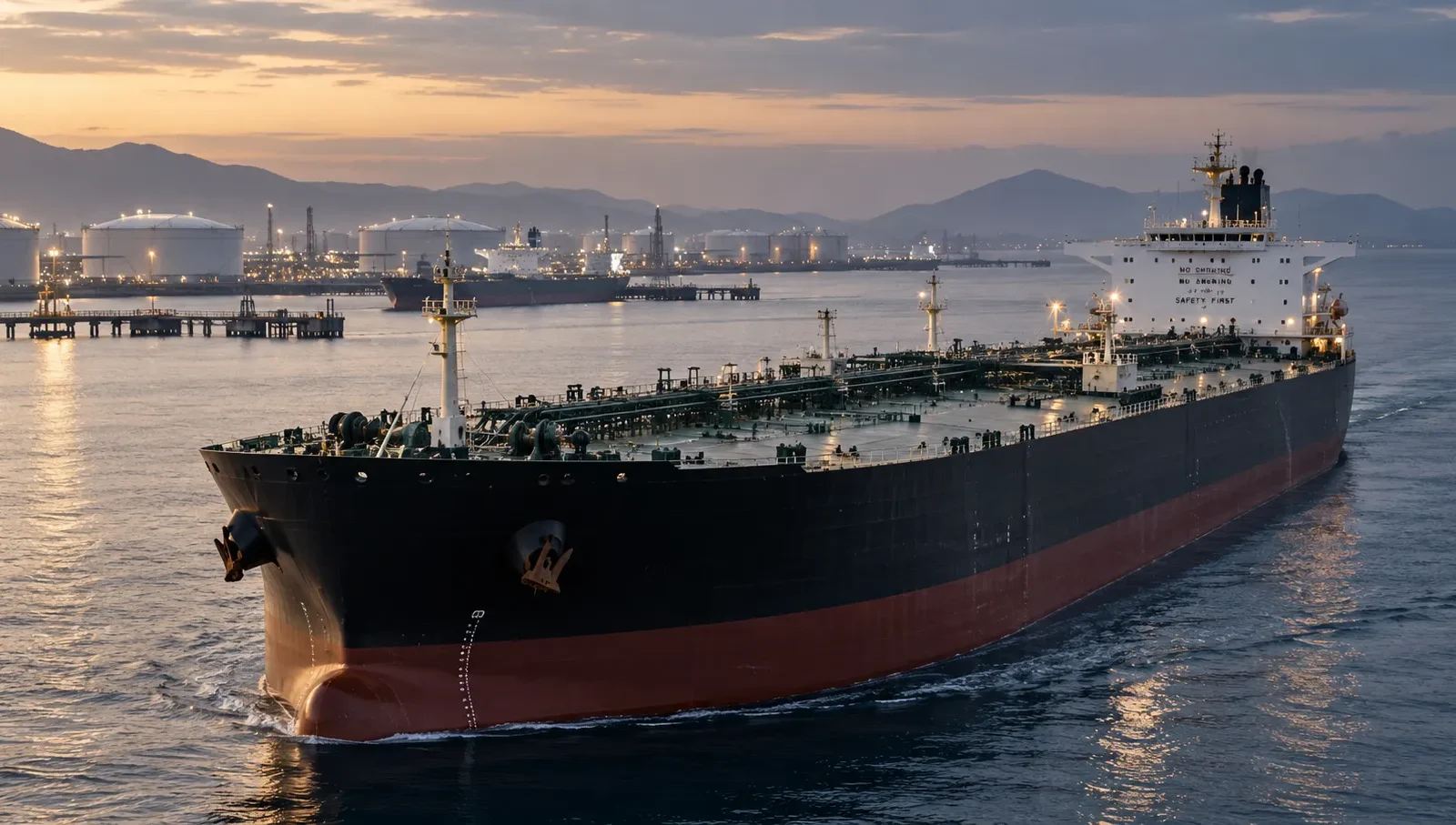
VLCC asset values have moved into historically unusual territory, with brokers now indicating that a 10-year-old Very Large Crude Carrier can be worth more than a comparable newbuilding contract. Braemar estimates cited on 15 September put a five-year-old South Korea-built VLCC near $170 million, a 10-year-old ship close to $150 million, and a newbuilding at roughly $135 million.
The headline is striking, but the market logic is deeper than “used ships are expensive”. Buyers are paying for immediate earning capacity at a time when crude-tanker freight has reached levels that can make three or four years of waiting for a new ship extraordinarily costly.
In other words, the tanker market is placing a premium on time.
A newbuilding may be younger, more efficient and technically superior. A secondhand VLCC, however, can trade now. When a vessel can potentially enter a freight market producing exceptional cash flow immediately, the normal depreciation curve can invert.
Indicative VLCC values are broker estimates, not executable offers for every vessel. Actual sale prices depend on yard, specification, surveys, scrubber status, delivery timing, class, trading history and buyer urgency.
VLCC Asset Values: Why a 10-Year-Old Ship Can Be Worth More Than a Newbuilding
Under normal market conditions, ship values follow a relatively intuitive curve. A newbuilding is worth more than a five-year-old ship, which is worth more than a 10-year-old ship, because the older vessel has fewer remaining trading years and may face higher maintenance, regulatory and vetting costs.
That logic has not disappeared. But another variable has become powerful enough to override it: delivery time.
A secondhand VLCC can be delivered and earning within weeks or months. A new ship ordered today may require several years before it enters service, depending on the shipyard and slot.
When freight earnings are normal, waiting can be acceptable. When freight earnings become extraordinary, waiting becomes an opportunity cost.
The current asset-price inversion therefore says something important about the freight market: buyers are assigning very high value to the right to participate immediately.
The VLCC Price Curve Has Inverted
Braemar’s latest market indications, reported on 15 September, place a five-year-old South Korean-built VLCC near $170 million and a 10-year-old ship close to $150 million, against about $135 million for a South Korean newbuilding.
The broker described the 10-year-old relationship as unprecedented in its experience: for the first time, a 10-year-old VLCC is being indicated above a newbuilding price.
| VLCC benchmark | Current indication | What the price is buying |
|---|---|---|
| 5-year-old South Korea-built | ~$170m | Modern tonnage plus immediate delivery and full access to the current earnings cycle. |
| 10-year-old VLCC | ~$150m | Less remaining life, but prompt trading exposure while earnings are exceptional. |
| South Korea newbuilding | ~$135m | New specification and longer asset life, but delayed delivery and no near-term spot-market exposure. |
The same market has produced other unusual valuation signals.
The Signal Group’s end-August benchmark showed VLCC values up roughly 30% year on year at five years, 42% at ten years, 61% at fifteen years and 90% at twenty years. Signal’s absolute values were lower than the latest Braemar indications — around $151.1 million for a five-year-old VLCC and $122.8 million for a 10-year-old ship — illustrating how quickly the market has moved and how broker valuations can differ.
That variation is important. Ship valuation is not a single exchange-traded price. Different brokers can produce materially different numbers depending on methodology, vessel specification and the transaction evidence available at the time.
For Tide Signal readers, the correct conclusion is not that every 10-year-old VLCC is automatically worth exactly $150 million. The important market signal is that prompt secondhand tonnage is now being valued at levels that can exceed newbuilding benchmarks.
Freight Earnings Explain the Asset-Price Shock
The asset market cannot be understood without the freight market behind it.
The Baltic Exchange’s Middle East Gulf–China TD3C benchmark has moved through the equivalent of $1 million per day in the current crisis. That number needs caution because normal fixing patterns inside the Gulf have become severely distorted and the willing owner pool is unusually small.
But even outside the most extreme benchmark, tanker earnings remain historically high.
Tide Signal has already tracked the freight repricing through the record WS450 Gulf of Oman–China VLCC market, where freight reached approximately $11.50 per barrel, and through the reported $25 million VLCC voyage for Iraqi crude.
Those are freight stories. VLCC asset values are the balance-sheet transmission of the same scarcity.
If a ship can enter a market producing exceptional daily cash flow now, its value changes before the global fleet count changes.
The $1 Million-a-Day Benchmark Does Not Mean Every VLCC Earns $1 Million
This distinction is essential.
Spot assessments are market benchmarks. They are not guaranteed earnings for every ship in the fleet.
Actual VLCC economics depend on the loading and discharge ports, ballast position, Worldscale or lump-sum freight, voyage duration, bunker consumption, war-risk insurance, crew and security costs, waiting time, commissions, sanctions and compliance restrictions, vessel specification and the value of the ship’s next employment.
For readers who want the mechanics behind tanker freight, Tide Signal’s Worldscale guide explains how WS rates relate to voyage freight and TCE, while the Voyage Margin Calculator provides an indicative framework for testing freight revenue against voyage costs.
DHT Just Locked a 10-Year-Old VLCC at $100,000 a Day for Three Years
One of the clearest pieces of evidence supporting higher asset values comes from DHT Holdings.
For related Tide Signal market analysis, see hipping Stocks Surge in 2026 as Tanker Shares.
On 14 September, DHT announced that the 2016-built DHT Panther had secured a three-year time charter at $100,000 per day, starting in October, with a global energy company.
That is strategically important because a multi-year charter removes part of the argument that today’s extraordinary spot market is too temporary to justify higher asset values.
A buyer of an older VLCC is still exposed to residual-value, technical and regulatory risk. But if a comparable vessel can lock six-figure daily employment for three years, the asset has visible forward cash-flow capacity.
Frontline’s $270 Million Sale Shows How Much Equity Has Been Created
The sale-and-purchase market is also producing realised transactions, not only theoretical valuations.
Frontline agreed in August to sell two 2017-built VLCCs for a combined $270 million, or $135 million per ship. The company said the disposal would generate approximately $179 million in net cash proceeds after debt repayment and an estimated $110 million gain.
After completion, Frontline declared a special one-time dividend of $0.80 per share in addition to its regular second-quarter dividend.
The transaction highlights a fundamental owner decision in a strong asset market: keep the ship and harvest freight, or sell the ship and crystallise asset appreciation.
Reported $200 Million Resale Deals Show the Premium for Prompt Delivery
The most aggressive end of the market is even more striking.
Recent broker reports have linked a very prompt VLCC resale in the Middle East to a price near $200 million, with another prompt transaction reported around $169 million.
TradeWinds has separately reported a “stratospheric” $200 million VLCC resale price connected with Middle Eastern buyers and Dynacom-linked tonnage.
These reports need to be treated correctly: a broker-reported deal can remain subject to confirmation, final terms, inspection or delivery conditions.
But even an indicative $200 million resale discussion tells the market something important: a ship available now is not being compared only with another ship. It is being compared with the value of several years of foregone earnings.
Why Middle Eastern NOCs Are Buying Ships
The current VLCC asset market is also being shaped by strategic buyers that value control as much as investment return.
ADNOC Logistics & Services announced in August that it would acquire six secondhand VLCCs and five VLGCs as part of a $1.3 billion fleet expansion. The six VLCCs were scheduled for delivery in the third quarter and would take ADNOC L&S’s VLCC fleet to 14 ships.
For a national oil company, owning or controlling tankers can reduce dependence on external owners during a disruption.
That matters because Strait of Hormuz disruption has shown that physical vessel supply and commercially available vessel supply are not the same thing.
A ship may exist but still be unavailable because the owner refuses Gulf exposure, war-risk terms are unacceptable, the charterer cannot clear the ship, the payment chain is restricted, the vessel is not in the correct position or the owner can earn more elsewhere.
Owning the transport asset can therefore become a form of energy-security infrastructure.
NOC-Owned VLCCs Are Taking a Larger Share of Middle East Exports
Broker estimates cited by Breakwave indicate that NOC-owned VLCCs carried roughly 24% of Middle East VLCC exports after the U.S.–Iran conflict began, compared with about 12% in 2023.
That shift matters beyond the asset market. If national oil companies continue building controlled fleets, more crude may move on vessels that are not fully exposed to the conventional independent spot market.
In the short term, buying pressure can push secondhand tanker prices higher. In the longer term, a larger producer-controlled fleet could reduce spot-market liquidity and eventually change the earnings ceiling available to independent owners.
The Market Is Paying for Optionality
Shipping assets are valuable partly because of the cargo they can carry and partly because of the options they provide.
A prompt VLCC gives its owner choices: enter the spot market immediately, secure a period charter at elevated rates, sell the ship into a strong S&P market, use the vessel strategically for proprietary crude flows, reposition according to risk appetite or retain exposure to further freight upside.
A newbuilding provides a different option set: newer machinery, longer remaining economic life, potentially better fuel performance, lower near-term survey and maintenance burden, better flexibility for future emissions regulation and a lower headline acquisition price in the current market.
The problem is that the newbuilding option cannot normally be exercised today.
That difference is what the market is capitalising.
Why Buying a $150 Million 10-Year-Old VLCC Is Not Automatically Rational
High freight can make an expensive ship look cheap very quickly. It can also create dangerous assumptions.
A buyer of 10-year-old tonnage still needs to evaluate remaining useful life, special surveys and drydocking, vetting and charterer acceptance, fuel efficiency, regulatory exposure and residual value.
CII, EEXI, EU ETS exposure on applicable voyages and future decarbonisation requirements can make older vessels more expensive to operate or more difficult to optimise. The buyer is also paying a very large premium at a point when the freight market is historically abnormal. If rates normalise quickly, secondhand asset values can fall faster than the physical ship deteriorates.
War Risk Is Inflating Both Freight and the Value of the Right Ship
One of the paradoxes of the current market is that higher physical risk is increasing the value of certain vessels.
Normally, additional risk should reduce an asset’s attractiveness. But when risk removes competing ships from a trade, the vessels that remain willing, insurable and operational can become more valuable because they gain pricing power.
Tide Signal’s guide to war-risk premiums explains how geopolitical exposure moves through freight, insurance, charterparty terms and owner approval.
The asset-market extension is straightforward: if risk makes a usable VLCC more profitable, the market may capitalise part of that earning power into the ship’s value.
Clean Tanker Rates Show the Boom Is Broader Than VLCCs
The crude tanker market is the most spectacular part of the current cycle, but it is not operating alone.
Tide Signal’s latest clean tanker rates analysis shows Middle East LR2, LR1 and MR routes also producing exceptional freight levels, including TC1 at WS785 and an indicative Baltic TCE around $232,000 per day.
That broader strength matters for asset pricing because investors and owners are not looking at one isolated VLCC route. They are looking at a regional energy-shipping system in which multiple tanker segments are being repriced by vessel scarcity, longer voyages and geopolitical risk.
Why Newbuildings Have Not Risen as Fast
Newbuilding prices respond differently from secondhand values.
A secondhand transaction reflects what a buyer will pay for immediate delivery in today’s market. A shipbuilding contract reflects yard capacity, steel and equipment costs, labour, engine specification, fuel technology, financing, yard competition, payment schedule and a delivery date years into the future.
That makes the newbuilding market structurally slower to reprice.
It also means the two prices are not direct substitutes. A $135 million newbuilding delivered several years from now and a $150 million 10-year-old VLCC available today solve different commercial problems.
The Newbuilding Buyer Is Making a Different Bet
An owner ordering a new VLCC today is effectively saying: the value of owning a modern ship through the late 2020s and 2030s is more important than capturing every dollar of the current spot-market spike.
That buyer may believe current secondhand prices contain too much cycle risk, future environmental regulation will favour newer tonnage, yard prices remain attractive relative to resale values, future fleet growth will remain manageable, long-term crude tonne-mile demand will remain supportive or the owner already has enough near-term market exposure.
That is why a cheaper newbuilding does not mean the market believes a new ship is technically inferior. It means time has become expensive.
Could VLCC Asset Values Fall as Fast as They Rose?
Yes.
Shipping asset values can move quickly because they are a leveraged reflection of expected future earnings.
The current premium could compress if Hormuz risk de-escalates materially, more owners return vessels to Gulf trading, war-risk premiums fall, oil flows normalise, spot VLCC earnings retrace sharply, NOC buying slows, yard delivery slots improve, the VLCC orderbook begins to weigh on forward expectations or buyers decide the remaining life of older ships no longer justifies the premium.
Conversely, values could remain elevated if freight stays exceptional, state-backed buyers continue acquiring prompt tonnage and the market remains short of ships that are both available and willing to perform high-risk voyages.
What the Asset Market Is Telling Shipping Investors
The most useful signal is not the absolute $150 million number.
It is the relationship between three prices: the price of a ship today, the price of a ship delivered later, and the earnings available between those two dates.
When the expected value of immediate cash flow exceeds the normal discount applied to age, secondhand ships can trade above newbuildings.
That is exactly what the current VLCC market is demonstrating.
The tanker market is no longer pricing age in isolation. It is pricing access to time.
A 10-year-old VLCC normally carries a clear discount to a new ship because it has less remaining life. Today, that discount can disappear because the older vessel can participate immediately in a freight market that a newbuilding ordered now may never see.
The inversion will not last forever. But while it lasts, it is one of the clearest signals that scarcity has moved from freight rates into the capital value of the ships themselves.
VLCC Asset Values FAQ
What are VLCC asset values?
VLCC asset values are market estimates or transaction prices for Very Large Crude Carriers. Values vary by age, shipyard, specification, condition, delivery timing, surveys, charter status and market demand.
How much is a five-year-old VLCC worth in September 2026?
Braemar estimates reported on 15 September indicate that a five-year-old South Korea-built VLCC could be worth around $170 million. Other broker and data-provider assessments may be lower because valuation methodology and timing differ.
How much is a 10-year-old VLCC worth?
The latest Braemar indication places a 10-year-old VLCC close to $150 million. Earlier benchmark data from Signal placed 10-year-old VLCC values lower, showing how rapidly the market is moving and why one broker estimate should not be treated as a universal transaction price.
What is the current VLCC newbuilding price?
Recent broker indications place a South Korean VLCC newbuilding around $135 million, while other market datasets have shown benchmarks closer to the low-$130 million range depending on specification and date.
Why can a used VLCC cost more than a newbuilding?
A secondhand vessel can trade immediately, while a newly ordered ship may not deliver for several years. When current freight earnings are exceptionally high, buyers may pay a premium for immediate access to cash flow.
Are 10-year-old VLCCs really worth more than newbuildings?
Current broker indications say they can be. Braemar’s latest estimate puts a 10-year-old VLCC near $150 million against roughly $135 million for a South Korean newbuilding. This is an indicative market valuation rather than a guarantee that every 10-year-old vessel will transact at that level.
What is driving VLCC prices higher?
Major drivers include exceptional freight earnings, scarce prompt tonnage, Middle East security risk, NOC fleet acquisitions, reduced owner willingness to trade through high-risk areas and the long delivery delay for new vessels.
Could VLCC prices fall again?
Yes. Secondhand tanker values are highly cyclical. A rapid fall in freight earnings, improved security conditions, reduced buying pressure or a weaker forward tanker outlook could compress the premium currently paid for prompt tonnage.
How are VLCC asset values different from VLCC freight rates?
Asset values measure what the ship itself is worth. Freight rates measure the price of transporting cargo or hiring the vessel. Strong freight can raise asset values because buyers capitalise expected future earnings into the purchase price.
Sources and Market References
- Splash — Tanker boom breaks every historical benchmark
- Breakwave Advisors — Mideast state fleet boom and prompt VLCC asset pricing
- The Signal Group — Vintage tonnage captures the freight premium
- Lloyd’s List — Tanker values have soared in 2026
- TradeWinds — Reported $200m VLCC resale
- DHT Holdings — DHT Panther three-year charter at $100,000/day
- Frontline — Sale of two 2017-built VLCCs for $270m
- ADNOC L&S — $1.3bn acquisition including six VLCCs
- Reuters — Record tanker freight and Middle East vessel scarcity