Bunkering operations are among the most frequent, commercially important and potentially high-risk operations carried out on board a merchant ship. A routine fuel delivery can involve hundreds or thousands of tonnes of fuel, substantial financial exposure, pollution risk, fire risk, fuel-quality risk and direct consequences for the vessel’s next voyage.
A successful bunkering operation therefore requires much more than connecting a hose and receiving fuel.
The ship must confirm the correct fuel grade and quantity, prepare suitable tanks, calculate available capacity, establish communications with the supplier, control transfer rates, prevent overflow, take representative samples, verify the Bunker Delivery Note (BDN), reconcile delivered quantities and preserve the documentation required by international regulations and company procedures.
Fuel quality creates another layer of risk. New bunkers can be contaminated, incompatible with fuel already onboard or outside contractual specifications. A quantity shortage of even a few percent can also represent a substantial commercial loss.
This guide explains bunkering operations from planning to final documentation, including safety precautions, bunker sampling, MARPOL requirements, quantity calculations, fuel-quality checks and practical shipboard controls.
Tide Signal explains the related commercial mechanics in Speed and Consumption Claims in Shipping: NYPE, Good.
Quick answer: A bunkering operation is the controlled transfer of marine fuel from a bunker barge, terminal, truck or other supply source to a vessel. Safe bunkering requires a verified bunker plan, correct tank allocation, effective ship–supplier communication, pollution and fire precautions, continuous monitoring, representative sampling, final quantity reconciliation and accurate documentation.
This guide covers conventional liquid oil-fuel bunkering. LNG, methanol, ammonia and other low-flashpoint or alternative fuels require dedicated vessel-specific procedures, equipment and regulatory controls.
For a practical Tide Signal reference, see ship-to-ship ammonia bunkering.
What Is Bunkering?
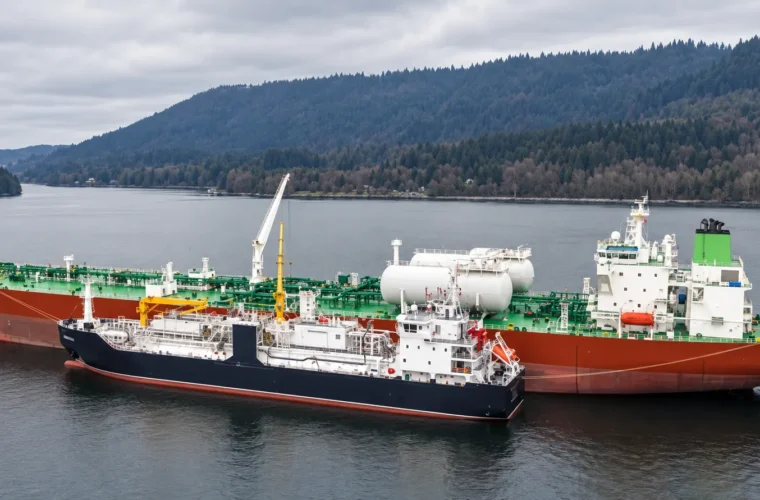
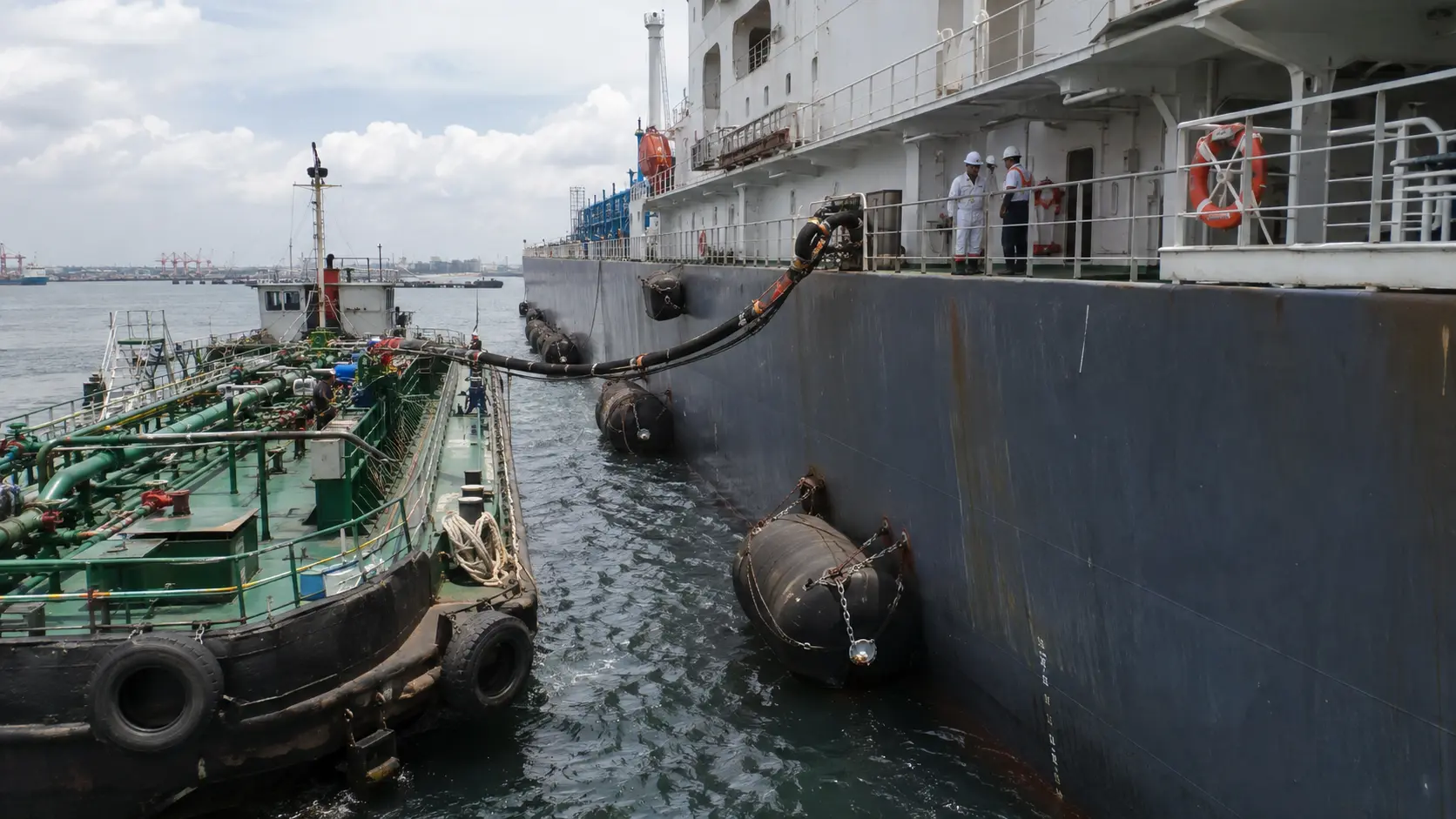
Bunkering is the process of supplying fuel to a vessel for use in its engines, boilers or other onboard combustion equipment.
The fuel may be delivered from:
- a bunker barge alongside;
- a shore terminal through fixed pipelines;
- a road tanker or truck;
- another vessel; or
- another approved supply arrangement.
On large merchant vessels, bunkering commonly involves fuel oils or marine distillates such as VLSFO and MGO. Ships equipped with approved exhaust-gas cleaning systems may also operate on higher-sulphur fuel where the applicable regulatory requirements are satisfied.
The operation involves several departments.
The Chief Engineer or another designated responsible engineer normally controls the receiving operation under the vessel’s Safety Management System. Engine-room personnel monitor tanks, valves, pipelines, transfer rates and machinery-space arrangements. Deck personnel may assist with hose handling, pollution prevention, communication, mooring supervision and watchkeeping.
The Master retains overall responsibility for the vessel.
Why Bunkering Is a Critical Shipboard Operation
Bunkering combines five major areas of risk at the same time.
| Risk | Potential consequence |
|---|---|
| Overflow / pollution | Fuel enters deck areas or the sea, creating environmental, regulatory and financial exposure. |
| Fire | Fuel leakage or vapour reaches an ignition source. |
| Wrong fuel or contamination | Engine damage, separator/filter problems, loss of propulsion or regulatory non-compliance. |
| Quantity shortage | Commercial loss and possible insufficient voyage reserves. |
| Operational error | Wrong tank filling, overflow, excessive pressure, mixing incompatible fuels or loss of containment. |
The financial exposure can also be significant.
If 1,000 tonnes of fuel are delivered at USD 650 per tonne, the cargo being transferred is worth approximately:
1,000 × USD 650 = USD 650,000.
A 2% unresolved shortage would represent:
20 tonnes × USD 650 = USD 13,000.
Fuel cost is also one of the largest components of voyage economics. Tide Signal’s Voyage Margin Calculator shows how bunker cost can materially change a voyage’s commercial margin.
Common Marine Bunker Fuels
The exact fuel terminology used in contracts, laboratories and bunker markets varies, but common categories include:
| Fuel | General description |
|---|---|
| VLSFO | Very Low Sulphur Fuel Oil, commonly supplied for compliance with the 0.50% global sulphur limit. |
| MGO | Marine Gas Oil, a distillate fuel frequently used in ECAs, auxiliary machinery and other applications. |
| HSFO | High Sulphur Fuel Oil, generally used only where an approved equivalent compliance method such as an exhaust-gas cleaning system permits its use. |
| Biofuel blends | Marine fuels incorporating renewable components such as FAME or other approved blend components. |
The fuel ordered should always be identified by the actual contractual specification rather than relying only on broad commercial labels such as “VLSFO”.
Before Bunkering: Planning Comes First
A safe operation begins before the bunker barge arrives.
The receiving vessel should establish exactly:
- which fuel grade is being supplied;
- how much fuel is ordered;
- which supplier and bunker barge are involved;
- which tanks will receive the fuel;
- the available capacity of each tank;
- the sequence in which tanks will be filled;
- the intended initial, maximum and topping-off transfer rates;
- which bunker manifold will be used;
- how the fuel will be sampled;
- who is responsible for each position;
- how communications will be maintained;
- what emergency-stop signal will be used; and
- what action will be taken if any abnormal condition develops.
The vessel’s Safety Management System, bunker checklist, risk assessment, standing orders and local port or terminal requirements take precedence over generic guidance.
Preparing the Bunker Plan
The bunker plan is the operational map for the fuel transfer.
A good plan should identify each receiving tank and establish a realistic sequence that prevents accidental overfilling or cross-contamination.
Typical planning information includes:
| Tank | Existing ROB | Available capacity | Fuel grade | Planned receipt |
|---|---|---|---|---|
| FO Storage P | 120 MT | 420 MT | VLSFO | 350 MT |
| FO Storage S | 80 MT | 460 MT | VLSFO | 400 MT |
| MGO Tank | 45 MT | 120 MT | MGO | 80 MT |
The planned receipt should leave the vessel within the maximum permitted filling level established by tank design, company procedures and vessel-specific operating requirements.
A theoretical tank capacity is not automatically the safe bunkering capacity.
Tank Capacity, Ullage and Filling Limits
One of the most dangerous bunkering assumptions is:
“The tank holds 500 cubic metres, therefore we can put 500 cubic metres into it.”
Fuel expands with temperature. Trim and list influence sounding or ullage interpretation. Tank geometry may make the final part of the filling range increasingly sensitive to small level changes.
The vessel must therefore use its approved tank calibration tables and company-defined maximum filling limits.
Before bunkering:
- initial soundings or ullages should be taken;
- tank temperatures should be recorded where required;
- actual ROB should be calculated;
- tank alarms and level-monitoring arrangements should be verified in accordance with company procedures;
- overflow arrangements should be checked; and
- the final planned quantity should be confirmed against actual available capacity.
Britannia and West P&I both emphasise proper tank measurement, calibration tables and trim/list corrections when bunker quantities are reconciled.
The Pre-Bunker Meeting
Before transfer begins, the ship and supplier should establish a common operating plan.
The discussion should confirm:
- fuel grades;
- quantity of each grade;
- receiving tanks;
- maximum transfer pressure;
- starting transfer rate;
- maximum agreed transfer rate;
- topping-off arrangements;
- estimated transfer duration;
- communication method;
- backup communication;
- emergency-stop procedure;
- sampling location and method;
- hose or loading-arm arrangement;
- line-clearing procedure after transfer;
- expected sequence for changing tanks; and
- responsible persons on both sides.
Ambiguous communication is unacceptable during bunkering.
Commands such as START, STOP, REDUCE RATE and emergency instructions should be clearly understood by both sides.
Deck and Pollution-Prevention Preparation
Before bunkering starts, the vessel should be prepared to contain an accidental leak before it reaches the sea.
Depending on the vessel and SMS, preparations normally address:
- scuppers and deck drainage;
- save-alls and drip trays;
- spill-response equipment;
- SOPEP/SMPEP equipment where applicable;
- firefighting equipment;
- ignition-source controls;
- warning signs and access control;
- lighting;
- manifold blanks and connections;
- unused bunker connections;
- deck watch arrangements; and
- the water surface around the vessel before transfer begins.
A pre-existing sheen or pollution should be identified before transfer so that responsibility is not confused if pollution is subsequently reported.
When bunkering from a barge, the vessel’s mooring condition also matters. Tide Signal’s Ship Mooring System guide explains why line condition, load distribution and changing draft must be monitored throughout an alongside operation.
Bunker Manifold and Hose Connection
The bunker hose or loading connection is one of the primary containment boundaries between supplier and receiving ship.
Before transfer, responsible personnel should verify that:
- the intended manifold is correctly identified;
- connections are suitable and properly secured;
- gaskets and connecting arrangements are in satisfactory condition;
- unused connections are correctly secured;
- the hose is adequately supported and protected from damaging movement;
- the hose condition and required certification have been checked where applicable;
- the agreed sampling arrangement is installed; and
- the receiving system is aligned according to the bunker plan.
The complete line-up should be independently checked in accordance with the vessel’s procedures before fuel is accepted.
Starting the Bunker Transfer
The initial transfer is an important verification stage.
Fuel should normally begin at a controlled low rate so that the receiving team can confirm that:
- fuel is entering the intended tank;
- the correct pipeline is pressurised;
- there are no manifold leaks;
- there are no unexpected tank-level changes elsewhere;
- the sampling system is operating correctly;
- communications remain effective; and
- the vessel is ready to increase toward the agreed transfer rate.
The operation should not move automatically to maximum rate simply because fuel has begun flowing.
Good bunkering practice verifies the system at low consequence before exposing it to high flow.
Monitoring During Bunkering
Bunkering is not a “start the pump and wait” operation.
The receiving team should continuously monitor the system.
Important checks include:
- manifold and hose condition;
- tank levels;
- expected rate of rise;
- tank temperatures;
- transfer pressure;
- current pumping rate;
- remaining tank capacity;
- unexpected transfer into another tank;
- overflow arrangements;
- sample collection;
- deck leakage;
- water surface around the vessel;
- bunker-barge position;
- mooring lines; and
- communication with the supplier.
Tank soundings or level readings should be compared periodically with the expected quantity received.
If the calculated onboard increase differs materially from the supplier’s reported delivery, that should be investigated during the operation rather than discovered only after the hose is disconnected.
Topping Off Bunker Tanks
The final stage of filling a tank carries increased overflow risk.
As the tank approaches its planned final level, the receiving vessel should provide sufficient warning to the supplier and reduce the transfer rate in accordance with the agreed plan.
The person controlling tank valves should know:
- which tank is being completed;
- which tank receives fuel next;
- the current transfer rate;
- the remaining capacity;
- the expected response after any valve change; and
- the emergency action if the level rises unexpectedly.
Valve changes during a high-rate transfer require particular control because a poorly coordinated restriction in the receiving line can create pressure problems.
Any change in transfer rate or tank sequence should be clearly communicated between ship and supplier.
Completing the Bunkering Operation
When the ordered quantity has been delivered, the operation moves from transfer control to verification.
Typical post-transfer actions include:
- confirming transfer has stopped;
- completing the agreed line-draining or clearing procedure safely;
- isolating the bunker system;
- taking final tank soundings or ullages;
- recording tank temperatures;
- checking trim and list;
- calculating final onboard quantity;
- verifying no pollution has occurred;
- closing and securing the manifold;
- disconnecting the hose when safe;
- finalising representative samples;
- reconciling ship and supplier figures;
- reviewing the BDN; and
- making required logbook and statutory entries.
The hose should not be disconnected merely because the supplier states that the delivery is complete. The ship must first establish that the receiving system is safely isolated and ready for disconnection.
Bunker Sampling Procedure
Representative bunker sampling is critical because fuel quality cannot be judged reliably by appearance alone.
A sample taken only at the beginning or end of delivery may not represent the entire bunker stem.
The objective is to obtain a composite sample that reflects the average characteristics of the fuel delivered throughout the operation.
Current IMO guidance describes the primary sample as being collected throughout delivery using sampling equipment positioned at the bunker manifold of the receiving ship.
A continuous drip-type sampling arrangement is therefore commonly used.
The sampling process should follow the applicable IMO guidelines, flag requirements, local requirements, contractual terms and company procedure.
The MARPOL Representative Sample
MARPOL Annex VI requires qualifying fuel deliveries to be accompanied by a representative sample.
The sample should be appropriately:
- collected;
- transferred into suitable sample containers;
- sealed;
- identified;
- signed as required;
- linked to the relevant BDN; and
- retained under the ship’s control.
The IMO states that the MARPOL representative sample must remain under the ship’s control until the fuel has been substantially consumed, but in any event for not less than 12 months from the date of delivery.
The MARPOL sample exists primarily for regulatory verification.
Commercial fuel-quality testing should therefore not depend on opening or consuming the sealed statutory MARPOL sample.
Ships commonly retain additional commercial samples for laboratory analysis and dispute purposes according to company and contract requirements.
What Is a Bunker Delivery Note?
The Bunker Delivery Note (BDN) is the formal record accompanying marine fuel supplied to a ship under MARPOL Annex VI requirements.
The applicable documentation includes key information about the delivery, including:
- receiving ship name and IMO number;
- port of delivery;
- date of commencement of delivery;
- supplier information;
- product name;
- quantity;
- density at 15°C;
- sulphur content; and
- the applicable supplier declaration.
Current SOLAS requirements also introduce important flashpoint information and supplier declarations for oil fuel.
The receiving officer should not treat the BDN as a document that is signed without review.
The document should be checked against:
- the ordered fuel;
- the delivered grade;
- the agreed quantity;
- the sample identification;
- density;
- sulphur information;
- flashpoint information where applicable;
- supplier details; and
- the actual receiving vessel.
MARPOL requires the BDN to be retained onboard for at least three years after the fuel delivery, subject to the applicable regulatory provisions.
Current Regulatory Note: MARPOL and SOLAS
The bunker documentation regime has become more important, not less.
Under MARPOL Annex VI Regulation 18, ships in scope must maintain the BDN and representative fuel-oil sample requirements associated with the delivery.
Tide Signal covers the subject in more detail in MARPOL Annexes Explained.
Since 1 January 2026, amendments to SOLAS Chapter II-2 also require ships carrying oil fuel, before bunkering, to receive a supplier declaration confirming conformity with the SOLAS flashpoint requirements and identifying the test method used.
The associated bunker documentation must contain the specified flashpoint information or the permitted statement that the measured flashpoint is at or above the applicable threshold described by SOLAS.
Operational implication: The pre-bunker document check is now also a safety-control step. Flashpoint documentation should not be treated as an accounting detail received only after transfer.
Fuel Sulphur Limits and Emission Control Areas
MARPOL Annex VI limits the sulphur content of fuel oil used onboard ships.
| Trading area | General sulphur limit |
|---|---|
| Outside designated SOx ECAs | 0.50% m/m |
| Inside designated SOx ECAs | 0.10% m/m |
Ships using an approved equivalent method, such as an exhaust-gas cleaning system, may operate under the applicable alternative-compliance regime.
The trading pattern therefore matters before bunkers are ordered.
A vessel should not reach an ECA boundary and only then discover that it lacks the appropriate compliant fuel or an approved equivalent arrangement.
Voyage planning, fuel changeover planning, remaining-on-board quantities and bunker procurement must work together.
Tide Signal’s Voyage ETA Calculator can support indicative voyage-time and bunker-cost scenarios, although statutory fuel planning must always use the vessel’s approved procedures and actual operating data.
Bunker Fuel Quality and ISO 8217
Receiving the correct quantity does not prove that the fuel is suitable for use.
Marine fuels can contain characteristics or contaminants capable of affecting:
- fuel pumps;
- injectors;
- purifiers;
- filters;
- combustion;
- cylinder condition;
- boilers; and
- overall propulsion reliability.
The current international marine-fuel specification is ISO 8217:2024, although the specific ISO edition and limits applicable to a delivery depend on the purchase contract.
ISO 8217:2024 covers marine fuels derived from petroleum as well as specified synthetic, renewable and FAME-containing fuels.
Typical laboratory parameters relevant to marine fuel analysis can include:
- density;
- viscosity;
- flashpoint;
- sulphur;
- water;
- sediment;
- ash;
- carbon residue;
- aluminium plus silicon catalytic fines;
- pour point;
- acid number;
- cold-flow characteristics for distillates;
- FAME content where applicable; and
- other parameters specified by the contract and fuel standard.
Where practical and consistent with company procedures, newly received bunkers should be kept segregated until representative laboratory results have been reviewed.
Fuel Compatibility: Why Two On-Spec Fuels Can Still Cause Trouble
Two fuels can individually meet their specifications and still create problems when mixed.
Fuel incompatibility can cause asphaltenes to precipitate and create excessive sludge.
Operational consequences may include:
- rapid filter blockage;
- purifier overload;
- poor fuel treatment;
- loss of fuel pressure;
- combustion problems; and
- in extreme circumstances, loss of propulsion.
DNV warns that mixing fuels with substantially different aromatic/paraffinic characteristics can create incompatibility and excessive sludge formation.
For that reason:
New bunkers should be loaded into empty or suitably segregated tanks wherever practicable rather than being mixed blindly with an existing fuel.
The vessel should follow its company fuel-management procedure and laboratory compatibility advice before commingling different bunker batches.
How Is Bunker Quantity Calculated?
Bunker quantity reconciliation requires more than reading one tank level.
Measurements can be affected by:
- tank geometry;
- fuel temperature;
- density;
- trim;
- list;
- pipeline contents;
- measurement accuracy;
- tank calibration tables; and
- air entrainment or foaming.
A simplified calculation begins with observed tank volume and converts it to a standard reference condition before converting volume into mass.
In simplified educational form:
Mass ≈ Standard Volume × Density at the corresponding reference condition
Commercial bunker surveys use the applicable tank tables and recognised petroleum measurement methods, including volume and weight correction factors where required.
West P&I and Britannia describe common bunker-survey terms including:
| Abbreviation | Meaning |
|---|---|
| TOV | Total Observed Volume |
| GOV | Gross Observed Volume |
| GSV | Gross Standard Volume |
| VCF | Volume Correction Factor |
| WCF | Weight Conversion Factor |
Official commercial calculations should use the approved measurement method, calibration tables and contractual basis applicable to the delivery.
Worked Bunker Quantity Example
Consider a simplified educational example.
A vessel receives VLSFO.
| Item | Value |
|---|---|
| Initial bunker ROB | 210 MT |
| Final calculated bunker quantity onboard | 1,190 MT |
| Fuel consumed during bunkering period | 4 MT |
| BDN delivered quantity | 990 MT |
The ship’s calculated receipt is:
Final ROB − Initial ROB + Consumption
1,190 − 210 + 4 = 984 MT
Supplier’s BDN:
990 MT
Difference:
990 − 984 = 6 MT
Percentage difference relative to BDN quantity:
6 ÷ 990 × 100 ≈ 0.61%
This does not automatically prove that either party’s measurement is wrong.
The team should review:
- initial and final soundings;
- temperatures;
- trim and list;
- calibration tables;
- pipeline contents;
- supplier measurements;
- Mass Flow Meter data where used;
- fuel consumed during the operation; and
- any abnormal observations during transfer.
What Should Happen When Bunker Figures Do Not Agree?
A significant discrepancy should not be discovered, debated and forgotten.
It should be investigated while evidence is still available.
Useful steps include:
- repeat the relevant tank measurements;
- verify tank temperatures;
- check trim and list corrections;
- review tank tables;
- check all tanks for unexpected fuel movement;
- compare supplier measurements;
- review Mass Flow Meter records where applicable;
- check sample and seal details;
- record the discrepancy in contemporaneous logs;
- notify the company promptly; and
- follow company, charterparty and P&I procedures concerning reservations or a Letter of Protest.
The officer responsible for documentation should not certify a quantity or factual statement that the vessel genuinely disputes without following the company’s approved dispute procedure.
Britannia also recommends early reconciliation during delivery rather than relying solely on final figures.
Mass Flow Meters in Bunkering
A Mass Flow Meter (MFM) measures fuel flow directly and can improve transparency compared with purely volumetric tank measurements when properly approved, sealed and operated.
However, an MFM does not remove the need for shipboard monitoring.
Where MFM bunkering is used, the vessel should still follow applicable procedures for:
- initial meter readings;
- seal verification;
- final meter readings;
- meter tickets;
- BDN comparison;
- tank-level monitoring;
- representative sampling; and
- abnormal-delivery investigation.
Manual or independent quantity checks remain useful as a cross-check and for overflow prevention.
What Is the Cappuccino Effect in Bunkering?
The Cappuccino Effect is a well-known bunker quantity problem involving excessive air or gas entrained in the fuel.
Aerated fuel can appear to occupy a larger volume than the same fuel after the entrained air has escaped.
Warning signs can include:
- unusual foaming;
- unstable sounding or ullage readings;
- unexpected tank-volume behaviour;
- visible air release; or
- a quantity discrepancy that changes after the fuel settles.
Suspicious conditions should be documented immediately.
Britannia advises that questionable quantity circumstances, including observed foam, should be recorded and investigated rather than accepted without reservation.
What Happens If a Bunker Spill Occurs?
A bunker spill is an emergency.
The immediate priorities are to:
- stop or control the source of the release when safe to do so;
- activate the vessel’s emergency response procedure;
- prevent further fuel from reaching the sea;
- notify the Master and responsible shipboard personnel;
- notify the bunker supplier;
- make the notifications required by the vessel’s SOPEP/SMPEP, local rules and company procedures;
- deploy approved spill-response equipment where safe and appropriate; and
- record the event accurately.
Personnel safety comes first. Crew should not expose themselves to fire, toxic atmosphere, slipping hazards or other unacceptable risks while attempting to recover spilled fuel.
West P&I stresses that spills during bunkering should be reported to the appropriate authorities and handled in accordance with the vessel’s applicable pollution-emergency plan.
Records Required After Bunkering
A completed bunkering operation should leave a clear documentary trail.
Depending on the vessel and applicable requirements, this may include:
- Bunker Delivery Note;
- MARPOL representative sample records;
- commercial bunker sample records;
- bunker checklist;
- bunker plan;
- initial and final tank measurements;
- temperature records;
- supplier measurement records;
- MFM documentation where applicable;
- laboratory analysis;
- Engine Log Book entries;
- Deck Log Book entries where relevant;
- Oil Record Book entries;
- Letters of Protest or reservations;
- supplier correspondence; and
- internal company reports.
Good records serve several purposes simultaneously:
regulatory compliance + operational traceability + commercial evidence + casualty investigation.
Why Bunkering Matters Commercially
Bunker management sits directly between ship operations and chartering economics.
The commercial department may see:
“VLSFO: USD 620/MT.”
The vessel sees a much larger operational problem:
- Which grade?
- Which tanks?
- How much safe capacity?
- Is the fuel compatible?
- Is it compliant for the next trading area?
- How long will bunkering take?
- Will bunkering delay departure?
- What is the actual delivered quantity?
- What does the laboratory result show?
On a long voyage, a small difference in consumption or bunker price can materially change the voyage result.
For example:
25 MT/day × 30 days = 750 MT
At USD 600/MT:
750 × 600 = USD 450,000
An additional consumption of only 2 MT/day over those 30 days would add:
60 MT × USD 600 = USD 36,000
This is why fuel planning, ship performance and chartering economics should not operate as separate worlds.
Common Bunkering Mistakes
1. Starting before everyone understands the plan
A signed checklist is not enough if the ship and supplier have different assumptions about rate, tanks or communications.
2. Using the wrong receiving tank
Incorrect valve alignment can contaminate another fuel grade or overfill a tank that was not intended to receive bunkers.
3. Trusting tank alarms instead of monitoring levels
Alarms are safeguards, not substitutes for active control of the operation.
4. Topping off at excessive rate
The final part of filling provides less margin for error.
5. Failing to monitor the manifold
A leaking connection may escalate rapidly if nobody has continuous visual oversight.
6. Poor ship–barge communication
“Slow down soon” is not an effective transfer command.
7. Taking a non-representative sample
A bottle filled from a single moment of the delivery may not represent the complete bunker stem.
8. Mixing new bunkers immediately
Fuel compatibility problems can create serious sludge and machinery problems even when each individual fuel is otherwise within specification.
9. Using untested new fuel too quickly
Where operationally possible, laboratory results should be reviewed before new fuel is brought into service.
10. Discovering quantity discrepancies only after departure
Measurements should be reconciled progressively while the supplier and evidence are still available.
11. Signing documents without verification
The BDN should be checked against the actual delivery and required regulatory information.
12. Focusing only on quantity
Receiving 1,000 tonnes of contaminated fuel can be worse than receiving slightly less of a safe, compliant product.
13. Ignoring trim and list
Tank readings may require correction according to the vessel’s approved calibration tables.
14. Treating bunkering as an engine-room-only operation
Deck condition, mooring, pollution prevention, communications and overall ship safety also influence the operation.
Complete Bunkering Operations Checklist
Before the supplier arrives
- Confirm grade and ordered quantity.
- Confirm bunker supplier and delivery method.
- Review voyage fuel requirement and required compliance grade.
- Calculate current ROB.
- Calculate available tank capacity.
- Prepare bunker tank plan.
- Consider fuel segregation and compatibility.
- Complete applicable risk assessment.
- Brief the shipboard team.
- Confirm required PPE.
- Verify tank-monitoring arrangements.
- Prepare pollution-response equipment.
Before transfer
- Complete ship–supplier pre-bunker conference.
- Confirm quantities and fuel grades.
- Agree transfer rate and maximum pressure.
- Agree topping-off rate.
- Agree communications and backup communications.
- Agree emergency-stop signal.
- Confirm sampling method.
- Inspect hose and manifold arrangement.
- Verify bunker-line alignment.
- Secure unused bunker connections.
- Prepare save-alls and deck containment.
- Control scuppers according to vessel procedure.
- Verify firefighting readiness.
- Check for pre-existing pollution.
- Take initial tank measurements.
- Record initial temperatures where required.
- Confirm supplier flashpoint documentation required before bunkering.
At start of transfer
- Start at controlled low rate.
- Confirm correct tank receives fuel.
- Check manifold connection for leakage.
- Confirm pressure is normal.
- Verify representative sampling begins correctly.
- Confirm communications remain effective.
- Increase rate only after system verification.
During transfer
- Maintain continuous manifold watch.
- Monitor receiving-tank levels.
- Compare actual and expected rate of rise.
- Monitor transfer pressure.
- Check hoses and connections.
- Check water around vessel.
- Monitor sample collection.
- Record significant start/stop events.
- Monitor other bunker tanks for unexpected level changes.
- Compare quantity received with supplier figures periodically.
- Monitor barge position and moorings.
Before topping off
- Calculate remaining tank capacity.
- Notify supplier well in advance.
- Reduce transfer rate according to agreed procedure.
- Confirm next tank or completion plan.
- Maintain continuous level monitoring.
- Avoid uncontrolled valve changes.
After transfer
- Confirm transfer stopped.
- Complete agreed line-clearing procedure safely.
- Isolate bunker system.
- Take final tank measurements.
- Record final temperatures.
- Record trim and list.
- Calculate final quantity received.
- Compare ship and supplier figures.
- Investigate material discrepancy immediately.
- Finalise representative samples.
- Check seals and labels.
- Verify BDN details.
- Check sulphur declaration.
- Check flashpoint information where applicable.
- Disconnect hose safely.
- Confirm no pollution occurred.
- Complete logbook and Oil Record Book entries.
- Send commercial sample for analysis according to company procedure.
- Segregate new fuel until quality/compatibility status is understood where practicable.
Bunkering Operations in One Flow
Voyage fuel requirement calculated
↓
Bunker grade and quantity ordered
↓
Tank plan prepared
↓
Risk assessment and crew briefing
↓
Supplier arrives
↓
Initial measurements
↓
Pre-bunker meeting
↓
Hose/manifold connected
↓
Sampling arrangement prepared
↓
Transfer starts at controlled rate
↓
Correct tank confirmed
↓
Bulk transfer monitored
↓
Topping-off rate reduced
↓
Transfer completed
↓
Final soundings and temperatures
↓
Quantity reconciliation
↓
Samples sealed and documented
↓
BDN verified
↓
Laboratory analysis
↓
Fuel introduced into service under company procedure
How Bunkering Connects to the Wider Operations Cluster
Bunkering should not sit alone inside Tide Signal’s Operations coverage.
It connects directly with:
- Ship Mooring Systems — because bunker-barge position and mooring loads must remain controlled throughout the transfer.
- Voyage ETA Calculator — because passage duration influences fuel requirement and bunker planning.
- Voyage Margin Calculator — because bunker cost can dominate voyage economics.
- Tide Signal Operations — for wider coverage of practical vessel operations and port-call risk.
Bunkering Operations: Frequently Asked Questions
What are bunkering operations?
Bunkering operations are the planning, preparation, transfer, monitoring, sampling, measurement and documentation activities involved in supplying marine fuel to a vessel.
Who is responsible for bunkering onboard?
The exact shipboard organisation is defined by the vessel’s Safety Management System. The Chief Engineer or another designated engineering officer commonly controls fuel receipt, while the Master retains overall responsibility for the vessel.
What is a bunker checklist?
A bunker checklist is a structured verification document used to confirm that safety, communication, pollution-prevention, tank-planning, transfer and documentation controls have been completed before, during and after bunkering.
What is a Bunker Delivery Note?
A Bunker Delivery Note is the formal document containing required information about fuel delivered to a ship, including the vessel, supplier, product, quantity, density, sulphur content and applicable declarations.
How long must a BDN be kept onboard?
Under MARPOL Annex VI Regulation 18, the BDN must generally be retained onboard for at least three years following the delivery.
How long must the MARPOL bunker sample be retained?
The representative MARPOL-delivered sample must remain under the ship’s control until the fuel has been substantially consumed, but for at least 12 months from the date of delivery.
Where should the MARPOL bunker sample be taken?
Current IMO sampling guidance describes the primary sample as being collected throughout the bunkering period using sampling equipment positioned at the bunker manifold of the receiving ship.
What is continuous drip sampling?
Continuous drip sampling collects small quantities of fuel throughout the delivery so that the final composite sample better represents the overall bunker stem than a sample taken at only one moment.
What is the global sulphur limit for marine fuel?
The general MARPOL Annex VI sulphur limit outside designated SOx Emission Control Areas is 0.50% m/m. Within applicable SOx ECAs, the limit is generally 0.10% m/m, unless the vessel uses an approved equivalent means of compliance.
What changed for bunkering under SOLAS in 2026?
From 1 January 2026, SOLAS Chapter II-2 amendments require ships carrying oil fuel to receive specified supplier flashpoint declarations before bunkering, with associated flashpoint information included in the fuel documentation.
What is ISO 8217?
ISO 8217 is the international specification for marine fuels used in diesel engines and boilers. The current published edition is ISO 8217:2024, although the edition contractually applicable to a bunker stem must be checked in the fuel purchase terms.
Why should new bunker fuel be segregated?
Segregation reduces the risk of contaminating existing fuel and allows compatibility and laboratory results to be reviewed before commingling or using the new batch where operationally practicable.
Can two compliant bunker fuels be incompatible?
Yes. Two fuels may individually meet their specifications but create excessive sludge when mixed because of chemical incompatibility.
How is bunker quantity checked?
The vessel normally compares initial and final tank measurements using approved calibration tables, temperatures, density and relevant corrections. Supplier tank figures or approved Mass Flow Meter data may then be reconciled against the vessel’s calculated receipt.
What is ROB in bunkering?
ROB means Remaining On Board. It represents the quantity of fuel already onboard and is fundamental to bunker planning, voyage reserves and final quantity reconciliation.
What is the Cappuccino Effect?
The Cappuccino Effect describes bunker fuel containing excessive entrained air or gas, which can make the apparent delivered volume temporarily larger and distort quantity measurements.
What should happen if the bunker quantity is short?
The discrepancy should be verified immediately through repeat measurements and review of supplier and ship figures. Material unresolved differences should be documented and escalated according to the vessel’s company, charterparty and P&I procedures.
Should new bunkers be used before laboratory results arrive?
Where operationally practicable and consistent with company procedures, segregating newly delivered fuel until representative test results have been reviewed reduces the risk of introducing contaminated or unsuitable fuel into the machinery system.
What is the biggest danger during bunkering?
There is no single universal danger. Overflow and pollution, fire, wrong-tank transfer, excessive pressure, fuel incompatibility, contamination and human error can all produce serious consequences. Effective planning and continuous monitoring are therefore essential.
Can bunkering continue without communication with the bunker barge?
Loss of agreed communication is an abnormal condition and should be handled in accordance with the vessel’s bunker procedure and agreed stop criteria. Effective communication is a fundamental control during fuel transfer.
Why is bunkering commercially important?
Fuel is one of the largest voyage costs. Bunker price, quantity, consumption, quality and delays during supply can all materially affect voyage profitability and schedule reliability.
Final View
Bunkering is routine only in the sense that ships perform it frequently.
The operation itself combines large quantities of fuel, high financial value, pollution exposure, fire risk, machinery reliability and regulatory compliance within a relatively short period.
A professional bunker operation therefore depends on a chain of controls:
correct order → realistic tank plan → verified capacity → prepared ship → clear communications → controlled transfer → continuous monitoring → representative sampling → accurate measurement → correct BDN → laboratory verification → traceable records.
If any part of that chain is weak, the consequences may appear immediately as an overflow or leak — or days later as clogged filters, damaged machinery, a sulphur-compliance problem or a bunker quantity dispute.
Tide Signal view: The safest bunkering operation is not the fastest one. It is the operation in which the receiving vessel can explain, at every moment, exactly which fuel is moving, through which line, into which tank, at what rate, with how much remaining capacity, how the delivery is being sampled and what action will stop the transfer if reality no longer matches the plan.
Authoritative Sources and Further Reading
- International Maritime Organization — MARPOL Annex VI Regulation 18 — fuel-oil quality, Bunker Delivery Notes and representative sample requirements.
- IMO — Guidelines for Sampling of Fuel Oil for MARPOL Annex VI and SOLAS Chapter II-2 — representative sampling and receiving-ship manifold guidance.
- IMO — SOLAS Chapter II-2 Flashpoint Amendments — fuel-oil supplier declaration and flashpoint requirements effective from 1 January 2026.
- ISO — ISO 8217:2024 — current international marine-fuel specification.
- West of England P&I — Bunkering Procedures — operational controls, sampling, quantity calculations and recordkeeping.
- Britannia P&I — Managing Bunker Quantity Disputes — tank measurements, MFM controls, quantity reconciliation and dispute prevention.
- The Standard Club — A Master’s Guide to Using Fuel Oil Onboard Ships — sampling, fuel handling and operational guidance.
- DNV — Marine Fuel Sulphur and Compatibility Guidance — compliant-fuel handling and compatibility risks.
This guide is educational and does not replace a vessel’s Safety Management System, bunker checklist, risk assessment, SOPEP/SMPEP, equipment manuals, flag or class requirements, terminal instructions, local regulations or the judgement of the Master and responsible engineering officers.