Operations · Chartering · Academy · Vessel Performance
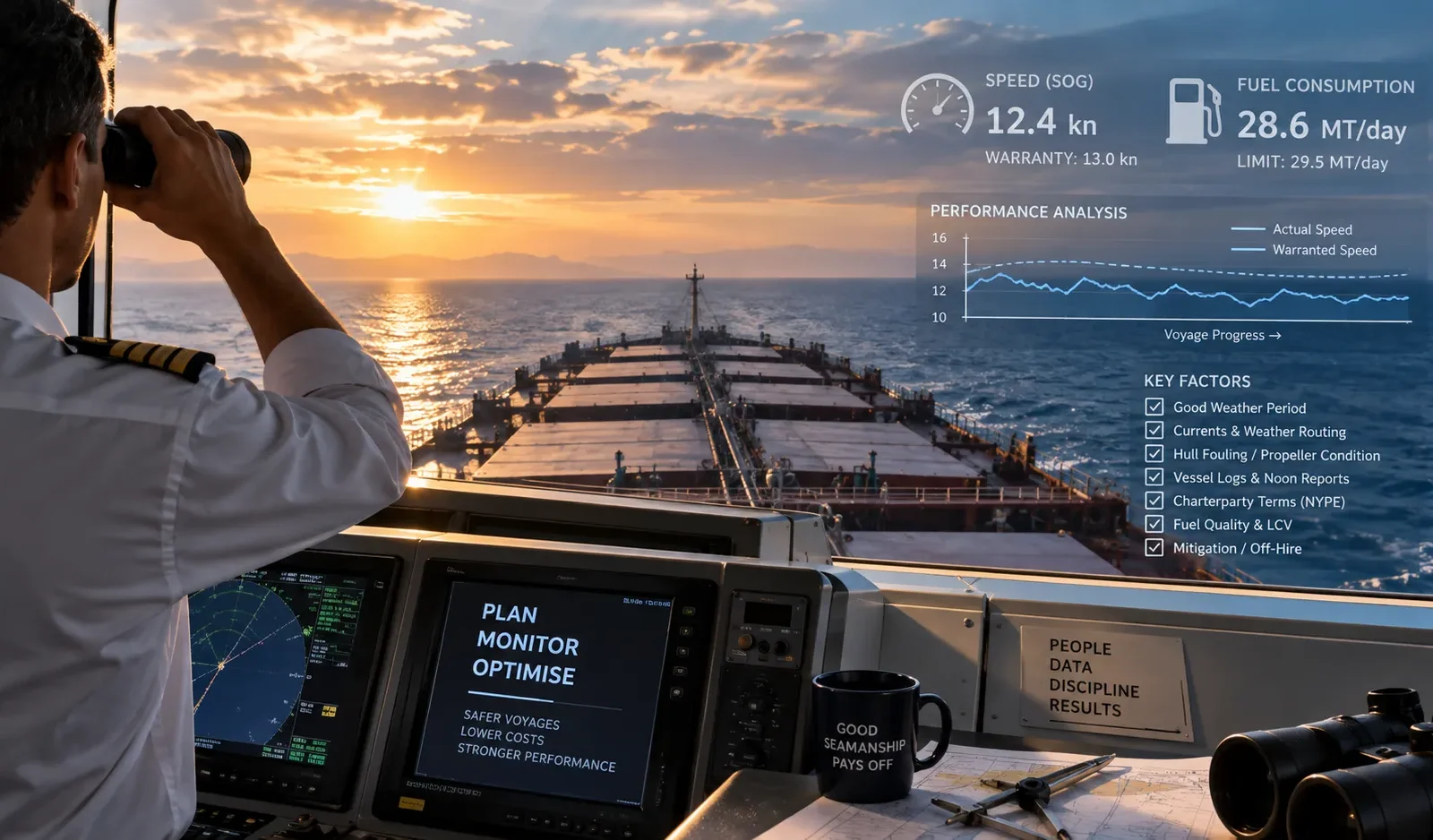
Speed and consumption claims arise when a time-chartered vessel is alleged to perform below the speed promised in the charterparty, consume more fuel than warranted, or both. The claim is rarely decided by a single noon report. The real analysis turns on the exact performance wording, good-weather definition, vessel logs, weather-routing data, currents, charterers’ orders, hull and machinery condition, bunker quality and the method used to convert underperformance into a financial loss.
How are speed and consumption claims assessed? First identify the exact charterparty warranty. Then isolate the periods that satisfy the agreed benchmark conditions, compare actual speed and fuel use against the contractual figures, remove periods affected by charterers’ orders or other excluded causes, and calculate the proven loss using the method allowed by the contract and evidence.
What Are Speed and Consumption Claims in Shipping?
Speed and consumption claims are most commonly associated with time chartering. The owner describes or warrants a vessel as capable of achieving a stated speed while consuming a stated quantity of fuel in defined operating conditions. If charterers later allege that the vessel was materially slower or burned more fuel than promised, they may seek damages or make deductions from hire.
Steamship Mutual notes that these disputes frequently arise as deductions from hire under time charters and that engine condition, hull fouling and weather are among the many factors capable of affecting performance.
NYPE remains the most widely used standard time-charter form in dry cargo. The exact performance promise, however, often comes from the vessel description, fixture recap and rider clauses rather than from a single standard line.
For the wider commercial structure, Tide Signal’s Voyage Charter vs Time Charter guide explains why performance risk becomes especially important when charterers are paying hire and bunkers.
The first question is never “How slow was the ship?” The first question is: What exactly did the charterparty promise, in what conditions, for which period, and with what tolerances?
The Charterparty Performance Warranty Comes First
A typical time-charter performance description may contain:
- ballast speed;
- laden speed;
- daily main-engine fuel consumption;
- auxiliary fuel consumption;
- fuel grades;
- good-weather criteria;
- sea-state and swell limits;
- current qualifications;
- the word “about”;
- “without guarantee” wording;
- a continuing-performance warranty;
- weather-routing provisions;
- slow-steaming or RPM instructions.
Steamship Mutual’s current FAQ emphasises that the precise wording controls. A performance warranty may apply at delivery only unless the contract makes it continuing, while wording such as “without guarantee” may significantly weaken the contractual commitment.
The word “about” should not be converted automatically into a fixed tolerance by the operator. Older arbitration practice sometimes applies numerical margins, but the permitted margin depends on the charter wording and facts. For operational calculations, use only the tolerance actually agreed or the tolerance adopted by the relevant legal or arbitral analysis.
Operational Causes of Slow Speed or High Consumption
Before a claim becomes a chartering argument, it is an operations problem. The office should first understand what physically happened to the vessel.
Other operational factors include:
- draft and displacement;
- trim;
- ballast condition;
- weather routing;
- engine load instructions;
- slow-steaming orders;
- fuel quality and calorific value;
- cleaning history;
- long idle periods;
- recent port stays in warm waters;
- shallow-water effects;
- sea-margin assumptions;
- maintenance condition.
Tide Signal’s Noon Reports in Shipping guide explains why distance, weather, RPM, ROB and consumption data must be read together rather than as isolated numbers.
Good Weather Is the Benchmark, Not a Casual Description
Performance clauses commonly test a vessel in defined good-weather conditions. That definition can include wind force, Douglas sea state, swell, significant wave height and current.
A typical clause might use wording such as:
That is only an illustration. The actual charterparty may be wider, narrower or materially different.
Steamship Mutual notes that where good weather is not expressly defined, Beaufort Force 4 or below is commonly treated as an important reference point under English-law performance analysis. But modern rider clauses often define much more than wind alone.
A good-weather test exists because owners do not ordinarily warrant that the vessel will maintain flat-water performance through heavy seas. The charter attempts to create a controlled benchmark in which the vessel’s underlying capability can be measured.
Operations point
A voyage can be commercially slow without containing enough contractual good-weather data to prove a speed-warranty breach by the ordinary method. That is why operators should distinguish “the ship arrived late” from “the vessel failed the contractual performance test.”
Vessel Logs, Noon Reports and Weather-Routing Evidence
Performance disputes often contain two competing data sets:
- the vessel’s own logs and daily reports; and
- a weather-routing company’s retrospective performance report.
Steamship Mutual notes that tribunals may give significant weight to vessel logbooks because mariners record the conditions actually experienced by the ship. However, if the logs are inconsistent, inaccurate or unsupported, their evidential value can fall sharply.
A useful operational record should make it possible to reconstruct:
- position and distance run;
- speed over ground;
- where available, speed through water;
- main-engine RPM;
- engine load;
- wind force and direction;
- sea and swell;
- current;
- course;
- draft and trim;
- main-engine consumption;
- auxiliary consumption;
- ROB;
- slow-steaming instructions;
- weather-routing instructions;
- machinery defects or limitations.
The value of the noon report is therefore not that it automatically proves performance. It is that it creates a daily operational chain that can later be tested against logs, engine data, routing information and bunker records.
Currents, Swell and Sea State Can Change the Result
Current treatment is a recurring source of dispute. A clause may expressly exclude adverse currents from good weather, may address both positive and adverse currents, or may be silent.
Steamship Mutual’s 2026 FAQ, discussing The Divinegate, notes that positive currents should not simply be stripped out of the performance calculation unless the charter wording allows that approach.
This matters because:
- speed over ground includes current effect;
- speed through water does not represent the commercial ETA by itself;
- a favourable current can make an inefficient vessel look better;
- an adverse current can make a healthy vessel look slower;
- weather-routing models may apply current factors differently.
Swell can be equally important. A moderate wind with long opposing swell may still reduce speed substantially. If the charter defines good weather by both wind and wave criteria, both must be respected.
How a Speed and Consumption Claim Is Calculated
The broad operational sequence is:
A conventional speed calculation may compare:
A consumption calculation may compare:
The exact methodology can differ materially according to the charter. Some clauses permit extrapolation from qualifying good-weather performance across the wider voyage. Others restrict or prohibit extrapolation. Periods of charterer-ordered slow steaming, off-hire, manoeuvring or other non-comparable operations may need to be excluded.
The calculation must also avoid double recovery. If slower speed already creates additional voyage days, and those additional days also create extra fuel use, the bunker calculation should be built around a coherent contractual counterfactual rather than simply adding every apparent difference independently.
Speed and Consumption Claims: 7 Worked Examples
Good-weather speed shortfall
Assume the charter benchmark, after applying the expressly agreed tolerance, is 12.5 knots. Qualifying good-weather data demonstrates an average of 11.8 knots. The relevant distance is 3,000 nautical miles.
Actual equivalent time: 3,000 ÷ 11.8 = 254.24 hours
Indicative time loss: 14.24 hours = 0.593 day
At USD 20,000/day hire, the simple economic exposure is approximately:
This is an operational illustration only. Recoverability depends on the charter wording, permitted extrapolation, causation and the proper legal measure of loss.
Fuel overconsumption only
Assume the charter expressly allows a maximum of 29.4 MT/day in qualifying conditions. Actual consumption over 10 relevant sea days is 31.2 MT/day. Bunker value is USD 650/MT.
10-day excess: 18.0 MT
Indicative fuel loss: 18 × USD 650 = USD 11,700
Slow speed and fuel: avoid double counting
A 4,200-nm passage is warranted at 12.5 knots. Actual demonstrated performance is 11.8 knots. Permitted consumption is 29.4 MT/day; actual is 31.2 MT/day.
Actual equivalent: 4,200 ÷ 11.8 = 355.93 h = 14.83 days
Time difference: 0.83 day
For fuel, a coherent comparison is between the contractual counterfactual and the actual voyage result:
Actual fuel: 14.83 × 31.2 ≈ 462.7 MT
Indicative total difference: ≈ 51.1 MT
Do not automatically claim the full 51.1 MT and then separately add every fuel tonne consumed during the 0.83-day time loss without checking whether that duplicates the same loss.
Most of the voyage is bad weather
A 20-day passage contains only two short periods meeting the charter’s strict good-weather definition. The ship’s overall average is poor, but the sample may be too limited to support the ordinary performance methodology.
The correct response is not to declare the entire 20-day passage a breach. First check whether the charter specifies a minimum qualifying period, whether extrapolation is allowed and whether the good-weather sample is sufficiently representative.
No qualifying good-weather period
Suppose no part of the voyage satisfies the contractual benchmark, yet the vessel appears clearly underpowered. Steamship Mutual and Skuld both note that alternative approaches may be attempted, but The Divinegate shows how difficult it can be to replace the agreed good-weather mechanism with a theoretical RPM-based calculation.
A charterer may need separate evidence of hull fouling, machinery defect, off-hire or another contractual breach rather than simply assuming the performance warranty has been proved.
Charterers order slow steaming
Warranted speed is 13 knots, but charterers instruct the vessel to proceed at 10.5 knots to meet a later berth window. The vessel complies safely.
The resulting lower average speed should not simply be used as evidence that the vessel could not achieve 13 knots. Performance analysis must isolate periods where the ship was operating under charterers’ speed or RPM instructions.
Biofuel changes the contractual benchmark
BIMCO’s 2026 Biofuel Clause for Time Charter Parties expressly recognises that biofuel’s lower calorific value can affect speed and consumption. Where that clause is used, the parties can agree a percentage adjustment or use an LCV-based mechanism.
If the charter benchmark has been validly adjusted before biofuel consumption begins, the claim should be measured against the adjusted figure — not automatically against the original conventional-fuel warranty.
Hull Fouling, Propeller Slip and Alternative Evidence
Hull fouling is one of the most important operational causes of sustained underperformance. Long idle periods, warm-water stays and marine growth can materially increase resistance.
Skuld’s April 2026 review notes that recent London arbitrations have paid attention to unusually high propeller-slip values where good-weather benchmark evidence was weak. The article highlights several awards in which persistent slip above roughly 20% supported findings of significant hull fouling or underperformance.
That does not mean “slip above 20% = automatic claim”. Slip is evidence, not a universal contractual threshold. It must be interpreted with RPM, propeller pitch, vessel condition, weather, current, draft and the actual charter obligations.
A practical operations review should compare:
- historical slip before the disputed voyage;
- slip after long idle periods;
- RPM vs achieved speed;
- fuel consumption at comparable engine load;
- underwater inspection results;
- hull-cleaning records;
- propeller condition;
- weather and current during the comparison periods.
Charterer Slow-Steaming Orders and CII
Modern performance analysis cannot ignore emissions-driven operating instructions. Charterers may instruct lower speed or specific RPM for commercial, ETA or CII reasons.
BIMCO’s CII Operations Clause for Time Charter Parties 2022 expressly permits written charterer instructions to adjust speed, RPM or consumption within safe operational limits, while also stating that existing speed and consumption warranties continue to apply as separate contractual obligations.
The key operational task is therefore to separate:
- the vessel’s underlying capability;
- the speed actually ordered by charterers;
- the speed actually achieved;
- periods affected by machinery or hull condition;
- periods affected by weather.
Tide Signal’s CII in Shipping guide explains the wider carbon-intensity framework.
Biofuel Can Change Speed and Consumption Warranties
This has become more important in 2026. BIMCO’s Biofuel Clause for Time Charter Parties 2026 allows parties to adjust speed and consumption warranties to reflect the lower calorific value and density characteristics of biofuel.
The clause can operate through:
- an agreed percentage adjustment;
- an LCV adjustment factor for consumption;
- a documented speed adjustment where the vessel cannot maintain the original speed because of biofuel energy characteristics.
This is a major operational point. A vessel may consume more tonnes per day of a lower-energy fuel without necessarily being in the same contractual position as a vessel overconsuming the reference fuel.
For the physical fuel-transfer and evidence chain, Tide Signal’s Bunkering Operations guide covers sampling, documentation and ROB control.
Speed and Consumption Claims Are Not Automatically Off-Hire
A vessel performing below a speed warranty does not automatically become off-hire. Performance claims and off-hire are separate contractual mechanisms.
A speed claim usually concerns whether the vessel delivered the warranted performance. Off-hire asks whether a qualifying event under the off-hire clause caused the required loss of service or time.
The same physical problem can sometimes support both arguments. For example, severe hull fouling or machinery trouble may create:
- a performance-warranty claim;
- an off-hire argument;
- extra bunker loss;
- a maintenance or due-diligence issue.
But each remedy must satisfy its own clause. Tide Signal’s Off-Hire in Shipping guide explains the distinction in detail.
Speed Claims vs Consumption Claims
| Issue | Speed claim | Consumption claim |
|---|---|---|
| Main question | Did the vessel achieve the warranted speed? | Did the vessel remain within the warranted fuel use? |
| Typical loss | Extra voyage time / hire exposure. | Extra bunker cost. |
| Key data | Distance, time, weather, current, RPM. | Fuel used, ROB, flowmeters/soundings, fuel grade, days. |
| Major confounders | Weather, current, routing, slow-steaming orders. | Speed, fuel quality, machinery load, auxiliary demand. |
| Common technical cause | Hull fouling or machinery limitation. | Hull resistance, machinery inefficiency, low-energy fuel. |
Speed and Consumption Claim Evidence Checklist
| Evidence | Why it matters |
|---|---|
| Fixture recap | Shows the negotiated speed, consumption, weather and tolerance wording. |
| Charterparty + riders | Determines whether the warranty is continuing and how claims are measured. |
| Noon reports | Daily speed, weather, RPM, distance and consumption chain. |
| Deck logbook | Contemporaneous wind, sea, swell, position and navigational conditions. |
| Engine logbook | RPM, engine load, machinery limitations and operational condition. |
| Weather-routing report | Independent reconstruction of wind, sea, swell and current. |
| Charterer instructions | Identifies slow-steaming, ETA, RPM or routing orders. |
| Bunker ROB / soundings | Supports actual fuel-consumption reconciliation. |
| Bunker delivery documents | Shows fuel grade, quantity and supply history. |
| Fuel laboratory results | Can support or challenge fuel-quality causation. |
| Hull-cleaning records | Important where fouling is alleged. |
| Underwater inspection | Direct evidence of hull or propeller condition. |
| RPM / slip trend | Can support technical analysis of resistance and propulsion efficiency. |
| Voyage estimate | Helps quantify commercial time and bunker consequences. |
Practical Operations Workflow When Underperformance Is Alleged
- Freeze the contract wording. Save the final recap, charterparty and riders before anyone starts calculating.
- Identify the benchmark. Separate ballast/laden speed, consumption, weather, currents, tolerances and continuing-warranty wording.
- Pull raw operational data. Noon reports alone are not enough if logs, engine records and ROB data are available.
- Mark charterer-ordered periods. Isolate slow steaming, RPM limits, route changes and ETA instructions.
- Mark defects and maintenance events. Machinery alarms, reduced engine output, hull cleaning and fouling evidence should be time-stamped.
- Reconstruct weather independently. Compare vessel observations with routing data instead of assuming one source automatically wins.
- Identify qualifying benchmark periods. Only then calculate actual performance.
- Test causation. Ask why the ship was slower or consumed more.
- Build the counterfactual. What would time and fuel have been if the vessel had performed exactly as contractually required?
- Check for double counting. Do not recover the same time or bunker loss twice under different headings.
- Separate performance from off-hire. Apply each contractual mechanism independently.
- Document the response. Claims are easier to defend when the operational file was built during the voyage rather than months later.
The financial impact should also be tested in the Voyage Estimation. A speed loss changes voyage duration; fuel overconsumption changes voyage cost; together they can change TCE, bunker exposure and the vessel’s next open position.
Tide Signal Operations → Chartering Path
- Noon Reports in Shipping — build the daily performance evidence.
- Speed and Consumption Claims — compare actual operations with the charterparty benchmark.
- Bunkering Operations — control fuel quantity, quality and documentation.
- CII in Shipping — understand speed and emissions constraints.
- Voyage Charter vs Time Charter — place the claim inside the commercial structure.
- Off-Hire in Shipping — separate performance from loss-of-service claims.
- Voyage Estimation — translate performance into P&L.
Common Mistakes in Vessel Performance Claims
- Using the whole voyage average without checking good weather.
- Assuming every “about” means the same fixed tolerance.
- Ignoring whether the warranty is continuing.
- Using speed over ground without reading the current wording.
- Ignoring swell because the wind was low.
- Treating weather-routing output as automatically superior to ship logs.
- Including charterer-ordered slow steaming as underperformance.
- Ignoring hull fouling after long idle periods.
- Calculating overconsumption without reconciling ROB and bunker records.
- Ignoring biofuel or fuel-quality effects.
- Calling the claim “off-hire” without satisfying the off-hire clause.
- Double counting time loss and fuel loss.
Tide Signal Analysis: Vessel Performance Is a Data Chain, Not a Single Number
Speed and consumption disputes often become legal or chartering disputes, but their foundation is operational.
A charterparty gives the benchmark. The bridge and engine room create the primary evidence. Weather and current create the environmental context. Maintenance history explains the vessel’s physical condition. Routing and charterer instructions explain how she was actually employed.
A strong claim or defence therefore depends on the integrity of the entire data chain.
The best performance file is built before anyone knows there will be a claim. Accurate logs, defensible noon reports, clear RPM instructions, reliable bunker figures and contemporaneous maintenance records are worth more than a polished retrospective spreadsheet built months later.
Speed and Consumption Claims: Frequently Asked Questions
What is a speed and consumption warranty?
It is a charterparty promise describing the speed a vessel is capable of achieving and the fuel she is expected to consume in specified conditions. The exact effect depends on the agreed wording.
Are speed and consumption claims mainly time-charter claims?
Yes, they are particularly important under time charter because charterers normally pay hire and bunkers and therefore carry direct exposure to additional time and fuel consumption.
What is “good weather” in a performance claim?
Good weather is the contractual benchmark used to test the vessel’s underlying performance. It may be defined by wind, sea state, swell, wave height and current. The charterparty definition controls.
Does Beaufort Force 4 always define good weather?
No universal rule should be assumed. Beaufort Force 4 is a common reference and Steamship Mutual notes that it is often used where wording is not otherwise defined, but many modern clauses contain additional sea-state, swell and current requirements.
Can a charterer claim if there are no good-weather days?
A claim may still be advanced, but the ordinary performance-warranty method may be difficult to apply. Alternative evidence can be used in some disputes, although recent case and arbitration commentary shows that replacement methodologies must be robust and consistent with the charter.
Are noon reports enough to prove underperformance?
Usually not by themselves. Noon reports are important evidence, but logs, engine data, routing reports, current, RPM, bunker records and the charterparty wording should be reviewed together.
Can hull fouling create a performance claim?
Yes. Hull fouling can reduce speed and increase fuel consumption. Depending on the contract and facts, it may support a performance claim, maintenance argument or off-hire case.
Is slow speed automatically off-hire?
No. Speed and consumption claims and off-hire are separate contractual mechanisms. The same technical problem can sometimes affect both, but each clause must be satisfied independently.
How are positive currents treated?
The charter wording is critical. Commentary on The Divinegate indicates that positive currents should not automatically be removed from the calculation unless the contract permits that treatment.
Can charterers order a lower speed?
Time charterers may be entitled to give commercial speed, ETA or RPM instructions subject to the charterparty and the Master’s safety obligations. Those instructed periods should be distinguished from genuine vessel underperformance.
Can biofuel change the performance warranty?
Yes. BIMCO’s 2026 Biofuel Clause for Time Charter Parties contains mechanisms for adjusting speed and consumption warranties where biofuel energy characteristics justify an adjustment.
- BIMCO — NYPE 2015 — current standard NYPE time charter form.
- Steamship Mutual — Speed and Performance: FAQs — current guidance on warranties, good weather, evidence, currents and alternative methodologies.
- Skuld — Speed and Performance Claims, 2026 — recent arbitration trends, slip and hull-fouling evidence.
- BIMCO — CII Operations Clause for Time Charter Parties 2022 — speed/RPM instructions and continuing performance warranties.
- BIMCO — Biofuel Clause for Time Charter Parties 2026 — adjustment of speed and consumption warranties for biofuel.
- Steamship Mutual — Speed and Performance: Pitfalls and Practice — claims methodology and charter wording.
Editorial note: This guide explains operational and commercial principles. Live performance disputes depend on the exact charterparty wording, governing law, technical evidence and facts and should not be treated as legal advice.