Technology · Operations · Alternative Fuels
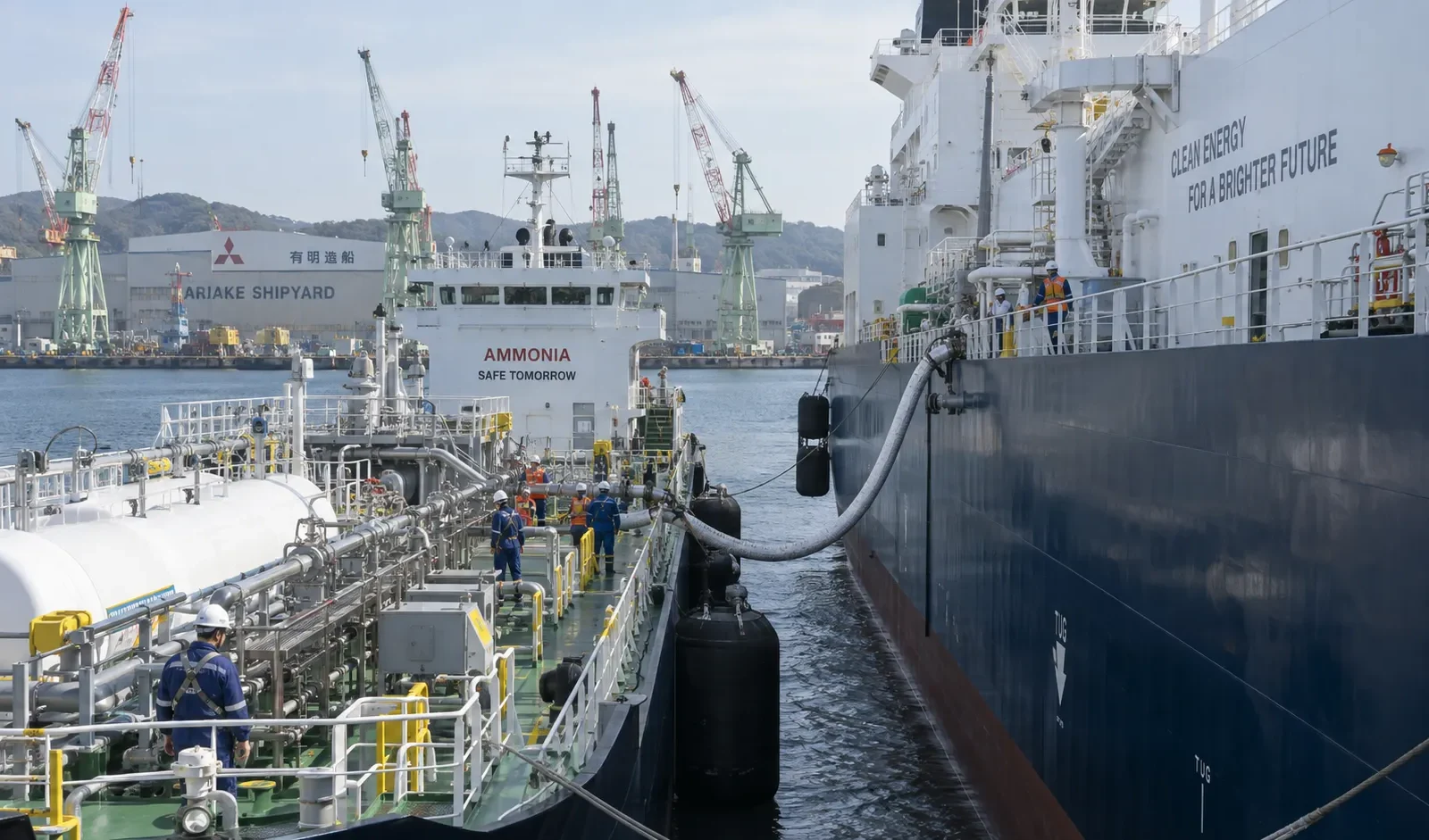
NYK Line and its partners have completed the world’s first ship-to-ship ammonia bunkering operation to an ammonia-fueled vessel. The transfer took place on 17 September at Japan Marine United’s Ariake Shipyard, where the ammonia carrier Shoei Maru supplied fuel ammonia directly to a new ammonia-fueled medium gas carrier preparing for sea trials.
Fuel ammonia was transferred directly from the 998 GT ammonia carrier Shoei Maru to a new ammonia-fueled medium gas carrier using a ship-to-ship hose connection. The operation was carried out ahead of sea trials in which the receiving vessel is expected to operate on ammonia fuel.
How the World’s First Ship-to-Ship Ammonia Bunkering Worked
NYK said the operation was completed with Japan Marine United, Nihon Shipyard, Mitsubishi Gas Chemical and Kokuka Sangyo.
The companies transferred ammonia from Shoei Maru to the newbuild AFMGC by connecting the two vessels directly with transfer hoses. That is the basic logic of ship-to-ship bunkering: the receiving vessel does not need to berth at a dedicated fixed fuel terminal while the bunker vessel delivers fuel alongside.
The companies said they established operating procedures and work processes in advance following extensive technical discussions. The transfer was completed safely, and the participants said the operation generated practical knowledge for future ammonia fuel supply.
For conventional fuel oil and LNG, ship-to-ship bunkering is already a familiar commercial method in many ports. For ammonia, the challenge is different because the fuel is toxic and requires strict containment, detection, isolation and emergency-response procedures.
Shoei Maru and the New Ammonia-Fueled Gas Carrier
The supply vessel, Shoei Maru, is owned by Kokuka Sangyo and normally carries ammonia for Mitsubishi Gas Chemical’s Niigata plant. NYK lists the ship at 998 gross tonnes, with a length of 71.5 metres and breadth of 12.5 metres.
The receiving vessel is a new 40,000 m³-class ammonia-fueled medium gas carrier. It is being built at Japan Marine United’s Ariake Shipyard and is scheduled for delivery in November 2026.
The project is supported by Japan’s NEDO Green Innovation Fund and is designed around domestically developed ammonia dual-fuel engines. NYK previously said the main two-stroke engine is designed for an ammonia co-firing ratio of up to 95%, while the auxiliary four-stroke engine is targeting at least 80%. The project’s whole-ship greenhouse-gas reduction target is 80% or more.
After delivery, NYK has said the AFMGC is expected to be time-chartered to Yara Clean Ammonia Switzerland, linking the vessel directly to the emerging international ammonia supply chain.
| Item | Detail |
|---|---|
| Bunker vessel | Shoei Maru |
| Owner | Kokuka Sangyo |
| Shoei Maru GT | 998 GT |
| Receiving ship | Ammonia-Fueled Medium Gas Carrier (AFMGC) |
| Receiving vessel class | 40,000 m³ |
| Shipyard | Japan Marine United, Ariake Shipyard |
| Delivery | Planned for November 2026 |
| Project support | NEDO Green Innovation Fund |
Why Ammonia Bunkering Is Operationally Different
Ammonia has one obvious attraction as a marine fuel: it contains no carbon. That means it produces no CO₂ from the carbon oxidation that occurs when conventional hydrocarbon fuels are burned.
But operationally, ammonia introduces a different hazard profile. It is toxic to humans and requires controls designed to prevent exposure during transfer, storage, maintenance and emergencies.
A commercial ammonia bunkering procedure must therefore address areas such as:
- transfer-hose integrity;
- connection and disconnection procedures;
- leak detection;
- gas detection and alarms;
- ventilation;
- exclusion zones;
- personal protective equipment;
- emergency shutdown;
- spill or release response;
- crew communication and training.
The industry already has extensive experience transporting ammonia as cargo. The new challenge is using it repeatedly as a fuel, which creates more frequent interfaces between ship, bunker supplier, port, machinery systems and crew.
Tide Signal’s existing Ammonia as Marine Fuel guide covers the wider safety framework, IMO rules, training requirements, emissions questions and engine technology.
Why Ship-to-Ship Bunkering Matters for Commercial Adoption
An alternative marine fuel cannot scale because engines exist. Owners also need to know whether the fuel can be sourced, delivered and transferred at commercial ports without creating excessive delay or operational risk.
STS bunkering matters because it can offer:
- greater flexibility than a fixed bunker terminal;
- fuel delivery at ports where dedicated infrastructure is limited;
- less dependence on one berth or terminal layout;
- a pathway for dedicated ammonia bunker vessels;
- the possibility of serving ammonia-fueled ships across multiple port locations.
But scalability depends on much more than one successful transfer. Ports, bunker suppliers, classification societies, flag States and ship operators still need repeatable procedures, compatible equipment, trained personnel and emergency-response capability.
The milestone is not that ammonia moved from one ship to another. Shipping already transports ammonia every day. The milestone is that ammonia was transferred specifically as marine fuel into a vessel designed to burn it — connecting the fuel-supply chain with the propulsion system that will consume it.
The Timing: IMO Focused on Ammonia in the Same Week
The operation took place during a week in which ammonia fuel was also receiving direct attention at the International Maritime Organization.
IMO held a dedicated technical seminar on the use of ammonia as marine fuel on 17 September, in the margins of the 12th session of the Sub-Committee on Carriage of Cargoes and Containers. The seminar covered ammonia production pathways, bunkering, onboard technology, engine development, spill response and safety.
That overlap is significant because the industry is moving from parallel development tracks towards integration. Regulators are working on the rules and safety architecture while owners, engine makers, yards and bunker suppliers are testing real operations.
The broader regulatory context is explored in Tide Signal’s IMO CCC 12 ammonia fuel analysis.
Does Ammonia Fuel Mean Zero-Emission Shipping?
Not automatically.
Ammonia contains no carbon, so combustion does not generate CO₂ from the fuel itself. But the total climate impact depends on how the ammonia was produced and what other emissions occur during combustion and across the supply chain.
The industry is particularly focused on:
- the carbon intensity of ammonia production;
- nitrous oxide emissions;
- NOx management;
- ammonia slip;
- pilot-fuel requirements;
- well-to-wake lifecycle emissions.
That is why terms such as “green ammonia”, “blue ammonia” and “low-carbon ammonia” matter commercially. Two ships can burn the same chemical molecule while the lifecycle emissions of the supplied fuel differ substantially.
The operational milestone in Japan therefore solves only one part of the transition: how the fuel gets safely onboard. Production scale, price, lifecycle emissions and global availability remain separate challenges.
How This Fits Into the Wider Ammonia-Fuel Market
The sector has already moved beyond purely experimental propulsion. In June 2026, Lloyd’s Register announced the delivery of MGC ANTWERPEN, which it described as the world’s first ammonia dual-fuel gas carrier.
That vessel, built by HD Hyundai for EXMAR, can transport ammonia or LPG and operate using ammonia fuel. The newly bunkered Japanese AFMGC adds another important step: a dedicated STS fuel-supply operation ahead of sea trials.
The direction of travel is therefore becoming clearer:
- develop engines capable of using ammonia;
- build vessels around those engines;
- develop crew and safety procedures;
- demonstrate bunkering;
- establish regular fuel supply;
- scale commercial operations.
The difficult part is that all six steps must progress together. A fleet of ammonia-ready ships has limited value without fuel, and a bunker network has limited value without enough ships to create demand.
What Happens Next?
The immediate next step is sea trials for the AFMGC using fuel ammonia. The vessel is in the final stage of construction ahead of its planned November delivery.
The issues worth watching now include:
- whether the sea trials meet the project’s engine and emissions targets;
- how operational procedures change after real bunkering experience;
- whether similar STS operations are repeated at commercial ports;
- how fast bunker-supply vessels and ammonia terminals develop;
- what insurance and port-safety standards become common practice;
- whether low-carbon ammonia becomes available at a competitive delivered price.
A single world-first operation does not create a global bunker market. But it removes one practical uncertainty: ship-to-ship ammonia fueling can move from engineering concept into an executed marine operation.
Ship-to-Ship Ammonia Bunkering FAQ
What was the world-first ammonia bunkering operation?
NYK and its partners transferred ammonia fuel from the ammonia carrier Shoei Maru to an ammonia-fueled medium gas carrier using the ship-to-ship method at JMU’s Ariake Shipyard on 17 September 2026.
Why is it described as a world first?
NYK describes it as the first ship-to-ship ammonia bunkering operation in which ammonia was supplied as fuel to an ammonia-fueled vessel.
What is ship-to-ship bunkering?
It is the direct transfer of fuel between a bunker vessel and a receiving ship through connected transfer hoses.
What is Shoei Maru?
Shoei Maru is a 998 GT ammonia carrier owned by Kokuka Sangyo. It normally transports ammonia for Mitsubishi Gas Chemical’s Niigata plant.
What is the receiving vessel?
It is a 40,000 m³-class ammonia-fueled medium gas carrier being completed at Japan Marine United’s Ariake Shipyard and scheduled for delivery in November 2026.
Is ammonia safe to use as marine fuel?
Ammonia can be used as marine fuel, but its toxicity requires specialised containment, detection, ventilation, protective equipment, training and emergency procedures.
Does ammonia produce CO₂ when burned?
Ammonia contains no carbon, so it does not generate CO₂ from carbon combustion. However, full lifecycle emissions depend on how the ammonia is produced and on other emissions such as nitrous oxide and ammonia slip.
What happens after the bunkering operation?
The receiving AFMGC is expected to undergo sea trials using ammonia fuel before its planned November 2026 delivery.
- NYK Line — World’s First Ship-to-Ship Ammonia Bunkering to an Ammonia-Fueled Vessel
- NYK Line — Contracts Signed for Construction of Ammonia-Fueled Ammonia Gas Carrier
- IMO — Technical Seminar on the Use of Ammonia as Marine Fuel
- Lloyd’s Register — MGC ANTWERPEN ammonia dual-fuel gas carrier
Editorial note: This is a news article on a specific bunkering milestone. Tide Signal’s existing ammonia fuel guide remains the main evergreen reference for IMO rules, safety, training, engines and lifecycle emissions.