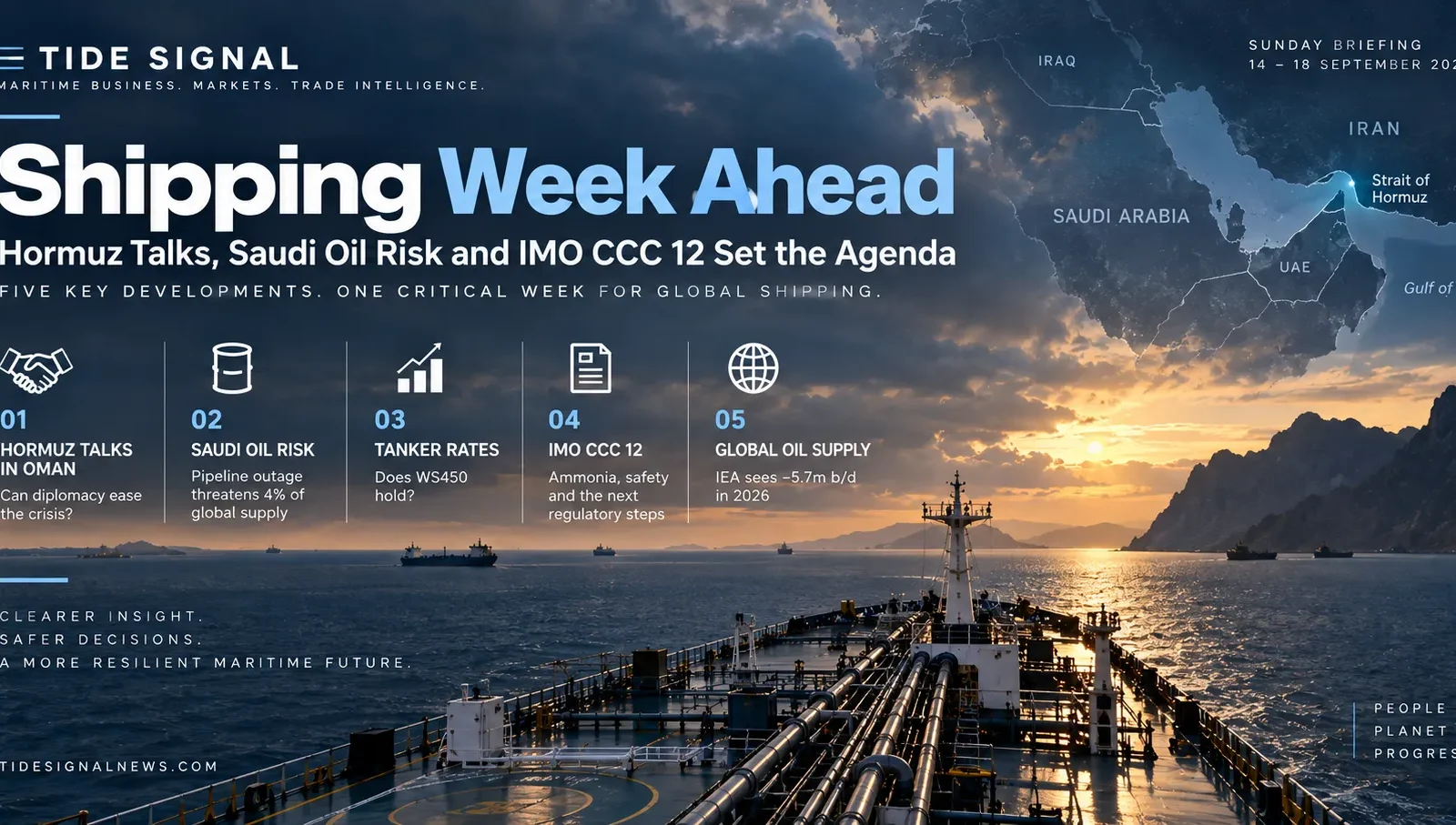
Shipping enters the week of 14–18 September with pressure building simultaneously at sea, ashore and around the negotiating table. A fresh vessel attack has reinforced the security threat in the Strait of Hormuz, Iran and Gulf states are due to meet in Oman, Saudi Arabia’s strategic East-West oil pipeline remains offline and tanker freight is already trading at extreme levels. At the same time, IMO’s CCC 12 opens in London with alternative-fuel safety and ammonia high on the technical agenda.
For the latest market context, see Tide Signal’s shipping week ahead.
This week is unusually concentrated. A diplomatic meeting on Monday could influence the operating outlook for the Strait of Hormuz. Saudi Arabia is racing against the clock to restore a pipeline that has become one of the main alternatives to Gulf tanker movements. Tanker owners are testing how much security risk charterers will pay for. And the IMO begins a technical week focused on cargoes, future fuels and alternative-fuel safety.
01Hormuz Talks in Oman: Diplomacy Returns, but No Immediate Reopening Is Expected
Iran and Gulf states are due to meet in Oman on Monday with the Strait of Hormuz among the central issues. The meeting comes after months of disrupted tanker movements, military incidents and failed attempts to restore predictable commercial traffic through the world’s most important oil chokepoint.
Expectations should remain controlled. A senior Iranian official told Reuters that the meeting is not expected to produce a signed Hormuz agreement. Iran is seeking a framework that would recognise a role for Tehran in the management of the Strait and allow it to collect fees from vessels using the passage, while Oman opposes parts of that proposal.
The diplomatic backdrop worsened again on Sunday when UK Maritime Trade Operations reported a vessel struck by an unidentified projectile while transiting Hormuz. A fire followed and those onboard were evacuated with assistance from local authorities.
Owners, charterers, insurers and crews do not price “open” or “closed” as a binary condition. They price the probability of attack, waiting time, insurance availability, crew exposure and the chance that a voyage cannot be completed as planned.
For Tide Signal’s current operating-status tracker, see Is the Strait of Hormuz Open?. For Sunday’s incident, read Ship Hit by Projectile in Strait of Hormuz as Fire Forces Crew Evacuation.
What to watch Monday: language on transit guarantees, fee collection, temporary shipping arrangements, vessel nationality and whether insurers interpret the talks as a real reduction in risk.
02Saudi Arabia’s East-West Pipeline: The Storage Clock Is Running
The second major issue is now ashore rather than at sea.
Saudi Arabia’s strategic East-West crude pipeline remains offline after drone attacks. The 1,200-km system has become crucial during the Hormuz disruption because it moves crude from eastern Saudi Arabia to the Red Sea export hub of Yanbu, allowing barrels to bypass the Strait entirely.
Reuters reported on Sunday that a prolonged outage could place up to roughly 4% of global oil supply at risk if pumping does not resume within days. The pipeline has been carrying around 4 million b/d, while available storage at Yanbu was reported to cover only about five to seven days of exports at current rates.
The outage becomes more serious because Saudi crude supply has already fallen sharply during the conflict. The IEA reported Saudi supply near 6 million b/d in August, the lowest level in more than three decades.
Read Tide Signal’s full infrastructure analysis: Saudi East-West Pipeline Shut as Bab el-Mandeb Risk Rises.
What to watch this week: repair guidance, restart timing, Yanbu loading programmes, Saudi production, export nominations and whether Red Sea security further limits the value of the western route.
03VLCC Freight: Does WS450 Hold, Break Higher or Start to Normalise?
The tanker market enters the new week after an extraordinary repricing of Gulf exposure.
Reuters reported that the Gulf of Oman-to-China VLCC benchmark reached around WS450, equivalent to roughly $11.50 per barrel of freight, after another wave of attacks reduced the number of owners willing to accept regional exposure and tightened the effective position list.
The important phrase is effective tanker supply. The global VLCC fleet does not need to shrink physically for freight to rise. Rates can jump when fewer vessels are commercially available for a loading area because owners, insurers, crews or financiers will not accept the security profile.
| Signal | Why it matters this week |
|---|---|
| TD34 / Gulf of Oman–China | Shows whether the record risk premium remains embedded in long-haul Gulf freight. |
| Available VLCC list | A smaller willing fleet can keep freight high even if export volumes weaken. |
| War-risk insurance | Changes the owner’s all-in voyage economics and minimum acceptable freight. |
| Atlantic replacement barrels | Longer-haul sourcing can increase tonne-mile demand outside the Gulf. |
Read VLCC Rates Hit Record WS450 on Gulf of Oman–China Route, Worldscale in Shipping and War Risk Premiums in Shipping.
04IMO CCC 12 Opens: Alternative-Fuel Safety Moves Back to Centre Stage
The IMO Sub-Committee on Carriage of Cargoes and Containers holds its 12th session from 14–18 September in London. The sub-committee’s work extends beyond cargoes: it is increasingly central to the technical safety framework for low-flashpoint and alternative fuels.
IMO work programmes identify CCC 12 as an important session for further development or finalisation of mandatory provisions for methyl/ethyl alcohol fuels, continued work on fuel cells and consideration of changes to the IGF Code for gas- and low-flashpoint-fuelled ships.
Ammonia receives additional attention on Thursday, 17 September, when the IMO Future Fuels and Technology Project holds a dedicated technical seminar in the margins of CCC 12. The programme covers ammonia production pathways, supply, bunkering, vessel and engine technology, spill response, safety and effluent management.
Alternative-fuel adoption increasingly depends less on whether an engine can burn the fuel and more on whether regulation, bunkering, crew competence, emergency response and port infrastructure can support routine operation.
Tide Signal has already built the background in Ammonia as Marine Fuel: IMO Rules, Bunkering and What to Watch at CCC 12.
05Global Oil Supply: The IEA’s −5.7m b/d Forecast Hangs Over the Week
The macro backdrop remains severe.
The International Energy Agency now expects global oil supply to fall by 5.7 million barrels per day in 2026, or around 6%, after repeated Gulf disruptions and a slower-than-expected return of normal Middle East flows.
This matters for shipping because the crude market can tighten at the same time as tanker patterns become less efficient. Replacement barrels from the Atlantic Basin can lengthen voyages to Asian refiners; renewed Gulf exports can suddenly pull ships back into a region where willing tonnage remains constrained; and a delayed Saudi pipeline restart reduces route optionality.
Read Tide Signal’s macro analysis: IEA Sees Global Oil Supply Falling 5.7m b/d in 2026.
The Week Ahead: Key Dates for Shipping
Iran and regional states meet as markets look for any sign of a workable shipping arrangement. CCC 12 also opens at IMO headquarters.
Alternative-fuel safety, IGF Code work, cargo and container issues remain on the technical agenda.
Production, bunkering, ship technology, spill response and safety take centre stage.
Attention shifts to formal conclusions and regulatory work forwarded to the Maritime Safety Committee.
What Would Change the Market Most?
Not every headline this week will have the same commercial weight. A diplomatic statement in Oman matters only if owners and insurers believe it changes the probability of safe passage. A Saudi pipeline restart matters because it restores physical export optionality. A drop in VLCC rates matters if it signals more owners are returning to Gulf trades. And an IMO technical conclusion matters when it changes the compliance path for real vessels rather than merely extending discussion.
| Event | Tightening signal | Stabilising signal |
|---|---|---|
| Hormuz talks | No framework; further attacks; new owner restrictions | Credible transit mechanism or lower threat level |
| Saudi pipeline | Repairs delayed; Yanbu stocks tighten | Pumping resumes and loading programmes normalise |
| VLCC market | WS450 holds or rises; position list shrinks | More owners accept Gulf employment |
| Oil supply | Further Gulf losses | Exports and refinery flows recover |
| CCC 12 | New safety barriers delay fuel adoption | Clearer technical pathway for alternative fuels |
- Reuters — New Strait of Hormuz vessel attack
- Reuters — No signed Hormuz deal expected at Monday Oman meeting
- Reuters — Saudi pipeline outage threatens global oil supply
- Reuters — VLCC rates hit record highs
- Reuters — IEA sees 2026 oil supply down 5.7m b/d
- IMO — CCC 12 meeting schedule
- IMO — Technical Seminar on the Use of Ammonia as Marine Fuel