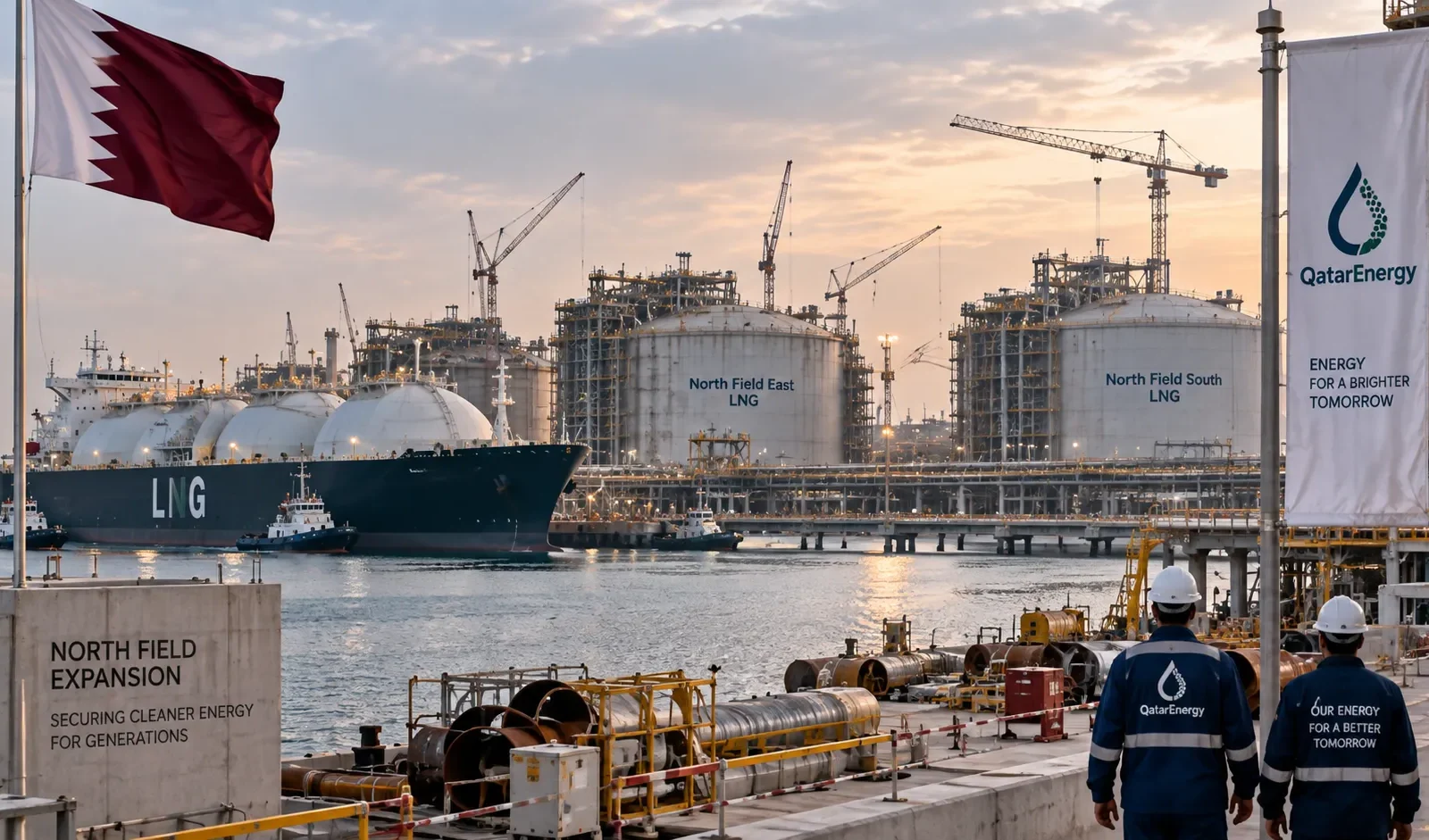
The QatarEnergy North Field expansion faces a new execution risk as disruption around the Strait of Hormuz slows the arrival of critical equipment. With North Field East scheduled to begin operations in 2027 and North Field South in 2028, any project slippage could push part of the expected LNG supply wave further into the future.
QatarEnergy has warned that the Strait of Hormuz crisis could delay some expansion projects because key equipment is struggling to reach Qatar.
Speaking at the Qatar Economic Forum in New York, QatarEnergy Chief Executive Saad al-Kaabi said the company was having difficulty receiving critical project equipment and that this could affect expansion schedules. Reuters reported the warning on 20 September.
The risk matters because Qatar’s expansion is one of the largest single additions of liquefaction capacity expected in the global LNG market. The North Field East project is scheduled to start operations in 2027, followed by North Field South in 2028.
The issue is therefore no longer only whether Qatar can move today’s LNG cargoes through a disrupted Gulf. It is also whether the same regional crisis can interfere with the construction timetable for tomorrow’s LNG supply.
QatarEnergy North Field Expansion Moves From Shipping Risk to Project Risk
The Strait of Hormuz has traditionally been analysed as a maritime chokepoint.
A vessel either transits, waits, diverts where possible or is unable to sail under acceptable commercial conditions.
The QatarEnergy warning introduces a second layer: project logistics.
Large LNG developments require a continuous flow of specialised equipment, modules, machinery, valves, electrical systems and construction material. Delays to the physical supply chain can affect installation sequences even when the construction site itself remains operational.
That means the same crisis affecting outbound energy cargoes can also affect inbound industrial equipment.
↓
Critical equipment arrives late
↓
Construction sequence comes under pressure
↓
LNG train commissioning may slip
↓
Future LNG supply reaches the market later
↓
Cargo and LNG-carrier demand timing changes
What North Field East and North Field South Add
The scale of the QatarEnergy North Field expansion explains why even a modest delay would attract global attention.
According to QatarEnergy’s official LNG strategy page, North Field East will add 32 million tonnes per annum of LNG capacity and raise Qatar’s production capacity from 77 MTPA to 110 MTPA.
North Field South will add another 16 MTPA, taking total capacity to 126 MTPA.
QatarEnergy has also announced North Field West, another 16 MTPA phase that is intended to raise Qatar’s LNG production capacity to 142 MTPA by the end of 2030.
| Project | Incremental capacity | Total Qatar LNG capacity | Current timing reference |
|---|---|---|---|
| Existing system | — | 77 MTPA | Current base capacity |
| North Field East | 32 MTPA | 110 MTPA | Scheduled to begin operations in 2027 |
| North Field South | 16 MTPA | 126 MTPA | Scheduled to begin production in 2028 |
| North Field West | 16 MTPA | 142 MTPA | Targeted by end-2030 |
The 2027 and 2028 startup references come from QatarEnergy’s latest public comments reported by Reuters. The capacity figures come from QatarEnergy’s own project information.
That distinction matters because project schedules can change more quickly than nameplate-capacity plans.
Why a North Field Delay Would Matter to the Global LNG Market
LNG markets have been expecting a major wave of new supply from Qatar, the United States and other exporting regions.
That expected capacity growth is important because it can increase cargo availability, reduce scarcity, improve destination flexibility and potentially lower the premium paid for spot cargoes during periods of tight supply.
Tide Signal’s existing LNG Prices 2026 analysis tracks the current side of that equation: high Asian spot prices, weaker price-sensitive demand and Europe’s competition for replacement cargoes.
This new article addresses a different search intent.
The question here is not where LNG prices are today. It is whether one of the largest future supply additions could reach the market later than planned.
If North Field capacity slips, the effect would depend on the duration and scope of the delay. A short construction interruption may have limited market impact. A material commissioning delay across one or more trains could alter the expected supply balance for 2027 or 2028.
Qatar Is Still Operating Under Severe Current LNG Constraints
The project warning comes while QatarEnergy is already dealing with an unusually difficult operating environment.
Al-Kaabi said QatarEnergy is currently producing only a very small volume of LNG, according to Reuters.
The latest shipping data show that Gulf LNG movements have not returned to normal. On 18 September, Reuters reported that several LNG vessels had reappeared outside the Strait of Hormuz after days of reduced visibility, including QatarEnergy-linked tonnage.
One QatarEnergy-linked vessel was also reported to have conducted a ship-to-ship transfer off Oman.
Tide Signal’s Strait of Hormuz shipping status hub tracks the broader operational picture, while the Ship-to-Ship Operations guide explains the operational framework behind STS transfers.
These workarounds can keep individual cargoes moving, but they do not remove the structural problem facing a project that depends on a reliable industrial supply chain.
The Shipping Impact Is About Timing, Not Just More LNG
The QatarEnergy North Field expansion is also tied to one of the largest LNG fleet-expansion programmes in the industry.
QatarEnergy’s 2024 Annual Review said the company had secured agreements for the ownership, long-term time charter and operation of 128 LNG carriers as part of its historic LNG Fleet Expansion Project.
That figure should not be read as the number of ships still awaiting delivery today; fleet deliveries have been progressing since then.
The more important commercial point is that ship capacity and liquefaction capacity are being developed as one system.
New LNG trains create cargoes. New LNG carriers provide the transport capacity required to move them.
If liquefaction schedules change while vessels continue delivering, the timing relationship between cargo supply and ship supply can change as well.
A North Field delay would not automatically be bullish or bearish for LNG-carrier freight.
Freight depends on the balance between ships, cargoes, voyage distance, seasonal demand, ballast positioning and available vessel supply. If vessels arrive before the cargoes they were intended to serve, near-term ship availability can increase. If project delays coincide with continued disruption and longer replacement voyages elsewhere, the effect can be very different.
The key variable is therefore synchronization: when the trains start, when the ships deliver and where the replacement cargoes come from in the meantime.
North Field East Alone Is a Massive Supply Addition
North Field East is not a marginal project.
QatarEnergy’s investor materials describe NFE as four liquefaction trains of 8 MTPA each — a total of 32 MTPA.
North Field South adds two further 8 MTPA trains.
QatarEnergy’s November 2025 investor presentation showed the full domestic expansion path from 77 MTPA to 142 MTPA, an increase of about 85% once North Field East, South and West are fully developed. See QatarEnergy’s investor presentation.
This is why even a scheduling risk around one phase matters to market expectations. Traders, utilities, portfolio players and shipowners build future planning around when new molecules are expected to become available.
Europe and Asia Both Care About the Project Schedule
Qatar’s expansion is strategically important because LNG demand is geographically fragmented.
Europe needs flexible supply to balance pipeline flows, storage levels and winter demand. Asian buyers range from large contracted importers to highly price-sensitive utilities that can step away from the spot market when prices become too high.
Additional Qatari supply could improve liquidity in both regions.
A delay does not mean Europe or Asia suddenly runs out of LNG. The United States, Australia and other suppliers continue to provide substantial volumes.
But the expected timing of new Qatari capacity affects the amount of competition buyers may face for marginal cargoes.
That is especially relevant after 2026 demonstrated how quickly a regional shipping shock can push spot LNG prices higher and force price-sensitive buyers to reduce demand.
Equipment Logistics Can Become a Critical Path
Large energy projects are built around sequencing.
A delayed component does not always delay the entire project. Construction teams can sometimes resequence work, accelerate another package or use inventory already on site.
But specialised equipment can become a critical-path item when there is no practical substitute and later commissioning work depends on its installation.
That is why Al-Kaabi’s warning is important even though QatarEnergy has not announced a revised startup date.
The company is signalling execution risk — not confirming that NFE or NFS will definitely start late.
Hormuz Risk Is Now Reaching Beyond the Voyage
The Strait of Hormuz is usually discussed in terms of oil and LNG exports, tanker traffic and war-risk insurance.
The North Field warning expands that framework.
A prolonged chokepoint crisis can affect:
outbound LNG cargoes; inbound equipment; contractor logistics; port access; personnel movement; insurance; commissioning schedules; and the timing of future export capacity.
Tide Signal’s War Risk Premiums in Shipping guide explains how geopolitical risk moves into voyage economics. For a project such as North Field, the commercial effect can also move further upstream into construction schedules and capital deployment.
North Field West Adds Another Layer to the 2030 Story
North Field West is not the immediate subject of QatarEnergy’s latest timing warning, and there is no basis to state that NFW has been delayed.
It remains relevant because it shows the full scale of Qatar’s longer-term strategy.
NFW is designed to add a further 16 MTPA and lift Qatar’s LNG capacity to 142 MTPA by the end of 2030.
That means project execution between now and the end of the decade is cumulative. Delay in one phase can affect contractor schedules, resources and commissioning sequences even if later phases retain their official targets.
The market will therefore watch not only the first gas or first LNG cargo from NFE, but whether the entire expansion pathway remains on schedule.
What Shipping and LNG Markets Should Watch Next
The Bottom Line
The QatarEnergy North Field expansion has become another example of how maritime disruption can move beyond ship traffic and into industrial project execution.
QatarEnergy has not announced that North Field East or North Field South will definitely start late.
But the company has now acknowledged that difficulty receiving critical equipment could delay some expansion projects.
That matters because NFE and NFS together are designed to lift Qatar’s LNG production capacity from 77 MTPA to 126 MTPA, while the wider expansion pathway targets 142 MTPA by the end of 2030.
For shipping, the central issue is synchronization: the timing of new LNG trains, new cargoes and new LNG carriers. If one part of that system slips while the others continue moving, the impact can reach freight, vessel availability and the future Europe–Asia LNG balance.
- Reuters — QatarEnergy says Hormuz crisis may delay some expansion projects, 20 September 2026
- Reuters — Hormuz traffic, LNG vessel movements and QatarEnergy-linked STS activity, 18 September 2026
- QatarEnergy — North Field East, North Field South and North Field West LNG capacity
- QatarEnergy — Investor Presentation, November 2025
- QatarEnergy — Annual Review 2024, LNG Fleet Expansion Project