Markets · Dry Bulk · Port Logistics
Russia grain exports are being pushed north. Disruption across the Black Sea and Sea of Azov is forcing exporters to use Baltic and Arctic ports that were built primarily for fertilizers, coal, metals and general cargo — creating a new logistics chain around rail capacity, terminal conversion and longer alternative sea routes.
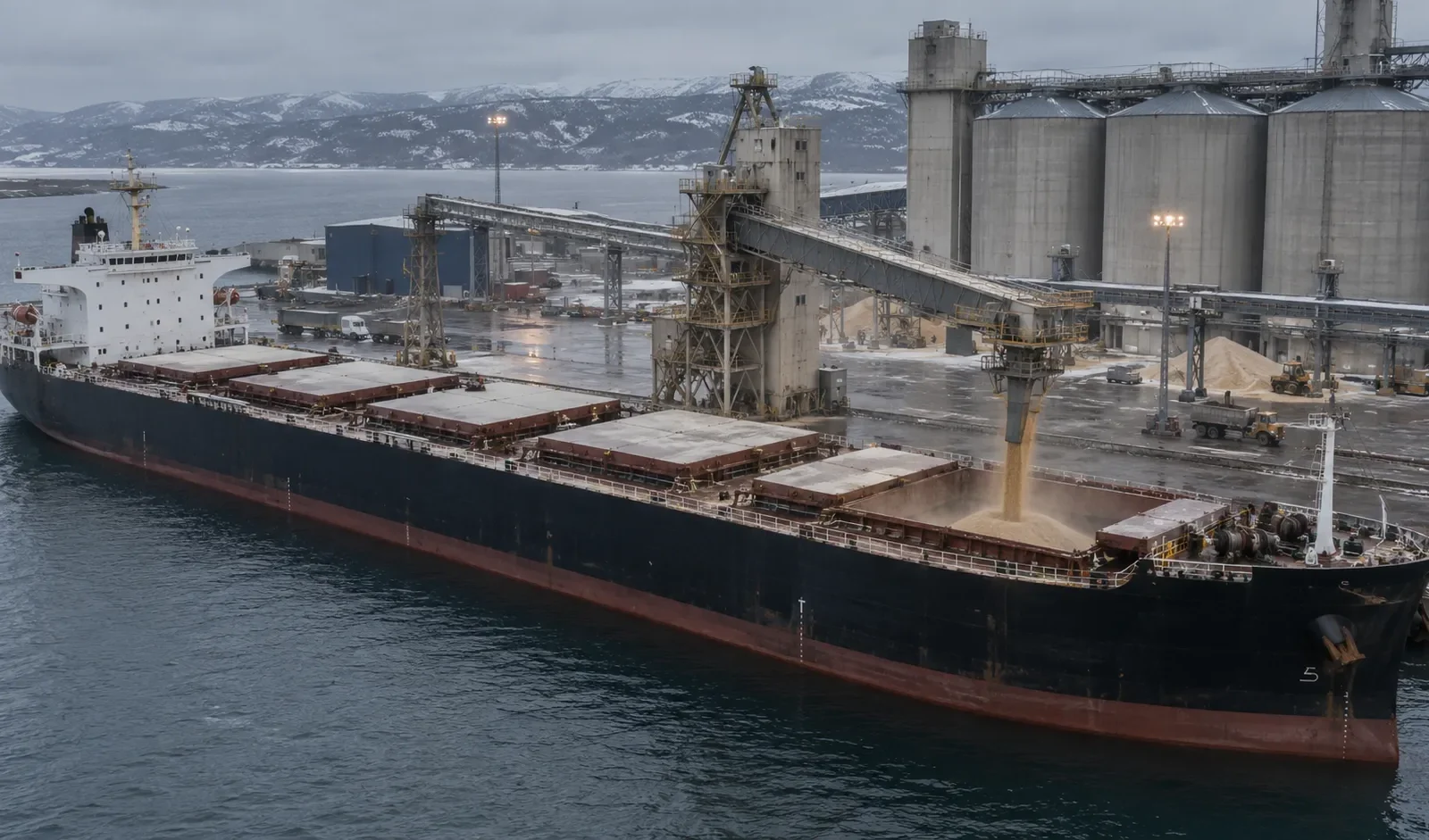
Russian companies are adapting facilities at Ust-Luga, St Petersburg and Murmansk to handle grain after attacks and navigation restrictions reduced the reliability of the country’s traditional southern export system. The change is still far too small to replace Black Sea capacity, but it is becoming strategically important for traders, rail operators, ports and dry-bulk shipowners.
The shift is not merely a port story. Russia’s southern grain-export machine was built around short inland supply chains feeding high-capacity Black Sea terminals. Moving cargo north requires a different rail network, different terminal interfaces, different ship positioning and — for many destinations — a different voyage-cost structure.
For dry-bulk markets, the immediate impact is likely to appear first in regional vessel demand, voyage duration, port positioning, rail-to-ship logistics and risk premiums, rather than as a simple one-direction move in the headline Baltic Dry Index.
Why Russia Is Rerouting Grain Away From the Black Sea
Russia’s grain export system has historically been concentrated in the south because the Black Sea and Sea of Azov provide efficient access to major import markets in North Africa, the Mediterranean and the Middle East.
That system has been disrupted by escalating attacks on ports, vessels and infrastructure. Navigation in the Sea of Azov was suspended following attacks, while key grain terminals around Novorossiysk have faced operational interruptions.
Industry data published earlier in September showed Russian seaborne grain exports falling sharply in August, with Azov–Black Sea volumes down heavily year on year. In the previous 2025/26 season, the Azov–Black Sea basin handled about 46.3 million tonnes of Russia’s roughly 52.7 million tonnes of seaborne grain exports.
That concentration is exactly why disruption matters. Alternative basins do not yet have anything close to the same grain-handling scale.
Tide Signal’s separate analysis of Ukraine Black Sea grain exports covers the parallel disruption on the Ukrainian side, where cargoes have increasingly shifted toward Danube routes. The Russian story is structurally different: it is about moving cargo north into Baltic and Arctic infrastructure.
Ust-Luga Emerges as the Most Immediate Baltic Alternative
The clearest example of Russia’s new strategy is Ust-Luga, west of St Petersburg.
Reuters reported that the private Ultramar terminal — a facility specialising in mineral fertilizers — has been rapidly adapted to handle grain. The terminal has a declared overall capacity of 37 million tonnes across its cargo activities and began accepting grain in August.
Rail applications for grain deliveries to Ultramar in September reached around 260,000 tonnes, with cargoes destined for markets including Egypt and Saudi Arabia.
This is important for three reasons.
- The terminal already has heavy bulk-cargo infrastructure. Converting spare capacity is faster than building a dedicated grain port from zero.
- Rail becomes the critical inland link. Grain that previously moved south must now compete for capacity on much longer northwestern rail corridors.
- The sea voyage changes. Cargo for Mediterranean and Middle Eastern buyers loaded in the Baltic follows a very different route from grain loaded at Novorossiysk.
St Petersburg Is Adding Smaller and More Flexible Grain Outlets
Reuters also reported that the Modul and BSMZ terminals in St Petersburg, which previously did not handle grain shipments, are beginning to accept grain.
Modul was cited as being able to handle up to approximately 70,000 tonnes of grain in containers per month.
Containerized grain is not a direct substitute for conventional bulk grain exports. The unit cost is typically higher, cargo parcel sizes are smaller, and the logistics chain is different. But it creates flexibility when the primary objective is keeping cargo moving rather than maximizing scale.
For shippers, this is a reminder that supply-chain resilience often relies on multiple imperfect alternatives rather than one replacement route matching the original system exactly.
Murmansk Opens an Arctic Route for Russian Grain
The most strategically unusual part of the rerouting is Murmansk.
Murmansk Commercial Sea Port, a major Arctic port with annual cargo capacity of up to approximately 24 million tonnes, has been preparing to start grain exports. The port traditionally handles cargoes such as coal, ore and metals rather than operating as a major grain hub.
Russian Railways approved an initial 40,000-tonne rail shipment of grain from the southern Stavropol region to Murmansk.
The distance itself shows the scale of the logistics change. Reuters reported Murmansk is around 2,700 km from Novorossiysk, Russia’s main southern grain gateway.
That means grain produced in or near Russia’s southern agricultural regions can travel thousands of kilometres in the opposite direction before even reaching a ship.
Why Murmansk still has strategic value
Despite the inland penalty, Murmansk offers characteristics Russia values in the current environment:
- it is a year-round ice-free Arctic port;
- it can handle large Panamax-class vessels;
- it provides access to open sea without relying on the Black Sea chokepoint system;
- it offers an additional route when Baltic and southern infrastructure face security pressure.
One industry source cited by Reuters argued that the ability to use large Panamax-class ships could help contain seaborne transport costs. That may reduce the ocean-freight penalty per tonne, although the full logistics calculation also includes the much longer rail leg.
Russia’s Alternative Port Capacity Is Still Much Smaller Than the South
The biggest constraint is scale.
Analysts cited by Reuters estimated existing combined grain-handling capacity at Russia’s Baltic ports at roughly 2–7 million tonnes, compared with more than 60 million tonnes of capacity at southern ports.
Even aggressive conversion of spare fertilizer, coal and multipurpose capacity cannot immediately reproduce the Black Sea system.
| Route / location | Current role | Strength | Main limitation |
|---|---|---|---|
| Novorossiysk / southern ports | Historic core grain export route | Very large dedicated capacity and shorter logistics to southern producing regions | Security disruption and operational interruptions |
| Ust-Luga | Rapidly growing alternative | Large existing bulk infrastructure and spare terminal capacity | Longer inland rail movement and conversion requirements |
| St Petersburg | Flexible supplementary route | Existing multipurpose infrastructure and container options | Smaller parcel scale and higher cost for containerized grain |
| Murmansk | Arctic strategic alternative | Ice-free access and ability to handle large bulkers | Very long inland rail distance from major grain-producing regions |
| Caspian / Far East | Additional diversification | Useful for specific destination markets | Geography and capacity limit ability to replace Black Sea volumes |
Rail Is Becoming the Hidden Bottleneck
Changing ports also changes the inland transport system.
A tonne of grain cannot simply be “redirected” by changing the destination field on a shipping order. Rail wagons have to be available, loading slots have to be scheduled, terminals need unloading capacity, storage has to be coordinated and ship arrival needs to match cargo accumulation.
Reuters reported that Russian Railways has given high priority to grain shipments toward Baltic and Arctic destinations and that state support has been used to facilitate the rerouting.
That support is commercially important because rail economics can determine whether an alternative export corridor is viable.
When cargo moves thousands of kilometres farther inland, the ocean freight rate is only one part of the delivered-cost equation.
Could Baltic and Arctic Rerouting Increase Tonne-Mile Demand?
Potentially — but not automatically.
Tonne-mile demand is cargo volume multiplied by sailing distance. If the same tonne of grain is carried farther at sea, vessel demand increases even if total cargo volume is unchanged.
For some traditional Russian destinations in the Mediterranean, North Africa or the Middle East, loading from Baltic or Arctic ports can lengthen the ocean voyage substantially compared with loading at Novorossiysk.
That can increase:
- laden voyage days;
- bunker consumption;
- vessel-days absorbed per cargo;
- ballast-positioning complexity;
- freight sensitivity to route and timing.
But the effect depends on destination. Northern European or Atlantic destinations may not create the same increase, while some long-haul trades can become materially longer.
For the broader market, Tide Signal tracks the Baltic Dry Index 2026, including Capesize, Panamax and Supramax market conditions.
Which Dry-Bulk Vessel Classes Could Benefit?
Grain cargoes are commonly carried by Panamax, Kamsarmax, Supramax and smaller bulk carriers depending on terminal draft, parcel size, destination and contract structure.
Panamax and Kamsarmax
Murmansk’s ability to handle Panamax-class vessels is commercially important because larger parcels can lower transport cost per tonne. A large grain lot also ties up more vessel capacity per voyage.
For routes into North Africa, the Middle East or Asia, larger vessels can improve unit economics where port restrictions allow.
Supramax and Ultramax
Smaller bulkers may remain important where converted terminals cannot efficiently accumulate or load full Panamax parcels, or where destination ports have tighter draft or berth constraints.
They can also be more flexible in emerging routes where cargo programmes are still being established.
Handysize
Handysize tonnage can participate in smaller parcel and port combinations but is less likely to dominate a high-volume replacement for Russia’s traditional deep-sea grain network.
Freight Economics: The Rail Leg Could Matter More Than the Sea Leg
For charterers and grain traders, the correct comparison is not simply:
Black Sea freight vs Baltic freight.
The real comparison is the entire delivered logistics chain:
- farm or elevator to railhead;
- rail distance and tariff;
- wagon availability;
- terminal handling charges;
- storage and waiting time;
- ocean freight;
- bunkers;
- insurance and war-risk costs;
- destination discharge cost;
- quality and contamination risk.
A route with higher ocean freight can still be preferable if the original port is unavailable. Conversely, a route that appears attractive on the freight market can become uneconomic once inland transport is included.
Tide Signal’s Voyage Estimation in Shipping guide explains how distance, bunkers, port time, freight and waiting time combine into the voyage result.
War Risk Is Changing More Than Insurance Premiums
The Black Sea disruption demonstrates why war risk cannot be treated only as an insurance surcharge.
Security conditions can change:
- whether a shipowner accepts a port;
- the premium required to fix a voyage;
- crew and insurer approvals;
- port operating hours and pilotage;
- terminal reliability;
- waiting time;
- the preferred export basin itself.
London marine insurers widened the Black Sea high-risk framework in September as attacks on commercial shipping increased. Tide Signal’s Black Sea high-risk zone analysis explains the marine-insurance implications.
In other words, the cost of war risk is partly visible in premiums — and partly hidden in the physical redesign of trade flows.
Why Fertilizer Exports May Not Be Displaced Immediately
One obvious concern is whether using fertilizer terminals for grain simply creates a new shortage elsewhere.
Reuters cited an industry source saying available spare capacity at Baltic terminals meant the adaptation was not expected to materially affect Russian fertilizer exports.
Ultramar reportedly exported around 16 million tonnes of fertilizer last year, below its declared overall terminal capacity.
That spare capacity is one reason the Baltic can absorb some grain quickly.
However, sustained grain growth would eventually create more direct competition for rail slots, storage, berth windows and terminal labour even if nominal terminal capacity remains available.
Russia Is Also Diversifying Through the Caspian and Far East
The Baltic and Arctic are not the only alternatives.
Russian officials have also pointed to the Caspian Sea and Far Eastern ports as part of a broader rerouting strategy.
Earlier September shipping data showed Caspian grain shipments rising year on year, while Far East volumes more than doubled from a low base.
These routes serve different destination economics. Caspian exports are particularly relevant to Iran and nearby markets, while Far Eastern routes can support Asian demand.
The important point is diversification. Russia is attempting to reduce dependence on one export basin by building multiple lower-capacity alternatives.
Can the Baltic and Arctic Replace the Black Sea?
Not in the near term.
The capacity gap is simply too large.
Russia’s southern ports historically handled tens of millions of tonnes of grain per season. Baltic grain capacity remains a fraction of that, and Murmansk is only beginning to establish the required cargo chain.
The alternative routes can:
- keep some export volumes moving;
- reduce pressure on farmers and storage;
- serve selected buyers;
- create additional bargaining and routing flexibility;
- provide strategic resilience.
They cannot yet reproduce the speed, scale and cost structure of the southern corridor.
September Exports Show the Scale of the Pressure
Sovecon estimated Russia’s September grain exports at around 2.45 million tonnes, approximately half the year-earlier volume.
Reuters also reported exports of around 4.4 million tonnes in July–August, down about 31% year on year.
That means Russia is not rerouting because the Baltic and Arctic suddenly became the cheapest grain corridors. It is rerouting because export capacity itself has become constrained.
The difference is crucial for freight markets. Emergency or strategic rerouting can persist even when the alternative route carries a higher delivered cost.
What This Means for Grain Buyers
Buyers in Egypt, Saudi Arabia and other major import markets may see the effects through freight and timing rather than through headline Russian crop availability alone.
Possible consequences include:
- wider variation in load-port options;
- longer voyage durations;
- more complicated laycan planning;
- greater exposure to rail and terminal delays;
- higher freight differentials between origins;
- changing parcel sizes and vessel classes.
For commodity buyers, the cheapest FOB grain does not necessarily produce the cheapest delivered cargo if logistics become unreliable.
What Shipowners and Charterers Should Watch
The most important market signals are now operational rather than political headlines alone.
- Actual loadings from Ust-Luga. Rail applications show intent; completed shiploadings show real throughput.
- Murmansk’s first export programme. The size and destination of early cargoes will show whether the Arctic route is commercially repeatable.
- Panamax versus Supramax fixtures. Vessel-class selection will reveal how converted terminals are functioning in practice.
- Rail congestion and subsidies. Inland economics may decide the maximum sustainable export volume.
- Black Sea terminal recovery. If southern capacity returns, some northern rerouting could reverse quickly.
- War-risk pricing. Vessel acceptance and insurance costs can shift route economics even before a port closes.
- Destination mix. Mediterranean and Middle East cargoes create different voyage implications from northern or Atlantic sales.
Russia Grain Exports and the Baltic Dry Index
It is tempting to connect any major dry-bulk disruption directly to the BDI. That can be misleading.
The BDI combines multiple dry-bulk vessel segments and global commodity routes. Iron ore and coal flows can dominate movements in larger vessel classes, while grain has a stronger direct influence on Panamax, Kamsarmax and smaller-bulker employment.
Russia’s grain rerouting can therefore be meaningful even if the headline BDI barely reacts.
The signals to watch are:
- Panamax and Kamsarmax availability in the Baltic;
- ballast movements into northern Europe;
- grain-route freight differentials;
- port waiting times;
- longer vessel employment on Mediterranean and Middle East destinations.
A regional trade shift can materially affect individual ship earnings without moving the global index enough to make headlines.
Frequently Asked Questions
Why are Russia grain exports moving to Baltic ports?
Disruption in the Black Sea and Sea of Azov has reduced the reliability of Russia’s traditional southern export system. Exporters are therefore using spare bulk-terminal capacity and new grain-handling arrangements in the Baltic.
Which Baltic ports are handling more Russian grain?
Ust-Luga is emerging as a major alternative, particularly through the Ultramar terminal. Terminals in St Petersburg are also beginning to handle grain.
Why is Murmansk being used for grain exports?
Murmansk provides an ice-free Arctic outlet and can handle large Panamax-class vessels. Its weakness is the very long inland rail distance from Russia’s main southern agricultural regions.
Can Baltic and Arctic ports replace Novorossiysk?
Not at current capacity. Russia’s southern ports historically handled far larger grain volumes. The northern routes are important for diversification and resilience but remain smaller.
Could the rerouting increase dry-bulk freight demand?
Yes, on some routes. Longer sea distances can increase vessel-days and tonne-mile demand, particularly for Mediterranean and Middle East destinations. The effect is route-specific and should not automatically be treated as a bullish signal for the entire Baltic Dry Index.
Which vessel types are most relevant to Russian grain exports?
Panamax, Kamsarmax, Supramax, Ultramax and smaller bulk carriers can all participate depending on parcel size, terminal restrictions, draft and destination.
How much did Russia export through the Black Sea previously?
Industry data cited by Reuters showed about 46.3 million tonnes moved through Azov–Black Sea ports in the 2025/26 season, close to 90% of Russia’s seaborne grain exports.
Key Takeaways
- Russia grain exports are increasingly being rerouted toward Baltic and Arctic ports as Black Sea disruption persists.
- Almost 90% of Russian seaborne grain moved through the Azov–Black Sea system in the previous export season.
- Ust-Luga’s Ultramar terminal has begun handling grain despite historically focusing on mineral fertilizers.
- September rail applications for grain deliveries to Ultramar reached around 260,000 tonnes.
- St Petersburg terminals are also adding grain capability, including containerized options.
- Murmansk is preparing grain exports and has an initial 40,000-tonne rail shipment approved from Stavropol.
- Alternative northern grain capacity remains far below southern-port capacity.
- The rerouting can change rail demand, voyage distance, vessel positioning, freight economics and regional dry-bulk employment.
- The strongest direct shipping impact is likely to appear in Panamax/Supramax grain routes rather than automatically in the headline BDI.
Sources and Further Reading
- Reuters — Russia adapts fertilizer, coal terminals in Baltic and Arctic ports to export Black Sea grain, 21 September 2026
- Reuters / Business Recorder — Russia’s seaborne grain exports drop due to port disruption, September 2026
- Lloyd’s List — Russia’s Black Sea grain exports plunge as attacks disrupt shipping
- Rosmorport — Prospective port investment projects, including Baltic grain-terminal capacity
Editorial verification: Tide Signal reviewed Reuters reporting and supporting shipping/port sources available on 22 September 2026. Export volumes, terminal use and routing can change quickly as security conditions and port operations evolve.