Markets · Operations · Dry Bulk · Black Sea
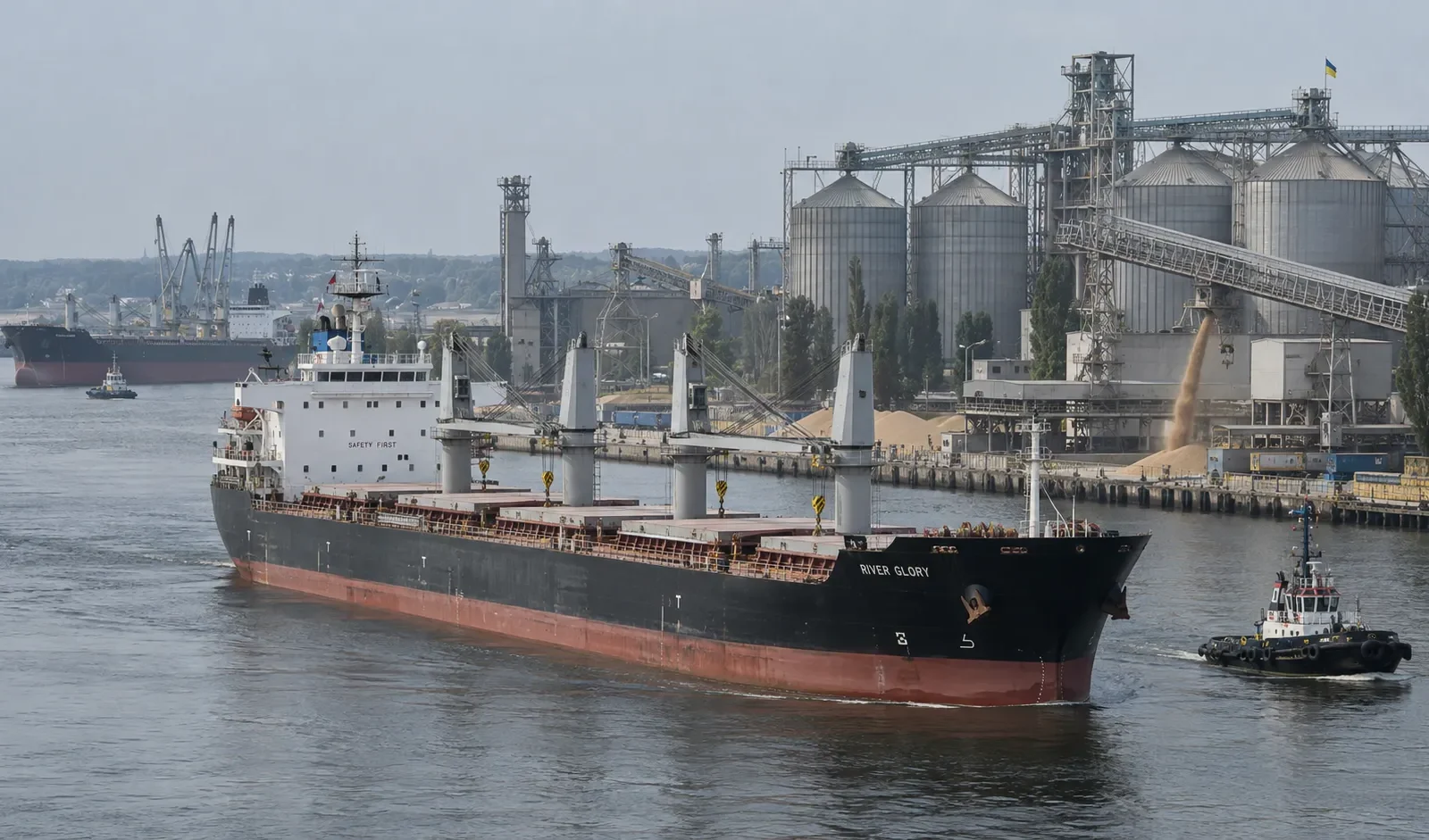
Ukraine Black Sea grain exports are facing a severe shipping disruption. Grain-carrier calls at Ukrainian Black Sea ports fell 92% month on month in August, according to Lloyd’s List analysis published on 17 September, as escalating attacks pushed more cargo towards Danube routes. The alternative corridor is functioning, but congestion, pilot availability, inspections, air-raid disruption and security risk are creating a second logistics bottleneck.
The problem is no longer confined to the security risk at Ukraine’s deepwater Black Sea ports. Cargo is being pushed towards the Danube, where the Sulina approach and the ports of Reni and Izmail have become strategically more important. That rerouting keeps export options open, but it also concentrates vessels, pilots, inspections, inland grain flows and security exposure into a narrower logistics system.
Ukraine Black Sea Grain Exports: Why Grain Ship Calls Fell 92%
Lloyd’s List reported on 17 September that grain-carrier calls at Ukrainian Black Sea ports fell 92% month on month in August. Its analysis also said broader commercial shipping activity at Ukraine’s Black Sea ports was down by about 90% year on year as the security environment deteriorated.
The fall matters because Ukraine’s Black Sea terminals normally offer the scale, storage, loading systems and deepwater access required to move large agricultural volumes efficiently. When owners, charterers, insurers or cargo interests become less willing to expose vessels to a port area, the effect reaches beyond the individual voyage.
It can reduce:
- available vessel choice;
- port-call frequency;
- cargo-programme reliability;
- forward fixture confidence;
- the ability to combine parcels efficiently;
- the predictability of laycan and loading schedules.
The broader security environment has worsened at the same time. On 18 September, Reuters reported that London marine insurers widened the Black Sea high-risk area after increased attacks on commercial shipping. Tide Signal’s Black Sea High Risk Zone analysis explains what that change means for voyage notification, owner acceptance and war-risk pricing.
The commercial consequence is straightforward: even when cargo exists, a workable export requires the right vessel, insurance, crew acceptance, port access, berth readiness, cargo readiness and a voyage that still makes financial sense after risk costs are added.
The 92% figure is fundamentally a shipping-capacity signal. It shows how quickly port activity can collapse when physical cargo demand remains but the maritime route becomes harder to insure, schedule and execute.
Why More Ukrainian Grain Is Moving Towards the Danube
As access to major Ukrainian Black Sea ports becomes more difficult, cargoes are being redirected towards the Danube system. The key names for shipping are Reni, Izmail and the Sulina Canal.
Reuters reported on 31 August that the queue of vessels waiting to access the Sulina Canal for Ukrainian Danube ports had grown to around 80 ships. The report said the pressure followed continued attacks that had restricted the use of Ukraine’s main Black Sea export gateways.
The Danube route provides an essential alternative, but it is not a frictionless replacement for large Black Sea terminals. The system has to absorb:
- additional vessel arrivals;
- more intensive pilot demand;
- inspection requirements;
- grain arriving by rail and truck;
- berth scheduling pressure;
- security interruptions;
- weather and river-navigation constraints.
Reuters said a shortage of pilots and priority treatment for essential cargo such as fuel were among the constraints affecting access. Daily entries were reported to have improved from around five vessels to at least seven, with the possibility of reaching ten, but the existing backlog was still expected to take significant time to clear.
What an 80-Vessel Sulina Queue Means Operationally
A queue of approximately 80 vessels is not just a headline number. It represents waiting time, bunker consumption, schedule uncertainty, charterparty exposure and delayed cargo.
80 vessels ÷ 7 entries per day ≈ 11.4 days
80 vessels ÷ 10 entries per day = 8 days
This simple arithmetic assumes no new arrivals and identical processing conditions, which is unrealistic. Reuters reported that clearing the backlog could take several weeks because new vessels continue to arrive and operations can be interrupted.
For an operator, the more relevant question is not “How many ships are waiting?” but:
- When will this specific vessel enter?
- Is the cargo ready when the vessel gets through?
- How much hire or demurrage exposure is building?
- How much additional bunker is being consumed?
- Does the berth window still work?
- Will the vessel miss its next employment?
Tide Signal’s Port Delays: When Waiting Time Becomes Commercial Risk explains how waiting time can move from an operational inconvenience into a material voyage-cost problem.
What the Shift Means for Dry Bulk Shipping
Ukraine Black Sea grain exports sit directly inside the dry-bulk market. But the impact is more complex than saying “less grain equals lower freight”.
A disruption can reduce cargo availability at one loading area while simultaneously increasing tonne-mile demand, repositioning requirements or smaller-vessel demand elsewhere. It can also create inefficient ballast legs and longer waiting periods that reduce effective fleet productivity.
The Danube shift can change the economics of the vessel mix because river access, channel restrictions, berth limitations and parcel sizes differ from those at major deepwater terminals. That can increase the relative importance of smaller dry-bulk tonnage or require different cargo aggregation strategies.
Tide Signal analysis
Do not read the 92% fall as a direct signal for the Baltic Dry Index. The BDI is a global dry-bulk benchmark driven by multiple vessel segments and commodity trades. The Ukraine disruption is one regional input. Its more immediate effect is likely to appear in local vessel positioning, grain-route freight, waiting time, war-risk cost and cargo diversion before it becomes visible in a broad global index.
For the wider dry-bulk market, Tide Signal tracks the Baltic Dry Index, including Capesize, Panamax and Supramax conditions. The Ukraine grain story is particularly relevant to operators following grain-driven Panamax, Supramax and smaller bulk employment, but route-level fixtures should be analysed separately from the headline BDI.
Could Ukraine Grain Disruption Push Freight Higher?
It can push some freight costs higher, but not automatically across the whole dry-bulk market.
Higher freight exposure can emerge through:
- war-risk premiums;
- higher crew or security costs;
- longer waiting time;
- fewer owners willing to call;
- restricted vessel choice;
- alternative loading ports;
- longer ballast or cargo routes;
- smaller parcel economics;
- reduced schedule reliability.
At the same time, if export volumes fall sharply enough, the reduction in cargo demand can work in the opposite direction. The final freight effect therefore depends on the balance between cargo loss and transport inefficiency.
That is why regional grain freight can strengthen even while total cargo volumes weaken, or vice versa. Owners price the voyage they are actually being asked to perform — not the macro headline alone.
Black Sea War-Risk Costs Are Now Part of Grain Economics
The security problem is directly linked to voyage economics. Reuters reported on 18 September that London marine insurers expanded the Black Sea high-risk zone as attacks on commercial shipping increased.
That matters because an owner considering a Ukrainian grain voyage may need to evaluate:
- additional war-risk premium;
- crew acceptance and bonus arrangements;
- insurance notification requirements;
- charterparty war-risk clauses;
- route and port approval;
- possible deviation;
- waiting exposure;
- the risk of physical damage or operational interruption.
Tide Signal’s War Risk Premiums in Shipping guide explains why the insurance bill can become a voyage-selection issue rather than a separate administrative cost.
The crucial commercial question is therefore not simply whether a vessel can sail to a port. It is whether the voyage remains acceptable to owners, charterers, insurers, crews and cargo interests at the price required.
Why Global Grain Buyers Are Watching the Black Sea
The Black Sea remains strategically important to global wheat and grain trade. When export logistics are disrupted, buyers may need to source replacement cargo from different origins, accept later delivery or pay more for alternatives.
Reuters reported in August that benchmark Chicago wheat futures had risen more than 17% from July as attacks disrupted Black Sea grain infrastructure. Its reporting also cited alternative wheat offers from Australia at around $320 per tonne, compared with Black Sea wheat around $260–$280 per tonne at the time.
Those numbers are not a permanent price relationship, but they illustrate the commercial importance of origin. A cargo is not interchangeable simply because the commodity is the same. Freight distance, quality, specification, timing, financing and port logistics can all change the delivered cost.
Importers exposed to Black Sea supply may therefore respond by:
- diversifying origins;
- booking cargo earlier;
- holding more inventory;
- accepting longer voyage distances;
- paying a higher freight or commodity basis;
- using different vessel sizes or ports.
How the Disruption Changes Voyage Economics
For shipowners and charterers, every alternative route should be rebuilt as a voyage estimate.
The switch from a deepwater Black Sea programme to a Danube-based export can change:
- ballast distance;
- expected waiting time;
- daily hire exposure;
- bunker consumption;
- port expenses;
- canal or agency costs;
- cargo parcel size;
- loading rate;
- war-risk cost;
- the vessel’s next open position.
Tide Signal’s Voyage Estimation in Shipping guide shows why even a modest change in time or bunkers can materially alter voyage profitability.
Daily hire: USD 18,000
Additional wait: 7 days
Hire exposure: 7 × USD 18,000 = USD 126,000
This excludes bunkers, port costs, insurance and any impact on the vessel’s next employment. It is an illustration of why congestion can quickly change freight negotiations.
For voyage-chartered tonnage, the contractual allocation of waiting time may also depend on NOR, laytime, berth access, congestion wording and the exact charterparty. Operational delay and legal time counting are not automatically the same thing.
Why Grain-Carrying Operations Need Stronger Documentation
Disruption increases the value of accurate cargo and port records. When a vessel’s arrival, access, loading sequence or cargo quantity changes, weak documentation can turn an operational problem into a commercial dispute.
Operators should keep clear records of:
- ETA updates;
- port and canal instructions;
- queue position where available;
- pilot orders;
- security notices;
- cargo readiness;
- berth nomination;
- draft restrictions;
- loading rates;
- ROB and bunker use;
- statement-of-facts events;
- all charterer and owner instructions.
For bulk operations, Tide Signal’s Pre-Stowage Planning guide explains how cargo intake, draft, ballast and bunker assumptions should be built before loading.
What the 92% Drop Does — and Does Not — Tell Us
| Signal | What it suggests | What it does not prove |
|---|---|---|
| −92% grain-carrier calls | Severe collapse in vessel-call activity at Ukrainian Black Sea grain ports. | That grain export tonnage fell exactly 92%. |
| ~80-vessel Sulina queue | Heavy pressure on the Danube alternative corridor. | That every vessel is a grain carrier or will face the same delay. |
| Higher war-risk exposure | Greater cost and owner-acceptance pressure. | That every voyage becomes uneconomic or impossible. |
| Higher wheat prices | Market concern about supply and logistics. | That shipping disruption alone explains the full commodity-price move. |
| Danube rerouting | Alternative export capacity is being used more heavily. | That Danube ports can fully replace deepwater Black Sea capacity. |
What Owners, Charterers and Grain Traders Should Watch Next
Tide Signal Analysis: The Problem Has Shifted From One Route to a Network
Ukraine Black Sea grain exports now illustrate a broader shipping lesson. When one major corridor becomes unsafe or unreliable, cargo does not simply disappear. It attempts to move through another part of the logistics network.
That transfer creates pressure elsewhere.
A deepwater port disruption can become:
- a river-navigation bottleneck;
- a rail-capacity problem;
- a pilot shortage;
- a smaller-vessel requirement;
- a port-congestion issue;
- a higher-insurance problem;
- a new freight negotiation.
This is why the Danube is not merely an “alternative route”. It is now part of the commercial resilience of Ukraine’s grain-export system. But resilience does not mean unlimited capacity.
The key metric is no longer only how much grain Ukraine can produce. It is how much cargo the maritime and inland logistics chain can move safely, predictably and at a delivered cost that buyers and charterers can accept.
Ukraine Black Sea Grain Exports: Frequently Asked Questions
Did Ukraine grain exports fall 92%?
The 92% figure refers to the month-on-month fall in grain-carrier calls at Ukrainian Black Sea ports in August, according to Lloyd’s List. It should not be presented as a 92% fall in grain-export tonnage.
Why are ships avoiding Ukrainian Black Sea ports?
Security risk has increased after attacks affecting ports and commercial shipping. That can affect owner willingness, insurance terms, crew acceptance and operational planning.
Where is Ukrainian grain being redirected?
More cargo is being routed towards the Danube system, particularly through the Ukrainian ports of Reni and Izmail via the Sulina Canal.
How large is the Danube shipping queue?
Reuters reported at the end of August that around 80 vessels were waiting for access through Sulina towards Ukrainian Danube ports. Queue length can change daily.
Can the Danube replace Ukraine’s Black Sea ports?
The Danube provides critical alternative capacity, but river access, pilots, inspections, berth capacity, inland transport and security constraints mean it cannot simply be treated as a like-for-like replacement for large deepwater terminals.
Will the disruption increase dry-bulk freight rates?
It can increase some regional freight and voyage costs through reduced owner participation, longer waits and rerouting. However, lower cargo volumes can work in the opposite direction. The impact depends on the route, vessel size and cargo programme.
Does this mean the Baltic Dry Index will rise?
Not necessarily. The BDI reflects several global dry-bulk segments and routes. Ukraine grain disruption is important for regional freight and vessel positioning, but it is only one part of the broader dry-bulk market.
Why does war-risk insurance matter to grain exports?
Additional insurance cost can change the economics of a voyage and reduce the pool of vessels willing to call. It therefore affects freight negotiations, cargo scheduling and the practical availability of tonnage.
Could global grain buyers switch to other origins?
Yes. Reuters has reported buyers looking to alternative exporters as Black Sea supply becomes less reliable. But switching origin can change commodity price, freight distance, specification and delivery timing.
- Lloyd’s List — Grain exports grind to a halt as attacks empty Ukraine’s Black Sea ports, 17 September 2026
- Reuters — Danube queue for Ukrainian ports grows to 80 vessels, 31 August 2026
- Reuters — Global wheat buyers brace for supply squeeze amid Black Sea attacks, 20 August 2026
- Reuters — London marine insurers widen Black Sea high-risk zone, 18 September 2026
Editorial note: Shipping conditions, port access, security risk, queues and insurance terms can change quickly. Tide Signal distinguishes vessel-call data from cargo-volume data and updates this analysis as materially new information becomes available.