Guides / Decarbonisation
EEXI vs CII: Key Differences for Shipowners
EEXI and CII are often mentioned together, but they do not measure the same thing. For shipowners, the difference matters because one is mainly about the ship’s technical efficiency, while the other is about how the vessel actually performs in operation year after year.
EEXI vs CII is one of the most important distinctions in shipping decarbonisation. Both belong to the IMO framework for improving ship energy efficiency and reducing carbon intensity, but they look at different parts of the same problem.
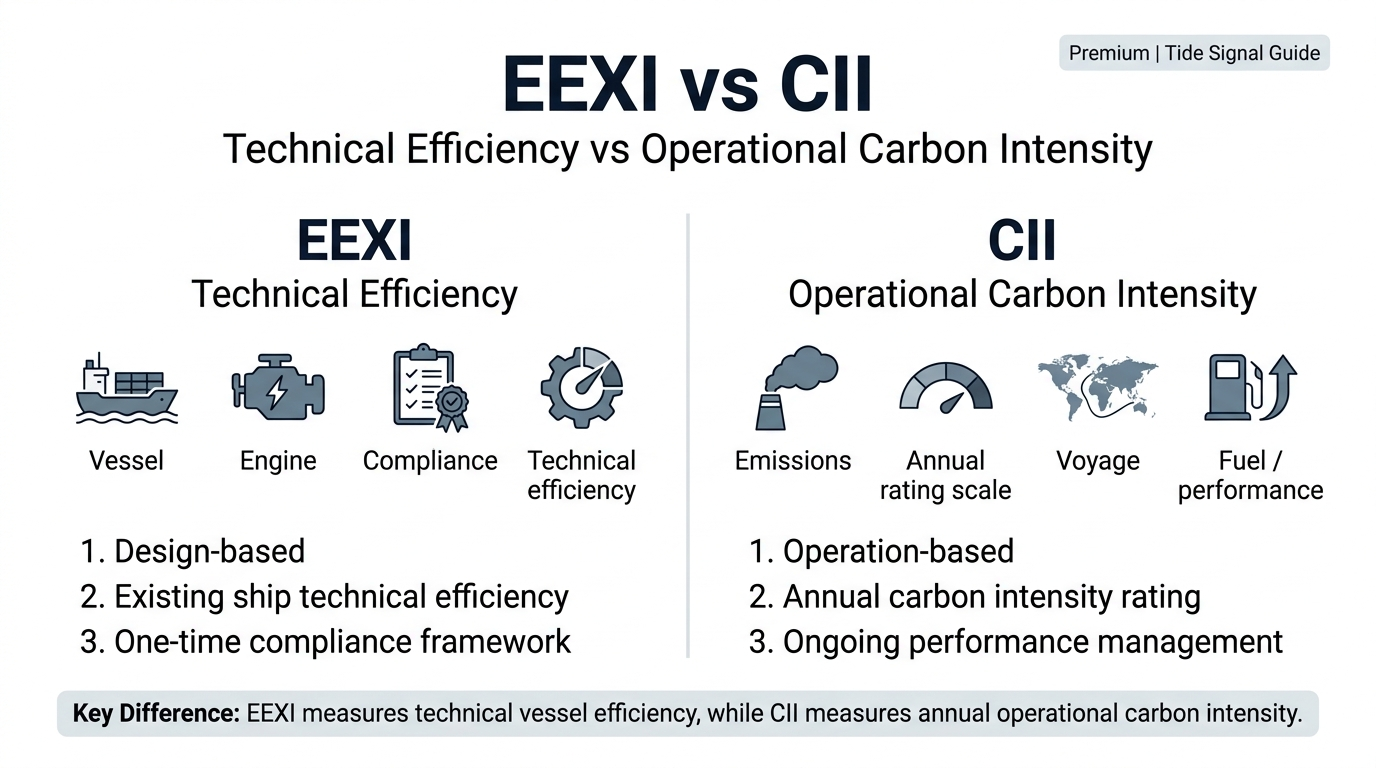
The Energy Efficiency Existing Ship Index, known as EEXI, focuses on the technical efficiency of an existing ship. The Carbon Intensity Indicator, known as CII, focuses on annual operational carbon intensity. In simple terms, EEXI asks whether the ship’s technical profile meets the required efficiency standard. CII asks how efficiently the ship was operated during the year.
For shipowners, managers, charterers and financiers, this difference is not academic. EEXI may influence technical modifications, engine power limitation and certification. CII may influence speed, utilisation, voyage planning, charterparty discussions, commercial attractiveness and long-term asset value.
Editorial view: EEXI is mainly a technical compliance gate. CII is a continuing operational and commercial pressure. Shipowners that treat them as the same regulation risk missing the real management challenge.
What Is EEXI?
EEXI stands for Energy Efficiency Existing Ship Index. It applies to existing ships and is designed to assess the technical efficiency of a vessel. The calculation is connected to the ship’s design, installed power, capacity and reference speed.
According to the IMO, from 1 January 2023 it became mandatory for applicable ships to calculate their attained EEXI. This formed part of the short-term greenhouse gas reduction measures adopted under MARPOL Annex VI.
In practical terms, EEXI is mainly a technical compliance question. Owners need to understand whether the vessel meets the required efficiency level and whether any technical or limiting measures are needed.
What Is CII?
CII stands for Carbon Intensity Indicator. It measures the operational carbon intensity of a ship, usually expressed in relation to the CO₂ emitted, the ship’s capacity and the distance travelled.
CII is different from EEXI because it is based on annual operation. It reflects how the vessel is actually traded, sailed, loaded, delayed and managed during the year.
Unlike EEXI, CII is not a one-off technical check. It is assessed annually. Ships receive a rating from A to E, and poor ratings can require corrective action through the Ship Energy Efficiency Management Plan, known as SEEMP.
| Point of Difference | EEXI | CII |
|---|---|---|
| Main purpose | Measures the technical efficiency of an existing ship. | Measures the annual operational carbon intensity of a ship. |
| Nature | Primarily technical and design-based. | Operational and performance-based. |
| Timing | Generally treated as a certification or compliance requirement. | Assessed every year through operational data. |
| Shipowner concern | Technical compliance, power limitation, documentation and certification. | Speed, fuel consumption, utilisation, distance, cargo work and voyage profile. |
| Commercial impact | Can affect technical capability and market perception. | Can affect chartering preference, operational decisions and long-term competitiveness. |
The Simple Difference: Design vs Operation
The easiest way to understand EEXI vs CII is to separate design from operation.
EEXI looks at what the ship is technically capable of, based on parameters such as power, capacity and reference speed. It is a technical efficiency calculation for the existing vessel. If the ship does not meet the required level, the owner may need to apply technical or operational-limiting measures to bring it into compliance.
CII looks at how the ship is actually used. Two similar ships may have different CII outcomes depending on speed, waiting time, ballast legs, cargo utilisation, port delays, weather, routing, fuel consumption and commercial employment pattern.
In plain English
- EEXI asks: is the ship technically efficient enough?
- CII asks: how carbon-efficient was the ship’s real operation this year?
- EEXI can often be solved through technical compliance work.
- CII needs continuing operational management.
- A ship can be EEXI-compliant but still receive a weak CII rating.
Why EEXI Compliance Does Not Guarantee a Good CII Rating
This is the point many non-specialists misunderstand. Passing EEXI does not automatically mean the vessel will perform well under CII.
EEXI is linked to technical efficiency. CII is linked to annual operation. A vessel may have acceptable EEXI documentation but still suffer from a poor CII rating if it trades inefficiently, sails fast, spends too much time in ballast, burns more fuel than expected or faces a difficult voyage profile.
This matters because CII can become visible in commercial discussions. Charterers, cargo interests, lenders and internal fleet teams may increasingly ask not only whether the vessel is compliant, but how she performs.
Why Shipowners Care About EEXI
EEXI matters because it is a compliance requirement connected with the technical profile of the vessel. If a ship cannot meet the required EEXI, the owner may need to evaluate available options.
Common responses may include technical documentation review, engine power limitation, shaft power limitation, energy-saving devices or other improvements depending on vessel type and class guidance.
From an owner’s perspective, the key issue is not only regulatory compliance. Technical measures can affect operational flexibility, speed capability, charterparty expectations and the way the vessel is marketed.
Why Shipowners Care About CII
CII matters because it repeats every year. It is not a certificate that can be filed away and forgotten. The annual rating depends on how the vessel is actually employed and operated.
This makes CII a management issue. It connects technical management, commercial operation, chartering, voyage planning, speed decisions and data quality. A superintendent may think in terms of fuel consumption and machinery condition. A chartering desk may think in terms of speed and laycan. A shipowner must bring these views together.
CII can also create tension between owner and charterer. Under a time charter, the charterer may control commercial orders such as speed, route and employment, while the owner remains responsible for regulatory compliance. This is why CII clauses and data transparency have become increasingly important.
Why CII becomes commercial
Speed matters: higher speed usually increases fuel consumption and can weaken carbon intensity.
Utilisation matters: ballast voyages and low cargo utilisation can affect the operational profile.
Waiting time matters: port delays and inefficient schedules can damage performance.
Charter terms matter: the party giving commercial orders may influence the vessel’s rating.
Data matters: inaccurate reporting can lead to poor decisions and weaker compliance control.
EEXI, CII and Vessel Speed
Speed is one of the most practical links between EEXI and CII. EEXI compliance may involve limiting available power, while CII performance can encourage slower, more efficient operation.
However, the commercial picture is not always simple. Slower speed may reduce fuel consumption, but it can also affect voyage duration, vessel availability and cargo scheduling. In strong freight markets, the opportunity cost of slower sailing may be higher. In weaker markets, slow steaming may be easier to accept.
This is why carbon regulation cannot be separated from freight markets, bunker prices and charterparty obligations. The right decision depends on the vessel, the market and the employment. For wider commercial context, see Tide Signal’s coverage of dry bulk market signals and shipping finance and carbon exposure.
EEXI, CII and the SEEMP
The Ship Energy Efficiency Management Plan, or SEEMP, is a key management tool in the IMO framework. For CII, the SEEMP becomes especially important because it connects the rating system with practical planning, monitoring and corrective action.
Where a vessel receives a weak CII rating, the company may need to prepare a corrective action plan and show how performance will be improved. This makes the SEEMP more than a file onboard. It becomes a live management document.
For owners and managers, the quality of the SEEMP process matters. A generic plan is less useful than a realistic plan linked to speed, route planning, maintenance, hull condition, fuel monitoring and commercial instructions.
How EEXI and CII Affect Chartering
EEXI and CII can both influence chartering, but in different ways. EEXI may affect the technical description of the vessel and her available performance. CII can affect how attractive the vessel appears to charterers with emissions targets or internal sustainability requirements.
A charterer may want to know whether the ship’s CII rating is likely to deteriorate during the charter period. An owner may want protection against commercial orders that damage the vessel’s rating. Both sides may need better clauses around speed, fuel consumption, data sharing and emissions responsibility.
This is especially important in time charter structures. The commercial operator of the vessel may make decisions that affect annual carbon intensity, while the regulatory impact may sit with the owner or manager. That is why the subject also connects with charterparty terms and the allocation of operational risk.
Technical Measures vs Operational Measures
EEXI often leads owners to consider technical or power-limiting measures. CII leads owners to consider continuous operational improvements. The two areas overlap, but they are not the same.
| Measure | More Relevant to EEXI | More Relevant to CII |
|---|---|---|
| Engine power limitation | Yes, often used for technical compliance. | Indirectly, by supporting lower power operation. |
| Hull and propeller cleaning | May support efficiency profile. | Yes, can reduce fuel consumption in operation. |
| Weather routing | Not central to EEXI. | Yes, affects fuel use and voyage efficiency. |
| Speed optimisation | May relate to power limitation. | Very important for annual carbon intensity. |
| Energy-saving devices | Can help technical efficiency. | Can also improve operational performance. |
The Role of Data Quality
CII depends heavily on accurate operational data. Fuel consumption, distance, time, cargo capacity and reporting discipline all matter. Poor data quality can create poor ratings, poor analysis or poor management decisions.
This links EEXI and CII with the wider digitalisation of shipping. A company cannot manage carbon performance properly if voyage data, noon reports, fuel data, engine data and commercial information are fragmented or unreliable.
Better data does not automatically improve the rating, but it helps managers understand the causes of weak performance. The same discipline that supports predictive maintenance can also support carbon reporting, because both depend on structured data, consistent records and practical follow-up.
Can a Shipowner Improve Both EEXI and CII?
Yes, but the approach must be realistic. Some measures improve both technical and operational efficiency. Others mainly solve one side of the problem.
For example, an energy-saving device may support EEXI and reduce fuel consumption in real operation. Hull cleaning may have less direct impact on EEXI documentation but may improve CII performance. Engine power limitation may help technical compliance but does not automatically guarantee good operational results.
The best approach is to treat the vessel as a commercial and technical system. Shipowners should review the ship’s age, trading pattern, fuel consumption, charter profile, speed requirements and future market position.
Practical checklist for owners
- Confirm the vessel’s EEXI compliance position and documentation.
- Review CII rating trend, not only the latest rating.
- Identify whether weak performance is caused by speed, fuel, waiting time, ballast legs or data quality.
- Check whether charterparty instructions may affect CII performance.
- Use SEEMP as a real management tool, not only a compliance file.
- Compare technical investment options with operational measures.
- Prepare clear internal reporting for commercial, technical and management teams.
Why This Matters Beyond Compliance
EEXI and CII are part of a larger shift in shipping. Carbon performance is becoming connected to finance, chartering, asset value and corporate reporting. A vessel that looks commercially attractive today may face stronger scrutiny if her emissions performance is weak.
This is why the discussion connects with CII in shipping, decarbonisation and shipping finance. The regulation itself is only one part of the story. The commercial interpretation of carbon exposure is becoming just as important.
Owners that understand the difference between EEXI and CII can make better decisions. They can separate one-off technical compliance from continuous operational performance and build a clearer fleet strategy.
Final View
EEXI vs CII is not a choice between two similar acronyms. It is a distinction between technical efficiency and operational carbon performance.
EEXI tells the market whether an existing ship meets the required technical efficiency standard. CII tells the market how the ship performs in real operation across the year.
For shipowners, the practical lesson is clear: comply with EEXI, but manage CII continuously. The future commercial value of a vessel will depend not only on whether she passes a technical check, but on whether she can trade efficiently, transparently and competitively in a carbon-conscious market.
Sources and Further Reading
For official and industry reference, readers may consult IMO’s EEXI and CII FAQ, IMO guidance on improving ship energy efficiency, DNV’s EEXI overview, DNV’s CII FAQ, Lloyd’s Register on EEXI compliance, and ClassNK information on CII.