Guides / Decarbonisation
CII in Shipping: Meaning, Ratings and Commercial Impact
CII in shipping is becoming one of the most important operational measures in modern maritime business. It links fuel consumption, distance sailed, vessel efficiency and commercial decision-making into a single annual rating.
CII in shipping, or the Carbon Intensity Indicator, is part of the industry’s wider move toward lower-carbon operations. It is not a fuel regulation in the same way as FuelEU Maritime, and it is not a carbon price like the EU ETS. Instead, CII is an operational efficiency measure that rates how efficiently a ship performs over a year.
For shipowners, managers, charterers and financiers, this makes CII more than a compliance detail. A vessel’s rating can affect how the ship is operated, how speed is managed, how voyages are planned and how attractive the asset appears in a market where emissions performance is becoming part of commercial judgement.
Quick View: CII in Shipping
- CII means Carbon Intensity Indicator.
- It measures a vessel’s operational carbon intensity over a calendar year.
- Ships receive an annual rating from A to E.
- A is the strongest rating; E is the weakest rating.
- The measure connects fuel use, distance sailed and vessel capacity.
- CII matters because it can influence vessel operation, chartering discussions and long-term asset value.
What is CII in Shipping?
CII is the Carbon Intensity Indicator. In simple terms, it measures how much carbon dioxide a ship emits in relation to the transport work it performs. The result is used to assign the vessel an annual rating.
The purpose is to encourage continuous improvement in the operational efficiency of ships. A vessel is not only judged by its design, age or installed equipment. It is also judged by how it is actually operated during the year.
For shipping companies, CII in shipping is becoming a practical way to connect daily vessel operation with long-term emissions performance. This is why the measure is increasingly relevant for both technical departments and commercial teams.
This distinction is important. Two similar ships can have different CII outcomes if they are traded differently, sailed at different speeds, spend different amounts of time idle, or operate under different cargo and ballast patterns.
How CII in Shipping Ratings Work
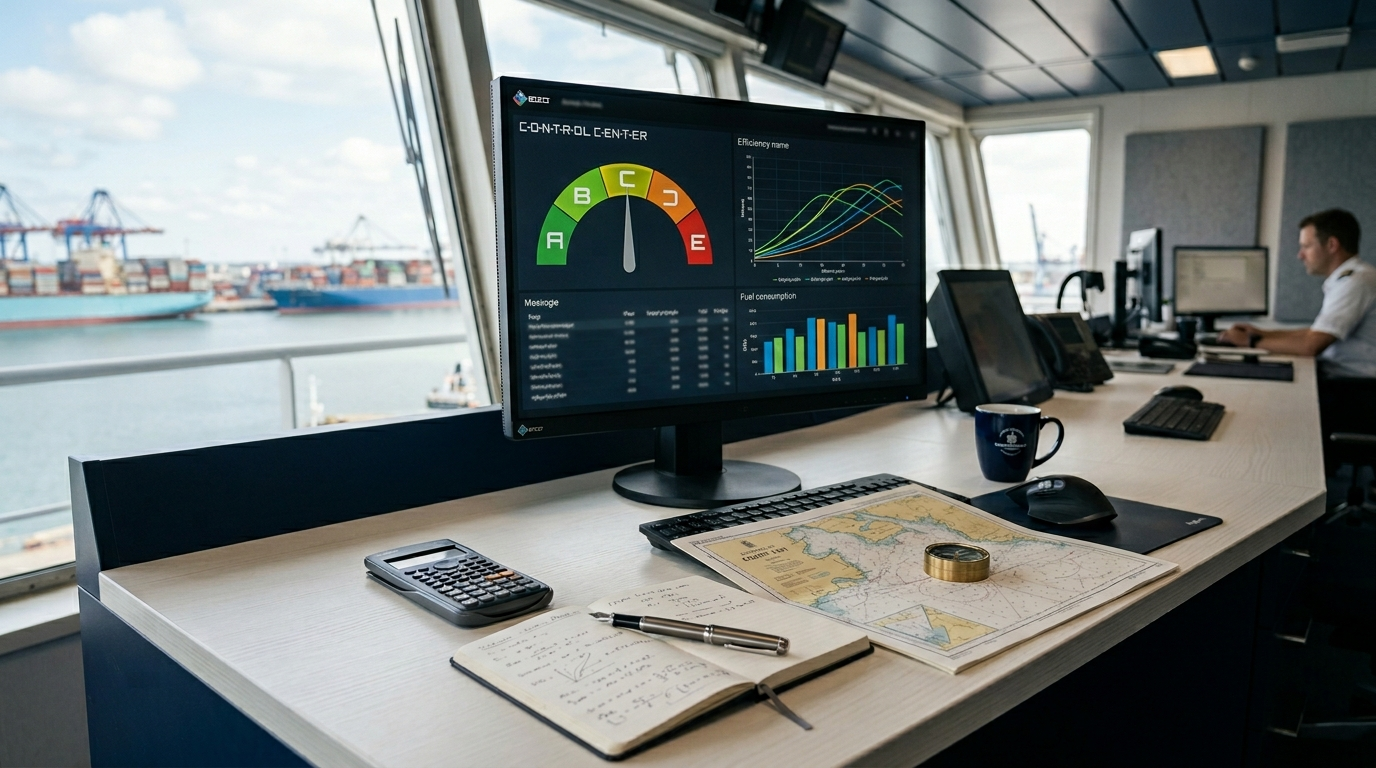
CII ratings are usually expressed on a scale from A to E. A vessel rated A performs strongly in carbon-intensity terms, while a vessel rated E performs poorly compared with the required reference level for its category.
A single weak year does not automatically mean that a ship is commercially unusable. However, repeated poor ratings can create pressure. Ships rated D for consecutive years or rated E may need corrective actions through their Ship Energy Efficiency Management Plan.
In practice, this means CII is not just a number reported after the year ends. It is increasingly something that needs to be monitored during the year, especially for vessels trading in volatile markets.
Why CII in Shipping Matters Commercially
The commercial importance of CII comes from the way it connects technical operation with market perception. A ship with a weak rating may face more questions from charterers, cargo interests, lenders or investors. A ship with a stronger rating may be easier to position as a more efficient asset.
This does not mean that CII alone decides whether a vessel earns money. Freight markets are still driven by cargo demand, fleet supply, port congestion, fuel prices and wider economic conditions. For dry bulk shipping, for example, freight pressure is also followed through market benchmarks such as the Baltic Dry Index.
But CII adds another layer to the decision. A voyage may look attractive on freight income, yet still create carbon-intensity consequences if it involves long ballast legs, high speed, waiting time or inefficient routing. This is where commercial and technical departments need to work together.
Commercial Impact Areas
- Chartering: CII may influence how vessels are presented and evaluated.
- Voyage planning: Speed, ballast distance and waiting time can affect annual performance.
- Fleet management: Managers need better visibility before the rating is final.
- Asset value: Efficiency performance can become part of long-term vessel assessment.
- Finance: Banks and investors are paying closer attention to emissions-related risk.
CII and Speed Management
Speed is one of the clearest operational levers affecting fuel consumption. In many vessel types, higher speed can increase fuel consumption significantly. As a result, speed decisions can influence both voyage economics and annual CII performance.
Slow steaming can help reduce emissions intensity, but it is not always commercially simple. A vessel may need to meet a laycan, satisfy charterparty obligations, avoid weather delays or reposition for the next employment opportunity. This is why CII management cannot be separated from real-world operations.
The practical question is not simply “should the ship slow down?” The better question is: what speed protects voyage margin while keeping the vessel within an acceptable carbon-intensity trajectory?
CII and Charterparty Responsibility
One of the most sensitive areas is responsibility between owner and charterer. Under a time charter, the charterer may control employment, routing and speed instructions, while the owner remains responsible for the vessel and its compliance framework.
For a practical explanation of the clause and calculation, see Speed and Consumption Claims in Shipping: NYPE, Good Weather & Calculations.
This creates a commercial tension. The party making operational decisions may not always be the party most exposed to the long-term rating consequence. For this reason, CII clauses, data sharing and voyage-performance transparency are becoming more important in chartering discussions.
A serious CII approach should define how performance is monitored, what data is shared, how instructions are handled, and what happens if a trading pattern risks damaging the vessel’s annual rating.
CII, EU ETS and FuelEU Maritime
CII is often discussed together with the EU ETS and FuelEU Maritime, but these measures are different.
CII is an IMO carbon-intensity rating mechanism. It focuses on operational efficiency over time.
EU ETS is a carbon-pricing mechanism. It requires shipping companies under its scope to surrender allowances for covered emissions.
FuelEU Maritime focuses on the greenhouse gas intensity of energy used on board ships trading in the EU regulatory environment.
The practical result is that shipowners and operators now face several overlapping pressures. One regulation may affect rating. Another may affect direct cost. Another may influence fuel choice. Together, they are changing the way voyage economics are calculated.
| Measure | Main focus | Commercial effect |
|---|---|---|
| CII | Operational carbon intensity | Vessel rating, efficiency pressure, chartering discussions |
| EU ETS | Carbon emissions cost | Allowance cost, voyage cost calculation, owner-charterer allocation |
| FuelEU Maritime | GHG intensity of energy used | Fuel strategy, compliance balance, alternative fuel decisions |
Why CII is Difficult for Tramp Shipping
CII can be especially challenging in tramp shipping, where vessels do not follow fixed schedules. A bulk carrier, tanker or multipurpose vessel may move between very different cargoes, ports and ballast patterns depending on market demand.
For a deeper reference, see MARPOL annexes.
A liner vessel has more predictable routes. A tramp vessel may not. This makes annual carbon-intensity management harder because the operator cannot always know the next voyage, ballast distance, port waiting time or cargo programme in advance.
For this reason, CII should not be treated as a simple annual report. It should be monitored as a moving operational risk. The earlier a company sees that a vessel is drifting toward a weaker rating, the more options it has to correct the trajectory.
How Shipping Companies Can Manage CII
A practical CII strategy does not need to start with expensive technology. It starts with reliable data, clear responsibility and regular monitoring.
Companies should track fuel consumption, distance, operating profile, speed, idle time and voyage pattern throughout the year. The goal is to avoid discovering the problem only after the rating period has effectively ended.
Practical CII Management Steps
- Monitor each vessel’s CII trend during the year.
- Review speed and consumption against voyage economics.
- Reduce unnecessary waiting, deviation and inefficient ballast legs where possible.
- Improve noon reporting and data quality.
- Use weather routing and voyage optimisation where commercially justified.
- Keep technical, operations and chartering teams aligned.
- Review charterparty clauses where operational control may affect rating.
What CII Means for Shipowners
For shipowners, CII creates a need for better operational discipline. The vessel’s annual rating can no longer be seen as a purely technical issue handled after the event. It is part of fleet performance.
Owners need to understand how each vessel is likely to perform under different trading patterns. Older vessels, inefficient designs and ships with heavy fuel-consumption profiles may require closer management.
At the same time, owners must avoid treating CII in isolation. A vessel that improves its rating by sacrificing too much earning capacity may not be commercially optimal. The real objective is balance: maintain compliance direction while protecting voyage and asset economics.
What CII Means for Charterers
Charterers are also affected, especially where their instructions influence the ship’s operating profile. Speed orders, port choices, waiting time, cargo rotations and ballast legs can all influence the vessel’s annual performance.
As CII becomes more visible, charterers may increasingly need to consider whether their operational decisions create rating pressure for the owner. This is why transparency and contractual clarity matter.
In future negotiations, a vessel’s efficiency profile may become part of the wider commercial discussion, alongside freight rate, consumption, speed, age, class status and emissions cost exposure.
The Wider Market View
CII is part of a broader shift in shipping. The industry is moving from a world where emissions were mainly a reporting issue to a world where emissions can affect cost, reputation, access to cargo, finance and asset strategy.
This does not mean the market will ignore freight fundamentals. Strong cargo demand can still lift earnings. Weak demand can still pressure rates. But regulation is adding a second layer of analysis: how much carbon exposure is attached to earning that freight?
For maritime companies, the winners will not necessarily be those with the most complicated dashboards. The winners will be those who understand the connection between vessel operation, fuel cost, carbon exposure and commercial timing.
Final View
CII should be understood as a practical operating measure with commercial consequences. It is not simply a regulatory label and it is not a complete measure of a vessel’s value. But it is becoming part of how ships are judged.
For shipowners, the challenge is to manage annual performance without weakening commercial flexibility. For charterers, the challenge is to understand how voyage instructions affect emissions outcomes. For the wider market, CII is another sign that shipping efficiency is no longer only a technical matter. It is now part of business.
Sources and Further Reading
For official and technical reference, readers may consult the IMO CII and EEXI FAQ, DNV’s CII overview, the European Commission EU ETS maritime FAQ, and DNV’s FuelEU Maritime guidance.