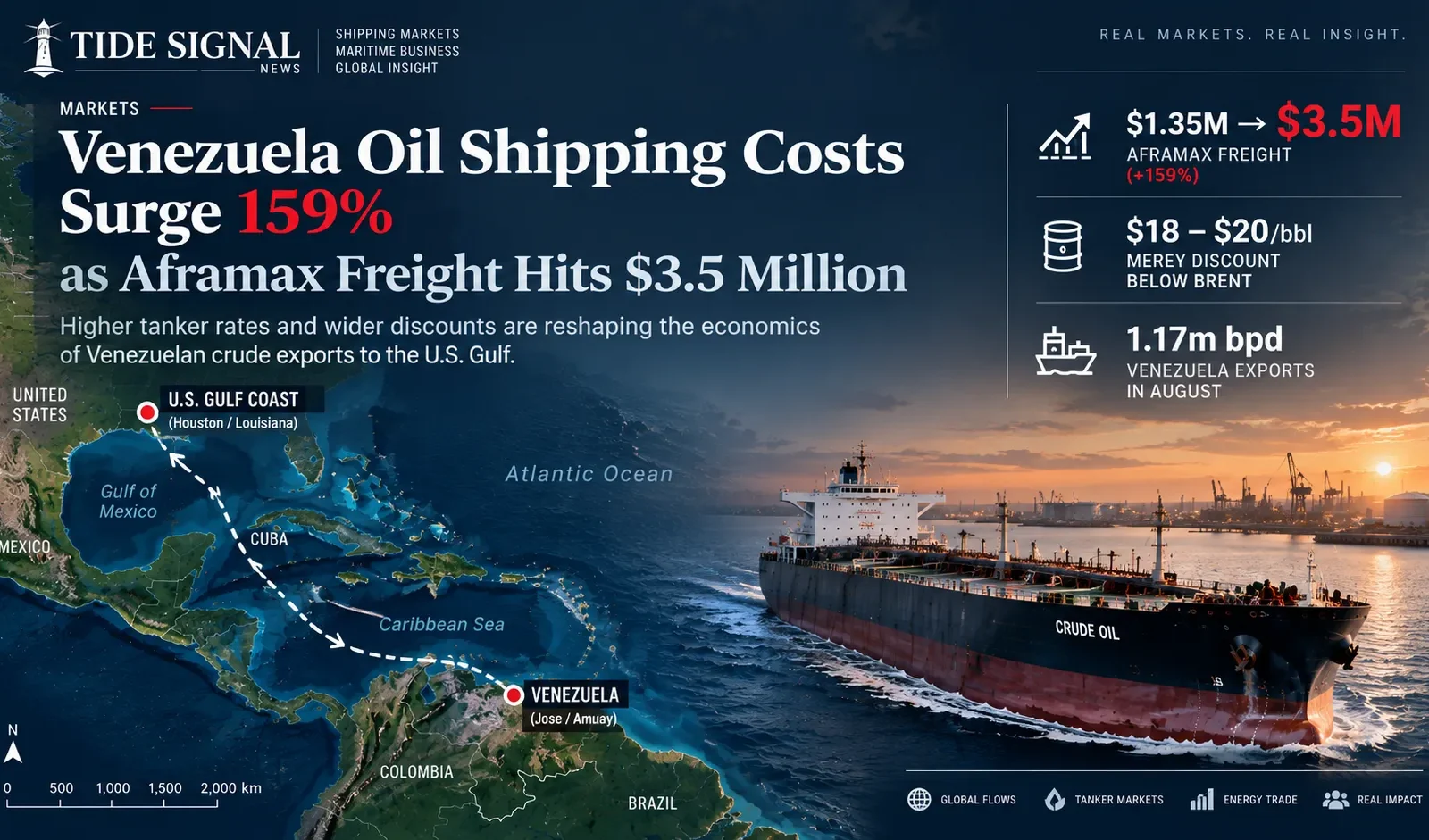
Venezuela oil shipping costs have surged as the cost of chartering an Aframax tanker from Venezuela to the U.S. Gulf Coast reaches about $3.5 million, up from roughly $1.35 million earlier this year.
The approximately 159% increase is changing the economics of Venezuelan heavy crude. Vitol and Trafigura are seeking wider discounts for Merey crude as expensive tanker freight, port congestion and longer vessel waiting times put pressure on trading margins.
Reuters reported on 22 September that the cost of moving Venezuelan crude to the U.S. Gulf has risen sharply amid an extraordinary tightening in global tanker markets. The change is important because freight is no longer a secondary cost in the trade. At current levels, transportation is becoming a major part of the commercial calculation behind every cargo.
The pressure comes at a time when Venezuela is moving substantial volumes into international markets. Overall oil exports were around 1.17 million barrels per day in August, while Vitol and Trafigura together handled close to 600,000 bpd.
For shipowners, that creates strong demand for available Aframax tonnage. For traders and refiners, however, it creates a much more difficult equation: the crude may still be attractive, but only if the purchase discount is large enough to absorb the higher cost of physically moving it.
Venezuela–U.S. Gulf Aframax Freight Hits $3.5 Million
The most striking number is the freight bill itself.
| Indicator | Earlier level | Latest reported level | Change |
|---|---|---|---|
| Venezuela → U.S. Gulf Aframax | About $1.35 million | About $3.5 million | Approximately +159% |
| Merey crude discount | Varied with market conditions | Offers around $18–$20/bbl below Brent | Wider discount pressure |
| Venezuela oil exports | 1.16m bpd in July | About 1.17m bpd in August | Broadly stable |
| Vitol + Trafigura exports | — | Nearly 600,000 bpd | Roughly half of total exports |
The jump from $1.35 million to $3.5 million means an Aframax voyage now costs more than two and a half times the level seen earlier in the year.
That does not automatically mean every Venezuela–U.S. Gulf fixture will cost exactly $3.5 million. Individual tanker fixtures depend on laycan, loading and discharge ports, vessel position, cargo size, charter-party terms, demurrage exposure and the strength of the position list.
But the direction is clear: available Aframax tonnage has become substantially more expensive.
Why Venezuela Oil Shipping Costs Are Rising
The Venezuela trade is being hit by a wider global tanker squeeze rather than an isolated local freight move.
Aframax markets across the Americas strengthened sharply during September as vessel supply tightened and owners gained greater negotiating leverage.
S&P Global Commodity Insights reported that the benchmark 70,000-tonne U.S. Gulf Coast–UK Continent/Mediterranean route reached WS450 on 10 September, while a Vancouver–China Aframax fixture reached a record $7.5 million.
The key issue is not simply the number of Aframax tankers in the global fleet. What matters to a charterer is the number of vessels that are:
- open in the correct geographical position;
- available within the required laycan;
- acceptable to the charterer and terminal;
- commercially willing to perform the voyage;
- not already committed to stronger alternative employment; and
- available at a freight level that preserves the cargo economics.
When that effective position list becomes short, freight can move very quickly.
Tide Signal’s guide to Worldscale in shipping explains how tanker freight quotations translate into the commercial cost of a voyage, while the voyage estimation guide covers the wider relationship between freight, bunkers, port costs, time and voyage margin.
Merey Crude Discounts Widen as Freight Eats Into Trading Margins
The second important number is the crude differential.
Reuters reported that Vitol and Trafigura were offering Venezuelan Merey heavy crude at discounts of around $18–$20 per barrel to Brent as higher shipping costs put pressure on margins.
This illustrates an important physical-oil principle: a crude grade cannot be evaluated on headline price alone.
A buyer must consider the full delivered cost.
If tanker freight increases sharply while the crude price differential remains unchanged, part of the trader’s margin disappears.
One way to restore that margin is to obtain the crude at a wider discount.
That is why a freight-market move can eventually feed back into physical crude pricing. The tanker market and the oil market are separate markets, but they meet at the delivered cost of every cargo.
Why Merey Crude Matters to U.S. Gulf Refiners
Venezuela produces large volumes of heavy crude, including Merey, that can be commercially attractive to complex refineries designed to process heavier feedstocks.
The U.S. Energy Information Administration has noted that Venezuelan heavy crude is particularly well suited to a number of U.S. refineries, especially along the Gulf Coast.
That structural refinery demand helps explain why the Venezuela–U.S. Gulf tanker route matters even when freight becomes expensive.
A refiner is not simply comparing Venezuelan crude with Brent on a screen. It is comparing the expected refinery yield and delivered cost of Venezuelan barrels against alternative heavy and medium-sour grades available elsewhere.
The wider the freight differential becomes, the more important the crude discount must become in keeping that trade competitive.
Vitol and Trafigura Handle Roughly Half of Venezuela’s Exports
The role of the major commodity traders is another important part of the story.
Venezuela exported around 1.17 million bpd in August, according to shipping data and documents cited by Reuters. International trading firms including Vitol and Trafigura maintained combined volumes of approximately 597,000 bpd.
That puts the two traders at roughly half of the country’s exported volume.
For traders operating at that scale, even relatively small changes in freight economics can become commercially significant. A prolonged increase in transportation costs affects cargo pricing, arbitrage decisions, vessel procurement and the price traders can afford to offer for the crude at loading.
Trafigura’s growing exposure to the tanker market is particularly notable. The company recently launched its Volare Shipping tanker platform, highlighting how extreme freight volatility is pushing large commodity traders to think differently about control of shipping capacity.
Port Congestion Adds Another Layer to the Freight Problem
Headline freight is only one part of the cost increase.
Reuters also reported rising tanker waiting times and congestion around Venezuelan export operations.
Congestion matters because tanker economics are heavily dependent on time.
If a vessel spends additional days waiting for a berth, cargo, documentation or terminal clearance, the consequences can include:
- additional demurrage exposure;
- lower vessel utilisation;
- fewer ships becoming open for subsequent cargoes;
- tighter regional tonnage supply;
- higher replacement freight for charterers; and
- greater uncertainty in voyage planning.
The result can become self-reinforcing.
This is why shipping markets frequently move faster than the underlying cargo volume would suggest.
The Aframax Squeeze Is Bigger Than Venezuela
The sharp increase in Venezuelan freight is part of a much broader repricing of tanker capacity.
During September, Aframax, Suezmax and VLCC markets have all experienced exceptional volatility as global crude flows adjust to disruption, changing voyage patterns and unusually tight vessel availability.
The U.S. Gulf Coast–Europe Aframax market has already experienced some of its strongest levels of the year, while tanker rates in other basins have also risen sharply.
At the larger end of the crude fleet, Tide Signal has been tracking the same mechanism through the extraordinary VLCC freight-rate surge.
The vessel classes and routes are different, but the market mechanism is similar:
That is particularly important when ships are being absorbed by longer voyages, waiting time or new trade patterns.
What the $3.5 Million Freight Bill Means for Charterers
For charterers moving Venezuelan crude, the first question is no longer simply whether a suitable vessel exists.
The question is whether the vessel can be secured at a freight level that still leaves the cargo commercially workable.
A charterer evaluating an Aframax fixture must consider the freight offer together with:
- the crude purchase differential;
- laycan flexibility;
- terminal congestion;
- expected waiting time;
- demurrage rate;
- bunker exposure;
- alternative vessel availability;
- the economics of competing crude grades; and
- the refinery’s actual requirement for heavy crude.
A cheaper crude barrel at the loading port is not necessarily cheaper once delivered to the refinery.
What It Means for Aframax Owners
For owners, the environment is considerably stronger.
A tight position list allows owners to compare Venezuelan employment with other Atlantic Basin opportunities and reject voyages that do not compensate adequately for time, operational complexity or the opportunity cost of committing the vessel.
The commercial calculation becomes particularly important when competing routes are also paying historically strong freight.
Owners therefore have more leverage over freight, demurrage and certain charter-party terms than they would in a well-supplied tanker market.
However, the headline rate should not be confused with pure profit.
Owners must still account for voyage duration, bunkers, port costs, waiting time, ballast positioning and the value of the vessel’s next employment.
Could Higher Freight Slow Venezuelan Oil Export Growth?
That is now one of the key questions.
Venezuela’s exports remained broadly stable at around 1.17 million bpd in August, suggesting that the country has so far maintained significant international crude flows despite operational constraints.
But continued export growth requires more than production.
The barrels must be stored, blended, loaded and physically transported to buyers.
If freight remains exceptionally expensive, the commercial burden can fall on several participants:
- PDVSA through lower realised crude prices;
- traders through reduced margins;
- refiners through higher delivered costs; or
- shipowners if tanker supply eventually loosens and freight rates retreat.
Which participant absorbs the cost will depend on bargaining power and market conditions at the time each cargo is negotiated.
The Real Signal Is the Crude Discount–Freight Relationship
For shipping-market observers, the headline $3.5 million figure is important, but it should not be watched alone.
The more valuable indicator is the relationship between the Merey crude discount and the tanker freight bill.
If freight continues rising while the crude discount remains stable, trader margins become more difficult.
If sellers accept larger discounts, cargo flows may continue even at elevated freight levels.
If Aframax availability improves and freight falls, Venezuelan barrels become more competitive without requiring the same level of price discount.
| Indicator | Why it matters |
|---|---|
| Venezuela–USGC Aframax freight | Shows the direct transportation cost of moving crude to a major refining market. |
| Merey differential to Brent | Shows how much price discount is available to absorb freight and quality differences. |
| Aframax position list | Indicates whether owners or charterers have stronger negotiating leverage. |
| Port waiting time | Can remove ships from effective supply and increase demurrage exposure. |
| Venezuela export volumes | Shows whether high freight is beginning to constrain physical flows. |
| USGC refinery demand | Determines how strongly buyers compete for Venezuelan heavy crude. |
What to Watch Next
Three signals will show whether the current freight shock becomes a short-lived spike or a more persistent change in Venezuelan crude economics.
1. Aframax vessel availability
A larger prompt position list would reduce owner leverage. Continued scarcity would keep freight supported.
2. Merey crude discounts
If the differential widens beyond the currently reported $18–$20 below Brent range, it would suggest freight and logistics are continuing to pressure crude netbacks.
3. Venezuelan export volumes and waiting times
Stable or rising exports despite expensive freight would indicate buyers are continuing to absorb the cost through crude discounts and strong refinery demand. Falling volumes alongside worsening congestion would point to a deeper logistics constraint.
FAQ
How much does an Aframax from Venezuela to the U.S. Gulf cost?
Reuters reported on 22 September 2026 that chartering an Aframax tanker from Venezuela to the U.S. Gulf Coast costs about $3.5 million, compared with approximately $1.35 million earlier in the year.
How much have Venezuela oil shipping costs increased?
Based on the reported increase from $1.35 million to $3.5 million, the freight bill has risen by approximately 159%.
Why is Venezuelan Merey crude trading at a large discount?
Higher transportation costs are putting pressure on trader margins. Vitol and Trafigura have been seeking Merey crude at discounts of around $18–$20 per barrel below Brent, according to Reuters.
How much oil is Venezuela exporting?
Venezuela exported approximately 1.17 million barrels per day in August 2026. International traders including Vitol and Trafigura accounted for close to 600,000 bpd of that volume.
Why are Aframax rates so high?
The increase reflects tight commercially available tanker supply, strong alternative employment, global crude-trade disruption and congestion that keeps ships occupied for longer. Similar strength has appeared across other Aframax markets during September.
Key Takeaways
- Aframax freight from Venezuela to the U.S. Gulf has climbed from about $1.35 million to $3.5 million.
- The increase is approximately 159%.
- Vitol and Trafigura are seeking Merey crude discounts of around $18–$20/bbl below Brent.
- Venezuela exported roughly 1.17 million bpd in August.
- Vitol and Trafigura together handled nearly 600,000 bpd, or roughly half of total exports.
- Port congestion and tanker waiting time are adding to the effective shortage of available ships.
- The Venezuela move is part of a broader global tanker squeeze rather than an isolated regional freight spike.
- The key market signal now is whether larger Merey discounts can continue offsetting elevated Aframax freight.
Reporting basis: Reuters reporting published 22 September 2026 on Venezuelan crude pricing, Aframax freight, trader activity and export volumes; S&P Global Commodity Insights reporting on September Aframax freight conditions; U.S. Energy Information Administration background on Venezuelan heavy crude and U.S. Gulf Coast refining.