SOLAS Chapter III is the core international framework for life-saving appliances and arrangements on merchant ships. It links survival craft, personal equipment, launching systems, maintenance, muster organization and emergency drills into one system designed to keep people alive after the ship can no longer provide a safe place of refuge.
SOLAS Chapter III — Life-Saving Appliances and Arrangements establishes the regulatory requirements for lifesaving systems carried on ships. The detailed technical standards for many of those appliances are contained in the mandatory International Life-Saving Appliance Code, usually called the LSA Code.
The simplest way to understand SOLAS Chapter III is that it is not only about carrying a lifeboat.
A ship needs the right survival craft and personal lifesaving equipment for its type and service. That equipment has to be approved, correctly stowed, accessible, maintained and ready for immediate use. Crew members must know their emergency duties. Launching appliances must work under real conditions. Drills must create competence without creating another casualty.
This is why Chapter III should be read as an emergency survival system, not as a list of orange equipment.
For the wider treaty structure, start with Tide Signal’s SOLAS Convention Explained. For the adjacent fire-safety framework, see SOLAS Chapter II-2 Fire Safety.
What Is SOLAS Chapter III?
SOLAS Chapter III is titled Life-Saving Appliances and Arrangements. The International Maritime Organization describes it as the chapter containing requirements for lifesaving equipment such as lifeboats, rescue boats and lifejackets, with the detailed technical standards supplied by the mandatory LSA Code.
The chapter applies through a combination of general provisions and ship-type-specific rules. The exact carriage requirement depends on factors including vessel type, construction date, voyage, number of persons on board and the specific regulation being applied.
This is why there is no single universal statement such as “every SOLAS ship must carry exactly this number of lifeboats and liferafts.” Passenger ships and cargo ships have different additional requirements, and some vessel types are also affected by other mandatory codes.
The official IMO overview of the chapter is available in the Summary of SOLAS Chapter III.
How SOLAS Chapter III Is Structured
The chapter is organized around general requirements, additional provisions for passenger ships, additional provisions for cargo ships, the technical link to the LSA Code, and supporting requirements for training, maintenance and emergency organization.
That structure shows why the chapter combines hardware and people. A vessel can carry fully approved equipment and still be operationally weak if the crew cannot launch, recover, muster, communicate or maintain the equipment correctly.
What Is the LSA Code?
The International Life-Saving Appliance Code is the mandatory technical code supporting SOLAS Chapter III. IMO adopted it by resolution MSC.48(66), and SOLAS regulation III/34 makes compliance with the applicable LSA Code requirements mandatory.
The Code contains detailed standards for:
- lifebuoys;
- lifejackets;
- immersion suits;
- anti-exposure suits;
- thermal protective aids;
- rocket parachute flares, hand flares and buoyant smoke signals;
- liferafts;
- lifeboats;
- rescue boats;
- launching and embarkation appliances;
- marine evacuation systems;
- line-throwing appliances;
- general alarm and public-address arrangements within the LSA framework.
IMO’s Life-Saving Appliances overview explains that the type, capacity and number of appliances vary with the ship’s size, activity and voyage.
sets the regulatory requirement
↓
LSA Code
sets detailed technical standards
↓
Flag / class approval + ship-specific documents
confirm the fitted arrangement
↓
Maintenance + drills + inspections
prove operational readiness
Lifeboats Under SOLAS Chapter III
The lifeboat is the most visible survival craft on many merchant ships, but its role is more complex than simply providing a floating container for the crew.
A lifeboat system includes the boat itself, propulsion, steering, seating, equipment, release gear, falls where fitted, davits or other launching appliances, embarkation arrangements and the procedures required to launch and recover it safely.
Totally enclosed lifeboats
Totally enclosed lifeboats provide protection against weather and sea exposure and are common on modern cargo ships. Depending on the ship and risk profile, additional arrangements may include self-contained air support and fire-protection systems.
The key operational issue is that enclosure creates both protection and another design problem: the people inside still need a safe internal environment. That is why lifeboat ventilation has become an important modern regulatory subject.
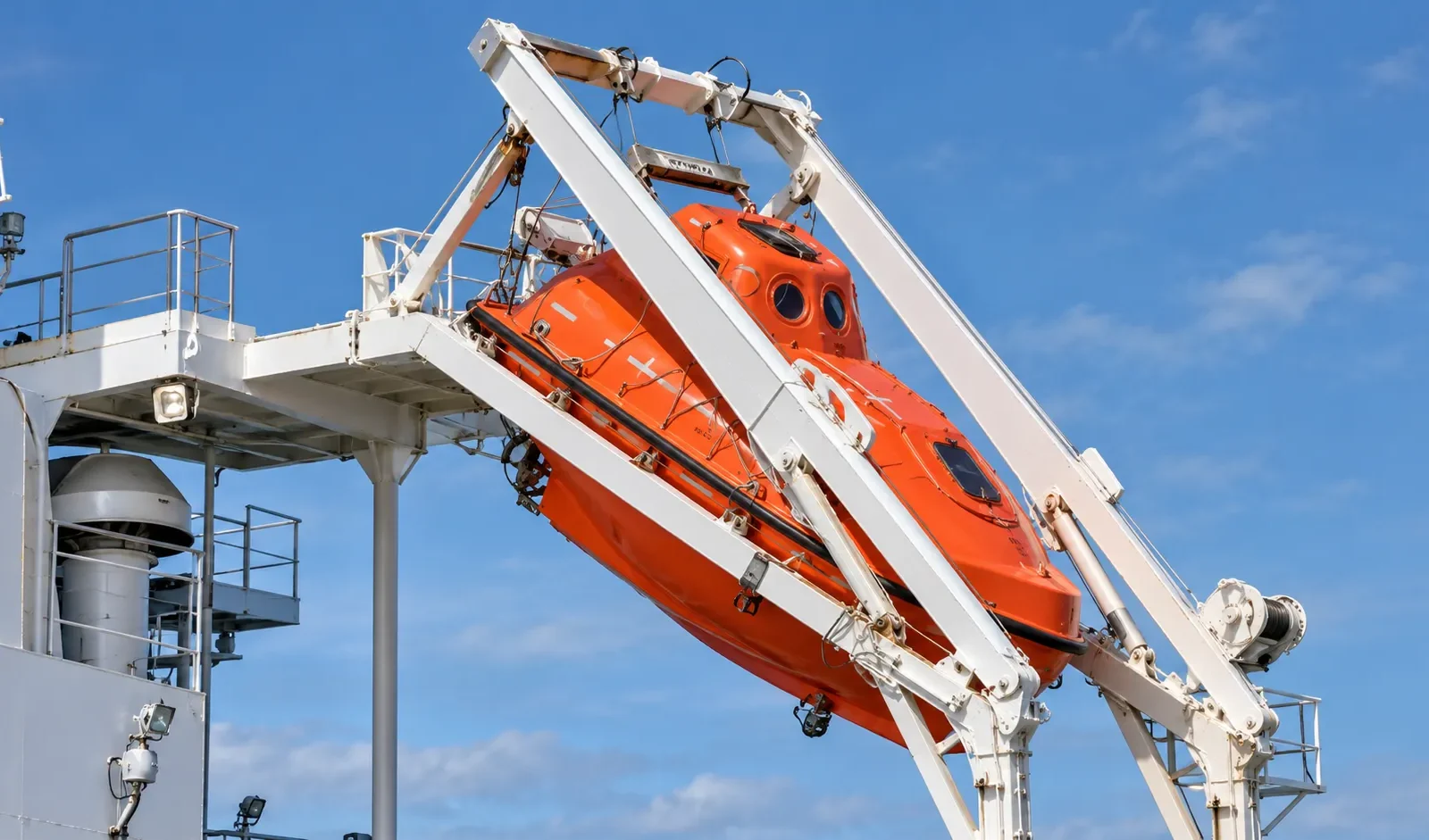
Free-fall lifeboats
A free-fall lifeboat is launched by allowing the craft to move down its ramp and enter the sea without conventional lowering through falls. This can provide rapid abandonment, but it also requires strict seating, restraint, launch-sequence and crew-training discipline.
Free-fall systems have specific drill provisions because routinely dropping a fully occupied boat simply to demonstrate compliance can create unnecessary risk. The ship must follow the current SOLAS drill provisions, approved procedures and manufacturer instructions.
Release gear
Release systems have historically been one of the highest-risk parts of lifeboat operations. A release mechanism that operates unintentionally while the boat is suspended can cause catastrophic injury or death.
For that reason, the LSA framework includes detailed requirements around release mechanisms, reset status, interlocks, indicators and safe handling. The 2026 amendments further refine requirements intended to reduce accidental release during recovery.
Liferafts: Portable Survival Capacity
Liferafts provide survival capacity that can be deployed if the ship must be abandoned. They may be throw-overboard or davit-launched depending on the approved arrangement.
A compliant liferaft system involves more than the raft container. Operational readiness also depends on:
- correct stowage;
- clear launching access;
- proper securing arrangements;
- correct painter connection;
- hydrostatic release arrangements where fitted;
- valid servicing status;
- approved capacity and markings;
- crew understanding of manual and automatic release;
- correct embarkation and davit operation where applicable.
A raft that is correctly serviced but secured incorrectly can fail at the moment it is needed. Likewise, a clear deck marking is meaningless if the crew does not understand which securing line, weak link, painter and hydrostatic-release component performs which function.
Hydrostatic release units
The hydrostatic release unit is designed to support automatic release of a liferaft if the ship sinks before the crew can launch the raft manually. The arrangement must be rigged exactly in accordance with the approved system.
This is a classic Port State Control area because an incorrect connection can leave an apparently complete liferaft installation unable to function as designed.
Rescue Boats and Fast Rescue Boats
A rescue boat has a different purpose from a survival craft used mainly for abandonment. Its role includes recovering persons from the water and marshalling survival craft.
Some lifeboats may also be approved to serve as rescue boats, while other ships carry a dedicated rescue boat. Certain vessel types and operations may require a fast rescue boat.
Operational readiness depends on:
- boat condition;
- engine and fuel readiness;
- steering and manoeuvring;
- launching appliance condition;
- recovery capability;
- crew competence;
- communications;
- personal protective equipment;
- safe launch and recovery risk assessment.
As far as reasonable and practicable, rescue boats other than lifeboats that also serve as rescue boats should be launched monthly with their assigned crew and manoeuvred in the water; in all cases the applicable SOLAS requirement must be met at intervals not exceeding three months. Flag-State instructions and ship-specific procedures should be checked for the exact implementation.
Personal Life-Saving Appliances
Personal life-saving appliances are the equipment a person may depend on before reaching a survival craft, while waiting for rescue, or if they enter the water unexpectedly.
| Appliance | Main safety purpose | Operational points |
|---|---|---|
| Lifebuoy | Provides immediate buoyancy to a person in the water and may mark the casualty position. | Correct location, accessibility, markings and associated light/smoke arrangements where required. |
| Lifejacket | Supports a person in the water and is designed to help maintain a survivable body position. | Correct size range, condition, light, whistle, markings, accessibility and crew/passenger familiarity. |
| Immersion suit | Reduces cold-water exposure and heat loss. | Correct size, zipper/seal condition, donning familiarity and periodic inspection. |
| Anti-exposure suit | Protects designated personnel from cold and exposure during rescue or emergency duties. | Application depends on the approved arrangement and role. |
| Thermal protective aid | Reduces heat loss for survivors in survival craft. | Stored and carried as part of the applicable LSA outfit. |
Lifejackets are performance equipment, not clothing
A lifejacket must do more than float. Its design and approval are based on defined in-water performance, including how it supports and turns a person.
This point became even more important in 2026, when updated LSA Code requirements entered into force for relevant newly installed lifejackets. The amendment refined the performance standard for turning an unconscious face-down person into a face-up position with the nose and mouth clear of the water.
Immersion suits require practical familiarity
The crew should not discover how to use an immersion suit for the first time during an actual abandonment. Donning technique, clothing underneath, gloves, hood arrangement, zippers, seals and compatibility with a lifejacket where applicable all matter.
The practical standard is not “the suit exists.” It is “the assigned person can find it, inspect it, don it correctly and move safely while wearing it.”
Pyrotechnics, Visual Signals and Line-Throwing Appliances
The LSA Code also covers visual distress aids such as rocket parachute flares, hand flares and buoyant smoke signals. These devices are designed to attract attention, mark position and assist rescuers in locating survivors.
From an onboard readiness perspective, officers should verify:
- expiry dates;
- approved storage location;
- condition of packaging;
- correct quantities according to the approved inventory;
- crew familiarity with safe use;
- segregation from inappropriate heat or ignition exposure.
Line-throwing appliances provide another emergency capability by projecting a line between the ship and another location. Their carriage and technical performance are also part of the SOLAS Chapter III / LSA framework.
Launching and Embarkation Arrangements
The best survival craft in the world is ineffective if people cannot reach it, board it and launch it.
Chapter III therefore addresses:
- stowage position;
- readiness for launching;
- embarkation arrangements;
- launching appliances;
- falls and winches where fitted;
- release mechanisms;
- lighting;
- access routes;
- muster and embarkation stations;
- launching under defined trim and list conditions.
A survival craft is intended to be in a state of continuous readiness. The arrangement must allow the crew to prepare the craft for embarkation and launching within the applicable regulatory timeframe.
Davit systems
Davit-launched craft introduce mechanical interfaces that require careful inspection: wires or falls, sheaves, winches, brakes, limit switches, hooks, foundations, hydraulic or electrical components, remote controls and structural connections.
Corrosion, seized components, incorrect lubrication, damaged wires or poorly adjusted brakes can turn a routine test into a serious accident.
Lowering speed
The LSA Code contains requirements for minimum and maximum lowering speed for survival craft and rescue boats. Amendments in force from 1 January 2026 revised the formula for minimum lowering speed and established a standard maximum lowering speed of 1.3 m/s, while allowing an Administration to accept a different maximum where the required safety considerations are satisfied.
Marine Evacuation Systems
A marine evacuation system, or MES, provides a rapid route from the embarkation deck to floating survival craft, usually through an inflatable chute or slide arrangement.
The system is particularly associated with passenger ships and high-capacity evacuation arrangements. Its effectiveness depends on deployment reliability, clear access, adequate lighting, trained crew and the ability to move large numbers of people away from the ship quickly.
An MES should therefore be understood as an integrated evacuation system rather than as one inflatable component.
Muster Lists and Emergency Instructions
Regulation III/37 connects the physical LSA system with the people expected to operate it.
The muster list assigns emergency duties and establishes who does what when the general emergency alarm is sounded. Depending on the vessel, duties may include:
- closing watertight and fire openings;
- preparing survival craft;
- bringing additional equipment to muster stations;
- operating communications;
- assisting passengers;
- checking accommodation and working spaces;
- mustering and accounting for personnel;
- launching lifeboats, liferafts or rescue boats;
- providing first aid;
- supporting firefighting or damage-control teams.
The critical management issue is that the list must match the people actually on board. A perfectly printed muster list is useless if crew changes, rank changes or emergency assignments have not been updated.
Emergency Training and Abandon-Ship Drills
SOLAS regulation III/19 covers emergency training and drills. The objective is not to produce a logbook signature. It is to ensure that people can perform the actions required during a real emergency.
Monthly participation
For cargo-ship crews, each crew member is required to participate in at least one abandon-ship drill and one fire drill every month. Where more than 25% of the crew have not participated in those drills on that particular ship during the previous month, the drills are to be held within 24 hours after departure from port.
Passenger ships have additional drill requirements, including a weekly drill regime under SOLAS Chapter III.
What an abandon-ship drill should achieve
A useful drill tests the complete emergency chain:
- alarm recognition;
- muster and headcount;
- correct clothing and lifejackets;
- communication;
- preparation of survival craft;
- operation of davits and associated systems as required;
- crew knowledge of release systems;
- emergency lighting;
- assigned duties;
- post-drill debrief and corrective action.
Lifeboat launching
Subject to the detailed exceptions in the regulation, each lifeboat is to be launched and manoeuvred in the water by its assigned operating crew at least once every three months during an abandon-ship drill.
IMO has clarified that the operating crew does not have to be inside a conventionally launched lifeboat during the actual lowering unless the master determines, after considering the safety aspects, that this should be done.
Free-fall lifeboats have specific provisions allowing a combination of launch preparation, actual free-fall launching with the operating crew, secondary launching or simulated launching at prescribed intervals.
Operational Readiness, Maintenance and Inspections
Regulation III/20 is one of the most operationally important parts of SOLAS Chapter III. Its basic principle is straightforward: before the ship leaves port and throughout the voyage, life-saving appliances must remain ready for use.
That requires a layered maintenance system rather than one annual survey.
| Layer | Purpose | Typical scope |
|---|---|---|
| Routine / onboard | Keep equipment ready between formal service events. | Condition checks, housekeeping, lubrication, battery/engine readiness, access and defect control. |
| Weekly | Frequent confirmation that survival craft and launching systems remain ready. | Visual inspections and required functional checks under the current regulation and onboard manual. |
| Monthly | Structured inspection against the onboard checklist. | Life-saving appliances and lifeboat equipment checked and recorded. |
| Annual | Detailed thorough examination and operational testing. | MSC.402(96) equipment within scope, using certified personnel of manufacturer or authorized service provider. |
| Five-year | Deeper examination, overhaul and overload testing where applicable. | Release gear and launching appliances within the MSC.402(96) framework. |
Weekly and monthly inspections are not clerical exercises
A checklist can identify deterioration before the annual service visit. Examples include corrosion, cracked covers, missing pins, damaged embarkation ladders, leaking hydraulics, engine starting problems, weak batteries, damaged grablines, seized sheaves and expired equipment.
If the crew repeatedly signs a checklist without finding obvious defects, the inspection system has stopped functioning even if the paperwork is complete.
MSC.402(96): Lifeboat and Rescue-Boat Maintenance Explained
IMO resolution MSC.402(96) created a uniform mandatory framework for the maintenance, thorough examination, operational testing, overhaul and repair of:
- lifeboats, including free-fall lifeboats;
- rescue boats;
- fast rescue boats;
- launching appliances;
- on-load and off-load release gear;
- relevant launching arrangements for davit-launched liferafts.
The framework became mandatory through associated SOLAS amendments from 1 January 2020. It was developed because inconsistent servicing and unsafe maintenance practices had contributed to serious lifeboat accidents.
Annual thorough examination
The annual thorough examination and operational tests within the resolution’s scope are to be carried out by certified personnel of the manufacturer or an authorized service provider in accordance with the resolution. An operator may perform this role only where it is itself properly authorized.
Five-year examination and overhaul
The five-year examination is deeper and includes the applicable overhaul and overload operational tests. It must also be carried out by appropriately certified personnel.
Records
The resolution requires reports and checklists to be completed and signed by the person carrying out the work and countersigned by the company representative or master. Maintenance and service records are to be updated and filed on board for the service life of the equipment.
After the required thorough examination, testing, overhaul or repair, the service provider issues documentation confirming that the arrangement remains fit for purpose.
The official IMO text is available in Resolution MSC.402(96).
The most dangerous LSA defects are often interface defects. The boat can be in good condition while the hook is unsafe. The davit can be maintained while the brake is incorrectly adjusted. The raft can be serviced while the HRU is rigged incorrectly. The crew can know the muster station while not understanding the release sequence.
Good Chapter III management therefore checks the complete chain from equipment approval to human action.
SOLAS Chapter III and LSA Code: What Changed in 2026?
Several LSA-related amendments entered into force on 1 January 2026. These changes are important because they affect both new equipment standards and the maintenance framework.
1. Revised adult lifejacket in-water performance
Resolution MSC.554(108) amended the LSA Code’s adult-lifejacket performance criteria. For equipment within the amendment’s application dates, the lifejacket must meet the revised test requirement for turning an unconscious face-down person to a face-up position with the nose and mouth clear of the water.
The same resolution also amended lifeboat/rescue-boat release-system provisions and launching-appliance lowering-speed requirements. The amendments apply to the specified life-saving appliances installed on or after 1 January 2026 under the resolution’s application definition.
2. New ventilation standard for totally enclosed lifeboats
Resolution MSC.535(107) entered into force on 1 January 2026 and introduces ventilation requirements for totally enclosed lifeboats.
The standard requires a ventilation capability of at least 5 m³/h per person for the certified number of persons for at least 24 hours, together with requirements for operation and ventilation openings.
However, the application date is crucial: the requirements apply to totally enclosed lifeboats installed on or after 1 January 2029 as defined by the resolution.
3. Ventilation added to annual examination where fitted
Resolution MSC.559(108), also in force from 1 January 2026, amended the mandatory MSC.402(96) maintenance framework. Where a ventilation system is fitted, it is now included among the items to be checked for satisfactory condition and operation during the annual thorough examination.
This connects design evolution with the maintenance regime: new lifesaving technology only improves safety if it remains operational after installation.
What Port State Control Looks for in Life-Saving Appliances
Port State Control does not need to stop at certificates. A PSCO can move from documents to the physical condition of equipment and then to crew familiarity.
Typical areas of attention include:
- valid statutory certification and Record of Equipment;
- condition and accessibility of lifeboats and liferafts;
- release gear and securing arrangements;
- davit, winch, brake and fall condition;
- rescue-boat readiness;
- lifejacket and immersion-suit condition;
- expiry status of pyrotechnics and other time-limited items;
- liferaft and HRU servicing status;
- launching instructions and markings;
- muster list accuracy;
- drill records;
- annual and five-year service reports;
- crew knowledge of emergency duties.
A deficiency becomes more serious when it suggests the emergency system would fail in actual use. An expired item may be one problem; an inoperable launching system, unsafe release gear or crew inability to demonstrate essential emergency procedures can indicate a much wider breakdown in safety management.
For the wider inspection workflow, see Tide Signal’s Port State Control Inspection: Ship Preparation Guide.
Who Is Responsible On Board?
Chapter III is a shared system, but responsibilities are not vague. The company, master and assigned officers must ensure that the vessel’s lifesaving equipment, records and emergency organization remain effective.
Master
The master retains overall responsibility for emergency preparedness and for ensuring drills are carried out safely. That includes judging whether a planned lifeboat operation introduces unacceptable risk.
Chief officer / safety officer
On many merchant ships, the chief officer has a central role in lifesaving-appliance inventory, drills, safety rounds, maintenance planning and coordination with approved service providers. Company SMS arrangements determine the exact allocation.
Second officer and bridge team
Bridge officers commonly support muster organization, communications, distress preparation, log entries, pyrotechnic inventory, emergency signals and navigation-related aspects of abandonment. The adjacent communications framework is covered in Tide Signal’s GMDSS Explained.
Engine department
The engine team may be responsible for lifeboat and rescue-boat engine condition, starting systems, fuel, batteries, mechanical maintenance and support during testing, depending on the ship’s SMS and equipment allocation.
Every crew member
Every crew member has an emergency duty. The minimum personal standard is to know:
- the emergency signals;
- muster station;
- assigned survival craft;
- route to the station;
- lifejacket location and use;
- immersion-suit arrangements where applicable;
- individual muster-list duty;
- who gives orders and how accountability is confirmed.
Common SOLAS Chapter III Failure Modes
| Failure mode | Why it matters | Better control |
|---|---|---|
| Incorrect liferaft / HRU rigging | Automatic release may not work as designed if the ship sinks. | Verify against approved arrangement and manufacturer instructions. |
| Lifeboat engine starts poorly | A survival craft may be launched but unable to clear the casualty. | Routine test, fuel/battery readiness and defect follow-up. |
| Release gear not fully reset | Can create accidental release risk during recovery. | Correct reset verification, indicators, maintenance and training. |
| Expired pyrotechnics | Reduces reliable visual distress capability. | Expiry tracking and controlled replacement. |
| Blocked embarkation route | Delays or prevents safe access during abandonment. | Routine deck rounds and strict escape-route control. |
| Muster list not updated | Emergency duties may be assigned to people no longer on board. | Update immediately after crew or role changes. |
| Drills become scripted | Crew can repeat motions without understanding the emergency. | Rotate scenarios, ask questions and debrief deficiencies. |
| Service records incomplete | Cannot demonstrate required examination or authorized servicing. | Maintain complete onboard service history. |
Practical SOLAS Chapter III Readiness Checklist
- Survival craft unobstructed and correctly secured.
- Liferafts correctly rigged with valid service / release arrangements.
- Lifeboat and rescue-boat engines ready.
- Davit, winch, brake, falls and release gear visually satisfactory.
- Embarkation areas and ladders clear.
- Lifejackets, immersion suits and lifebuoys in assigned positions.
- Pyrotechnics and time-limited equipment within validity.
- Muster list reflects current crew and duties.
- Emergency instructions and signage legible.
- Defects entered into the PMS / defect-control process immediately.
- Required inspections completed and recorded.
- Drill participation checked against SOLAS timing.
- Recent crew changes assessed against the 25% drill trigger.
- Launch / manoeuvre due dates reviewed.
- Rescue-boat drill schedule reviewed.
- Liferaft, HRU and service-provider due dates tracked.
- Annual and five-year service windows visible in the PMS.
- Outstanding defects risk-assessed and escalated.
- Manufacturer bulletins and flag/class notices reviewed where applicable.
- Safety Equipment Certificate and Record of Equipment available.
- MSC.402(96) service reports complete where applicable.
- Authorized service-provider documentation available.
- Drill and inspection records consistent with actual practice.
- LSA markings, instructions and signage readable.
- Crew can explain release, launch, muster and rescue-boat duties.
- No temporary securing arrangement defeats approved operation.
- No overdue maintenance hidden behind an open work order.
How SOLAS Chapter III Connects With Other SOLAS Chapters
Real emergencies do not respect chapter boundaries. Chapter III becomes most effective when it works together with the rest of the ship’s safety framework.
| Related framework | Connection with Chapter III |
|---|---|
| SOLAS II-1 | Subdivision, emergency power and machinery reliability influence whether evacuation becomes necessary and whether launching systems remain supported. |
| SOLAS II-2 | Fire detection, containment and escape routes determine whether people can reach muster and embarkation stations safely. |
| SOLAS IV / GMDSS | Distress alerts and search-and-rescue communications connect the abandoned ship with external rescue services. |
| SOLAS V | Navigation and bridge systems support distress position, route planning and safe coordination during emergency response. |
| ISM Code | The SMS turns statutory requirements into company procedures, maintenance routines, drills and corrective actions. |
| STCW | Training and competence standards support survival craft, rescue boat and emergency-response duties. |
This is why the broader SOLAS Convention pillar should be read together with the specialist child guides rather than as a collection of disconnected rules.
SOLAS Chapter III FAQ
What does SOLAS Chapter III cover?
SOLAS Chapter III covers life-saving appliances and arrangements, including survival craft, rescue boats, personal lifesaving equipment, launching and embarkation arrangements, emergency training, drills, maintenance, muster lists and associated operational requirements.
What is the LSA Code?
The International Life-Saving Appliance Code contains detailed technical standards for equipment required by SOLAS Chapter III. It covers personal lifesaving appliances, visual signals, liferafts, lifeboats, rescue boats, launching systems, marine evacuation systems and other lifesaving equipment.
Is the LSA Code mandatory?
Yes. SOLAS regulation III/34 requires life-saving appliances and arrangements to comply with the applicable requirements of the LSA Code.
What is the difference between a lifeboat and a rescue boat?
A lifeboat is primarily a survival craft for abandonment. A rescue boat is designed to recover persons from the water and marshal survival craft. Some approved lifeboats may also perform the rescue-boat function.
How often must crew participate in abandon-ship drills?
Each crew member must participate in at least one abandon-ship drill and one fire drill every month, subject to the detailed SOLAS provisions. If more than 25% of the crew have not participated on that particular ship during the previous month, the drills are to be held within 24 hours after departure.
How often must a lifeboat be launched and manoeuvred?
Subject to the detailed exceptions in SOLAS regulation III/19, each lifeboat is generally to be launched and manoeuvred in the water by its assigned operating crew at least once every three months during an abandon-ship drill. Free-fall lifeboats have special provisions.
What is MSC.402(96)?
MSC.402(96) is the mandatory IMO framework for maintenance, thorough examination, operational testing, overhaul and repair of lifeboats, rescue boats, launching appliances and release gear within its defined scope.
Who can perform the annual lifeboat thorough examination?
The annual thorough examination and operational testing under MSC.402(96) must be performed by certified personnel of the manufacturer or an authorized service provider in accordance with the resolution. A ship operator can only perform such work if it is itself properly authorized.
What changed for lifejackets in 2026?
MSC.554(108), in force from 1 January 2026, revised the in-water performance requirement for relevant newly installed adult lifejackets, including the turning requirement for an unconscious face-down person.
Did all enclosed lifeboats need new ventilation in 2026?
No. The ventilation amendments entered into force on 1 January 2026, but MSC.535(107) applies the new design requirement to totally enclosed lifeboats installed on or after 1 January 2029 under the resolution’s defined application criteria.
What is the new totally enclosed lifeboat ventilation standard?
For lifeboats within the amendment’s application, the LSA Code requires ventilation capability of at least 5 m³/h per person for the maximum certified number of persons for at least 24 hours, together with requirements for operation and ventilation openings.
What does Port State Control check on lifesaving appliances?
PSC may review certificates, equipment condition, servicing, stowage, release gear, launching arrangements, expiry dates, muster lists, drill records and crew familiarity. The inspection can move from paperwork to practical demonstration where justified.
Does SOLAS Chapter III cover EPIRBs?
EPIRBs form part of the ship’s distress and search-and-rescue communications framework and are primarily addressed through SOLAS Chapter IV / GMDSS requirements rather than being treated as a Chapter III personal lifesaving appliance. See Tide Signal’s GMDSS guide for the radio framework.
What is the most important practical lesson from SOLAS Chapter III?
Equipment, maintenance and crew competence must work together. A compliant certificate does not compensate for a failed release mechanism, blocked launching area, overdue service item or crew that cannot execute its emergency duties.
Final View
SOLAS Chapter III is the ship’s survival architecture after prevention has failed. Chapter II-1 tries to keep the ship afloat. Chapter II-2 tries to control fire. Chapter IV calls for help. But Chapter III answers the hardest question: what happens when people must leave the ship or recover someone from the sea?
The answer depends on far more than a lifeboat certificate. It depends on approved equipment, correct installation, safe launching, reliable release gear, maintained engines, valid liferafts, usable personal equipment, accurate muster lists, competent crews and drills that build capability without exposing seafarers to unnecessary risk.
That is why the strongest Chapter III ships do not treat lifesaving appliances as survey items. They treat them as equipment that may one day have to work perfectly on the worst day of the voyage.
- IMO — International Convention for the Safety of Life at Sea (SOLAS), 1974
- IMO — Summary of SOLAS Chapter III
- IMO — Life-Saving Appliances
- IMO — History of Life-Saving Appliance Requirements
- IMO — Prevention of Accidents Involving Lifeboats
- IMO Resolution MSC.402(96) — Lifeboat and Rescue-Boat Maintenance Requirements
- IMO Resolution MSC.554(108) — 2026 LSA Code Amendments
- IMO Resolution MSC.535(107) — Totally Enclosed Lifeboat Ventilation
- IMO Resolution MSC.559(108) — Amendments to MSC.402(96)
- IMO — Shipping Rules in Force from 1 January 2026
Technical note: Applicability can vary by ship type, construction date, voyage, equipment installation date and Administration. Always verify the current consolidated SOLAS text, LSA Code, flag-State requirements, class requirements, approved Safety Equipment documentation, manufacturer instructions and company SMS before using this guide for a real vessel decision.