Technology / Guides
Maritime Data Quality: The Hidden Barrier to Digital Shipping
Digital shipping does not fail only because companies lack software. It often fails because the data underneath the software is incomplete, inconsistent or not trusted. In 2026, maritime data quality is becoming a commercial, regulatory and operational issue.
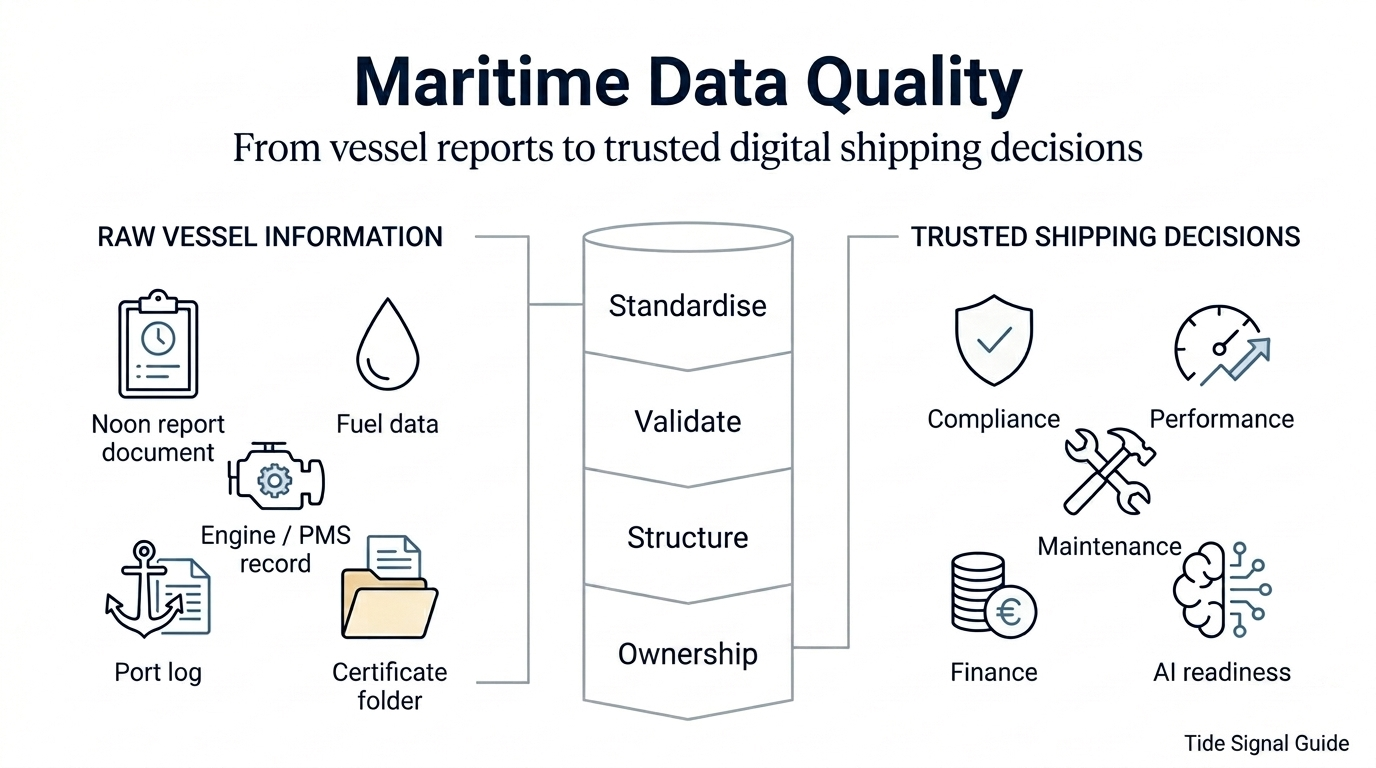
Maritime data quality is the condition of vessel, voyage, technical and commercial data that shipping companies use to make decisions. Good data is accurate, complete, structured, timely and owned by the right people. Poor data is scattered across emails, spreadsheets, noon reports, PMS systems, certificates, port documents and manual notes without a clear structure.
For years, poor maritime data mainly created internal frustration. Reports were late, spreadsheets did not match, equipment names were inconsistent and managers had to chase information from vessels or departments. Today the problem is more serious. Carbon reporting, CII ratings, FuelEU Maritime, port digitalisation, finance, predictive maintenance and AI tools all depend on reliable data.
This is why maritime data quality has become one of the hidden barriers to digital shipping. The industry can buy dashboards, analytics platforms and AI tools, but if the input data is weak, the output will also be weak. Shipping does not need more screens. It needs data that can be trusted.
Editorial view: The next phase of maritime digitalisation will not be won by the company with the most software. It will be won by the company that controls its data discipline: naming, ownership, reporting, verification and follow-up.
Why Data Quality Matters Now
The timing matters. Shipping is entering a period where digital information is no longer optional. The IMO Maritime Single Window became mandatory from 1 January 2024 for IMO Member States, creating a stronger expectation for electronic data exchange when ships call at ports.
At the same time, decarbonisation rules are increasing the value of accurate fuel, voyage and emissions data. FuelEU Maritime has applied in full from 1 January 2025. EEXI and CII requirements entered into force from 1 January 2023. These measures do not work properly if companies cannot trust the data behind vessel performance, fuel use and operational carbon intensity.
This means maritime data quality is no longer a back-office IT topic. It affects compliance, chartering, technical management, finance and commercial credibility.
Why the issue is urgent
- CII ratings depend on accurate operational data.
- FuelEU Maritime increases pressure on fuel and emissions reporting.
- EU ETS makes emissions exposure a commercial cost.
- AI tools need clean and structured data to produce useful results.
- Port digitalisation requires standardised information exchange.
- Finance teams need reliable data to understand carbon and asset risk.
The Problem: Shipping Has Data, But Not Always Usable Data
Most shipping companies already have a large amount of data. Vessels send noon reports, technical departments manage PMS records, crews complete checklists, operators track voyages, finance teams monitor costs and compliance teams collect emissions information.
The problem is that this data is often fragmented. It may exist in different systems, different formats and different naming structures. One vessel may call the same equipment by one name in the PMS, another name in a manual and another name in a defect report. A voyage report may not match bunker data. A spreadsheet may be updated manually without a clear audit trail.
This is where digital transformation becomes difficult. The company has information, but not necessarily information that can be connected, analysed and trusted.
| Weak Data Situation | Operational Result | Commercial Risk |
|---|---|---|
| Different names for the same equipment | PMS, manuals and defect records do not connect properly. | Maintenance history becomes harder to analyse. |
| Incomplete noon reports | Fuel, speed and weather performance become unclear. | CII and voyage performance analysis may be unreliable. |
| Manual spreadsheet updates | Errors enter reports without strong traceability. | Management decisions may be based on weak assumptions. |
| Fragmented certificate data | Expiry dates and compliance documents are harder to control. | Higher risk of missed renewals or inspection problems. |
| Poor data ownership | No one knows who is responsible for correcting errors. | Bad data stays in the system and spreads across reports. |
Data Quality Is Not the Same as Digitalisation
A company can be digital and still have poor data. Using software does not automatically create data quality. A modern dashboard can still show wrong information if the data behind it is inconsistent, incomplete or late.
This is one of the most common mistakes in maritime digital projects. Companies focus on the visible interface: dashboards, charts, mobile apps, reports and automation. But the real value sits deeper: clean data structures, reliable reporting workflows, clear responsibility and practical validation.
Digitalisation should not mean turning messy spreadsheets into messy dashboards. It should mean improving how information is captured, checked, structured and used.
The 2026 Carbon Reporting Pressure
Carbon reporting is one of the clearest reasons data quality matters. A vessel’s carbon performance depends on fuel consumption, distance, time, capacity, operating profile and voyage context. If these inputs are wrong, the analysis becomes weak.
This connects directly with Tide Signal’s coverage of CII in shipping and EEXI vs CII. CII is operational and annual. That means the rating is affected by how the vessel actually trades, not only by what the vessel is on paper.
The same pressure appears in finance. Carbon exposure is becoming part of the way shipping risk is understood. If lenders, charterers or internal management teams ask for emissions performance, weak data can damage confidence.
Where carbon data can break down
Fuel consumption: inconsistent bunker reporting can distort emissions analysis.
Distance data: voyage distance may differ between systems or reports.
Waiting time: port delays may affect performance but remain poorly classified.
Operational context: ballast legs, weather and cargo utilisation may be missing.
Manual corrections: late spreadsheet edits can create uncertainty and audit risk.
AI in Shipping Has a Data Problem
Artificial intelligence is becoming one of the most discussed areas in shipping. Companies want AI for maintenance, routing, procurement, document search, compliance support and operational decision-making.
But AI does not remove the need for data quality. It increases it. A model trained or connected to poor-quality information can produce confident but unreliable results. In shipping, that is dangerous because decisions often involve safety, compliance, cost and operational risk.
The practical lesson is simple: before asking what AI can do, shipping companies should ask whether their data is structured enough to support it.
AI needs more than data volume
- Consistent vessel and equipment naming.
- Clear document versions and revision control.
- Reliable PMS and defect history.
- Structured noon report and fuel data.
- Defined access rights and data ownership.
- Human review where safety or compliance is involved.
Predictive Maintenance Depends on Data Discipline
Predictive maintenance is a good example of the data quality challenge. A company may want early-warning systems for machinery risk, but the result depends on the quality of machinery history, sensor data, defect reports, running hours and crew observations.
If one engineer records a defect in one way and another engineer records the same issue differently, the system becomes harder to analyse. If spare parts are named inconsistently, repeat failures may be missed. If job history is incomplete, the early-warning logic becomes weaker.
This is why predictive maintenance in shipping should be treated as a data discipline issue, not only as a technology project.
Vessel Reports Are the Foundation
Noon reports, arrival reports, departure reports, bunker reports, port logs and machinery records are not just routine paperwork. They are the foundation of vessel performance analysis.
In many companies, these reports are still treated as administrative tasks. The vessel sends them, the office stores them and the process continues. But the same reports may later support fuel analysis, CII calculations, voyage performance, charterparty discussions, claims, finance reports and operational benchmarking.
If the original reporting discipline is weak, every later analysis becomes weaker.
| Report Type | Why It Matters | Data Quality Risk |
|---|---|---|
| Noon report | Fuel, speed, distance, weather and voyage performance. | Manual errors or inconsistent formats can distort analysis. |
| Bunker report | Fuel consumption, cost and emissions exposure. | Poor reconciliation can create carbon reporting problems. |
| Port log | Waiting time, berth time and operational delays. | Weak delay classification hides real performance issues. |
| PMS record | Maintenance history and machinery reliability. | Incomplete job closure weakens technical analysis. |
| Certificate record | Compliance, inspections and audit readiness. | Missing expiry data can create avoidable operational risk. |
Data Ownership Is Often Missing
One of the hidden weaknesses in maritime data quality is ownership. Everyone uses the data, but not everyone owns it. A technical team may rely on PMS data, an operations team may rely on voyage data, finance may rely on cost data and compliance may rely on emissions data. But when the data is wrong, who fixes it?
Without ownership, errors become permanent. A wrong equipment name stays wrong. A duplicate vessel record remains in the system. A manual correction is made in one spreadsheet but not another. Over time, small errors become structural problems.
Good maritime data governance does not need to be complicated. It needs clear responsibility: who enters data, who validates it, who corrects it and who approves structural changes.
Data ownership checklist
- Define who owns each data type: vessel, equipment, voyage, fuel, certificates and finance.
- Create standard naming rules for vessels, systems, equipment and documents.
- Remove duplicate records and old versions where possible.
- Use controlled fields instead of free text where consistency matters.
- Set a correction process when data errors are found.
- Review critical reports regularly instead of waiting for audits or claims.
- Train onboard and shore teams on why data quality affects commercial decisions.
Why Finance Teams Should Care
Maritime data quality is not only a technical or IT issue. It also affects finance. Vessel performance, fuel exposure, maintenance cost, off-hire risk, emissions cost and asset value all depend on information quality.
A finance team cannot properly evaluate carbon exposure if emissions data is unreliable. A shipowner cannot compare vessels if operational profiles are not recorded consistently. A lender or investor may ask for sustainability data, but the company must know whether the numbers are defensible.
This connects with shipping finance and carbon exposure. As carbon becomes more commercial, weak data becomes a financial risk.
Port Digitalisation Raises the Standard
Port calls generate a large amount of information: arrival data, crew and passenger details where applicable, cargo declarations, certificates, security information, waste declarations, port clearance and operational messages.
The IMO Maritime Single Window requirement shows where the industry is moving. Port information exchange is becoming more structured and electronic. This does not mean every company is already fully mature, but it raises expectations around data standardisation and digital workflows.
In this environment, companies with weak internal data processes may struggle. The vessel and office need to provide accurate information faster, in formats that can be shared, checked and reused.
The Human Side of Data Quality
Data quality is not only a system problem. It is also a human workflow problem. Crew and shore teams often understand the practical reality better than any software. If they see data entry as meaningless paperwork, quality will fall. If they understand that reports affect carbon ratings, claims, finance and maintenance decisions, the culture can improve.
This is especially important onboard. Seafarers already face heavy reporting demands. Adding more forms without simplifying the workflow can make data quality worse. The goal should be fewer duplicate entries, clearer fields and better use of information already collected.
The best data systems respect operational reality. They make reporting easier, not heavier.
What Good Maritime Data Quality Looks Like
Good data quality is not perfection. Ships operate in real conditions, and some uncertainty will always exist. The aim is to make data reliable enough to support decisions.
A good data environment has consistent naming, clear ownership, structured records, validation steps, version control and practical reporting discipline. It also has enough flexibility to reflect operational reality.
The strongest companies will not be those with the most complex systems. They will be those that create a clean foundation and build digital tools on top of it.
Signs of stronger data maturity
- One vessel record used consistently across systems.
- Standard equipment naming across PMS, manuals and spares.
- Noon reports checked against fuel and voyage data.
- Certificate expiry dates controlled in one reliable place.
- Carbon reporting linked to operational context.
- Dashboards connected to verified data, not manual copies.
Final View
Maritime data quality is becoming one of the most important foundations of digital shipping. Without clean and trusted data, AI becomes unreliable, carbon reporting becomes fragile, performance monitoring becomes shallow and finance teams struggle to understand real risk.
The industry does not need to choose between seamanship and digitalisation. It needs digital systems that respect operational reality and strengthen decision-making. That starts with better data.
In 2026, data quality is not just an IT concern. It is a shipping management discipline. Companies that treat it seriously will be better prepared for compliance, performance, finance and the next generation of maritime technology.
Sources and Further Reading
For official and industry reference, readers may consult IMO information on the Maritime Single Window, IMO’s EEXI and CII FAQ, European Commission information on FuelEU Maritime, EMSA on the full application of FuelEU Maritime, DNV’s overview of maritime digitalisation, and DNV’s EEXI overview.