Technology / Guides
Predictive Maintenance in Shipping: From PMS to Early Warning
Predictive maintenance is changing how shipping companies think about machinery reliability. Instead of relying only on fixed schedules and manual checks, operators are starting to use data, condition monitoring and early-warning systems to reduce failures and downtime.
Predictive maintenance in shipping is the use of machinery data, condition monitoring, inspection history and operational context to identify potential problems before they become failures. It does not replace engineers, planned maintenance systems or class requirements. Instead, it gives technical teams better information at the right time.
For shipowners and managers, the attraction is clear. Machinery failure can create off-hire, repair costs, safety risk, port delays and commercial disruption. A better warning before failure gives the company more time to plan spares, arrange service, adjust operation and avoid expensive surprises.
The idea sounds simple, but implementation is not. Predictive maintenance depends on data quality, sensor coverage, machinery history, crew reporting, class acceptance, cybersecurity and trust between office and vessel. In shipping, the challenge is not only technical. It is operational.
Quick View: Predictive Maintenance in Shipping
- Predictive maintenance aims to detect early signs of machinery problems.
- It uses data from sensors, inspections, alarms, PMS history and operating conditions.
- It can support better planning, fewer failures and reduced downtime.
- It does not remove the need for crew judgement or proper maintenance discipline.
- The biggest barriers are data quality, system integration and trust in the warning logic.
- The practical goal is not more dashboards. It is earlier, clearer and more useful decisions.
What Predictive Maintenance Means in Shipping
In traditional planned maintenance, tasks are scheduled according to time intervals, running hours or manufacturer recommendations. This remains important and will not disappear. Many shipboard systems still need structured routines, inspections, lubrication, cleaning, calibration and class-related maintenance.
Predictive maintenance adds another layer. Instead of asking only “when is the next scheduled job?”, it asks “what is the current condition of this equipment and is it showing signs of future failure?”
This is the shift from fixed scheduling toward condition awareness. A purifier, pump, generator, compressor or main engine component may not fail suddenly without signs. Vibration, temperature, pressure, consumption, alarms, oil condition and performance trends can all provide clues if the data is captured and interpreted correctly.
From PMS to Early Warning
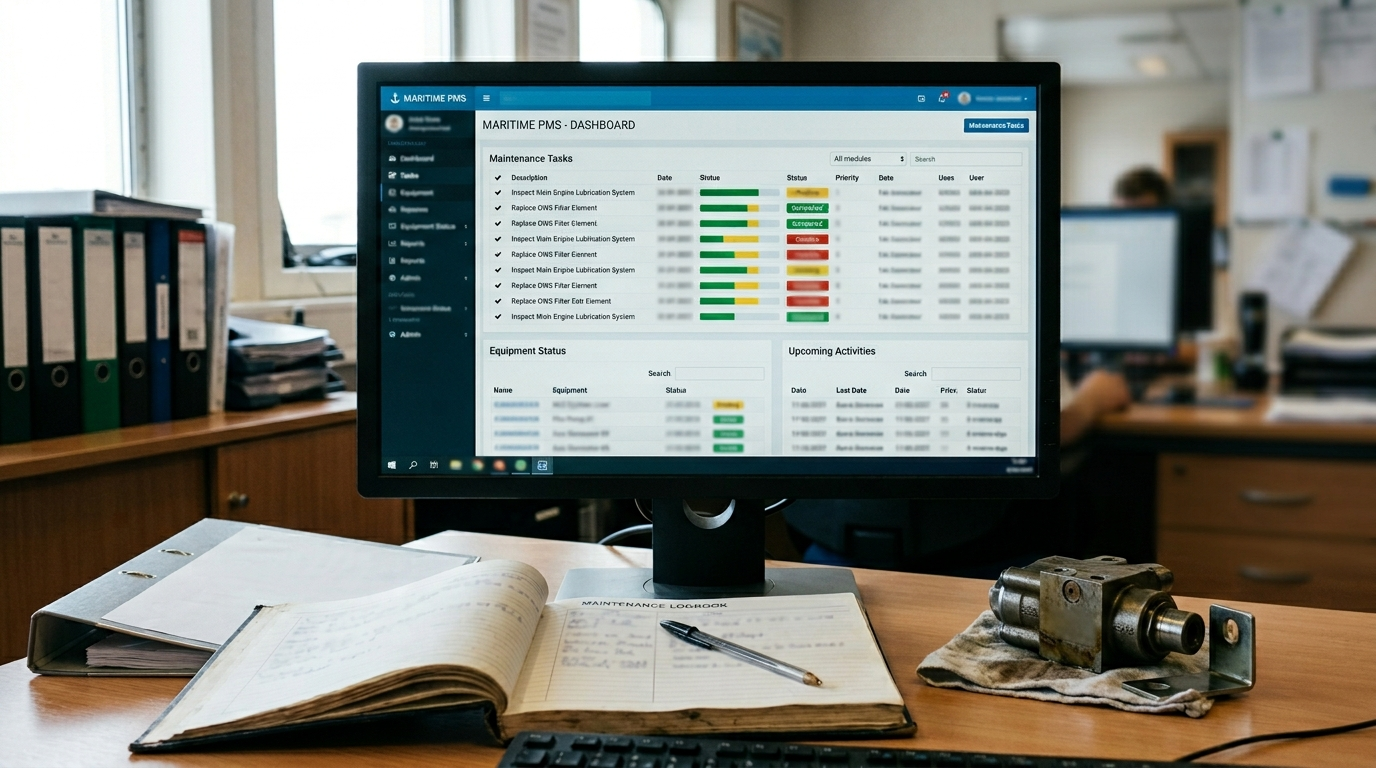
A Planned Maintenance System, or PMS, is the backbone of shipboard maintenance administration. It records jobs, intervals, running hours, spares, inspections, certificates and maintenance history. For many companies, the PMS is still the main tool used to control technical routines.
Predictive maintenance does not make the PMS irrelevant. In fact, it can make the PMS more valuable. The PMS provides context: what has been done, when it was done, which spare parts were used, what defects were recorded and how often a problem repeats.
The stronger model is not PMS versus predictive maintenance. It is PMS plus condition monitoring. The planned system provides structure, while live or periodic data provides early warning. Together, they can support better technical decisions.
Condition Monitoring and Machinery Data
Condition monitoring is central to predictive maintenance. It involves collecting information about machinery health while the equipment is operating or during regular checks.
In an engine room, relevant data may include vibration, temperature, pressure, flow, fuel consumption, lube oil condition, exhaust gas temperature, bearing condition, running hours, alarm history and manual inspection notes.
The value is not only in collecting data. The value is in identifying changes that matter. A single temperature reading may not say much. A trend over time, compared with load, ambient conditions and machinery history, may be far more useful.
Common Data Sources
- PMS records: job history, intervals, running hours and recurring defects.
- Sensor data: vibration, pressure, temperature, flow and operating parameters.
- Alarm history: repeated alarms, abnormal patterns and warning frequency.
- Inspection notes: crew observations, leaks, noise, wear, smell or abnormal behaviour.
- Oil analysis: contamination, wear particles, viscosity and degradation.
- Performance data: fuel use, load, efficiency and machinery output.
Why Predictive Maintenance Matters Commercially
The commercial case is not only about technology. It is about avoiding disruption. A machinery failure during a voyage, port stay or cargo operation can affect schedule, charter commitments, off-hire exposure and repair cost.
Unplanned downtime is expensive because it usually arrives with poor timing. The vessel may need urgent spares, service attendance, deviation, port support or class involvement. If the failure affects safety or propulsion, the cost can become much larger than the maintenance job itself.
Predictive maintenance gives owners and managers a better chance to act before the problem becomes critical. That does not mean every failure can be prevented. But even partial improvement can make a difference across a fleet.
What Equipment Can Be Monitored?
Predictive maintenance can apply to many types of shipboard machinery, but not every system needs the same level of monitoring. The focus should usually begin with critical equipment where failure has high operational or safety impact.
| Equipment Area | Typical Monitoring Focus | Operational Value |
|---|---|---|
| Main engine | Performance, exhaust temperatures, vibration, pressures, lube oil condition | Reduced propulsion risk and better planning of major maintenance |
| Diesel generators | Load profile, alarms, temperature, vibration, fuel and lube oil condition | Improved power reliability and lower blackout risk |
| Pumps and compressors | Vibration, pressure, flow, bearing condition, leakage and motor load | Earlier detection of wear, cavitation or performance loss |
| Purifiers | Vibration, temperature, alarms, sludge discharge patterns and performance | Reduced fuel and lube oil treatment problems |
| Auxiliary systems | Cooling, lubrication, air, hydraulic and control system indicators | Better reliability of supporting systems that affect main operations |
Predictive Maintenance and Class
Classification societies have been developing frameworks around condition-based maintenance, planned maintenance and machinery survey arrangements. This matters because ship maintenance is not only a company decision. It is also connected with class, statutory requirements and survey confidence.
A company may want to use data more actively, but it must still demonstrate control, traceability and reliability. Class acceptance depends on proper procedures, verified systems and evidence that maintenance decisions are supported by credible information.
This is why predictive maintenance in shipping must be treated as a structured process, not as a dashboard experiment. The system needs governance, documentation, responsibilities and auditability.
Why Data Quality Is the Main Barrier
Predictive maintenance is only as useful as the data behind it. Poor sensor quality, missing PMS records, inconsistent naming, manual errors and fragmented systems can weaken the result.
Many shipping companies have data, but not always usable data. A vessel may have alarms in one system, PMS history in another, noon reports somewhere else and inspection notes in emails or spreadsheets. If these sources do not connect, prediction becomes difficult.
This is why maritime data quality is one of the hidden barriers to digital shipping. Before a company can rely on advanced analytics, it needs clean structure, consistent reporting and clear ownership of technical data.
The Role of Crew and Engineers
Predictive maintenance should support the crew, not replace them. Engineers still understand machinery behaviour in ways that a model may not. They hear abnormal noise, notice vibration, smell overheating, see leakage and understand operational context.
The best systems combine machine data with human experience. A warning from the system should be checked against onboard reality. A crew observation should be recorded in a way that the office can use. Both sides need trust.
If predictive maintenance is introduced as surveillance or extra paperwork, crews may resist it. If it is introduced as a practical tool that helps avoid breakdowns and improves planning, adoption becomes easier.
Predictive Maintenance and Digital Twins
Predictive maintenance also connects with maritime digital twins. A digital twin can provide a structured model of vessel systems and performance, while predictive maintenance uses machinery data to detect risk and support decisions.
The link between the two is important. A digital twin without reliable data becomes a visual model. Predictive maintenance without context can become a list of disconnected alerts. Together, they can help technical teams understand what is happening, where it is happening and what decision should follow.
The most valuable future systems will not simply show more information. They will help technical teams prioritise attention.
Cybersecurity and Data Access
Connecting machinery data to shore-based systems creates cybersecurity and data governance questions. Remote monitoring can be valuable, but vessel systems must be protected.
Shipping companies need clear policies around what data is collected, how it is transmitted, who has access, how vendors connect and what happens if connectivity fails. Technical reliability and cyber discipline must move together.
This is especially important where third-party systems, cloud platforms or remote advisory services are involved. Predictive maintenance cannot be allowed to create new operational vulnerabilities.
When Predictive Maintenance Fails
Predictive maintenance can fail when companies expect too much too quickly. Buying software is not the same as changing maintenance culture.
Common problems include weak data, lack of crew engagement, poor alarm prioritisation, unclear responsibilities, overreliance on dashboards and no follow-up process when warnings appear.
A warning that nobody owns is not useful. A system that creates too many false alerts will eventually be ignored. A dashboard that is not connected to actual maintenance planning will not reduce failures.
Common Implementation Mistakes
- Collecting data without defining decisions.
- Adding dashboards without improving maintenance workflow.
- Ignoring crew feedback and practical engine room experience.
- Using inconsistent equipment names and poor PMS structure.
- Failing to assign responsibility for alerts and follow-up.
- Expecting AI to solve problems caused by weak data discipline.
How Shipping Companies Can Start
The best starting point is not a fleet-wide technology rollout. It is a focused review of critical machinery, available data and recurring failures.
Companies can begin by selecting high-impact equipment, improving PMS structure, standardising defect reporting and connecting condition data to maintenance planning. A small successful use case is more valuable than a large digital project that nobody trusts.
Predictive maintenance should be introduced as part of the technical management process. It should help superintendents, chief engineers and fleet managers make better decisions, not create another isolated system.
Practical Starting Steps
- Identify critical equipment where failure creates high operational risk.
- Review existing PMS data quality and job history.
- Standardise defect reporting and equipment naming.
- Connect available sensor or alarm data with maintenance records.
- Start with a small number of high-value early-warning cases.
- Define who reviews alerts and who approves action.
- Use crew feedback to validate whether warnings are useful.
The Wider Market View
Predictive maintenance is part of a broader move toward data-driven vessel management. Shipping companies are under pressure to improve reliability, reduce downtime, manage costs and support better fleet decisions.
This also connects with vessel performance monitoring. The same data culture that supports fuel efficiency and emissions performance can also support machinery reliability.
The strongest companies will not be the ones with the most digital tools. They will be the ones that turn data into disciplined action.
Final View
Predictive maintenance in shipping is not about replacing the planned maintenance system or removing engineering judgement. It is about moving from routine scheduling alone toward better condition awareness and earlier warnings.
The opportunity is real: fewer surprises, better planning, reduced downtime and stronger technical control. But the value depends on data quality, crew trust, workflow discipline and clear responsibility.
In the end, predictive maintenance is not a technology product by itself. It is a maintenance philosophy supported by data. Shipping companies that understand this will be better placed to use it safely and commercially.
Sources and Further Reading
For official and industry reference, readers may consult DNV’s Condition Based Maintenance service overview, ABS guidance on condition monitoring, Lloyd’s Register guidance on machinery survey arrangements, and MAN Energy Solutions PrimeServ Assist.