Panamax and Kamsarmax bulk carriers operate in many of the same dry-bulk trades, but they are not simply two names for the same ship. The Kamsarmax evolved as a larger, higher-capacity development of the conventional Panamax bulker — while the modern freight market has blurred the distinction by adopting an 82,500 DWT vessel as the Baltic Exchange’s standard Panamax benchmark.
Panamax vs Kamsarmax: Quick Comparison
| Feature | Panamax | Kamsarmax |
|---|---|---|
| Typical DWT | Roughly 65,000–80,000 DWT, with many conventional bulkers around 75,000–78,000 DWT | Generally around 80,000–83,000 DWT; common modern designs are around 82,000–82,500 DWT |
| Typical LOA | Often around 220–225 m for conventional bulk carriers | About 229 m for the established Kamsarmax design |
| Beam | Approximately 32.2 m | Approximately 32.2–32.3 m |
| Draft | Varies materially with design and loading condition | Modern examples around 14.4–14.6 m at design summer draft |
| Cargo volume | Lower than equivalent Kamsarmax | Approximately 97,000–98,000 m³ grain capacity on representative designs |
| Typical cargoes | Grain, coal, bauxite, minerals and other major bulks | Grain, coal, bauxite, iron ore and other major bulks |
| Cargo gear | Usually gearless in the modern deep-sea bulk market | Usually gearless |
| Main advantage | Established port compatibility and broad trading flexibility | More cargo capacity without moving into a much larger beam category |
What Is a Panamax Bulk Carrier?
The term Panamax originally described vessels sized around the dimensional restrictions of the original Panama Canal locks.
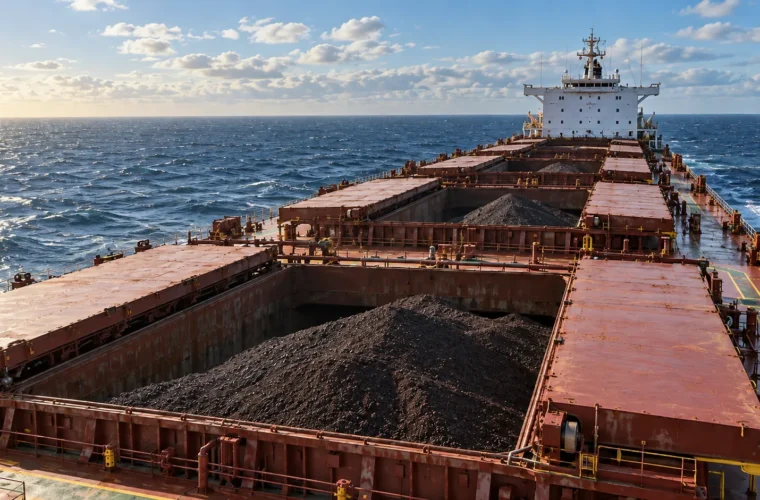
In dry bulk, the term developed into a major commercial vessel segment used extensively for transporting:
- grain;
- thermal and metallurgical coal;
- bauxite;
- some iron-ore parcels;
- fertilisers;
- and other major bulk commodities.
Traditional Panamax bulkers were commonly built around the mid-70,000 DWT range.
For decades, vessels of approximately 74,000–76,000 DWT formed an important reference point for the freight market.
Their scale made them economically attractive for large cargo parcels while their dimensions still allowed access to a broad range of ports and trades.
What Is a Kamsarmax?
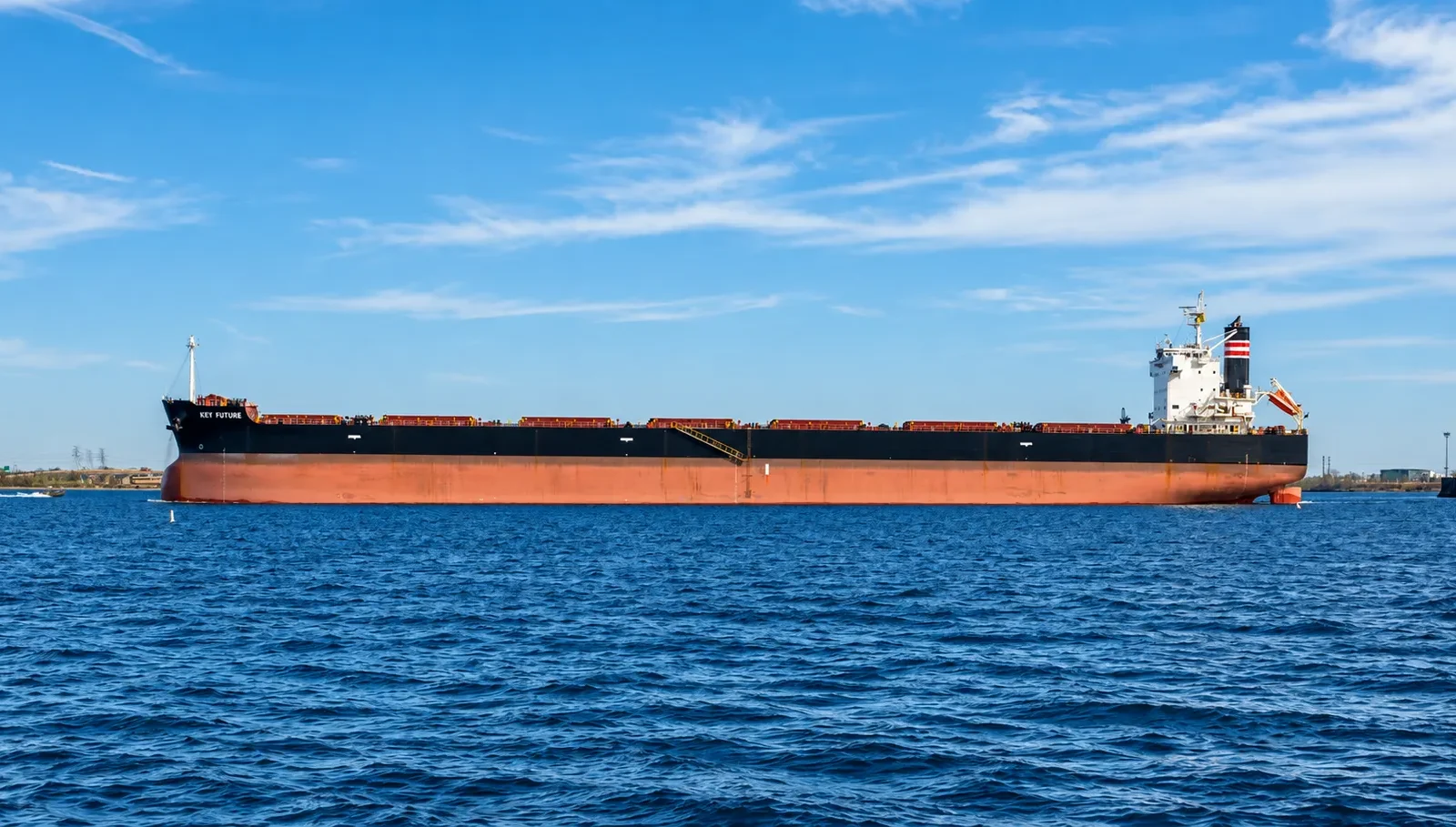
A Kamsarmax is essentially an enlarged Panamax-type dry-bulk carrier designed around the maximum practical vessel length for access to Port Kamsar in Guinea, an important West African bauxite-loading port.
Tsuneishi Shipbuilding, which developed and named the Kamsarmax concept, describes the class as a larger Panamax bulker designed at the maximum length that can enter Port Kamsar.
Its established design has approximately:
- 229 m LOA;
- 32.26 m beam;
- 20.15 m depth;
- 14.55 m draft;
- 82,400 DWT;
- and approximately 98,000 m³ cargo capacity.
The result is a vessel that carries several thousand tonnes more cargo than an older conventional Panamax without moving into the substantially larger Capesize segment.
retain the flexibility of a Panamax-style beam while using additional hull length and design optimisation to carry more cargo.
Why Is It Called Kamsarmax?
Unlike “Panamax,” which came from the Panama Canal, Kamsarmax takes its name from Port Kamsar in Guinea.
Kamsar is one of the world’s important bauxite-export locations.
Tsuneishi developed its Kamsarmax design with a length of 229 metres — about four metres longer than the conventional 76,000-tonne-class Panamax bulker used as its reference.
The objective was to increase deadweight and transport efficiency while keeping the vessel within the beam characteristics associated with Panamax trading.
The concept was introduced in the 2000s and became sufficiently successful that “Kamsarmax” is now widely used across dry-bulk chartering, sale-and-purchase, shipbuilding and fleet descriptions.
The Biggest Difference: Cargo Capacity
The most commercially important distinction is not the name painted on a specification sheet.
It is how much paying cargo the vessel can carry for a given voyage and port combination.
Consider a simplified example.
If a conventional Panamax can load around 75,000 tonnes of cargo while a Kamsarmax can load around 82,000 tonnes under comparable conditions, the Kamsarmax can move roughly 7,000 additional tonnes in a single voyage.
vs
82,000 tonnes
↓
approximately 7,000 tonnes additional cargo per voyage
Over multiple voyages, that difference becomes commercially significant.
A charterer moving 820,000 tonnes of grain, coal or bauxite may require fewer Kamsarmax cargoes than conventional Panamax cargoes, provided both loading and discharge ports can accept the larger vessel at the required draft.
DWT Does Not Mean Cargo Weight
One of the most common misunderstandings in vessel comparisons is treating deadweight as if it were the exact cargo capacity.
It is not.
Deadweight tonnage — DWT — represents the total weight the vessel can carry.
That total includes:
- cargo;
- bunker fuel;
- fresh water;
- lubricants;
- stores;
- crew and effects;
- and other consumables.
An 82,500 DWT Kamsarmax therefore cannot automatically load 82,500 tonnes of cargo.
Actual cargo intake depends on the vessel’s consumables, loading condition, required reserves, water density, draft limits and voyage requirements.
Why Draft Can Matter More Than DWT
A larger deadweight figure only creates value if the vessel can actually use it.
Imagine a Kamsarmax arriving at a loading terminal capable of supplying a full 82,000-tonne parcel.
If the destination port restricts the vessel to a draft that only allows 75,000 tonnes of cargo, much of the Kamsarmax’s theoretical capacity advantage disappears.
This is why chartering decisions are based on much more than vessel class.
+ port draft
+ berth dimensions
+ water density
+ bunker quantity
+ cargo stowage factor
↓
Actual cargo intake
Panamax vs Kamsarmax Dimensions
The two vessel types can appear almost identical from a distance.
Their beam is often extremely similar.
The main dimensional change is usually length and the associated increase in hull volume and deadweight.
| Dimension | Conventional Panamax | Representative Kamsarmax |
|---|---|---|
| LOA | Often around 220–225 m | 229 m |
| Beam | Approximately 32.2 m | 32.26 m |
| DWT | Often around 74,000–78,000 DWT in older conventional designs | Approximately 82,000–82,500 DWT |
| Grain capacity | Design dependent | About 97,000–98,000 m³ on common modern designs |
Figures above are representative commercial examples rather than universal class limits.
The Important Twist: The Baltic Exchange Now Uses a Kamsarmax-Sized “Panamax”
This is where modern terminology becomes particularly interesting.
In January 2020, the Baltic Exchange changed its standard Panamax vessel from the traditional 74,000 DWT specification to a larger 82,500 DWT vessel.
The current Baltic Panamax vessel used for its time-charter routes is specified at:
- 82,500 DWT;
- 14.43 m summer salt-water draft;
- 229 m LOA;
- 32.25 m beam;
- and approximately 97,000 m³ grain capacity.
Those dimensions are extremely close to what the physical shipping market would commonly recognise as a modern Kamsarmax.
A broker can discuss the “Panamax market” while the benchmark vessel behind the Baltic Panamax Index is effectively an 82,500 DWT Kamsarmax-sized bulker.
The Baltic Exchange completed the derivatives transition from its older P4TC benchmark to the newer P5TC in January 2026, ending publication of the legacy 74,000 DWT benchmark.
The change reflects the evolution of the actual fleet rather than a sudden disappearance of the Panamax name.
Panamax vs Kamsarmax in Chartering
Commercially, charterers do not simply ask which ship is larger.
They ask which ship produces the lowest delivered transport cost while satisfying the port and cargo programme.
A Kamsarmax may offer:
- more tonnes per voyage;
- lower freight cost per tonne under favourable conditions;
- better economics for large cargo programmes;
- strong grain cubic capacity;
- and access to many of the same trades served by Panamax vessels.
A smaller Panamax may still be preferable when:
- draft is restricted;
- berth length is limited;
- the cargo parcel is smaller;
- the charterer’s stem does not justify the extra capacity;
- or a particular vessel’s position produces a better freight result.
Typical Panamax and Kamsarmax Cargoes
Grain
Grain is one of the classic Panamax/Kamsarmax cargoes.
Typical trades include exports from North America, South America, the Black Sea and Australia into Asia, the Middle East and other consuming regions.
Because grain has lower density than commodities such as iron ore, cargo-hold cubic capacity can become important.
That is one reason modern Kamsarmax designs emphasise large grain capacity in addition to deadweight.
Coal
Panamax and Kamsarmax vessels are heavily employed in thermal and metallurgical coal trades.
Examples include cargoes from:
- Indonesia;
- Australia;
- South Africa;
- Colombia;
- the United States;
- and Russia.
The right vessel size depends heavily on loading infrastructure and the discharge port.
Bauxite
Bauxite is particularly relevant to the history of the Kamsarmax itself.
Guinea has become one of the world’s most important bauxite-exporting countries, and Port Kamsar is a major loading location.
The vessel class was specifically developed to maximise cargo capacity while maintaining access to Kamsar.
Iron Ore
Capesize vessels dominate many of the world’s largest long-haul iron-ore trades, but Panamax and Kamsarmax ships can still carry iron ore where parcel size, terminal limitations or trading patterns favour smaller vessels.
Are Panamax and Kamsarmax Geared?
Most modern deep-sea Panamax and Kamsarmax bulk carriers are gearless.
They normally depend on shore-based loading and discharge infrastructure rather than carrying their own cranes.
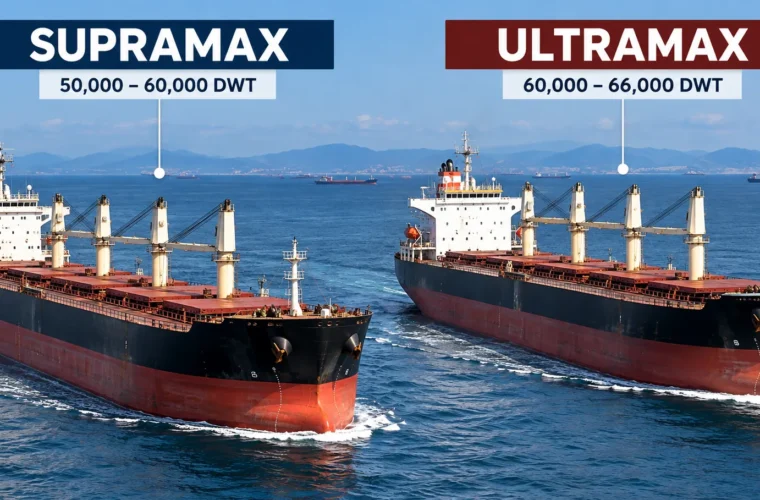
That contrasts with vessel classes such as Supramax and Ultramax, which are commonly equipped with cargo cranes and therefore have greater flexibility at ports with limited shore equipment.
Panamax vs Kamsarmax: Which Is More Economical?
There is no universal winner.
On a voyage where both terminals allow full utilisation, a Kamsarmax often has a scale advantage because more cargo can be spread across the voyage’s fixed and semi-fixed costs.
But freight economics are never determined by DWT alone.
The calculation includes:
- freight rate;
- bunker consumption;
- voyage distance;
- canal costs;
- port charges;
- draft restrictions;
- cargo quantity;
- loading and discharge time;
- ballast distance;
- vessel position;
- and demurrage exposure.
A theoretically more efficient Kamsarmax positioned thousands of miles away may be commercially inferior to an immediately available Panamax.
This is why the physical chartering market revolves around effective tonnage availability, not simply vessel specifications.
How the Baltic Panamax Index Fits In
The Baltic Panamax Index — BPI tracks freight conditions across a group of representative Panamax time-charter routes.
The Baltic’s current Panamax 5TC benchmark includes routes covering both Atlantic and Pacific employment.
Because the representative ship is now an 82,500 DWT vessel, today’s Panamax benchmark is much closer to the modern Kamsarmax fleet than to the older 74,000 DWT vessels that historically defined the segment.
This is particularly important when analysing:
- physical time-charter rates;
- period fixtures;
- FFAs;
- vessel earnings;
- asset values;
- and public dry-bulk shipping companies.
Tide Signal tracks this segment in its Baltic Dry Index 2026 market hub.
What Is P5TC?
P5TC is the Baltic Exchange’s weighted average of five Panamax time-charter route assessments.
It is built around the modern 82,500 DWT benchmark vessel and is used extensively as a reference for:
- physical chartering;
- FFA derivatives;
- company earnings exposure;
- market analysis;
- and period-rate comparisons.
In January 2026, the Baltic Exchange completed the market’s transition away from the legacy P4TC benchmark.
That development matters because it formally aligned the derivatives market with a physical Panamax fleet that had already shifted toward larger vessels.
Can a Kamsarmax Transit the Panama Canal?
The name Kamsarmax does not automatically determine canal eligibility.
Canal transit depends on the vessel’s actual dimensions, draft, operating condition and the applicable Panama Canal requirements at the time of transit.
The original Kamsarmax concept retained a beam of approximately 32.26 metres, deliberately preserving the dimensional characteristics associated with conventional Panamax trading.
But a charterer or operator should always verify the ship’s actual particulars and current canal restrictions rather than relying solely on the vessel-class label.
What About New Panamax and Post-Panamax?
The opening of the Panama Canal’s larger Neopanamax locks changed the meaning of maximum canal size.
As a result, the term “Panamax” in shipping today is partly historical and partly commercial.
A modern dry-bulk Panamax benchmark does not mean “the absolute largest ship capable of transiting the Panama Canal.”
Instead, Panamax has become the established name of a dry-bulk market segment.
That is another reason vessel classes should be understood as trading categories rather than rigid engineering laws.
Kamsarmax Is Still Evolving
Ship designs have continued to increase cargo efficiency.
Tsuneishi has developed a newer Wide Kamsarmax design that retains a 229-metre length while increasing carrying capacity.
The published design reaches approximately:
- 88,500 DWT;
- 103,300 m³ cargo capacity;
- and a design draft of approximately 14.45 m.
That illustrates an important point: vessel-class terminology evolves as shipyards, owners and charterers pursue greater transport efficiency.
Panamax vs Kamsarmax: Commercial Example
Assume a trader needs to move approximately 800,000 tonnes of grain.
For illustration only:
| Vessel | Illustrative Cargo | Voyages for 800,000 t |
|---|---|---|
| Panamax | 75,000 t | About 10.7 cargoes |
| Kamsarmax | 82,000 t | About 9.8 cargoes |
In practice, cargo programmes cannot be reduced to a simple division because parcel sizes, draft limits, port windows, freight rates and ship availability all affect execution.
But the example demonstrates why an additional 6,000–8,000 tonnes of cargo intake can matter across a large commodity programme.
Panamax or Kamsarmax: Which Vessel Is Better?
The correct commercial answer is: the vessel that produces the best voyage economics for the specific cargo, ports and timing.
Kamsarmax usually provides more carrying capacity and can reduce unit transport cost when its additional deadweight can be fully utilised.
Conventional Panamax tonnage can remain attractive where draft, berth length, cargo quantity or vessel positioning favours the smaller ship.
The commercially superior vessel is the one that maximises cargo intake without creating additional port, draft, waiting-time or positioning costs that outweigh the scale advantage.
Panamax vs Kamsarmax: The Bottom Line
Panamax and Kamsarmax belong to the same broad dry-bulk family, but the Kamsarmax represents the industry’s shift toward extracting more cargo capacity from the traditional Panamax footprint.
A conventional Panamax historically centred on roughly 74,000–78,000 DWT. A modern Kamsarmax typically sits around 82,000–82,500 DWT and approximately 229 metres LOA.
The distinction has become less clear in market language because the Baltic Exchange now uses an 82,500 DWT, 229-metre vessel as its official Panamax benchmark.
That means modern charterers may talk about the “Panamax market” while fixing ships that would commonly be described physically as Kamsarmax vessels.
Understanding that difference is essential for reading dry-bulk freight reports correctly.
Frequently Asked Questions
What is the difference between Panamax and Kamsarmax?
A Kamsarmax is generally a larger development of the conventional Panamax bulk carrier. Typical Kamsarmax vessels are around 82,000–82,500 DWT and 229 m long, while older conventional Panamax bulkers were commonly around 74,000–78,000 DWT.
How big is a Kamsarmax?
A representative Kamsarmax is approximately 229 m long, 32.26 m wide and around 82,400 DWT, with roughly 98,000 m³ of cargo-hold capacity.
Why is it called Kamsarmax?
The class was designed around the maximum practical vessel length for access to Port Kamsar in Guinea, a major bauxite-loading port.
Is a Kamsarmax a Panamax?
Commercially they belong to the same broad market segment, but Kamsarmax normally describes the larger 82,000 DWT-class design. The distinction is blurred because the Baltic Exchange now uses an 82,500 DWT Kamsarmax-sized vessel as its standard Panamax benchmark.
What does a Kamsarmax carry?
Kamsarmax vessels commonly carry grain, coal, bauxite, iron ore and other major dry-bulk commodities.
Are Kamsarmax vessels geared?
Most modern Kamsarmax bulk carriers are gearless and rely on shore-based loading and discharge equipment.
What is the Baltic Panamax benchmark vessel?
The Baltic Exchange currently uses an 82,500 DWT vessel with approximately 229 m LOA, 32.25 m beam and 97,000 m³ grain capacity for its Panamax time-charter benchmark.
What is P5TC?
P5TC is the Baltic Exchange’s weighted average of five representative Panamax time-charter routes using its modern 82,500 DWT standard vessel.
- Baltic Exchange — Panamax benchmark vessel and P5TC routes
- Baltic Exchange — Transition from 74,000 DWT P4TC to 82,500 DWT P5TC
- Tsuneishi Shipbuilding — Kamsarmax specifications
- Tsuneishi Shipbuilding — Kamsarmax concept and Port Kamsar origin
- Tsuneishi Shipbuilding — Wide Kamsarmax specifications
Editorial note: Vessel-class ranges are commercial conventions rather than universal legal limits. Individual ships may differ in deadweight, dimensions, cargo capacity, draft and operational capability. Always use a vessel’s approved particulars and current port or canal requirements for operational decisions.