Lloyd’s £1.4bn Gulf losses have put a hard number on the financial impact of the Middle East conflict. For shipping, however, the figure tells a wider story. War risk is moving through insurance terms, owner approvals, vessel availability and freight — turning geopolitical exposure into a direct commercial cost.
The Lloyd’s market remained profitable in the first half of 2026, reporting gross written premium of £34.7 billion, a combined ratio of 90.8%, an underwriting profit of £1.9 billion and profit before tax of £3.5 billion.
But one distinction is essential: the £1.4 billion is not a £1.4 billion marine claims bill. A significant share of the losses is linked to land-based infrastructure and political violence or terrorism cover. The shipping connection comes from the wider risk environment surrounding the Gulf — including severely reduced Strait of Hormuz traffic, war-risk insurance, owner reluctance and the increasingly expensive economics of vessels that remain willing to trade.
THE £1.4BN FIGURE — IN CONTEXT
Lloyd’s reported approximately £1.4bn of losses arising from the Middle East conflict in H1 2026.
It is a cross-class insurance loss figure — not a marine-only claims total.
Lloyd’s £1.4bn Gulf Losses: What the Number Actually Covers
According to Lloyd’s official Half Year Results 2026, the market delivered what it described as a solid first-half performance despite geopolitical tension and a softer pricing environment.
| H1 2026 | Result |
|---|---|
| Gross written premium | £34.7bn |
| Underwriting profit | £1.9bn |
| Combined ratio | 90.8% |
| Investment return | £1.8bn |
| Profit before tax | £3.5bn |
The combined ratio is particularly useful. A figure below 100% generally indicates that underwriting remained profitable before investment income. In other words, the market absorbed a substantial geopolitical loss without allowing it to overturn overall underwriting performance.
The Financial Times reported that much of the Middle East loss estimate was associated with damage to land-based infrastructure and political violence or terrorism policies.
That makes the composition of Lloyd’s £1.4bn Gulf losses as important as the headline number itself. Refineries, petrochemical facilities, logistics assets, energy infrastructure and commercial property can generate major insured losses even when no merchant vessel is directly damaged.
Shipping Is Seeing the Same Conflict Through Hormuz
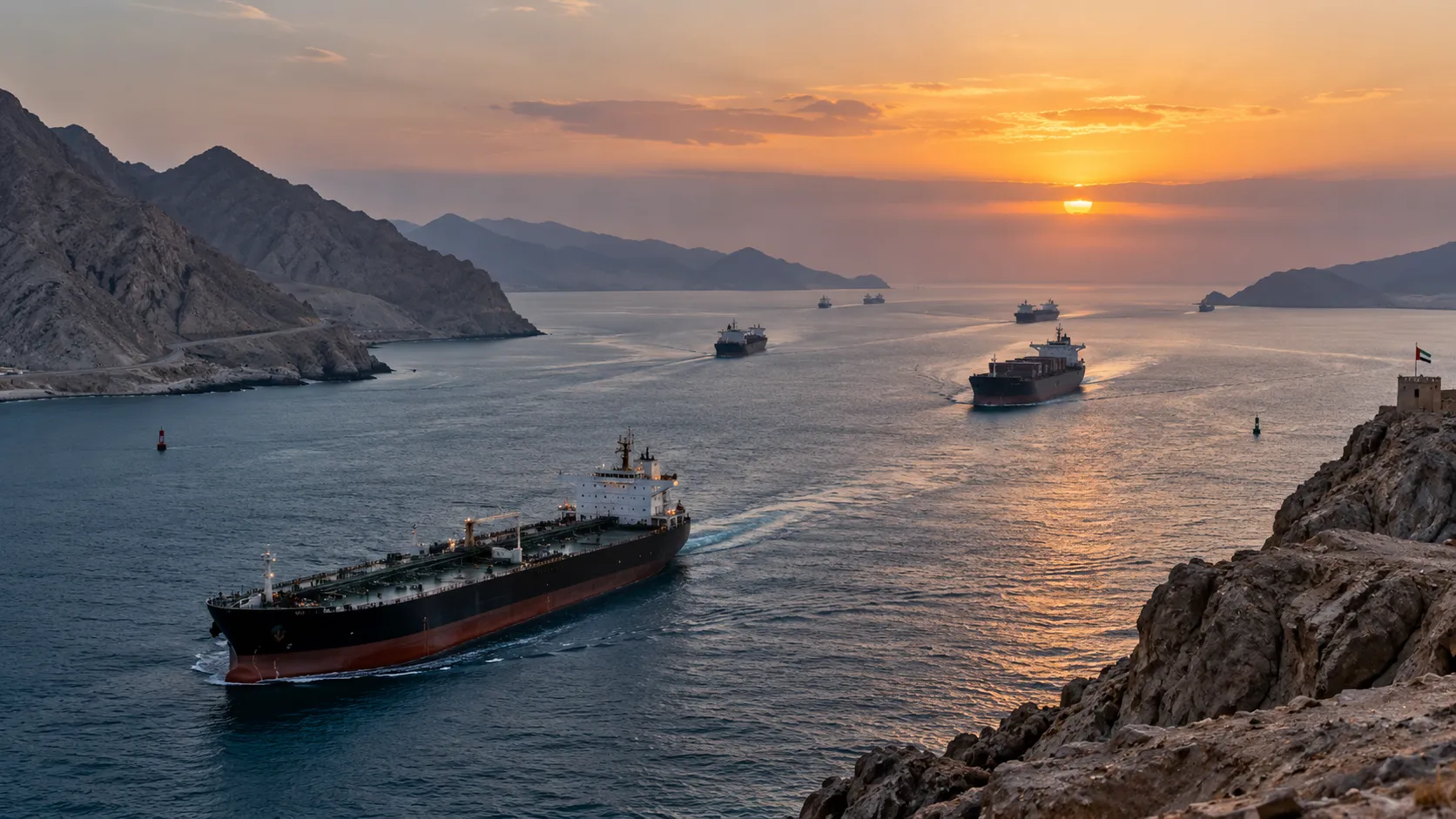
The marine side of the story is visible in the Strait of Hormuz.
On 4 September, Reuters reported that only four AIS-visible commodity vessels crossed the strait on Thursday: two MR tankers, one Kamsarmax and one Handysize.
The 10-day average stood at around 15 vessels. Before the conflict, roughly 125 commercial vessels crossed the waterway each day.
The comparison is not perfect because vessels operating with AIS switched off are excluded from the observed count. Even with that limitation, visible commercial traffic remains dramatically below the pre-conflict pattern.
Tide Signal is following those movements separately in Strait of Hormuz Nears Standstill as US Prepares New Iran Sanctions, where the operational consequences for tankers, dry bulk and regional energy flows are tracked as the situation develops.
The two stories sit on opposite sides of the same risk equation. Lloyd’s shows the financial loss accumulating across the insurance market. Hormuz shows how the conflict is changing the behaviour of ships.
Insurance Is No Longer a Background Voyage Cost
Marine insurance normally sits behind the fixture. In a conflict zone, it can move to the front of the commercial discussion.
An owner may have a suitable vessel. A charterer may have cargo. The freight may initially appear attractive. But the voyage still depends on whether insurance can be obtained on acceptable terms and whether the owner is prepared to accept the remaining exposure.
The International Union of Marine Insurance has said that significant cargo, hull, liability and offshore-energy capacity remained available in the Middle East, while pricing and policy structures were adjusted as the security situation changed.
That is an important difference. The market did not simply move from insured to uninsured.
It moved toward more selective underwriting, more dynamic pricing and more voyage-specific assessment.
Tide Signal’s guide to War Risk Premiums in Shipping explains how those additional costs can move directly into freight negotiations, charterparty allocation, owner approvals and voyage margins.
Available Insurance Does Not Mean an Available Ship
This distinction is central to understanding today’s Gulf freight market.
A voyage can be insurable and still be rejected by the owner.
The insurer may provide terms. The owner may still conclude that the combined exposure to crew safety, vessel damage, sanctions, detention, delay and subsequent employment is too high.
That creates a gap between the physical fleet and the effective fleet.
A ship exists physically, but it is only commercially available for a high-risk voyage if the owner, insurer, managers, crew, lenders and relevant authorities are all prepared to support the employment.
When that pool becomes smaller, charterers compete for fewer usable vessels.
That is when insurance begins to influence freight without appearing as a simple line item in a freight index.
How War Risk Travels Into Freight
The commercial chain can be surprisingly direct:
Security risk → insurance repricing → tighter owner approval → fewer workable vessels → higher freight.
That sequence helps explain some of the extraordinary freight numbers seen during the Hormuz disruption.
Tide Signal previously examined The $25 Million VLCC Voyage, where the reported cost of moving Iraqi crude illustrated how quickly the economics can change when access to a high-risk trade becomes scarce.
The vessel in that scenario was not being paid only for distance sailed.
It was being paid for something much harder to secure: commercially acceptable access to the Gulf.
The market is not always pricing distance or fuel. Sometimes it is pricing access.
That is one of the clearest links between Lloyd’s £1.4bn Gulf losses and shipping economics. A geopolitical event does not have to destroy a ship to alter the price of moving cargo.
The Owner and Charterer Are Solving Different Equations
A very high freight rate can look irrational until the incentives on each side of the fixture are separated.
The charterer may be working with discounted crude, a strong refinery margin, a strategic cargo requirement or an alternative supply source that is even more expensive.
Paying several million dollars more for freight can therefore remain commercially rational.
The owner faces another calculation.
Revenue must compensate not only for bunkers, port costs and time, but also for war-risk exposure, crew considerations, potential delay, sanctions risk, insurance cost, loss of subsequent employment and the possibility that security conditions deteriorate before the voyage is completed.
That difference between cargo economics and vessel economics is often where a large risk premium appears.
For practical voyage modelling, Tide Signal’s Voyage Margin Calculator can be used to test how additional voyage expenses, freight changes and commissions alter the final margin and break-even freight requirement.
Lloyd’s Has Already Added Dedicated Hormuz War-Risk Capacity
The insurance market has not only commented on the crisis. It has developed additional capacity around it.
In June, Lloyd’s announced a new marine war-risk consortium for Strait of Hormuz shipping.
The facility, led by Chubb and supported by participating Lloyd’s syndicates and specialist market partners, was designed to provide additional capacity for vessels and cargo transiting the strait.
Lloyd’s said the consortium could provide up to $200 million of capacity for hull and P&I risks, with a further $200 million of cargo capacity, subject to underwriting criteria, sanctions screening and applicable regulation.
That development gives useful context to the current results.
While Lloyd’s £1.4bn Gulf losses demonstrate how costly the conflict has become across the broader insurance market, Lloyd’s participants are simultaneously building products intended to keep maritime trade functioning through the same region.
This is not contradictory. It is how specialty insurance markets operate: risk is absorbed, reassessed, repriced and — where there is sufficient capital and underwriting confidence — written again under revised terms.
The Gulf Crisis Extends Beyond Tanker Insurance
It is tempting to reduce the current situation to tankers and war-risk premiums. The real commercial network is wider.
A successful Gulf cargo movement depends on multiple systems functioning at the same time:
- the producing asset must remain operational;
- the cargo must be available for loading;
- the terminal and port must remain accessible;
- the vessel must be accepted by the charterer and terminal;
- the owner must approve the trading area;
- insurance must remain available;
- sanctions and compliance checks must clear;
- banks must be able to process the transaction;
- the crew must be able to perform the voyage safely;
- and the receiving side must remain able to take delivery.
Breaking any one part of that chain can disrupt trade without a vessel ever being physically struck.
A missile attack on a refinery can remove cargo from the market. A sanctions designation can stop a payment. An insurance cancellation clause can force a fresh commercial decision. A security warning can lead an owner to refuse orders through a route that remains technically navigable.
That is why Gulf disruption is better understood as a network risk than a single marine casualty risk.
What the 90.8% Combined Ratio Tells Us
The combined ratio helps separate a dramatic loss headline from the financial condition of the market.
A ratio below 100% generally means underwriting premium exceeded claims and expenses.
Lloyd’s reported 90.8% for the first six months of 2026.
That performance suggests the market was able to absorb the Gulf losses while maintaining underwriting profitability across its diversified portfolio.
This is also a reminder that insurance pricing is not only a reaction to fear. Underwriters are attempting to translate probability, severity, uncertainty and capital exposure into a price.
When risk becomes harder to estimate, terms can tighten before the actual level of claims is fully known.
Why Profit Before Tax Fell
Lloyd’s profit before tax fell to £3.5 billion despite the stronger underwriting performance.
Investment returns were £1.8 billion, compared with £3.2 billion in the previous first-half period.
This distinction prevents an easy but incorrect reading of the results: the decline in overall profit was not simply the result of Middle East claims.
The Lloyd’s result reflects both underwriting and investment performance.
For shipping readers, the underwriting side is arguably more revealing because it shows that insurers have continued to deploy capital into complex risks while maintaining positive underwriting economics overall.
Could Gulf War-Risk Pricing Stay High Even if Traffic Recovers?
Yes.
Shipping markets and insurance markets do not always normalise at the same speed.
Visible vessel traffic could recover before underwriters become comfortable enough to return to previous pricing. A temporary reduction in attacks may not be sufficient if uncertainty remains around sanctions, mines, missile capability, port infrastructure or the durability of any political agreement.
Owners can behave in the same way.
One successful transit does not necessarily convince the next owner that conditions have normalised.
A sustained sequence of safe passages, clearer security guidance and greater confidence in policy stability may be required before the effective fleet expands materially.
That lag is commercially important because freight can remain elevated even after a route appears to be reopening.
What Shipping Companies Should Watch Now
The next clues are likely to appear in operational data before they appear in another half-year insurance report.
- Hormuz transits: whether visible daily crossings begin moving consistently above the recent average.
- War-risk pricing: whether additional premiums begin easing or react sharply to new incidents.
- Owner acceptance: whether a wider range of owners approve Gulf employment.
- Available tonnage: whether the effective fleet expands enough to reduce scarcity premiums.
- Sanctions: whether additional measures affect ships, traders, insurers, banks or cargo buyers.
- Infrastructure damage: whether attacks create further energy, property or business-interruption claims.
- Freight: whether Gulf-capable vessels continue commanding exceptional premiums.
Tide Signal Analysis: Lloyd’s £1.4bn Gulf Losses Are Part of a Larger Repricing
Lloyd’s £1.4bn Gulf losses should not be interpreted as a standalone marine catastrophe figure. They are more useful as evidence of how far the economic consequences of the conflict have spread.
The shipping market is experiencing the same process through different channels.
Security conditions alter insurance terms. Insurance terms affect the owner’s willingness to trade. Fewer willing owners reduce available tonnage. Charterers then pay more for the vessels that remain commercially usable.
At the same time, damage to refineries, terminals and other land-based infrastructure can affect cargo flows even when the sea route remains physically open.
The result is a market where the cost of war does not appear in one place.
Part of it appears in insurance claims.
Part of it appears in additional premiums.
Part of it appears in freight.
Part of it appears in delayed cargoes, rejected voyages and lost commercial flexibility.
The £1.4 billion figure gives the conflict a financial scale. Hormuz traffic gives it an operational scale. Freight and insurance pricing show how the cost is eventually transmitted through maritime trade.
As long as vessel movements through the strait remain far below normal, insurance capacity, owner appetite and effective tonnage supply will remain closely connected.
Frequently Asked Questions
What are Lloyd’s £1.4bn Gulf losses?
Lloyd’s reported approximately £1.4 billion of insurance losses arising from the Middle East conflict in the first half of 2026. The figure covers relevant insurance classes and should not be interpreted as a marine-only claims total.
Are the £1.4bn losses all related to ships?
No. Reporting indicates that a substantial proportion relates to land-based infrastructure and political violence or terrorism cover.
Is marine war-risk insurance still available in the Gulf?
Yes, capacity has remained available for qualifying risks, but pricing, policy conditions, sanctions screening and individual underwriting assessments can change rapidly.
Why does insurance affect freight rates?
Higher risk can increase insurance costs and reduce the number of owners willing to perform a voyage. A smaller commercially available fleet gives charterers fewer options and can push freight higher.
What is the difference between fleet size and effective fleet?
Fleet size counts ships that physically exist. The effective fleet is the number of vessels commercially available for a particular trade after owner approval, insurance, crew, sanctions, financing and operational restrictions are considered.
What does Lloyd’s 90.8% combined ratio mean?
A combined ratio below 100% generally indicates underwriting profitability before investment income. Lloyd’s therefore remained profitable on underwriting during H1 2026 despite significant Middle East conflict losses.
Related Tide Signal Coverage
-
War Risk Premiums in Shipping: The Hidden Cost Behind High-Risk Voyages
How additional war-risk costs move into freight, charterparty allocation, owner approvals and voyage economics. -
Strait of Hormuz Nears Standstill as US Prepares New Iran Sanctions
Tide Signal’s continuing coverage of the operational disruption through the Gulf’s most important shipping chokepoint. -
The $25 Million VLCC Voyage Reshaping Iraqi Crude Freight
A commercial case study in how geopolitical risk, vessel availability and owner appetite can reprice freight. -
Voyage Margin Calculator
Model freight revenue, voyage costs, commissions, margin and break-even freight.
Sources & Further Reading
- Lloyd’s — Half Year Results 2026
- Financial Times — Lloyd’s Gulf conflict losses
- Reuters — Gulf shipping traffic through Hormuz, 4 September 2026
- International Union of Marine Insurance — Middle East marine insurance capacity
- Lloyd’s — Marine war-risk consortium for Strait of Hormuz shipping
Reporting status: 4 September 2026. Tide Signal will update this analysis if Lloyd’s revises its Middle East conflict loss estimate, war-risk insurance capacity changes materially or Strait of Hormuz traffic conditions shift.