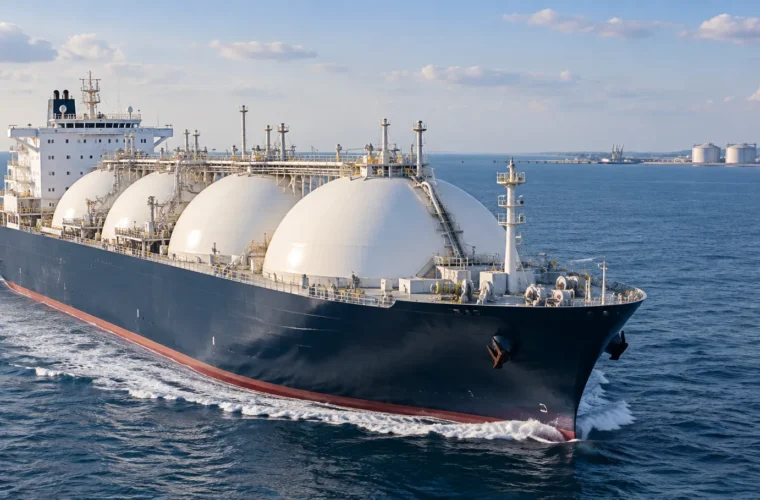
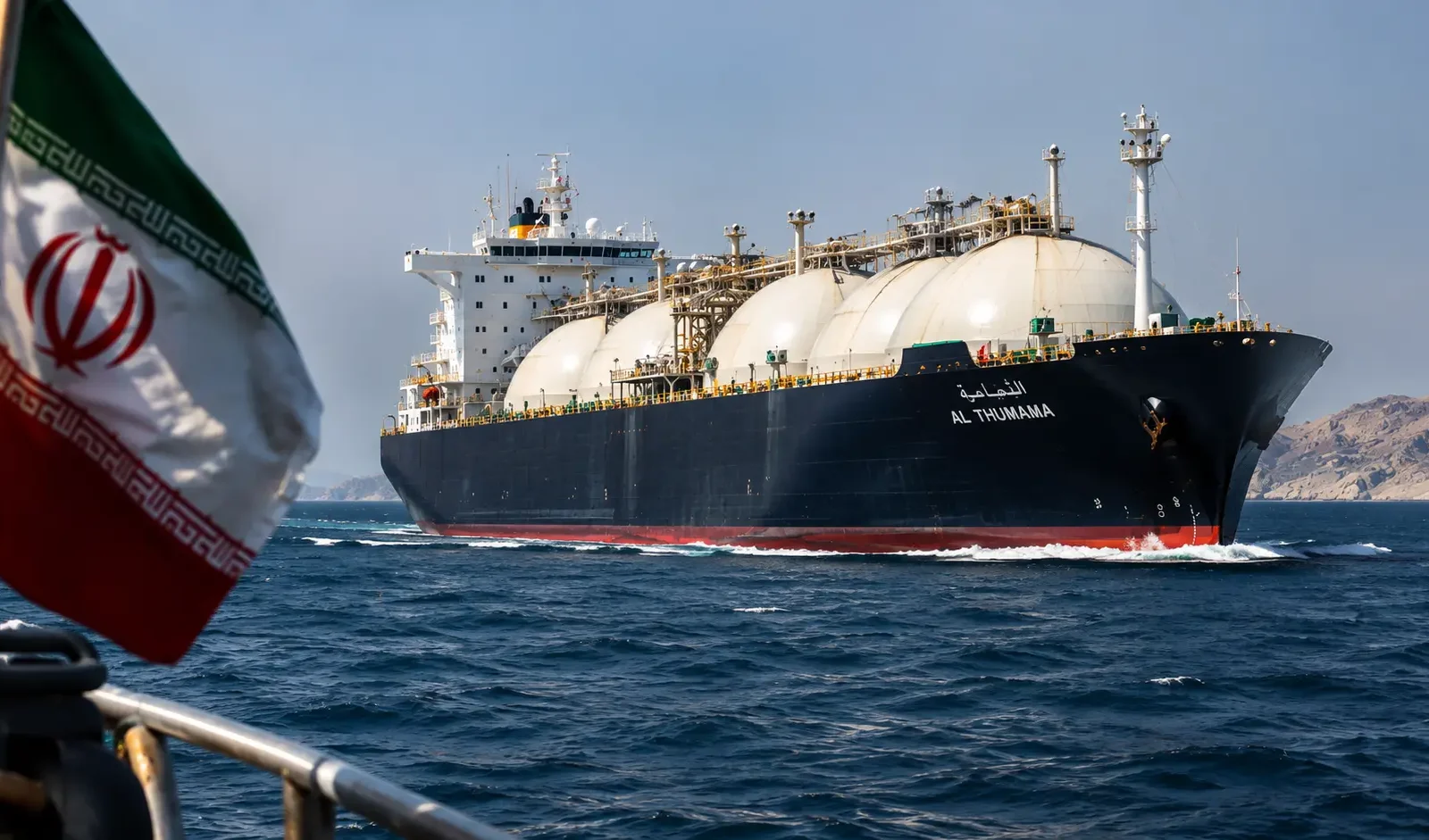
Iran says a liquefied natural gas (LNG) tanker struck a naval mine and suffered an explosion in the Strait of Hormuz on 13 November 2026. The Hormuz LNG tanker report remains independently unverified, and the vessel has not been identified. It comes as official maritime security reporting records further attacks on merchant vessels and a severe threat level in one of the world’s most important energy shipping corridors.
Iran Reports LNG Tanker Mine Strike on 13 November
Iran’s Revolutionary Guards Navy said on Friday, 13 November, that a tanker carrying liquefied natural gas hit a naval mine in the Strait of Hormuz and suffered an explosion. According to Iranian state media, the vessel had been using a route that Iranian authorities considered unauthorised and dangerous.
Reuters reported the statement on 13 November, noting that no further details about the tanker were immediately available.
The reported vessel’s name, flag, owner, voyage details, precise position, damage assessment and crew status have not been established by the available account. Crucially, the allegation does not itself independently establish that a naval mine caused the reported explosion.
Later on the same day, the Revolutionary Guards Navy said two oil tankers had caught fire following alleged mine strikes while trying to pass through Hormuz. Reuters also reported that statement. The report did not identify the tankers or verify the circumstances. It is therefore not possible to determine from these claims alone whether they refer to distinct incidents.
What Is Independently Documented? UKMTO and JMIC Reports
The security concern is not based only on the latest Iranian statements. The Joint Maritime Information Center (JMIC) Update 113, dated 12 November 2026, recorded four recently reported tanker attacks in the Strait of Hormuz and the Arabian Gulf. The advisory assigned the Strait of Hormuz a SEVERE threat level.
| Incident | Vessel | Location | Reported outcome |
|---|---|---|---|
| 10 Nov UKMTO 201-26 | Unnamed tanker | 19 NM northeast of Lima, Oman | Unknown projectile strike; crew reported safe, no environmental damage reported |
| 11 Nov UKMTO 202-26 | NCC FAJR | North of Khasab, Oman | Attack reported to authorities; crew reported safe |
| 10 Nov reported 12 Nov UKMTO 203-26 | FUJAIRAH ENERGY | Arabian Gulf | Unknown projectile strike; multiple casualties taken ashore for medical assistance |
| 11 Nov reported 12 Nov UKMTO 204-26 | DOMINICA PROSPERITY | 14 NM northwest of Ras Al Khaimah, UAE | Engine-room projectile strike; crew evacuated safely; firefighting reported |
The dates above distinguish the time of an incident from the date on which a time-late report was circulated. All four entries are based on the official JMIC advisory, not on unverified social-media footage or claims about unidentified vessels.
The Dominica Prosperity case illustrates the seriousness of the threat. Reuters reported that an unidentified projectile struck the Liberia-flagged tanker near Ras Al Khaimah, causing a fire in the engine room. All 22 crew members were safely evacuated, according to India’s shipping minister.
Why the Strait of Hormuz Remains at Severe Risk
The 12 November JMIC security advisory assessed deliberate hostile action against shipping in the Strait of Hormuz as highly likely under the prevailing conditions. It also warned of navigation interference and advised mariners to remain alert to possible mining activity within or near the traffic separation scheme.
That assessment is more authoritative for operational threat context than any single unattributed video or online claim. It does not, however, confirm the specific LNG mine-strike report issued the following day.
Traffic has continued through the waterway, but its commercial use remains restricted by security conditions, vessel availability, voyage approvals and the willingness of shipowners and crews to accept the exposure.
For a broader perspective on the route’s operating conditions, see Tide Signal’s regularly maintained Strait of Hormuz shipping status guide.
LNG Tanker Movements Recovered in October — Despite the Threat
The reported LNG incident comes at a commercially sensitive moment. Reuters reported on 10 November, citing S&P Global Energy vessel-tracking data, that 31 laden LNG tankers exited the Strait of Hormuz in October, compared with 23 in September.
Of the October departures, 23 had loaded at Qatar’s Ras Laffan terminal and eight at the UAE’s Das Island facility, according to the cited data. October was the strongest month for outward LNG movements through the waterway since the conflict disrupted traffic earlier in 2026.
This is a recovery in observed movements, not evidence that the shipping route has returned to normal. Any increase in vessel transits places more commercial tonnage in a corridor where serious incidents are still being reported.
+
continued vessel attacks and security alerts
↓
greater commercial exposure to unresolved maritime risk
Reuters separately reported that the Washington Institute for Near East Policy recorded 37 attacked ships in October and at least 10 in the first 10 days of November. Those figures reflect the institute’s wider incident dataset and should not be added to JMIC counts without checking for overlap and differing definitions.
Why Hormuz Matters for Global Oil and LNG Trade
The Strait of Hormuz links the Persian Gulf to the Gulf of Oman and the Arabian Sea. It is the main seaborne exit for energy shipments originating in Qatar and several major Gulf oil-exporting countries.
According to the International Energy Agency’s February 2026 Strait of Hormuz factsheet, around 20 million barrels per day of crude oil and petroleum products passed through the strait in 2025 — approximately one-quarter of global seaborne oil trade.
For LNG, the IEA estimated that about 93% of Qatar’s and 96% of the UAE’s LNG exports travelled through Hormuz, together representing around 19% of global LNG trade in 2025.
Any prolonged disruption can affect LNG supply schedules, destination flexibility and competition for available cargoes. Asian buyers are particularly exposed to Gulf LNG supply, while European gas markets can also face indirect effects when global cargo allocation changes.
What Does the Risk Mean for Shipowners and Charterers?
Security incidents influence shipping economics even when they do not force the complete closure of a route. Vessel operators, cargo interests, brokers and insurers each assess the same exposure from a different commercial position.
- Voyage acceptance: Owners may reconsider whether a proposed Gulf voyage is consistent with their risk policies and insurance arrangements.
- War-risk cover: Additional premium terms, notification obligations and underwriter approval can change the economics of a fixture.
- Tonnage availability: If some operators decline Gulf employment, the pool of willing and suitable LNG or oil tankers can tighten.
- Cargo schedules: Uncertain passages and operational restrictions can affect nominations, laycans and loading programmes.
- Seafarer safety: Masters and operators must prioritise crew protection and official navigational guidance over commercial schedule pressure.
No precise freight-rate or insurance-premium movement can be attributed solely to the unverified 13 November LNG report on the information reviewed for this article. The broader mechanism, however, is clear: sustained uncertainty can be priced into voyages before any new loss occurs.
For a deeper explanation, read Tide Signal’s guide to war-risk premiums and voyage costs.
October’s recovery in LNG departures demonstrates that commercial flows can improve even as vessel attacks continue. That leaves the market exposed to a difficult combination: renewed energy-shipping activity and a persistent threat to the ships conducting it.
The immediate consequence of the latest LNG report depends on whether an identifiable ship and a verified mine strike emerge. The underlying operational risk, documented in official advisories, already exists regardless of that confirmation.
What Should Shipping Markets Watch Next?
- Vessel identification: Whether a named LNG carrier, flag state, operator or rescue authority independently confirms the 13 November report.
- Incident classification: Whether subsequent evidence establishes a mine, projectile, other explosive cause or no verified incident.
- Security advisories: New UKMTO alerts and JMIC threat assessments for Hormuz and the Gulf.
- LNG movements: Vessel departures from Qatar and the UAE, as well as congestion and delays affecting loading schedules.
- Commercial terms: Any corroborated changes in war-risk insurance, chartering appetite and available tanker capacity.
The next confirmed operational update is likely to matter more than any attempt to infer vessel details from the initial claim. For now, Hormuz remains commercially navigable for some shipping movements, but exposed to a severe security environment.
Strait of Hormuz LNG Tanker: Frequently Asked Questions
Did an LNG tanker definitely hit a mine in the Strait of Hormuz?
No independently verified mine strike involving an identified LNG tanker had been established in the reports reviewed for this article. Iran’s Revolutionary Guards Navy reported the incident on 13 November 2026; Reuters carried that claim while noting that the vessel’s details were not immediately available.
Which LNG tanker was reportedly damaged?
The vessel had not been identified in the 13 November report. Its name, flag, owner, position, damage and crew status should not be assumed without subsequent verified information.
Is the Strait of Hormuz closed to shipping?
Not completely. Commercial vessels have continued to transit the waterway, although movements are constrained and security conditions are severe. A physically passable route is not necessarily operating under normal commercial conditions.
What is the official security threat level in Hormuz?
The JMIC advisory dated 12 November 2026 classified the Strait of Hormuz threat level as SEVERE, warning of highly likely deliberate hostile action and continued navigation interference.
Why would a Hormuz incident affect LNG prices and shipping costs?
Disruption can complicate the movement of Qatari and UAE LNG cargoes, reduce the availability of willing carriers, affect voyage planning and alter insurance or chartering conditions. A particular price effect cannot be assumed without contemporaneous market evidence.
How much global LNG trade normally passes through Hormuz?
The IEA estimated that LNG exports from Qatar and the UAE transiting the strait represented approximately 19% of global LNG trade in 2025. That is a historical baseline rather than a claim about current November 2026 flows.
- Reuters, 13 November 2026 — Iran’s report of an LNG tanker mine strike
- Reuters, 13 November 2026 — Separate Iranian claim concerning two oil tankers
- JMIC / UKMTO, 12 November 2026 — Update 113: vessel incidents and severe threat level
- Reuters, 12 November 2026 — Dominica Prosperity attack and crew evacuation
- Reuters, 11 November 2026 — Vessel attacks amid recovering traffic
- Reuters via Baird Maritime, 10 November 2026 — October LNG vessel movements (S&P Global Energy)
- International Energy Agency, February 2026 — Hormuz oil and LNG trade factsheet
Editorial and verification note: This report distinguishes official allegations from documented maritime-security incidents and uses 2025 IEA figures solely as historical trade context. This is a news and market-analysis article, not an operational navigation instruction. Operators should follow current UKMTO, flag-state, company-security and relevant coastal-state advisories. The article should be revised if independently verified information about the reported LNG tanker becomes available.