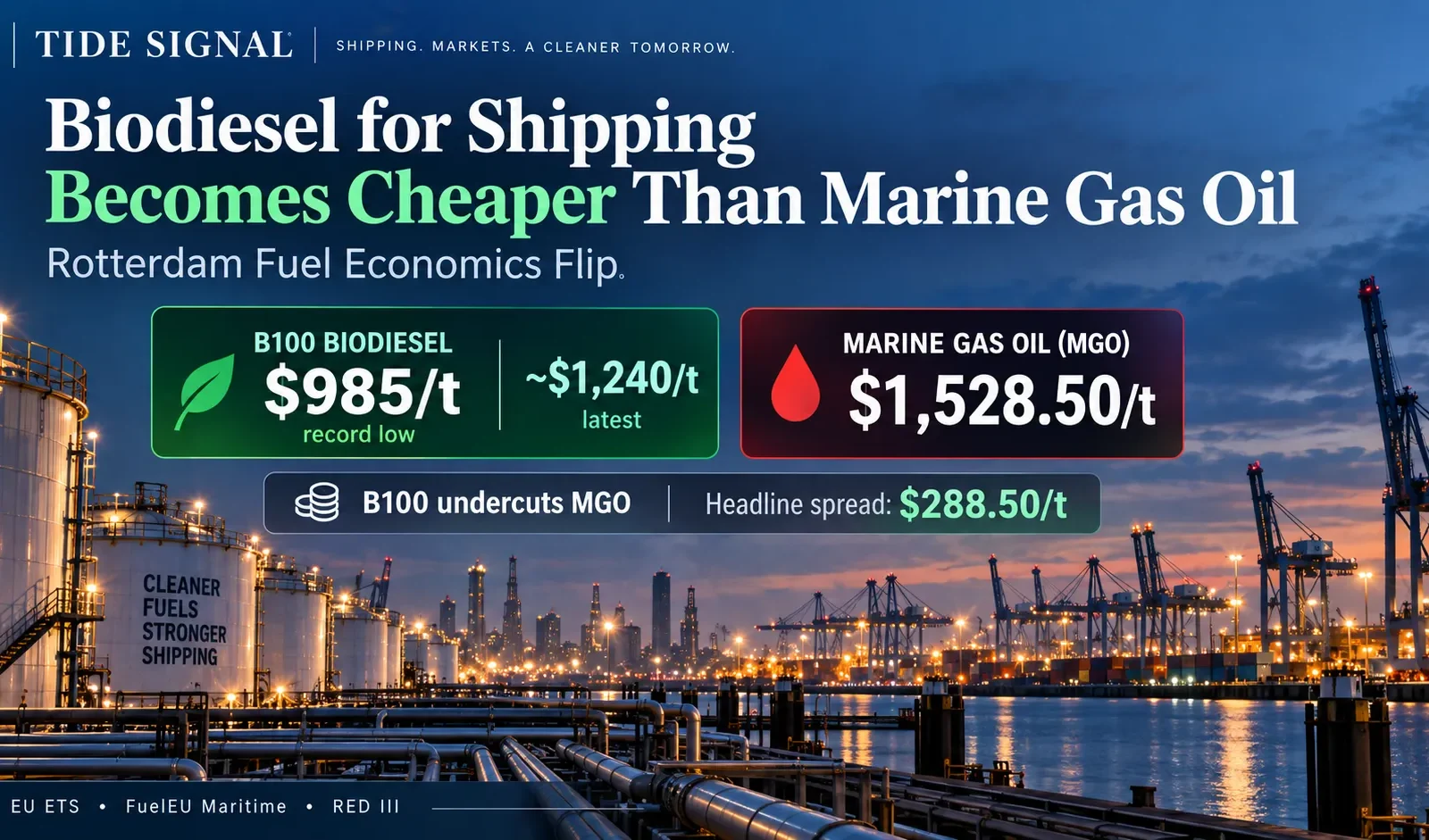
A fuel-price relationship that would have looked unlikely only months ago has appeared in Rotterdam: marine biodiesel is now cheaper than marine gasoil on a headline per-tonne basis.
B100 biodiesel fell to a record low of about $985 per tonne before rebounding to around $1,240, while marine gasoil surged to approximately $1,528.50 per tonne. The reversal is forcing shipowners and bunker buyers to reconsider fuel economics as EU ETS, FuelEU Maritime and Dutch RED III compliance costs increasingly interact with the physical bunker market.
Biodiesel vs Marine Gas Oil: What Changed in Rotterdam?
The Rotterdam bunker market has produced one of the most striking marine-fuel price reversals of 2026.
According to pricing data reported by the Financial Times, marine biodiesel fell as low as $985 per tonne before recovering to approximately $1,240 per tonne.
The record-low level represented a sharp decline from as much as approximately $1,388 per tonne in July.
Marine gasoil moved in the opposite direction.
The distillate bunker fuel reached approximately $1,528.50 per tonne, compared with around $714.50 per tonne before the latest Middle East supply disruption accelerated.
That means marine gasoil has increased by roughly 114% from the earlier level cited in the market data.
The Headline Price Gap Is $288.50 per Tonne
Using the rebound B100 level of approximately $1,240 per tonne and the cited MGO level of $1,528.50 per tonne produces a simple headline price difference of:
On a simple 1,000-tonne bunker stem, that would correspond to a nominal purchase-price difference of approximately:
At the brief B100 record low of $985 per tonne, the nominal difference against $1,528.50 MGO would have been approximately $543.50 per tonne.
For a hypothetical 1,000-tonne purchase, that would be more than $543,000 in headline fuel-price difference.
Why B100 Is Not Automatically $288.50 per Tonne “Cheaper” in Real Voyage Economics
The headline price spread is commercially important, but it should not be confused with a direct voyage-cost saving.
Pure FAME biodiesel has a different heating value and physical characteristics from conventional fossil marine distillates.
MAN Energy Solutions’ operational guidance for biofuels lists typical B100 FAME heating value at around 36–37 MJ/kg.
That means shipowners must consider the amount of useful energy received from each tonne rather than assuming that one tonne of B100 performs exactly like one tonne of MGO.
Technical factors can also include:
- fuel-system compatibility;
- storage stability;
- oxidation;
- cold-flow properties;
- filter behaviour;
- material compatibility;
- lubricity;
- fuel treatment;
- manufacturer approval; and
- bunker quality and certification.
DNV notes that FAME and HVO can both be used as marine biofuels, but compatibility and required preparation can differ from vessel to vessel.
That is why the correct commercial comparison is not simply: Which fuel costs less per tonne?
It is: Which fuel produces the lowest total cost for the required voyage while meeting machinery, regulatory and emissions requirements?
What Is B100 Marine Biodiesel?
B100 generally describes a fuel that is effectively 100% biodiesel rather than a blend containing a smaller renewable component.
One of the most common marine biodiesels is FAME — fatty acid methyl ester.
FAME can be produced from feedstocks including waste cooking oil, vegetable oils, animal fats and other qualifying renewable or waste-based sources.
Marine buyers also use blended products.
For example:
- B20 generally indicates approximately 20% biodiesel component;
- B30 approximately 30%;
- B50 approximately 50%; and
- B100 represents essentially pure biodiesel.
The exact specification, feedstock, certification and product characteristics matter significantly for regulatory and operational purposes.
Why Did Rotterdam Biodiesel Become So Cheap?
The B100 decline did not happen in isolation.
Several forces have moved simultaneously.
Market reporting indicates that producers and suppliers have had a strong incentive to increase renewable-fuel sales as they manage Dutch compliance requirements linked to implementation of the EU’s Renewable Energy Directive.
At the same time, the fossil diesel market has moved sharply higher because of tightening global distillate supply.
This creates a highly unusual outcome.
Historically, shipowners often treated biofuel as the lower-carbon option that carried a price premium.
The Rotterdam market now demonstrates that the relationship can reverse.
Marine Gas Oil Has More Than Doubled From Earlier 2026 Levels
The other half of the story is not falling biodiesel.
It is surging diesel.
The cited marine gasoil price of approximately $1,528.50 per tonne compares with around $714.50 per tonne before the latest major supply disruption.
That is an increase of approximately 114%.
The wider diesel market is facing exceptionally tight supply conditions.
Tide Signal’s Global Diesel Shortage Could Last Into 2027 analysis examines the refinery outages, export restrictions, low inventories and supply disruptions driving the broader distillate squeeze.
For shipping, that global diesel shortage flows directly into the bunker market because MGO competes with other middle-distillate demand across transport and industry.
Why Rotterdam Is Especially Important
Rotterdam is not a small experimental biofuel location.
It is one of the world’s largest bunkering centres and an important European hub for conventional and alternative marine fuels.
The Port of Rotterdam reported that total bunker volumes fell 25.1% in the first half of 2026 compared with the same period in 2025.
Fossil fuel-oil volumes fell even more sharply, while sales of alternative fuels increased by approximately 28%.
The port specifically identified implementation of RED III in the Netherlands as one factor affecting bunker-market competitiveness and the relative cost of conventional marine fuels.
This means the current B100-MGO inversion is occurring inside one of the most commercially significant bunker markets in the world.
RED III Is Already Changing Bunker Purchasing Behaviour
The Renewable Energy Directive is no longer an abstract emissions policy for marine fuel suppliers.
Its implementation is affecting real bunker pricing.
S&P Global reported in September that higher Dutch RED III compliance costs were already diverting bunker demand away from Rotterdam toward competing Northwest European locations.
The market effect is important.
A conventional bunker product may appear competitive before regulatory compliance costs are added.
After those costs are included, the commercial ranking can change.
This is one reason marine fuel procurement is becoming more complex: the physical fuel price is no longer the only price that matters.
EU ETS Makes the Comparison Even More Interesting
The EU Emissions Trading System adds another layer.
Shipping has been included in the EU ETS since 2024.
The phase-in means shipping companies surrender allowances for an increasing share of covered emissions.
For 2026 compliance, shipping companies must surrender allowances corresponding to 70% of covered emissions reported for 2025.
Tide Signal’s EU ETS Shipping 2026 guide covers the September deadline, phase-in rules, voyage scope and commercial exposure in detail.
The regulatory treatment of sustainable biofuels is especially important.
The European Commission states that companies do not need to surrender EU ETS allowances for combustion emissions from sustainable biomass that complies with the sustainability criteria of the Renewable Energy Directive.
That means a properly certified qualifying biofuel can create a commercial benefit beyond the physical bunker-price comparison.
Fuel purchase price
+ voyage consumption
+ EU ETS exposure
+ FuelEU compliance value
+ certification
+ operational impact
= true fuel economics
FuelEU Maritime Changes the Calculation Again
FuelEU Maritime has applied since 1 January 2025 and is designed to reduce the greenhouse-gas intensity of energy used by ships calling at European ports.
For the 2025–2029 period, the regulation requires a 2% reduction in annual average GHG intensity against the regulatory reference value.
The critical difference from a simple exhaust-emissions rule is that FuelEU considers fuel on a well-to-wake basis.
That means the production pathway and sustainability certification of a biofuel can materially affect its compliance value.
The European Commission’s FuelEU guidance makes clear that non-fossil fuels need appropriate sustainability and emissions documentation if operators want the corresponding pathway recognised.
Biofuels that fail to satisfy the applicable sustainability requirements can receive an unfavourable default emissions treatment.
For the complete timeline and compliance mechanics, see Tide Signal’s FuelEU Maritime 2027 compliance guide.
A Cheap B100 Stem With Poor Documentation Can Still Be Expensive
This is one of the most important operational lessons from the current market.
The lowest bunker quotation does not automatically produce the lowest regulatory cost.
A shipping company considering biodiesel must also establish:
- the exact biofuel pathway;
- feedstock origin;
- sustainability certification;
- well-to-wake GHG value;
- bunker delivery documentation;
- mass-balance or certification-chain evidence where required;
- fuel specification;
- engine compatibility; and
- how the fuel will be reported under applicable EU rules.
Without adequate documentation, some of the expected regulatory benefit can disappear.
A nominally cheap tonne of fuel can therefore become expensive if it fails to deliver the expected compliance value.
B100 vs MGO: The Commercial Comparison
| Factor | B100 Biodiesel | Marine Gas Oil |
|---|---|---|
| Rotterdam price reference | ~$1,240/t after touching $985/t | ~$1,528.50/t |
| Headline tonne price | Currently lower in cited market comparison | Currently higher |
| Energy content | Lower than conventional distillate; energy-adjusted comparison required | Higher energy density per unit mass |
| EU ETS potential | Qualifying sustainable biomass can materially reduce allowance exposure | Conventional fossil emissions remain within ETS scope where applicable |
| FuelEU value | Can improve ship GHG-intensity result depending on certified pathway | Fossil oil alone provides limited compliance flexibility |
| Operational familiarity | Requires fuel-specific checks and compatibility review | Highly established across conventional marine engines |
| Documentation | Certification and pathway evidence are commercially critical | Conventional bunker documentation remains required |
What Does This Mean for a 1,000-Tonne Bunker Stem?
Using the headline Rotterdam market levels purely as a purchase-price illustration:
| Fuel | Price / tonne | 1,000-tonne headline cost |
|---|---|---|
| B100 at rebound price | $1,240 | $1.240 million |
| MGO | $1,528.50 | $1.5285 million |
| Nominal difference | $288.50/t | $288,500 |
The number is attention-grabbing.
But a serious bunker decision must then adjust for fuel energy content, expected consumption, engine performance, compliance value, certification and voyage profile.
That is why bunker procurement is increasingly moving closer to a total voyage-cost calculation rather than a simple dollars-per-tonne comparison.
Operations Teams Still Need to Treat B100 as a Different Fuel
A lower market price does not remove the operational work required before switching fuel.
DNV’s guidance highlights issues that can arise with high concentrations of FAME biodiesel, including storage stability, oxidation, cold-flow performance, material compatibility and filter behaviour.
For some vessels the transition can be straightforward.
For others, additional preparation or component checks may be required.
Before taking a high-biofuel or B100 stem, owners and operators should therefore consider:
- engine-maker guidance;
- fuel-system materials;
- storage arrangements;
- tank condition;
- fuel segregation;
- temperature requirements;
- filter monitoring;
- purification strategy;
- sampling;
- testing; and
- changeover procedures.
Tide Signal’s Bunkering Operations guide covers the broader bunker planning, sampling, documentation and safety workflow.
Fuel Quality Still Matters More Than the Price Screen
The current price shock can tempt buyers to focus almost entirely on economics.
That would be a mistake.
A fuel that causes filter blockage, compatibility problems, storage degradation or machinery issues can erase a price saving quickly.
Marine biofuel procurement therefore requires a combination of:
- commercial assessment;
- technical approval;
- laboratory analysis;
- supplier due diligence;
- regulatory verification; and
- onboard preparation.
The relevant pollution-prevention framework also remains connected to MARPOL Annex VI.
For the wider regulatory structure, Tide Signal’s MARPOL Annexes guide explains the six international pollution-prevention annexes and their shipboard requirements.
Does Biodiesel Now Beat VLSFO and HSFO Too?
That depends on how the comparison is made.
B100 does not necessarily have the lowest simple physical bunker price against every conventional product.
HSFO and VLSFO can still trade at significantly lower headline dollars-per-tonne levels.
But the comparison changes when bunker buyers account for:
- energy content;
- EU ETS carbon cost;
- FuelEU compliance balance;
- RED III effects;
- scrubber requirements for HSFO;
- voyage scope; and
- certified lifecycle GHG performance.
ENGINE reported earlier in September that, after energy and EU compliance adjustments, Rotterdam B100 had moved from a premium to a discount against some conventional fuels.
This is why the phrase “biodiesel is cheaper” needs a qualifier: the exact answer depends on the fuel, vessel, voyage and compliance methodology.
Could This Accelerate Biofuel Adoption?
Potentially.
The biggest commercial barrier to alternative fuels has often been cost.
If a lower-GHG fuel becomes competitive on physical bunker price while simultaneously reducing compliance exposure, the incentive changes dramatically.
Instead of paying a green premium, an operator may be able to use the same fuel choice to:
- reduce bunker expenditure;
- reduce EU ETS exposure;
- improve FuelEU performance;
- lower reported lifecycle GHG intensity; and
- gain operational experience with alternative fuels.
That combination could accelerate short-term demand.
But it also creates the possibility that rising demand eventually pushes biodiesel prices higher again.
Biofuel Supply Is Still the Bigger Long-Term Constraint
One week of favourable pricing does not mean the shipping industry can immediately replace conventional bunker fuels with biodiesel.
Biofuel availability remains limited relative to global marine fuel consumption.
The Financial Times reported that marine biodiesel currently represents only a small share of global shipping fuel demand, even though use is growing.
Feedstock competition is also important.
Waste oils, renewable feedstocks and other raw materials are demanded by road transport, aviation, industry and energy markets as well as shipping.
That means the longer-term marine biofuel price will depend not only on shipping regulation but also on:
- feedstock availability;
- aviation demand;
- road-fuel mandates;
- production capacity;
- certification rules;
- international trade flows; and
- government policy.
Why the Price Reversal Matters for Chartering
Alternative fuels increasingly create contractual questions between owners and charterers.
Under a time charter, the charterer often purchases bunkers.
But the owner controls the machinery and remains concerned with technical compatibility, safety and vessel integrity.
A fuel switch can therefore raise questions around:
- who selects the fuel;
- who confirms technical suitability;
- who receives the EU ETS benefit;
- how FuelEU compliance value is allocated;
- whether consumption warranties need adjustment;
- how remaining fuel onboard is treated;
- who carries off-spec risk; and
- what evidence must be delivered with the bunker stem.
This means the Rotterdam B100 price move matters not only to bunker traders.
It can move directly into charterparty negotiations.
Why Shipowners Should Not Assume the Price Advantage Will Last
B100 has already demonstrated how volatile this market can be.
The fuel fell to approximately $985 per tonne and then rebounded toward $1,240.
That is a rise of roughly 26% from the record low.
The rapid rebound demonstrates why an owner cannot base an annual fuel strategy on one daily price observation.
The correct decision requires:
- forward bunker pricing;
- route planning;
- compliance forecasts;
- contract exposure;
- expected consumption;
- fuel availability by port; and
- technical readiness.
The Bigger Signal: Decarbonisation Is Becoming a Fuel-Cost Decision
For years, much of shipping’s alternative-fuel debate was framed around a simple assumption: lower-carbon fuels would cost more.
The Rotterdam market is showing that this assumption is not always valid.
A combination of fossil-fuel supply disruption, renewable-fuel availability and regulatory pricing can reverse the economics.
Alternative fuels are moving from a pure compliance expense toward a potentially competitive operating choice.
That does not mean biodiesel has permanently won the marine-fuel transition.
It means the decision is becoming more dynamic.
Fuel strategy now sits at the intersection of:
- commodity markets;
- shipping regulation;
- engine technology;
- carbon pricing;
- charterparty economics;
- fuel availability; and
- voyage profitability.
What Shipowners and Bunker Buyers Should Watch Next
Several indicators will determine whether the current price relationship survives.
- Rotterdam B100: whether prices remain around current levels or continue rebounding from the $985 low.
- Marine gasoil: whether global diesel shortages continue pushing distillate prices higher.
- RED III: whether Dutch compliance economics continue supporting biofuel sales.
- EU ETS: the price of EU allowances and the carbon cost attached to conventional fuel consumption.
- FuelEU Maritime: the commercial value of compliance surplus and certified lower-GHG fuel pathways.
- Feedstock prices: especially waste oils and other raw materials used in FAME production.
- Biofuel availability: whether increased shipping demand can be supplied without pushing prices sharply higher.
- Engine approvals: the technical limits and conditions applying to individual vessel fuel systems.
Frequently Asked Questions
Is biodiesel cheaper than marine gasoil?
At the cited Rotterdam market levels, yes on a simple per-tonne basis. B100 rebounded to around $1,240 per tonne after touching $985, while marine gasoil reached about $1,528.50 per tonne. A full commercial comparison must also account for energy content, consumption, certification and regulatory costs.
What is the current Rotterdam B100 biodiesel price?
Recent market reporting showed B100 falling as low as approximately $985 per tonne before recovering to around $1,240 per tonne. Marine fuel prices can move rapidly and should be checked against current bunker assessments before any commercial decision.
What is the marine gasoil price in Rotterdam?
The cited September market comparison placed MGO at approximately $1,528.50 per tonne, up sharply from around $714.50 per tonne earlier in 2026.
What does B100 mean in shipping?
B100 generally refers to essentially pure biodiesel rather than a blend containing a smaller proportion of biofuel. FAME is one of the most widely used biodiesel types in marine applications.
Is B100 a drop-in marine fuel?
Biofuels such as FAME and HVO can often be used in conventional marine diesel systems, but compatibility depends on the vessel, fuel specification, engine and fuel-system materials. Owners should obtain technical guidance before use.
Does biodiesel reduce EU ETS costs?
Qualifying sustainable biomass that complies with the relevant Renewable Energy Directive sustainability criteria can receive favourable treatment under the EU ETS. The exact benefit depends on verified fuel characteristics and documentation.
Does biodiesel help with FuelEU Maritime?
A qualifying low-GHG biofuel can improve a vessel’s FuelEU Maritime greenhouse-gas intensity result. The benefit depends on the certified fuel pathway, lifecycle emissions data, voyage scope and regulatory documentation.
Why is marine gasoil so expensive in 2026?
Global distillate markets have tightened significantly as refinery disruptions, reduced exports and geopolitical supply shocks have constrained diesel availability. Shipping competes for the same broader middle-distillate supply pool.
Is B100 always cheaper than MGO?
No. Biofuel prices are volatile and the current Rotterdam relationship can change quickly. The price advantage also depends on whether the comparison is made per tonne, per unit of energy or after regulatory compliance costs.
Can every ship burn B100 biodiesel?
Not automatically. Fuel-system compatibility, manufacturer guidance, storage arrangements, seals, filters, fuel treatment and other operational factors should be reviewed before using high-concentration biodiesel.
Key Takeaways
- Rotterdam marine biodiesel fell to a record low of approximately $985 per tonne before rebounding toward $1,240 per tonne.
- Marine gasoil rose to approximately $1,528.50 per tonne, more than double the earlier 2026 level cited in market reporting.
- At the rebound level, the simple headline price difference is approximately $288.50 per tonne in favour of B100.
- A direct tonne-for-tonne comparison does not capture the full economics because B100 and MGO have different energy and operational characteristics.
- EU ETS can improve the economics of qualifying sustainable biofuels by reducing carbon-allowance exposure.
- FuelEU Maritime can provide additional value when the biofuel has an eligible, properly certified lower-GHG pathway.
- RED III implementation in the Netherlands is already influencing Rotterdam bunker-market pricing and purchasing behaviour.
- The current market shows that lower-carbon fuels do not always carry a price premium over conventional marine fuel.
- The commercial decision must combine bunker price + energy content + voyage consumption + EU ETS + FuelEU + certification + technical compatibility.
Sources and Further Reading
- Financial Times — Biodiesel for shipping now cheaper than conventional fuels after price fall
- Port of Rotterdam — Bunker volumes declined 25.1% in the first half of 2026
- European Commission — FuelEU Maritime
- European Commission — FuelEU Maritime Questions and Answers
- European Commission — EU ETS Maritime FAQ
- DNV — Use of Biofuels in International Shipping
Editorial note: Marine fuel prices are volatile and bunker assessments can change rapidly. The $985/t, $1,240/t and $1,528.50/t figures in this article represent reported Rotterdam market levels, not permanent or universally available bunker quotations. Actual fuel economics depend on stem size, supplier, specification, delivery window, calorific value, vessel equipment, voyage scope, carbon costs, FuelEU treatment and sustainability certification.