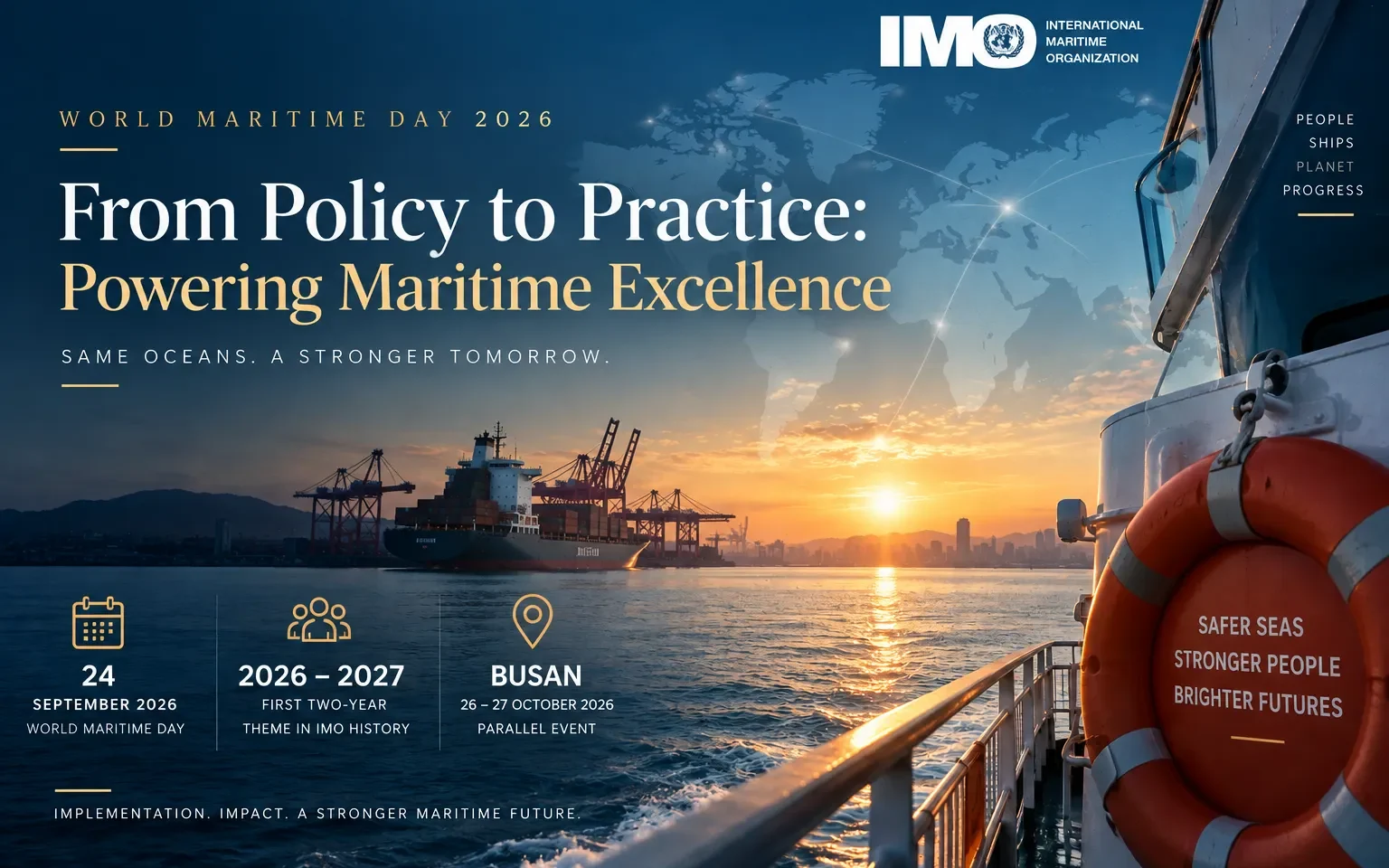
World Maritime Day 2026 takes place on Thursday, 24 September, with the International Maritime Organization putting implementation at the centre of this year’s global maritime agenda. The official theme, “From Policy to Practice: Powering Maritime Excellence”, asks a fundamental question for shipping: how do international rules become real safety, environmental and operational improvements onboard ships and across ports?
The World Maritime Day 2026 theme is not simply a one-day slogan. For the first time, IMO has adopted the same World Maritime Day theme for a two-year period covering 2026 and 2027, with a wider campaign focused on technical cooperation, enforcement, training and practical implementation.
The International Maritime Organization’s official World Maritime Day page states that the objective is to move maritime regulations from adoption in principle into national legislation, enforcement and everyday maritime operations.
World Maritime Day 2026 is on Thursday, 24 September 2026. The IMO theme is “From Policy to Practice: Powering Maritime Excellence.” The campaign runs across 2026–2027 and focuses on converting international maritime rules into effective implementation at sea, in ports and through national maritime administrations.
- When is World Maritime Day 2026?
- What is the 2026 theme?
- What “From Policy to Practice” means
- Why it matters to global shipping
- The nine IMO implementation pillars
- What implementation means onboard
- SOLAS and MARPOL in practice
- Port State Control and enforcement
- New fuels, cybersecurity and digitalization
- World Maritime Day Parallel Event 2026
- World Maritime Day 2026 FAQ
When Is World Maritime Day 2026?
World Maritime Day 2026 falls on Thursday, 24 September 2026. The IMO observes World Maritime Day globally on the final Thursday of September.
This year’s date is particularly significant because shipping is simultaneously dealing with changes in fuel technology, decarbonisation, digitalisation, cyber risk, seafarer training and increasingly complex regulatory requirements.
The IMO confirmed the 24 September celebration during its 137th Council session, along with details of the 2026 World Maritime Day Parallel Event.
What Is the World Maritime Day 2026 Theme?
The official World Maritime Day 2026–2027 theme is:
IMO selected the theme to focus attention on the point where international maritime regulation succeeds or fails: implementation.
The official IMO campaign page explains that the theme is designed around turning regulations into tangible results.
What Does “From Policy to Practice” Mean in Shipping?
International shipping has one of the most developed global regulatory systems of any industry. Conventions, codes and guidelines cover ship safety, pollution prevention, navigation, crew competence, maritime security and many other areas.
But adopting a convention is only one stage.
| Stage | Responsibility | What Implementation Looks Like |
|---|---|---|
| IMO | International standards | Conventions, codes, resolutions and guidelines |
| Member State | National implementation | Legislation, administration and enforcement |
| Flag State | Ship oversight | Survey, certification and compliance monitoring |
| Shipping Company | Company implementation | SMS procedures, maintenance, training and controls |
| Ship & Crew | Daily operation | Testing, drills, records, navigation and safe procedures |
| Port State Control | External verification | Inspection, deficiencies, corrective action and detention where applicable |
Why World Maritime Day 2026 Matters to Global Shipping
The IMO says that more than 50 international conventions shape everyday maritime activity. The Organization’s February 2026 campaign launch stressed that the benefit of those instruments depends on their effective application.
The official IMO campaign launch also highlights an important regulatory problem: audits under the IMO Member State Audit Scheme have identified gaps in national laws and enforcement in some countries.
That makes implementation much more than an administrative issue.
For shipowners, implementation can mean investment, procedures and maintenance. For flag States, it means oversight. For ports, it means infrastructure and enforcement. For maritime schools, it means training. And for seafarers, it means converting requirements into actions performed correctly every day.
The Nine IMO Priorities Behind the 2026–2027 Campaign
IMO’s campaign identifies nine areas where stronger implementation can translate international maritime policy into measurable results.
IMO aims to strengthen countries’ ability to apply international maritime requirements through legislative support, training and stronger enforcement frameworks.
Small Island Developing States and Least Developed Countries can face particular administrative and technical challenges, making targeted assistance an important part of implementation.
New fuels, automation and digital systems introduce new technical risks. Regulations therefore need to be supported by appropriate training, oversight and operational risk management.
The energy transition requires States and operators to translate climate policy into workable fuel, machinery, emissions-monitoring and operational systems.
For the European regulatory side, Tide Signal’s EU ETS Shipping 2026 guide and FuelEU Maritime guide explain how emissions regulation is already affecting compliance and commercial decisions.
The campaign calls for stronger due diligence, transparency, practical guidance and information sharing to reduce fraudulent registration and misuse of national flags.
Findings from the IMO Member State Audit Scheme can expose weaknesses in legislation, enforcement and oversight, giving States a basis for targeted reforms.
IMO specifically highlights Maritime Single Windows and the integration of digital systems into everyday port operations.
Cyber risk increasingly affects navigation, communications, machinery, cargo systems and port operations.
Tide Signal’s Maritime Cyber Security guide examines why cyber resilience is becoming part of shipboard operational readiness rather than simply an IT concern.
IMO also highlights practical implementation of environmental instruments dealing with plastics, invasive species, underwater radiated noise, ship recycling and other marine-environment issues beyond greenhouse-gas emissions.
The complete nine-pillar framework is set out in the IMO’s 2026 Policy to Practice campaign announcement.
What “Policy to Practice” Means Onboard a Ship
For seafarers, World Maritime Day 2026 has a very practical meaning.
International requirements eventually become familiar shipboard tasks:
- passage planning and bridge procedures;
- GMDSS testing and distress readiness;
- fire, abandon-ship and emergency drills;
- maintenance of life-saving appliances;
- bunkering procedures and pollution controls;
- cargo securing and stability checks;
- statutory record keeping;
- permit-to-work systems;
- crew familiarisation;
- safety-management procedures;
- cyber-risk controls;
- Port State Control preparation.
The IMO Secretary-General has emphasized that when the Organization talks about “practice”, it is ultimately talking about the people who make the maritime system function — including seafarers, port workers, ship operators, Port State Control officers and flag State administrators.
For the communications side of practical implementation, see Tide Signal’s GMDSS Explained: SOLAS Chapter IV.
For survival craft and emergency equipment, see SOLAS Chapter III: Lifeboats, Liferafts and Life-Saving Appliances.
SOLAS and MARPOL Show Why Implementation Matters
SOLAS: Ship Safety Beyond the Certificate
The International Convention for the Safety of Life at Sea is one of the clearest examples of the difference between written regulation and practical compliance.
SOLAS requirements reach across ship construction, fire protection, life-saving appliances, radio communications, navigation, cargoes and security.
But practical safety depends on whether systems actually function.
A fire door must close. A lifeboat must be maintained. GMDSS equipment needs to work. Passage planning has to be correct. Officers must know the procedures.
Read Tide Signal’s complete SOLAS Convention Explained reference guide.
MARPOL: Environmental Regulation in Daily Operations
The same implementation principle applies to MARPOL.
International pollution requirements become real through equipment, procedures, bunker documentation, record books, waste handling and emissions controls onboard individual ships.
Explore the full MARPOL Annexes I–VI Explained guide for the wider pollution-prevention framework.
Port State Control: Where Maritime Policy Meets Reality
Port State Control is one of the clearest real-world tests of the World Maritime Day 2026 theme.
Certificates establish a vessel’s formal compliance position, but inspectors can examine whether equipment, procedures, records and crew competence support that documentation.
| Area | International Framework | Practical Inspection Focus |
|---|---|---|
| Fire Safety | SOLAS | Equipment, alarms, fire doors, drills and familiarity |
| Life-Saving Appliances | SOLAS Chapter III | Lifeboats, liferafts, launching arrangements and drills |
| Radio Communications | SOLAS Chapter IV | GMDSS equipment, batteries, tests and records |
| Navigation | SOLAS Chapter V | Bridge equipment, passage planning and records |
| Pollution Prevention | MARPOL | Equipment, documentation and operational procedures |
| Safety Management | ISM Code | SMS effectiveness, maintenance and corrective action |
Tide Signal’s Port State Control Inspection: What Ships Must Prepare Before Arrival covers the practical preparation process in detail.
New Fuels, Digital Ships and Cyber Risk Raise the Implementation Challenge
The maritime regulatory environment is becoming more technically demanding.
Alternative Fuels
Methanol, ammonia, LNG, hydrogen, biofuels and future energy systems can introduce different safety, storage, bunkering and emergency-response requirements.
This makes crew competence and operational procedures as important as the regulation itself.
Digital Shipping
Digital reporting, Maritime Single Windows, connected bridge systems and increasingly automated ship functions are changing where regulatory implementation occurs.
Cybersecurity
Ships increasingly depend on connected navigation, communications and operational technology. A cyber requirement therefore needs to translate into functioning company procedures, crew awareness, system protection and recovery capability.
Read Tide Signal’s Maritime Cyber Security in 2026 and Maritime Cyber Risk and Digital Shipping for the wider operational-resilience context.
Why Is the World Maritime Day Theme Running for Two Years?
The 2026–2027 campaign is the first World Maritime Day theme to span two years.
The IMO Council endorsed the approach in July 2025, giving Member States and maritime stakeholders additional time to align training, technical cooperation, events and implementation work with the theme.
That changes the significance of World Maritime Day 2026.
Rather than ending on 24 September, the date effectively marks a major point in a broader 2026–2027 implementation campaign.
The original IMO announcement is available in IMO’s 2026–2027 World Maritime Day theme briefing.
World Maritime Day Parallel Event 2026: Busan
After World Maritime Day on 24 September, the international programme continues with the 2026 World Maritime Day Parallel Event.
The event will be held in Busan, Republic of Korea, on 26–27 October 2026.
IMO lists the Busan gathering on its official World Maritime Day 2026–2027 event page.
World Maritime Day 2026 and the IMO Blue-Light Campaign
IMO Headquarters in London will be illuminated in blue on World Maritime Day to promote the theme.
The Organization has also invited eligible Member States and maritime organizations to illuminate landmarks and support the campaign through events and outreach.
The official campaign hashtags are #WorldMaritimeDay and #MaritimePolicytoPractice.
World Maritime Day 2026 Is About Making the Rulebook Work
The message behind “From Policy to Practice: Powering Maritime Excellence” is straightforward: creating international standards is only the beginning.
SOLAS, MARPOL, training requirements, environmental regulation, cyber guidance and future fuel standards only achieve their purpose when administrations can enforce them, companies can implement them and crews can apply them safely in real operations.
World Maritime Day 2026 puts implementation — not simply regulation — at the centre of the maritime industry’s agenda.
World Maritime Day 2026 FAQ
When is World Maritime Day 2026?
World Maritime Day 2026 is Thursday, 24 September 2026. The IMO observes World Maritime Day on the final Thursday of September each year.
What is the World Maritime Day 2026 theme?
The official World Maritime Day 2026–2027 theme is “From Policy to Practice: Powering Maritime Excellence.”
What does “From Policy to Practice” mean?
It refers to moving international maritime rules beyond formal adoption and translating them into national legislation, enforcement, training and effective day-to-day maritime operations.
Who organizes World Maritime Day?
World Maritime Day is organized by the International Maritime Organization (IMO), the United Nations specialized agency responsible for the safety and security of shipping and the prevention of pollution from ships.
Why does the theme cover 2026 and 2027?
IMO adopted the same theme across two years to give Member States and maritime stakeholders more time to support implementation, technical cooperation, training and related activities.
Is this the first two-year World Maritime Day theme?
Yes. IMO states that the 2026–2027 campaign is the first World Maritime Day theme to run for two years.
Where will the World Maritime Day Parallel Event 2026 take place?
The World Maritime Day Parallel Event 2026 will be held in Busan, Republic of Korea, on 26–27 October 2026.
What does World Maritime Day 2026 mean for seafarers?
For seafarers, the theme focuses on practical competence and implementation. International requirements become real through training, maintenance, drills, navigation, communications, pollution prevention, documentation and safe daily shipboard operations.
What are the official World Maritime Day hashtags?
IMO encourages campaign activity using #WorldMaritimeDay and #MaritimePolicytoPractice.
Official Sources
- International Maritime Organization — World Maritime Day Theme 2026–2027
- IMO — Global “Policy to Practice” Campaign
- IMO — 2026–2027 World Maritime Day Theme Announcement
- IMO Council — World Maritime Day 2026 Date and Busan Parallel Event
Information checked against official IMO material on 23 September 2026.