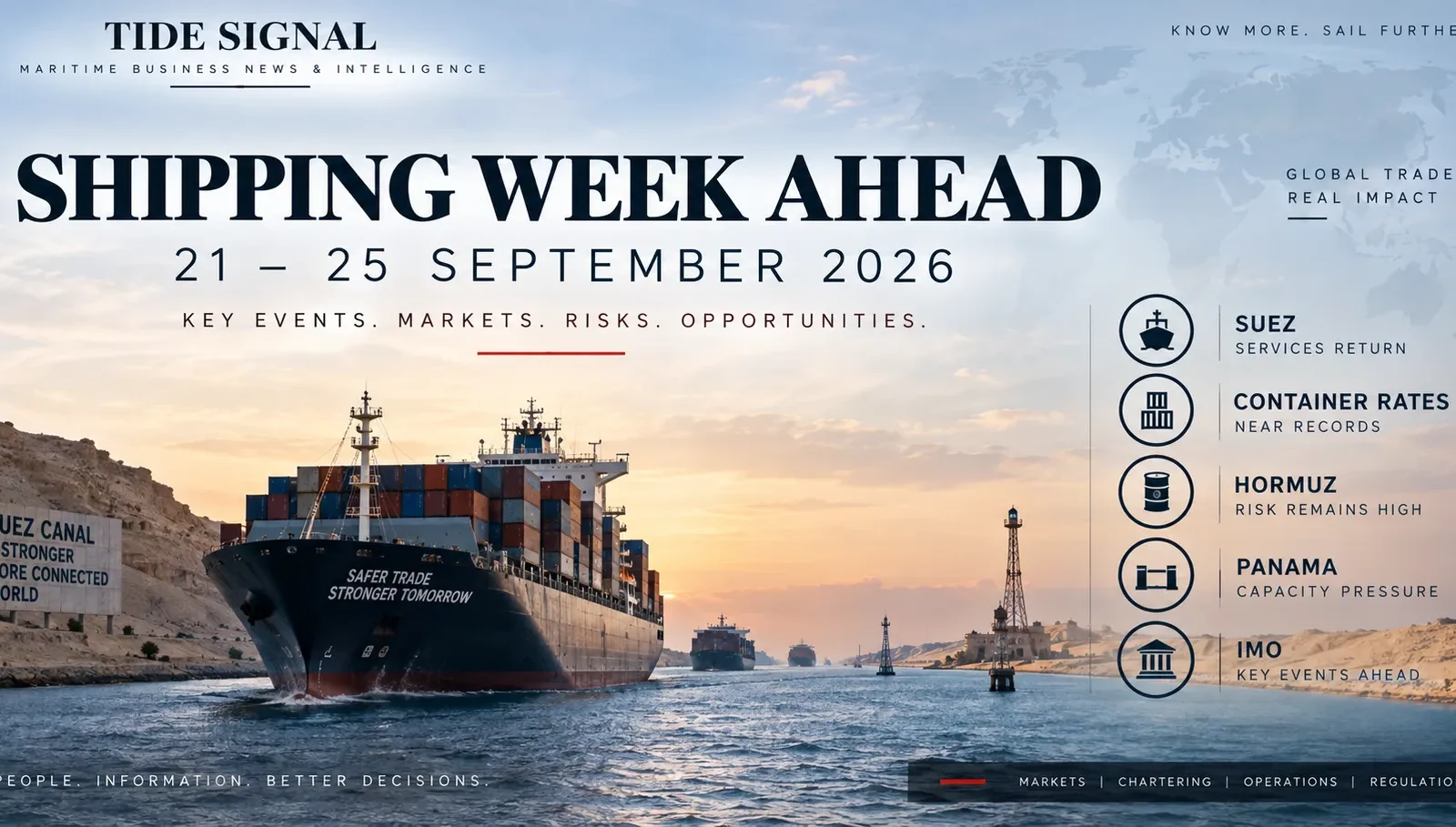
Shipping enters 21–25 September with the global network pulling in opposite directions. More Asia–Europe services are returning through Suez just as Transpacific container rates approach pandemic-era highs, Hormuz remains heavily disrupted, Panama Canal capacity is under pressure and IMO puts alternative-fuel preparedness and implementation at the centre of the maritime calendar.
Sunday, 20 September 2026 · Tide Signal Sunday Briefing · Shipping Week Ahead
Can shorter Suez routings release capacity quickly enough to cool container freight — or will security risk, Golden Week demand and chokepoint pressure keep shipping costs elevated?
This week is less about one isolated market and more about network interaction. The Suez Canal can release voyage time and effective containership capacity. The Panama Canal is being asked to absorb additional energy and container traffic while water constraints remain relevant. Hormuz continues to remove reliability from Gulf trades. At the same time, pre-Golden Week cargo demand is keeping container rates elevated and bunker costs remain a major part of the freight equation.
This briefing is forward-looking. It separates confirmed dates and current market data from the signals that owners, charterers, shippers and operators should monitor during the next five trading days.
Suez Return: Gemini’s AE5 Becomes the Next Test of the Red Sea Route
The most concrete network event this week happens on Monday. Maersk and Hapag-Lloyd have moved four additional Gemini Cooperation services — AE5, AE11, AE12 and ME2 — from the Cape of Good Hope to the trans-Suez route. They join AE15 and AE19, which had already returned to Suez.
According to Maersk’s published implementation schedule, the AE5 westbound change begins with Marchen Maersk from Tanjung Pelepas on 21 September. The first eastbound AE5 sailing under the new routing is scheduled from Algeciras on 22 September. The first AE12 sailing had not yet been announced when Maersk issued the advisory.
The carrier says the change should improve transit efficiency, but it also makes clear that future service decisions remain dependent on stability in the Red Sea and the wider Middle East.
Read the carrier notice: Maersk — Structural changes to AE5, AE11, AE12 and ME2.
Tide Signal has already examined that operational risk in Suez Canal Shipping Returns — Why Faster Asia–Europe Transits Could Trigger the Next Port Congestion Wave.
Container Rates: Can Shanghai–US East Coast Break the Pandemic-Era High?
Container freight enters the week with the Transpacific market under renewed pressure ahead of China’s Golden Week.
Xeneta’s market-average spot rate from the Far East to the US East Coast reached $11,259 per FEU on 17 September. That was 11.2% below the platform’s pandemic-era high of $12,683. Far East–US West Coast stood at $7,960 per FEU, 17.9% below its own historical peak.
Drewry’s World Container Index tells the same directional story using a different methodology. Its global composite rose 1% to $4,500 per 40ft container on 17 September. Shanghai–New York increased 7% to $10,394, while Shanghai–Los Angeles rose 5% to $7,712.
The next-week detail matters. Drewry says carriers have announced nine blank sailings for the coming week, up from eight in the current week, and expects rates to rise slightly as pre-Golden Week demand meets active capacity management.
See the latest benchmark data from Drewry’s World Container Index and Xeneta’s 18 September market update.
| Route / index | Latest cited level | What matters this week |
|---|---|---|
| Far East → US East Coast | $11,259/FEU — Xeneta | How close the market gets to its platform-specific pandemic high |
| Shanghai → New York | $10,394/40ft — Drewry | Pre-Golden Week demand and blank-sailing discipline |
| Shanghai → Los Angeles | $7,712/40ft — Drewry | Whether Transpacific strength broadens or stays concentrated |
| Drewry WCI | $4,500/40ft | Whether global composite follows the US trade higher |
The important tension is that Suez returns can release effective capacity on Asia–Europe while carriers are simultaneously tightening Transpacific capacity ahead of Golden Week. That means one global “container rate” number can hide very different regional conditions.
Tide Signal tracks the wider market on its Container Shipping Rates hub.
Hormuz: Traffic Remains Far Below Normal as Tanker Risk Stays Elevated
The Strait of Hormuz remains the most serious physical shipping-risk variable entering the week.
Reuters reported that only four commodity vessels transited the strait on Thursday, down from six the previous day and far below a 10-day average of 16, based on preliminary Kpler data. Three LNG vessels also reappeared outside the strait after several days, indicating some movement around the Gulf export system even as normal traffic remains heavily constrained.
The numbers have to be interpreted carefully because some ships may transit with AIS turned off or otherwise avoid normal tracking. But the scale of the reduction still shows how far the route remains from ordinary commercial conditions.
The latest Reuters report is available here: Hormuz traffic remains below the 10-day average.
That matters beyond crude. Hormuz affects LNG, LPG, refined products, dry-bulk cargoes and container supply chains connected with Gulf ports. The commercial question is increasingly not simply whether a transit is physically possible, but whether the full voyage remains insurable, crewable and economically acceptable.
Follow Tide Signal’s live Strait of Hormuz operating-status hub, plus War Risk Premiums in Shipping and Worldscale in Shipping for the freight mechanics behind the risk premium.
Panama Canal: A $5 Million Slot Shows How One Chokepoint Can Stress Another
The Panama Canal enters the week as a second-order consequence of disruption elsewhere. Energy cargoes that would normally use other routes are competing for canal capacity at the same time as the container peak season increases demand for predictable passage.
Reuters reported that an LPG carrier recently paid more than $5 million for a Panama Canal reservation slot. The significance is not the single auction price by itself. It is what the bid says about the value of schedule certainty when alternative routes are already under pressure.
The analysis also noted that canal traffic has been elevated while water availability remains an operational constraint. That combination raises the possibility that a disruption originating in the Middle East can transfer cost into a completely different trade lane.
Read the Reuters analysis: Panama Canal stress shows the real shipping squeeze may still be ahead.
Tide Signal’s dedicated Panama Canal Restrictions 2026 page tracks booking capacity, drought risk, transit availability and the operational consequences for owners and charterers.
IMO Week: Alternative-Fuel Spill Response and World Maritime Day Move to the Foreground
The regulatory side of the week is unusually concentrated around implementation rather than headline rulemaking.
On 21–22 September, IMO holds a Research and Development Forum in Singapore focused on marine pollution preparedness for alternative fuels. The agenda covers response challenges associated with LNG, LPG, methanol, ammonia, hydrogen and bio/e-fuels.
The issue is operationally important because alternative fuels do not create one generic spill scenario. A fuel can introduce flammability, toxicity, cryogenic, dispersion or environmental-response problems that require different detection, PPE, containment and emergency techniques.
The official event page is IMO Research and Development Forum: Marine pollution preparedness for alternative fuels.
Thursday: World Maritime Day 2026
On 24 September, the sector marks World Maritime Day. The IMO theme for 2026–2027 is “From Policy to Practice: Powering Maritime Excellence.” The focus is implementation — turning conventions, codes and agreed standards into real national enforcement, training, technical capability and day-to-day ship operations.
See the official World Maritime Day 2026–2027 theme page.
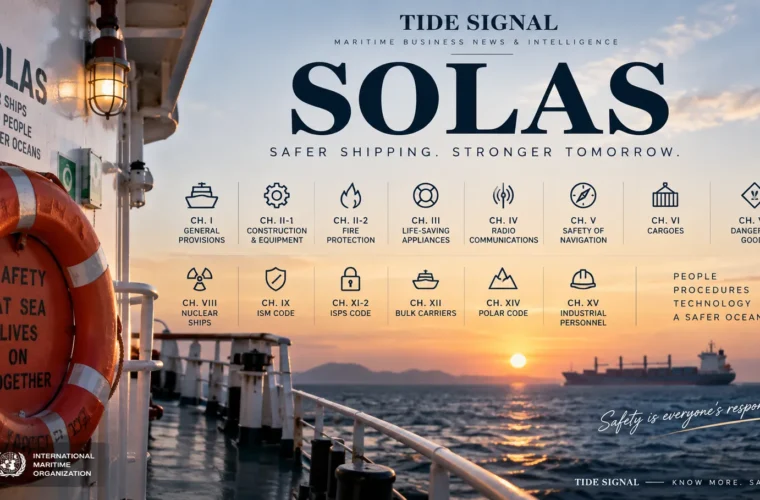
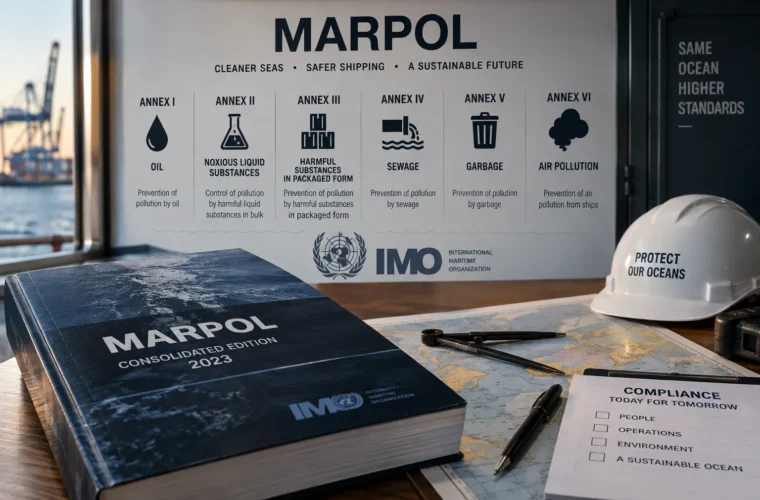
That theme is particularly relevant after a week in which Tide Signal expanded its own regulatory reference library with MARPOL Annexes Explained, SOLAS Convention Explained and SOLAS Chapter II-2 Fire Safety.
The Week Ahead: Key Dates for Shipping
| Date | Event | Shipping relevance |
|---|---|---|
| Mon 21 Sep | AE5 first westbound sailing under latest Gemini Suez change | Tests the pace of the Asia–Europe return to the Suez/Red Sea corridor |
| 21–22 Sep | IMO R&D Forum, Singapore | Alternative-fuel spill response, pollution preparedness and practical safety capability |
| Tue 22 Sep | AE5 first eastbound sailing under latest Suez change | Further evidence of network restructuring away from Cape routing |
| Wed 23 Sep | US EIA Weekly Petroleum Status Report | Crude, gasoline and distillate stocks can affect oil-product pricing and tanker-market sentiment |
| Wed 23 Sep | Flash manufacturing and services PMIs | Fresh read on industrial and trade demand across major economies |
| Thu 24 Sep | World Maritime Day | IMO focuses on implementation under “From Policy to Practice: Powering Maritime Excellence” |
| Fri 25 Sep | US durable-goods data | Another demand signal for manufacturing, investment and trade-sensitive markets |
The US Energy Information Administration confirms its next Weekly Petroleum Status Report is scheduled for 23 September. The week’s US economic calendar also includes flash PMIs on Wednesday and durable-goods orders on Friday.
What Would Change the Market Most?
| Signal | Tightening / disruptive signal | Stabilising / easing signal |
|---|---|---|
| Suez / Red Sea | Service reversals, security escalation, insurance restrictions | AE5 and other services execute as scheduled without disruption |
| Container rates | Further blank sailings, fuel surcharges, Golden Week rush | Added capacity begins to cap Transpacific spot increases |
| Hormuz | Further attacks, lower tracked traffic, smaller willing tanker list | More consistent vessel movement and easier insurance availability |
| Panama | Higher slot premiums, tighter transit availability | More predictable booking capacity and lower auction pressure |
| Alternative fuels | Large unresolved spill-response or training gaps | Clearer practical response standards and implementation tools |
Tide Signal view: the defining feature of 21–25 September is that shipping is simultaneously shortening and lengthening routes.
Container carriers are cutting Asia–Europe voyage distance by moving more services back through Suez. At the same time, Middle East security disruption is pushing other cargoes toward longer or more expensive alternatives and increasing pressure on routes such as Panama. The freight market will therefore be determined less by nominal fleet size than by where ships are willing and able to trade, how long each voyage takes and how much capacity carriers choose to expose to the market before Golden Week.
That makes this a week to watch execution rather than announcements: do the Suez sailings actually run, do container rates push closer to historical highs, does Hormuz traffic recover, and does chokepoint stress continue migrating from one region to another?
- Maersk — Structural changes to AE5, AE11, AE12 and ME2 Gemini services
- Reuters — Maersk and Hapag-Lloyd add more Suez services
- Drewry — World Container Index, 17 September 2026
- Xeneta — Weekly Ocean Container Shipping Market Update, 18 September
- Reuters — Hormuz traffic remains below 10-day average
- Reuters — Panama Canal stress and global shipping squeeze
- IMO — R&D Forum on alternative-fuel pollution preparedness
- IMO — World Maritime Day 2026–2027 theme
- US EIA — Weekly Petroleum Status Report
Editorial note: Shipping Week Ahead is Tide Signal’s Sunday forward-looking briefing. Confirmed dates and published market data are distinguished from Tide Signal analysis. Security conditions, carrier schedules, freight assessments and regulatory developments can change after publication.