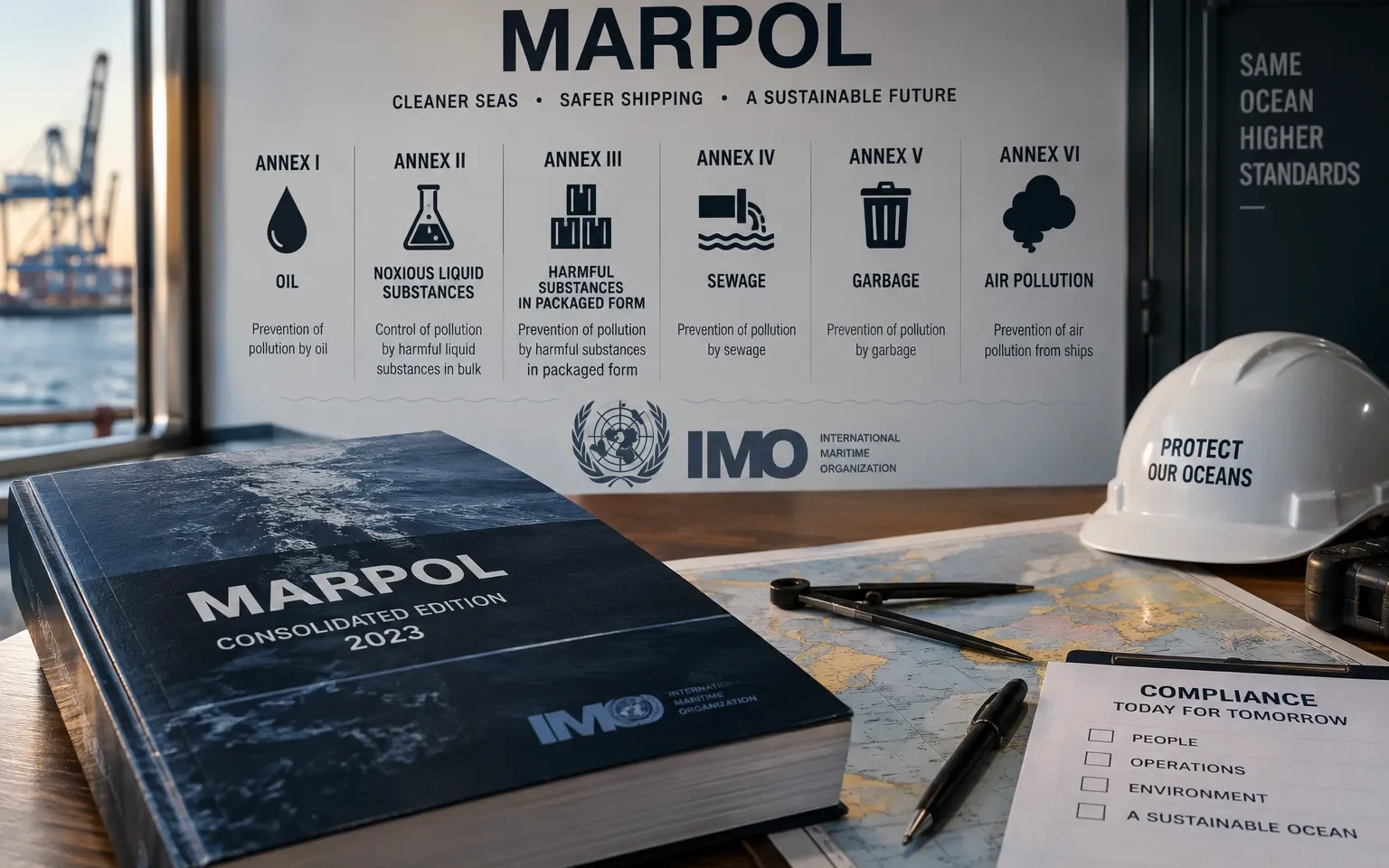
The MARPOL annexes form the core international framework for preventing pollution from ships. They cover oil, noxious liquid substances, harmful packaged goods, sewage, garbage and air pollution — and they affect everything from engine-room bilge handling and tanker cargo residues to garbage segregation, sewage discharge, bunker sulphur, NOx emissions, CII and Port State Control.
Tide Signal Academy · MARPOL & Environmental Compliance · Updated 20 September 2026
MARPOL is the main international convention for preventing pollution of the marine environment by ships from operational and accidental causes, implemented through six technical annexes covering different pollution sources.
What Is MARPOL?
MARPOL is the common name for the International Convention for the Prevention of Pollution from Ships. The original Convention was adopted in 1973, the 1978 Protocol was adopted after a series of tanker accidents, and the combined instrument entered into force in 1983. A 1997 Protocol later added Annex VI on air pollution.
The Convention is maintained by the International Maritime Organization and has been amended repeatedly as ship technology, environmental policy and operational practice have evolved. The official IMO overview describes MARPOL as the principal international convention covering prevention of pollution of the marine environment by ships from both operational and accidental causes.
For the current official framework, see the IMO MARPOL Convention overview.
The most important structural point is that MARPOL is not one single pollution rule. It is a convention containing six technical annexes, each focused on a different pollution source. That means the correct question onboard is not simply “Are we MARPOL compliant?” but rather which Annex governs the operation being performed and what equipment, procedures, records and discharge conditions apply.
↓
What pollution source is involved?
↓
Which MARPOL Annex applies?
↓
What equipment, procedure, record, certificate and discharge rule apply?
This is why MARPOL touches almost every department onboard. Deck officers may deal with cargo residues, garbage, sewage and tanker cargo operations. Engineers manage oily bilge, sludge, bunkers, fuel sulphur, incinerators and emissions equipment. The master and senior officers are responsible for ensuring that approved procedures, certificates and records match what the ship actually does.
The Six MARPOL Annexes: Quick Reference Table
| Annex | Main pollution source | Typical shipboard examples | Key compliance evidence |
|---|---|---|---|
| Annex I | Oil | Engine-room bilge, sludge, tanker cargo residues, oily mixtures | IOPP, Oil Record Book, SOPEP/SMPEP, approved oily-water equipment |
| Annex II | Noxious liquid substances in bulk | Chemical cargo residues, tank washing, prewash, stripping | NLS Certificate, P&A Manual, Cargo Record Book, product carriage requirements |
| Annex III | Harmful substances in packaged form | Packaged marine pollutants, containers, portable tanks | IMDG-compliant marks, labels, documentation, stowage and segregation |
| Annex IV | Sewage | Blackwater, sewage treatment, holding tanks | ISPP Certificate where applicable, approved treatment/discharge arrangements |
| Annex V | Garbage | Plastics, food waste, domestic waste, cargo residues, cooking oil, incinerator ash | Placards, Garbage Management Plan, Garbage Record Book where applicable |
| Annex VI | Air pollution and energy efficiency | Fuel sulphur, NOx, ODS, incineration, fuel quality, EEXI, CII | IAPP, IEE, EIAPP as applicable, BDNs, fuel samples, SEEMP, emissions records |
The table is deliberately simplified. Each Annex contains definitions, exceptions, ship-size thresholds, area-specific controls, certification requirements and technical standards. The value of a strong MARPOL reference is not only remembering “I equals oil” or “V equals garbage”; it is understanding how the Annex becomes a real shipboard procedure.
MARPOL Annex I is usually the first Annex seafarers encounter because it applies far beyond oil tankers. It regulates pollution by oil from operational sources as well as accidental discharges. IMO highlights both tanker construction measures and operational controls, including the familiar 15 ppm standard for oily machinery-space discharges through approved oil-filtering equipment.
The official background is available from the IMO MARPOL Annex I oil-pollution page.
What does Annex I cover?
- machinery-space bilge water containing oil;
- sludge and oily residues;
- fuel-oil and lubricating-oil transfers;
- oily-water separation and monitoring;
- oil tanker cargo tank washing and ballast operations;
- oil discharge monitoring and control systems on tankers;
- segregated ballast and tanker construction requirements;
- oil pollution emergency planning;
- Oil Record Book entries;
- shore reception of oily residues.
The 15 ppm rule
One of the best-known MARPOL requirements concerns machinery-space oily bilge water. Approved oil-filtering equipment must be capable of producing an effluent with an oil content not exceeding the applicable 15 parts per million standard when discharge is permitted under the Annex.
That number does not create a general right to pump anything oily overboard. The system has to be approved, operated correctly and used only under the conditions permitted by Annex I. Bypassing equipment, manipulating alarms or making records that do not reflect the real operation creates serious regulatory exposure.
Oil Record Book
The Oil Record Book is a central piece of Annex I evidence. Machinery-space operations are recorded in Part I, while oil tankers use Part II for cargo and ballast operations as applicable.
The value of the record book is not simply that entries exist. An inspector can compare the ORB with tank soundings, sludge quantities, incinerator use, bunker records, bilge-system configuration, voyage history and shore-disposal receipts. The documentary chain should make operational sense from one page to the next.
IMO work in 2026 continued to focus on clearer and more consistent Oil Record Book guidance. That is useful context for operators: recordkeeping remains an active enforcement issue, not an old administrative formality.
SOPEP and emergency response
Ships in the relevant Annex I categories must carry an approved Shipboard Oil Pollution Emergency Plan (SOPEP). For oil tankers of 150 gross tonnage and above and other ships of 400 gross tonnage and above, Annex I requires such an emergency plan.
The plan provides a structured response to an oil-pollution incident: reporting, contact information, immediate actions to control a discharge, coordination with authorities and ship-specific information. A plan that exists but is unfamiliar to the senior officers is a weak control.
IOPP Certificate
The International Oil Pollution Prevention Certificate forms part of Annex I survey and certification for ships in scope. The important operational point is that the certificate and its supplement describe approved arrangements. Physical modifications to piping, tanks, filtering equipment or pollution-prevention systems should therefore be controlled through the appropriate technical and statutory process rather than treated as ordinary shipboard alterations.
Annex I and tanker operations
For tankers, Annex I reaches into cargo operations, tank washing, ballast arrangements and ship construction. MARPOL progressively introduced segregated ballast and double-hull requirements that fundamentally changed tanker design and reduced the consequences of accidental oil releases.
For practical tanker-transfer context, see Tide Signal’s Ship-to-Ship Transfer in Shipping guide, which explains STS planning, fendering, mooring, hoses, cargo control and the MARPOL framework around oil transfers.
A bulk carrier accumulates oily bilge water in the engine room. The chief engineer cannot treat “it is only bilge water” as the end of the analysis. If the mixture contains oil, Annex I controls how it may be retained, treated, transferred ashore or discharged through approved equipment. The operation must also be recorded correctly in the Oil Record Book.
MARPOL Annex II applies to noxious liquid substances carried in bulk. It is therefore particularly important for chemical tankers and other ships certified to carry such cargoes.
The core idea is that not all chemicals create the same environmental hazard. Annex II uses a pollution-category system that determines how strictly residues, tank washings and discharge operations must be controlled. The IMO’s current chemical pollution guidance describes four categories.
Categories X, Y, Z and Other Substances
| Category | Environmental meaning | Operational effect |
|---|---|---|
| X | Major hazard to marine resources or human health | Discharge to the marine environment is prohibited; strict residue handling and prewash requirements apply. |
| Y | Hazard to marine resources/human health or legitimate uses of the sea | Discharge is limited in quality and quantity and subject to detailed conditions. |
| Z | Minor hazard | Less stringent restrictions than X or Y, but Annex II controls still apply. |
| OS | Evaluated as presenting no harm under Annex II criteria | Not subject to the Annex II discharge requirements that apply to X/Y/Z residues. |
For modern ships constructed on or after 1 January 2007, IMO notes a maximum permitted residue quantity of 75 litres in a tank and associated piping after discharge for products in Categories X, Y and Z, reflecting improved stripping performance.
The P&A Manual
Every ship certified to carry noxious liquid substances in bulk must have an approved Procedures and Arrangements Manual. The P&A Manual translates Annex II into ship-specific operating procedures.
- cargo-system arrangements;
- stripping performance;
- tank washing;
- prewash requirements;
- residue disposal;
- underwater discharge arrangements where permitted;
- ventilation procedures where applicable;
- entries to be made in the Cargo Record Book.
The P&A Manual is therefore not a generic chemical-tanker textbook. It is part of the vessel’s approved compliance arrangement and should be used as such.
Cargo Record Book
Ships carrying noxious liquid substances in bulk must maintain a Cargo Record Book. It records cargo and residue operations required under Annex II. As with the Oil Record Book, the record should describe what genuinely occurred and should be consistent with the cargo sequence, tank-cleaning records and port reception documentation.
Prewash and reception facilities
For certain cargoes and circumstances, residues cannot simply be dealt with through a normal sea discharge after unloading. A mandatory prewash may be required, with the resulting washings delivered to a reception facility before the ship leaves the unloading port. The exact requirement depends on the product category, cargo properties and Annex II provisions.
This is a good example of why chemical-tanker compliance cannot be reduced to memorising X, Y and Z. The operator has to connect the product classification to the ship’s stripping efficiency, unloading procedure, prewash status, reception facility and Cargo Record Book.
Emergency plan for NLS
Annex II also requires an approved shipboard marine pollution emergency plan for noxious liquid substances for relevant ships of 150 gross tonnage and above. On ships carrying both oil and NLS, the required emergency planning may be combined into an integrated SMPEP.
MARPOL Annex III deals with harmful substances carried by sea in packaged form. This makes it very different from Annex II, which is focused on noxious liquid substances carried in bulk.
Under Annex III, harmful substances are principally those identified as marine pollutants in the International Maritime Dangerous Goods Code, or substances meeting the Annex III criteria. The Annex establishes general requirements for packing, marking, labelling, documentation, stowage, quantity limitations, exceptions and notifications.
The operational detail is closely connected with the IMDG Code. IMO explains that SOLAS chapter VII and MARPOL Annex III both interface with the IMDG Code: SOLAS addresses safety of dangerous-goods carriage, while Annex III addresses prevention of pollution by harmful packaged substances.
Annex II vs Annex III
| Question | Annex II | Annex III |
|---|---|---|
| How is the substance carried? | Liquid in bulk | Packaged form |
| Typical ship | Chemical tanker | Containership, general cargo, ro-ro or any ship carrying packaged dangerous goods |
| Main operational concern | Residues, stripping, tank washing, discharge | Packaging, marking, documentation, stowage, loss/damage prevention |
| Main linked code | IBC Code | IMDG Code |
What matters onboard?
The ship needs to know what is actually loaded, where it is stowed and whether the cargo documentation correctly identifies marine-pollutant status. Damaged packaging, leaking containers, incorrect marks or poor stowage can transform a documentary error into a pollution incident.
Annex III therefore connects cargo documentation directly with environmental protection. A package can be legally significant not only because its contents are dangerous to the ship or crew, but because the substance is harmful to the marine environment if lost overboard.
Why Annex III is easy to overlook
Annex III often receives less day-to-day attention than Annex I, V or VI because it does not revolve around a familiar engine-room plant or a universal record book. But that makes correct cargo information even more important. The ship may depend heavily on declarations, container markings and documentation prepared before the cargo reaches the vessel.
For operators, this creates a chain-of-custody mindset: cargo acceptance, dangerous-goods documentation, stowage position, segregation, deck inspections and emergency response all contribute to keeping a packaged marine pollutant out of the sea.
A container contains drums of a substance classified as a marine pollutant under the IMDG Code. The MARPOL issue is not a routine controlled discharge at sea. The compliance chain is correct classification, packing, marks and labels, documentation, stowage, handling and preventing loss into the marine environment.
MARPOL Annex IV controls pollution from ship sewage. The revised Annex applies to ships engaged in international voyages of 400 gross tonnage and above or ships certified to carry more than 15 persons. Ships in scope must have an approved sewage-treatment arrangement, an approved comminuting and disinfecting system, or a sewage holding tank as applicable.
The official rules and current IMO background are explained on the IMO sewage pollution page.
The 3 nm and 12 nm rules
The distances most seafarers remember are three and twelve nautical miles, but the complete requirement is more specific.
- Approved sewage treatment plant: discharge may be permitted when the approved plant is in operation and the applicable effluent requirements are met.
- Comminuted and disinfected sewage: discharge using an approved system may be permitted more than 3 nautical miles from the nearest land.
- Sewage not comminuted or disinfected: discharge may be permitted more than 12 nautical miles from the nearest land when the ship is en route, proceeding at not less than 4 knots and the discharge rate is approved by the Administration.
These are MARPOL baseline rules. Ships must also check local coastal-State and port restrictions, which can be stricter than the international minimum.
Annex IV Special Area
The Baltic Sea is designated as a Special Area under Annex IV, with stricter requirements for sewage discharges from passenger ships. The IMO Special Areas list should be checked for the exact application dates and reception-facility conditions.
Sewage treatment plant does not mean “anything can go overboard”
An approved treatment plant must be operated within its design and certification conditions. Chemical dosing, aeration, membrane condition, biological process health, alarms and maintenance can all affect performance. Crew should not assume that a running motor or green lamp is proof that the discharge is compliant.
The correct approach is to understand the approved system, its limitations, sampling or performance checks required by company/flag arrangements, and any local port prohibition.
Blackwater vs greywater
A common operational mistake is to assume that every wastewater stream is automatically identical under MARPOL. Annex IV defines sewage in a specific way. Greywater can be regulated through other international, national, port, class or company requirements depending on the vessel and area.
The safest approach is to map each wastewater stream to the ship’s approved system and the applicable rule rather than relying on informal labels.
A vessel with untreated sewage in a holding tank cannot simply begin pumping when GPS shows 12.1 miles from land. The ship must confirm that the Annex IV conditions are met, including being en route, required speed and approved discharge-rate arrangements, and must also verify that no stricter local prohibition applies.
MARPOL Annex V has one of the broadest applications of the MARPOL annexes. IMO states that, unless expressly provided otherwise, Annex V applies to all ships, including merchant ships, fixed and floating platforms and non-commercial vessels.
The basic principle is straightforward: discharge of garbage into the sea is generally prohibited unless the Annex specifically permits it.
The current official overview is available from IMO — Prevention of Pollution by Garbage from Ships.
Plastics: complete prohibition
The best-known Annex V rule is the prohibition on discharge of plastics into the sea. This includes plastic garbage and fishing gear, subject only to the narrow emergency/accidental-loss exceptions defined by the Annex.
A plastic bottle does not become legal to discharge because the ship is far from land. Distance does not override the plastics prohibition.
What counts as garbage?
- food waste;
- domestic waste;
- operational waste;
- plastics;
- cargo residues;
- incinerator ashes;
- cooking oil;
- fishing gear;
- animal carcasses generated during normal ship operations.
Different categories have different disposal rules. Food waste, non-HME cargo residues, cleaning agents/additives and animal carcasses can be subject to specific conditional provisions. The correct answer depends on whether the ship is inside or outside a Special Area, distance from land, whether the ship is en route, whether food waste has been comminuted and whether cargo residues are harmful to the marine environment.
Garbage Management Plan
All ships of 100 gross tonnage and above, ships certified to carry 15 persons or more, and fixed or floating platforms must carry a Garbage Management Plan under the current regime. The plan sets procedures for minimisation, collection, storage, processing and disposal and identifies the person responsible for implementing it.
Garbage Record Book: important 100 GT threshold
A particularly important modern change is the extension of the Garbage Record Book requirement to ships of 100 GT and above within the applicable scope. Older training material may still refer to the previous 400-GT threshold. The IMO confirms that the 100-GT requirement is now in force.
The Garbage Record Book records disposal to reception facilities, permitted discharges, incineration and accidental or exceptional losses as applicable. IMO states that the record book must be retained for two years after the last entry.
Placards
Ships of 12 metres or more in length overall and fixed or floating platforms are required to display placards notifying crew and passengers of the garbage-discharge requirements. Language requirements depend on the ship’s operation.
Cargo residues and HME
Annex V also affects dry-bulk operations. Solid bulk cargo residues must be classified with respect to whether they are harmful to the marine environment (HME). HME cargo residues cannot simply be washed overboard and must be managed in accordance with the Annex and applicable reception-facility requirements.
This is one reason environmental compliance and dry-bulk cargo documentation intersect. A shipper’s cargo declaration can determine how hold-cleaning residues and wash water must be managed after discharge.
Why garbage records are commercially important
Waste handling can become a port-delay issue when the ship arrives with full storage, inadequate segregation, unclear receipts or a local reception facility that requires advance booking. Good Annex V management therefore has a commercial dimension: the ship needs storage capacity, shore arrangements and clear records, not only knowledge of what can be discharged at sea.
A bulk carrier finishes discharging a dry cargo and plans to wash the holds at sea. Before wash water is discharged, the vessel must know whether the cargo residues are HME, whether the ship is in a Special Area, what the Annex permits for that residue and whether any cleaning agent is itself harmful to the marine environment.
MARPOL Annex VI is the newest of the six MARPOL annexes and one of the fastest-changing areas of ship regulation. It entered into force in 2005 and controls air pollution from ships.
- sulphur oxides (SOx);
- nitrogen oxides (NOx);
- particulate matter;
- ozone-depleting substances;
- volatile organic compounds in defined circumstances;
- shipboard incineration;
- fuel-oil quality and documentation;
- energy-efficiency requirements;
- EEDI, EEXI, SEEMP and CII-related measures.
Fuel sulphur: 0.50% globally, 0.10% in SOx ECAs
Since 1 January 2020, the global sulphur limit for fuel oil used onboard ships is 0.50% m/m outside designated SOx Emission Control Areas. Inside applicable SOx ECAs the limit is 0.10% m/m, unless the ship uses an approved equivalent means of compliance.
The official IMO explanation is available at IMO 2020 — sulphur emissions.
For practical fuel receipt, sampling, BDN review and quantity control, use Tide Signal’s Bunkering Operations guide alongside this MARPOL overview.
Bunker Delivery Note and fuel samples
MARPOL Annex VI requires the fuel-supply chain to be documented. The Bunker Delivery Note contains required information about the fuel supplied, while the representative MARPOL sample supports regulatory verification.
The BDN should not be treated as a supplier invoice that receives an automatic signature. It forms part of the statutory evidence that the delivered fuel corresponds to the regulatory declarations. Onboard controls should connect the BDN, sample seals, tank plan, delivery timing and the vessel actually receiving the fuel.
Tide Signal’s bunkering guide explains current BDN retention, sampling and the shipboard transfer sequence in detail. This matters because an Annex VI inspection can compare the ship’s fuel, BDNs, sample seals, fuel-changeover records and the voyage actually performed.
NOx tiers
Annex VI controls nitrogen oxide emissions from marine diesel engines through NOx Tier standards. The applicable Tier depends on engine/ship construction dates and the area of operation. Tier III requirements apply to qualifying engines when operating in designated NOx ECAs.
This creates an important difference from the sulphur rule. A 0.10% SOx-ECA fuel requirement can apply operationally to an existing ship entering an area, while NOx Tier III applicability is tied to qualifying engines and defined construction-date criteria.
Emission Control Areas
Annex VI ECAs impose stricter emission standards for specified pollutants. The ECA network has expanded significantly. The Mediterranean became an SOx ECA in 2025, and the Canadian Arctic and Norwegian Sea designations entered into force in March 2026, with pollutant-specific application rules and dates that operators should verify from the current IMO list.
A further major change is the North-East Atlantic ECA. For the exact 2027–2028 implementation timeline, Tier III construction tests, boundary issues and fuel-changeover planning, see Tide Signal’s North-East Atlantic ECA guide.
EEXI, CII and SEEMP
Annex VI is no longer only an air-pollutant rulebook. It is also the legal home of major IMO energy-efficiency and operational carbon-intensity requirements.
From 2023, ships in scope became subject to the Energy Efficiency Existing Ship Index (EEXI), while ships of 5,000 gross tonnage and above in the relevant categories calculate annual operational CII and receive a rating. The IMO review of the short-term measure continues through a second phase running from 2026 to 2028.
See the official IMO EEXI and CII guidance and Tide Signal’s CII in Shipping for the operational and commercial side of carbon-intensity performance.
Ozone-depleting substances and incineration
Annex VI also controls deliberate emissions of ozone-depleting substances and places restrictions around shipboard incineration. Ships with relevant rechargeable systems may need an Ozone-Depleting Substances Record Book, while installed incinerators must meet applicable approval and operating requirements.
These subjects receive less commercial attention than sulphur or CII, but they are still statutory items that can appear during survey or Port State Control.
Alternative fuels still sit inside Annex VI compliance
A vessel that burns LNG, methanol, ammonia or another alternative fuel does not leave the MARPOL system. The exact emissions, fuel-quality, NOx, GHG and technical requirements can differ, and additional codes or interim guidelines may apply.
For ammonia specifically, Tide Signal’s Ammonia as Marine Fuel guide covers current safety, engine, bunkering and IMO work.
Annex VI is where traditional environmental compliance and ship economics increasingly meet. Fuel choice affects sulphur compliance, NOx strategy, bunker cost, machinery performance, EEXI, CII and eventually the commercial attractiveness of the vessel. Environmental regulation is therefore no longer a separate “compliance department” issue; it is part of voyage, technical and asset strategy.
MARPOL Special Areas vs Emission Control Areas: Do Not Confuse Them
One of the most persistent MARPOL misunderstandings is the use of “Special Area” and “ECA” as if they mean the same thing. They do not.
| Term | Where used | What it controls | Example |
|---|---|---|---|
| Special Area | Annexes I, II, IV and V | More stringent pollution/discharge controls due to environmental or traffic conditions | Antarctic area under Annex II; Baltic under Annex IV; multiple garbage Special Areas under Annex V |
| Emission Control Area (ECA) | Annex VI | More stringent SOx, particulate-matter and/or NOx emission controls | North Sea, Baltic, Mediterranean SOx ECA, North American ECA |
| Particularly Sensitive Sea Area (PSSA) | Separate IMO protective designation | Area-specific protective measures against shipping risk | May involve routeing or other IMO-adopted protective measures |
The authoritative list of current designations and implementation dates is maintained by IMO on its MARPOL Special Areas page.
This distinction matters operationally. A ship may be inside an Annex V garbage Special Area without being inside an Annex VI ECA, or inside an ECA where stricter air-emission limits apply while a completely different set of discharge rules is relevant to garbage or sewage.
Why the legal date matters
Designation, entry into force and the date on which stricter measures actually take effect can be different dates. This is especially important for newly created ECAs and Special Areas whose stricter rules depend on reception-facility readiness or defined transitional periods.
Operators should therefore avoid using a simple map and the words “new ECA” as the whole compliance instruction. A proper voyage instruction needs the exact boundary, pollutant covered, applicability date, ship/engine criteria and the action required before entry.
Which MARPOL Annex Applies? Practical Decision Table
| Shipboard situation | Main MARPOL Annex | First compliance question |
|---|---|---|
| Engine-room oily bilge | Annex I | Can it be retained, landed ashore or processed/discharged under approved Annex I arrangements? |
| Sludge disposal | Annex I | Where did the sludge go and is the ORB trail complete? |
| Crude/product tanker cargo residues | Annex I | What tanker discharge/tank-cleaning rule applies? |
| Bulk chemical residue | Annex II | Is the product X, Y, Z or OS and what does the P&A Manual require? |
| Marine pollutant in drums/containers | Annex III | Is packaging, marking, documentation and stowage IMDG compliant? |
| Untreated sewage | Annex IV | What treatment status, distance, speed and local rules apply? |
| Plastic garbage | Annex V | Do not discharge to sea. |
| Food waste | Annex V | Are distance, processing, en-route and Special Area conditions met? |
| Dry-bulk cargo residues / hold wash water | Annex V | Is the cargo HME and is discharge permitted in the current area? |
| Bunker sulphur content | Annex VI | Is the ship inside or outside an applicable SOx ECA and what compliance method is used? |
| NOx Tier III requirement | Annex VI | Does the engine/ship construction test and operating area trigger Tier III? |
| CII / EEXI / SEEMP | Annex VI | Is the vessel in scope for the relevant energy-efficiency requirement? |
| Ballast-water exchange/treatment | Not MARPOL | Check the Ballast Water Management Convention. |
| Anti-fouling coating / organotin | Not MARPOL | Check the Anti-Fouling Systems Convention. |
| Dangerous goods safety | SOLAS / IMDG | Annex III also applies if the substance is a marine pollutant. |
This table is useful because shipboard incidents often cross regulatory boundaries. A damaged dangerous-goods container can create a SOLAS/IMDG safety issue and a MARPOL Annex III pollution issue simultaneously. A bunker spill can involve Annex I pollution response while the fuel’s sulphur and BDN documentation sit under Annex VI.
Quick memory method for the six Annexes
A useful training sequence is: Oil — Chemicals in bulk — Harmful packages — Sewage — Garbage — Air. The sequence follows Annex I through VI and helps officers quickly identify the first regulatory reference before opening the detailed procedure.
That memory device is only the starting point. The professional step is then to verify the current regulation, ship applicability and approved onboard procedure.
MARPOL Certificates, Plans and Record Books
MARPOL compliance produces a documentary architecture that varies by ship type, tonnage, equipment and trade. IMO’s survey-and-certification guidance lists the principal certificates and documents that may be required onboard.
The following is a practical reference, not a substitute for the vessel’s statutory-certificate list.
| Annex | Typical certificate / approval | Typical records / plans |
|---|---|---|
| I | International Oil Pollution Prevention (IOPP) Certificate where applicable | Oil Record Book Part I/II as applicable; SOPEP or combined SMPEP; equipment approvals |
| II | International Pollution Prevention Certificate for Carriage of Noxious Liquid Substances in Bulk / relevant Certificate of Fitness | Cargo Record Book; approved P&A Manual; NLS emergency plan / SMPEP |
| III | No single universal “Annex III certificate” equivalent to IOPP/IAPP | IMDG transport documents, marine-pollutant marks, stowage/segregation and cargo documentation |
| IV | International Sewage Pollution Prevention (ISPP) Certificate where applicable | Approved sewage treatment/comminuting/holding arrangements and associated technical documentation |
| V | No universal garbage pollution certificate | Garbage Management Plan, Garbage Record Book where applicable, placards |
| VI | IAPP Certificate; International Energy Efficiency Certificate; EIAPP certificates for engines as applicable | BDNs, MARPOL fuel samples, SEEMP, fuel-changeover records, ODS Record Book where applicable, DCS/CII documentation |
The current IMO overview of certificates and survey practice is available from IMO Surveys, Verifications and Certification.
Electronic record books
MARPOL allows approved electronic record books in relevant areas under IMO guidelines. This does not mean any spreadsheet or unapproved software can automatically replace a statutory record book. The electronic system must meet the applicable approval and integrity requirements.
Why record consistency matters
A common inspection problem is not one obviously missing certificate. It is inconsistency between documents.
- ORB sludge figures that do not reconcile with tank capacities and disposals;
- garbage landing receipts that conflict with Garbage Record Book quantities;
- BDNs and fuel-changeover records that do not match the vessel’s ECA route;
- sewage-system operation inconsistent with voyage location;
- chemical cargo entries inconsistent with the P&A Manual;
- equipment certificates that do not match installed equipment.
Reception-facility receipts matter
Shore disposal is a major part of the MARPOL system. Sludge, garbage, sewage and chemical residues may all need reception facilities in different circumstances. A receipt is not merely an accounting document; it can form part of the evidence that waste generated onboard was handled lawfully.
Operators should therefore retain receipts in the correct file, ensure quantities make sense against shipboard records and investigate obvious discrepancies rather than simply archiving them.
MARPOL and Port State Control
Port State Control officers can inspect MARPOL certificates, equipment, records and crew familiarity. The inspection is not limited to checking dates on certificates. Operational compliance can be tested.
Tide Signal’s Port State Control Inspection guide explains the wider arrival-preparation process. For MARPOL specifically, common attention areas can include:
- Oil Record Book entries and oily-water systems;
- sludge and bilge tank levels;
- SOPEP/SMPEP availability and crew familiarity;
- chemical Cargo Record Book and P&A Manual;
- sewage-treatment equipment;
- Garbage Management Plan and Garbage Record Book;
- garbage segregation and placards;
- IAPP and IEE certificates;
- fuel sulphur, BDNs and MARPOL samples;
- ECA changeover procedures and records;
- ODS records;
- SEEMP and energy-efficiency documentation where applicable.
The key risk is a mismatch between paperwork and reality. A pristine record book cannot compensate for disconnected piping, inoperative equipment or a crew that cannot explain the procedure. Equally, well-maintained equipment does not excuse missing or inaccurate statutory records.
What an inspector may be trying to establish
The underlying questions are often simple even when the regulatory detail is complex: Is the equipment approved? Does it work? Does the crew know how to use it? Do the records match the voyage and tank levels? Is there any unexplained route by which waste could have disappeared? Are statutory documents current?
Thinking in those terms helps crews prepare more effectively than memorising model answers for a checklist.
Who Is Responsible for MARPOL Compliance Onboard?
Exact responsibilities are defined by the company Safety Management System, ship type and individual job descriptions. MARPOL does not replace the vessel’s chain of command. But the practical division often looks like this.
| Role | Typical MARPOL responsibilities |
|---|---|
| Master | Overall shipboard command, statutory readiness, pollution reporting, emergency response and ensuring lawful operations. |
| Chief Engineer | Machinery-space Annex I controls, sludge/bilge systems, bunkering, Annex VI fuel/emission systems, engineering records. |
| Chief Officer | Deck/cargo pollution controls, tanker/chemical records where applicable, garbage organisation, cargo-residue management. |
| Second Engineer / engineering team | Operation and maintenance of relevant pollution-prevention equipment under the vessel’s procedures. |
| Deck officers | Position awareness, cargo operations, garbage/sewage procedures, log entries, pollution-prevention watchkeeping. |
| All crew | Garbage segregation, spill prevention, reporting abnormalities and following shipboard environmental procedures. |
| Company ashore | SMS, technical support, training, procurement, reporting, statutory/flag/class coordination and corrective action. |
Environmental compliance fails when it is treated as one officer’s private paperwork. Garbage generated by the galley, oil managed in the engine room, cargo residue on deck and bunker sulphur selected by the commercial chain all eventually become part of the same shipboard compliance system.
The commercial department also matters
Some MARPOL consequences start before the vessel receives voyage orders. A chartering or operations decision can determine whether a ship enters an ECA, whether compliant bunkers must be stemmed, whether a cargo creates Annex II or Annex V residue requirements, or whether port reception facilities need to be booked.
For that reason, environmental regulation should appear in voyage estimation, fixture review and voyage instructions rather than being left to the crew after the commercial decision is already fixed.
Tide Signal’s Voyage Estimation guide provides the commercial framework for fuel, time and port-cost assumptions that can be affected by environmental requirements.
MARPOL vs SOLAS, Ballast Water, AFS and Other Rules
MARPOL is fundamental, but it is not the entire maritime regulatory system. Several common shipboard subjects fall under other conventions.
| Subject | Main framework | Relationship to MARPOL |
|---|---|---|
| Ship safety, fire, lifesaving, navigation | SOLAS | Separate safety convention; can overlap operationally with pollution prevention. |
| Dangerous goods in packaged form | SOLAS + IMDG | MARPOL Annex III adds marine-pollution requirements for harmful substances. |
| Ballast water and invasive species | BWM Convention | Not one of the MARPOL annexes. |
| Anti-fouling systems | AFS Convention | Separate environmental convention. |
| Ship recycling | Hong Kong Convention | Separate lifecycle/environmental framework. |
| Seafarer work and living conditions | MLC, 2006 | Separate labour convention. |
| Oil-pollution preparedness and response cooperation | OPRC | Complements MARPOL prevention requirements with preparedness/response framework. |
The point is not to memorise treaty names in isolation. Professional ship operation requires identifying the correct regulatory layer for the real task. A single operation can trigger several conventions at once.
Example: bunkering
A bunkering operation can involve MARPOL Annex I spill prevention, MARPOL Annex VI fuel quality and sulphur documentation, SOLAS fire-safety requirements, local port rules, charterparty bunker clauses and company SMS procedures at the same time. Calling it simply “a MARPOL operation” would therefore be incomplete.
Example: dangerous cargo container
A container carrying a marine pollutant can involve SOLAS and the IMDG Code for safe carriage plus MARPOL Annex III for pollution prevention. If the unit is lost overboard, reporting and recovery obligations may also arise under other international and national frameworks.
10 Common MARPOL Mistakes
1. “MARPOL is mainly for tankers”
Wrong. Annex I machinery-space rules, Annex IV sewage, Annex V garbage and Annex VI air-pollution controls affect many ship types.
2. Treating Special Areas and ECAs as the same thing
Special Areas under Annexes I, II, IV and V are not the same legal concept as Annex VI Emission Control Areas.
3. Using the old 400-GT Garbage Record Book threshold
Current Annex V rules extend the Garbage Record Book requirement to ships of 100 GT and above within the applicable scope.
4. Starting ECA fuel changeover at the boundary
Where a fuel changeover is required, the ship must complete it in time to be compliant when it enters the controlled area. Tide Signal’s North-East Atlantic ECA guide explains the operational logic.
5. Assuming distance from land makes plastic discharge legal
It does not. Annex V prohibits discharge of plastics into the sea.
6. Treating all chemical cargoes the same
Annex II requirements depend on the exact substance category, ship arrangements, stripping capability, prewash and other conditions.
7. Treating a BDN as a routine supplier receipt
The BDN is part of statutory Annex VI fuel documentation and should be reviewed against the actual fuel delivery and vessel.
8. Keeping perfect paperwork while equipment does not work
Inspectors can test operational readiness. Records and physical condition must tell the same story.
9. Assuming MARPOL is the only rule
Flag, coastal-State and port rules can be stricter, especially for sewage, scrubber wash water, garbage and local discharges.
10. Treating records as something to complete later from memory
Statutory recordkeeping should be timely, accurate and based on the real operation. Reconstructed entries create inconsistency risk and can undermine the credibility of the entire record.
How MARPOL Compliance Connects to Voyage Economics
Pollution prevention is a statutory obligation, but it also changes commercial decisions. A ship may need more expensive low-sulphur fuel in an ECA, additional time for tank cleaning, a port reception facility for residues, a different berth for waste landing, or a slower cargo turnaround because a mandatory prewash is required.
These costs do not mean the regulation is optional. They mean the commercial team should price the regulatory requirement before the voyage is fixed.
| MARPOL issue | Possible commercial effect |
|---|---|
| ECA fuel requirement | Higher bunker cost, fuel-changeover planning, tank segregation |
| Annex II prewash | Port time, reception-facility cost, cargo sequence implications |
| Garbage / residue landing | Port fees, agent coordination, storage constraints |
| Sewage restrictions | Holding-tank capacity and discharge planning |
| PSC deficiency | Delay, detention, repair cost, charterparty consequences |
| CII / energy efficiency | Speed strategy, fuel use, technical investment and charter attractiveness |
This is where an Academy reference can support Markets and Chartering coverage: environmental rules alter the cost and availability of transport, and shipping markets ultimately price those constraints.
Practical MARPOL Readiness Checklist
- Check statutory MARPOL certificates and endorsements.
- Review open defects affecting pollution-prevention equipment.
- Confirm record books are complete, legible and internally consistent.
- Verify tank levels against recorded transfers and disposals.
- Check SOPEP/SMPEP contacts and pollution-response equipment.
- Review garbage segregation, placards and landed-waste receipts.
- Confirm sewage-system status and local port restrictions.
- Review BDNs, fuel samples and ECA changeover records.
- Ensure senior officers can explain current procedures without relying on guesswork.
- Use the correct approved procedure for the specific Annex.
- Verify ship position and environmental zone before any permitted discharge.
- Maintain pollution-prevention watches during bunker/cargo transfers.
- Stop the operation if equipment response or tank behaviour is abnormal.
- Record required operations accurately and promptly.
- Retain evidence of shore disposal and reception-facility use.
- Stop or minimise the source where safe.
- Follow SOPEP/SMPEP/SMS emergency procedures as applicable.
- Notify the master and company immediately.
- Make required coastal-State / flag / authority reports.
- Preserve logs, records, photos, samples and equipment data.
- Do not alter records to make the event appear different from what occurred.
MARPOL Annexes: Frequently Asked Questions
What does MARPOL stand for?
MARPOL is the common short name for the International Convention for the Prevention of Pollution from Ships.
How many MARPOL annexes are there?
There are six technical MARPOL annexes: Annex I oil, Annex II noxious liquid substances in bulk, Annex III harmful substances in packaged form, Annex IV sewage, Annex V garbage and Annex VI air pollution.
What is MARPOL Annex I?
Annex I regulates prevention of pollution by oil from operational and accidental sources, including machinery-space oily water and oil-tanker cargo operations.
What is MARPOL Annex II?
Annex II controls pollution by noxious liquid substances carried in bulk and uses Categories X, Y, Z and Other Substances to determine environmental-control requirements.
What is MARPOL Annex III?
Annex III regulates harmful substances carried in packaged form and works closely with the IMDG Code for packing, marking, labelling, documentation and stowage.
What is MARPOL Annex IV?
Annex IV regulates sewage pollution from ships and establishes requirements for treatment equipment, holding arrangements and permitted discharge conditions.
What is MARPOL Annex V?
Annex V regulates garbage from ships. It generally prohibits garbage discharge unless expressly permitted and imposes a complete prohibition on the discharge of plastics into the sea.
What is MARPOL Annex VI?
Annex VI regulates air pollution from ships, including SOx, NOx, particulate matter, ozone-depleting substances, fuel quality, incineration and energy-efficiency/carbon-intensity requirements.
What is the global marine-fuel sulphur limit?
The global MARPOL Annex VI fuel-sulphur limit is 0.50% m/m outside designated SOx ECAs, where the limit is generally 0.10% m/m unless an approved equivalent method is used.
What is the difference between a MARPOL Special Area and an ECA?
Special Areas under Annexes I, II, IV and V impose stricter pollution/discharge controls. Emission Control Areas are an Annex VI concept imposing stricter air-emission standards.
Does MARPOL apply only to large merchant ships?
No. Applicability varies by Annex and requirement. Some MARPOL rules apply broadly to all ships, while certificates, record books and technical requirements can use ship-size, ship-type or voyage thresholds.
Does Annex V apply to yachts and smaller vessels?
The Annex V prohibition framework applies broadly to ships operating in the marine environment, although documentation requirements such as management plans and record books use defined thresholds.
Can plastics ever be discharged under Annex V because the vessel is far offshore?
No. Distance from land does not make routine plastic discharge legal. Annex V prohibits discharge of plastics into the sea.
How far from land can untreated sewage be discharged?
Under the MARPOL Annex IV baseline, untreated sewage may be discharged more than 12 nautical miles from the nearest land when the ship is en route, proceeding at not less than 4 knots and the approved discharge-rate conditions are met. Local rules may be stricter.
What does 15 ppm mean under Annex I?
It is the well-known oil-content standard associated with approved machinery-space oil-filtering equipment when an oily-water discharge is permitted under Annex I.
What are Categories X, Y and Z under MARPOL?
They are Annex II pollution categories for noxious liquid substances. X represents the highest environmental hazard in the system, Y a hazard requiring restrictions and Z a minor hazard with less stringent restrictions.
What is a P&A Manual?
The Procedures and Arrangements Manual is an Administration-approved ship-specific manual describing how a vessel carrying noxious liquid substances complies with Annex II cargo-residue and discharge requirements.
What is SOPEP?
SOPEP means Shipboard Oil Pollution Emergency Plan. It provides the approved shipboard response framework for oil-pollution emergencies on vessels required to carry one.
What is SMPEP?
SMPEP commonly refers to a Shipboard Marine Pollution Emergency Plan that can integrate oil and noxious-liquid-substance emergency requirements where applicable.
What is an IOPP Certificate?
The International Oil Pollution Prevention Certificate is the statutory Annex I certificate issued to ships in the relevant survey and certification categories.
What is an IAPP Certificate?
The International Air Pollution Prevention Certificate is the main Annex VI air-pollution certificate for ships in its certification scope.
Is CII part of MARPOL?
Yes. The Carbon Intensity Indicator framework is implemented through MARPOL Annex VI, together with other energy-efficiency measures including EEXI and SEEMP requirements.
Is ballast-water management part of MARPOL?
No. Ballast-water management is governed by the separate Ballast Water Management Convention.
Can Port State Control detain a ship for MARPOL deficiencies?
Serious pollution-prevention deficiencies can contribute to detention or other enforcement action depending on the deficiency and applicable PSC framework. Inspectors can assess documents, equipment and crew familiarity.
Are electronic MARPOL record books allowed?
Approved electronic record books can be used in areas permitted by MARPOL and IMO guidance. An ordinary spreadsheet is not automatically an approved statutory record book.
Do local port rules override MARPOL?
MARPOL provides international baseline requirements. Coastal States and ports may impose additional or stricter restrictions within their jurisdiction, so voyage-specific local rules must also be checked.
Which Annex covers bunkering?
Bunkering can touch more than one Annex. Annex I is relevant to spill and oil-pollution prevention, while Annex VI governs fuel-quality, sulphur and bunker documentation requirements. SOLAS and local port rules also apply to safety.
Which Annex covers hold-wash water after dry-bulk cargo?
Annex V is central where cargo residues are involved, especially the HME classification of solid bulk cargoes. The exact discharge rule depends on the residue, cleaning agents, area and operational conditions.
Why should charterers care about MARPOL?
Because MARPOL can change bunker cost, routing, port time, residue-disposal cost and vessel availability. Regulatory requirements can therefore alter voyage economics and charterparty performance even though statutory compliance remains a shipowner/operator responsibility in many contexts.
- Bunkering Operations — Annex VI fuel delivery, sampling, BDNs and onboard controls.
- Ship-to-Ship Transfer — tanker transfer procedure, safety and MARPOL Annex I context.
- Port State Control Inspection — documents, equipment and crew readiness before arrival.
- North-East Atlantic ECA — Annex VI NOx, SOx and 0.10% sulphur implementation.
- CII in Shipping — annual carbon-intensity ratings and operational performance.
- Ammonia as Marine Fuel — safety, engines, bunkering and future-fuel regulation.
- Voyage Estimation — how fuel, distance, time and regulation feed into voyage economics.
- IMO — International Convention for the Prevention of Pollution from Ships (MARPOL)
- IMO — MARPOL Annex I: Prevention of Pollution by Oil
- IMO — Chemical Pollution / MARPOL Annex II and III
- IMO — International Maritime Dangerous Goods Code
- IMO — Prevention of Pollution by Sewage from Ships
- IMO — Prevention of Pollution by Garbage from Ships
- IMO — Sulphur 2020 / MARPOL Annex VI
- IMO — EEXI and CII FAQ
- IMO — MARPOL Special Areas and Emission Control Areas
- IMO — MARPOL Annex VI Resolutions and Guidelines
- IMO — Surveys, Verifications and Certification
Compliance note: This Tide Signal Academy guide is an educational and operational reference, not legal advice or a substitute for the current MARPOL Convention text, IMO resolutions/circulars, flag-State instructions, class requirements, coastal-State law, port rules, charterparty terms or the vessel’s approved manuals. MARPOL is amended over time; always verify the current requirement for the specific ship, voyage, cargo and operating area.