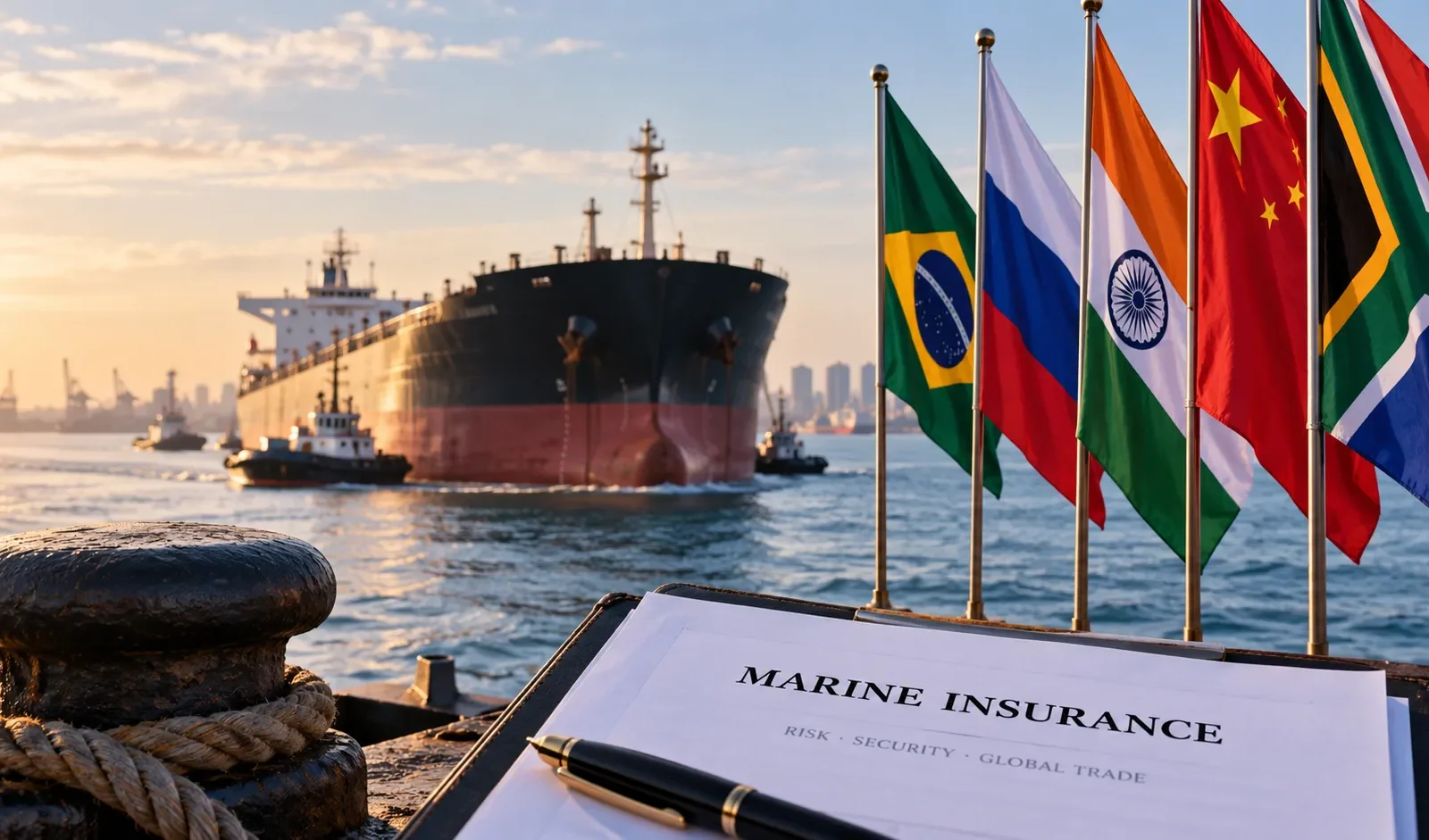
BRICS has moved insurance and reinsurance closer to the centre of its financial agenda, raising a question with direct consequences for global shipping: could the bloc eventually build a marine-risk system capable of reducing dependence on the International Group of P&I Clubs and Western-centred reinsurance markets?
The answer is not yet.
But the direction is becoming much clearer.
At the September 2026 BRICS summit in New Delhi, the group’s official declaration called for a more self-reliant BRICS insurance ecosystem, further discussion on increasing reinsurance capacity and continued work on a proposed BRICS Insurance Resilience Centre. Members also expressed interest in India’s proposal for a BRICS Risk Lab at GIFT City.
Iranian President Masoud Pezeshkian went further, proposing a joint BRICS reinsurance company with $10 billion of initial capital, initially aimed at protecting major infrastructure and energy projects. Russian President Vladimir Putin separately urged BRICS members to accelerate work on their own reinsurance mechanism.
None of this means BRICS has approved a $10 billion marine insurer, created a new P&I club or replaced the existing global system. The Iranian proposal remains a proposal, and the New Delhi Declaration stops well short of establishing a multinational insurer.
But shipping is one of the sectors where any serious BRICS reinsurance architecture could have the greatest strategic impact.
Key distinction: the $10 billion figure is an Iranian proposal for a joint BRICS reinsurance company. It is not an approved BRICS insurance fund and is not currently a dedicated shipping or P&I facility.
BRICS Reinsurance Moves From Concept Toward Institutional Architecture
The strongest official signal came in paragraph 92 of the 2026 BRICS New Delhi Declaration.
The declaration states that BRICS members recognise the need to use their collective potential to build a more self-reliant insurance ecosystem to support trade and to continue discussion on increasing reinsurance capacity.
It also records continued discussions around a BRICS Insurance Resilience Centre, or BIRC, described as a voluntary shared-capability platform that could develop common risk models, exchange insurance and reinsurance best practices, build specialist risk capabilities and support further cooperation among interested BRICS regulators and reinsurance companies.
India has also proposed hosting a BRICS Risk Lab at the GIFT City International Financial Services Centre in Gujarat.
Those may sound like technical institutional details, but they matter. Large-scale insurance systems are not created simply by announcing capital. They require risk models, claims expertise, actuarial data, legal frameworks, regulatory cooperation, loss-prevention systems, catastrophe modelling, reinsurance structures and the confidence of banks, ports, shipowners and cargo interests.
The New Delhi Declaration is therefore more important than a single headline about a $10 billion fund. It shows BRICS discussing the infrastructure required to make alternative insurance capacity credible over time.
Iran Proposes a $10 Billion BRICS Reinsurance Company
Iranian President Masoud Pezeshkian proposed creating a joint BRICS reinsurance company with $10 billion in starting capital.
The initial focus described publicly was on major infrastructure and energy projects rather than marine P&I specifically.
That qualification matters. Reinsurance for infrastructure and energy risk is not automatically interchangeable with the specialised liability cover required by a tanker, container ship or bulk carrier.
However, the overlap with maritime trade is obvious. BRICS members include some of the world’s largest energy producers, oil and commodity importers, shipowners, shipbuilders, ports, cargo interests, state insurers and reinsurance markets.
A multinational reinsurance vehicle created to support energy and cross-border trade could eventually become relevant to hull, cargo, war-risk or liability insurance if participating countries chose to expand its mandate.
That is why the maritime industry should follow the proposal even though a shipping-specific BRICS insurer does not yet exist.
Putin Pushes BRICS to Build Its Own Reinsurance Mechanism
Russian President Vladimir Putin used the New Delhi summit to urge members to accelerate work on an independent reinsurance mechanism as part of broader efforts to deepen BRICS financial infrastructure.
Russia has strong reasons to support such a system.
Sanctions have repeatedly shown that access to insurance, reinsurance, banking and maritime services can influence whether a vessel can trade commercially even when the physical ship remains fully operational.
A vessel can have a flag, class, crew, cargo, technically navigable route and willing owner. But if recognised liability cover, reinsurance, banking or sanctions-compliant services are unavailable, the voyage can still become commercially impossible.
That is the strategic importance of marine insurance.
Marine insurance is not simply protection against loss. It is part of the infrastructure that determines whether global trade can move.
That makes reinsurance capacity strategically important to governments seeking greater autonomy from sanctions, conflict-driven withdrawals of cover and concentrated financial infrastructure.
Why P&I Insurance Matters So Much to Global Shipping
Protection and Indemnity insurance, usually shortened to P&I, covers major third-party liabilities connected with operating a ship.
Depending on club rules and individual cover, these can include crew injury and illness, passenger liabilities, cargo loss or damage, oil pollution, wreck removal, collision liabilities, damage to fixed and floating objects, stowaways, fines, towage, salvage-related exposures and large maritime casualties.
These liabilities can reach enormous values after a major casualty.
That is why credible P&I is not just another annual insurance policy. It is effectively an operating passport for international shipping.
The International Group Covers About 87% of Ocean-Going Tonnage
The International Group of P&I Clubs consists of 12 principal P&I Clubs.
According to the Group itself, its member clubs collectively provide marine liability cover for approximately 87% of the world’s ocean-going tonnage.
Each club is independent and member-owned, but the Group allows clubs to share large-loss exposure through pooling and reinsurance arrangements.
This structure gives the International Group extraordinary depth.
It is important, however, not to describe the International Group simply as a British insurer. The Group secretariat is based in London and the modern system has deep historical links to the London marine market, but the clubs, members, management structures and insured fleets are international.
The real strategic issue for BRICS is therefore not nationality alone. It is concentration of globally accepted maritime liability capacity within a system closely integrated with Western financial, legal, sanctions and reinsurance frameworks.
Why Reinsurance Is the Real Power Behind Large Marine Risks
An insurer can only retain so much risk on its own balance sheet. Reinsurance allows insurers to transfer part of that exposure to other risk carriers.
For marine liability, that becomes critical because a single casualty can generate claims across pollution, cargo, personal injury, wreck removal, collision, port infrastructure, environmental damage and business interruption.
Without deep reinsurance, an insurer may be able to issue a certificate but may not have enough financial capacity to respond to a catastrophic loss.
That difference separates paper insurance from credible insurance.
P&I Club vs Reinsurer: What Is the Difference?
| Function | P&I Club / Primary Insurer | Reinsurer |
|---|---|---|
| Direct relationship | Covers shipowner/member directly | Covers insurer or pool |
| Purpose | Handles insured liabilities and claims | Spreads extreme losses across more capital |
| Why shipping needs it | Provides recognised liability protection | Makes catastrophic claims financially manageable |
A credible BRICS maritime-insurance alternative would therefore need much more than one new insurer. It would need a layered risk structure capable of absorbing catastrophic claims.
India Has Already Built a $1.5 Billion Maritime Insurance Pool
The most important real-world example inside BRICS may already be operating.
India launched the Bharat Maritime Insurance Pool, or BMIP, on 12 May 2026.
The official Indian government announcement describes BMIP as a $1.5 billion domestic maritime insurance pool backed by a $1.4 billion sovereign guarantee, equivalent to ₹12,980 crore.
The pool was designed to maintain insurance availability during geopolitical disruption and reduce dependence on external insurance capacity.
Its scope includes Hull & Machinery, Cargo, Protection & Indemnity and War Risk.
The pool applies to qualifying Indian-flagged or controlled vessels and certain voyages connected with Indian trade, including volatile maritime corridors.
India Explicitly Linked BMIP to Insurance Sovereignty
The rationale is unusually direct.
When India approved the pool, the government referred to the high dependence of Indian vessels on International Group P&I cover and the risk that insurance could be withdrawn because of sanctions or geopolitical tensions.
The policy objective was therefore not simply cheaper insurance.
It was continuity of trade.
That makes BMIP highly relevant to the wider BRICS discussion.
India has already demonstrated one model: combine domestic underwriting capacity with a sovereign guarantee to ensure marine insurance remains available during extreme geopolitical conditions.
BMIP Has Already Expanded Into P&I
On 30 July 2026, India’s Department of Financial Services launched a dedicated Protection & Indemnity insurance product under the Bharat Maritime Insurance Pool.
By 29 July, the government said the pool had already issued 1,608 policies covering cargo and hull war risks.
The government also reported that war-risk premium rates had fallen by approximately 35–40% from levels observed at the height of the West Asia conflict.
Those figures show why national or regional insurance pools matter commercially. They can affect whether a ship can trade, how much the voyage costs, which owners are willing to enter a region, which cargoes remain economically viable and how dependent a country is on foreign risk capacity.
Tide Signal’s guide to war-risk premiums in shipping explains how insurance cost can spread directly into freight, voyage margin, charterparty negotiations and owner approval.
Could BMIP Become a Template for BRICS?
Possibly — but scaling a national pool to a multinational system would be far more difficult.
A BRICS-wide system would have to reconcile different insurance laws, solvency regimes, currencies, claims jurisdictions, sanctions policies, political interests, rating requirements, state guarantees, capital controls and approaches to international maritime conventions.
That complexity is precisely why the New Delhi Declaration emphasises voluntary participation, common risk models and technical discussion rather than announcing a single immediate BRICS insurer.
Why Shipping Sanctions Have Made Insurance Strategic
Modern sanctions increasingly operate through commercial infrastructure rather than through physical interdiction alone.
Shipping requires a chain of service providers: banks, insurers, reinsurers, P&I clubs, classification societies, flag registries, brokers, ports, bunker suppliers, ship managers and cargo counterparties.
If major providers withdraw because of sanctions exposure, a ship may become commercially isolated without being physically stopped.
This is particularly important in oil and commodity shipping, where vessels may need approval from multiple parties before a fixture can proceed.
Tide Signal has been tracking the same mechanism through its coverage of Iran shipping sanctions and bunkering restrictions and the Iran vessel blacklist and P&I/class exposure.
Insurance Can Reduce Effective Fleet Capacity Without Removing a Ship
The physical fleet is not the same as the commercially available fleet.
Consider a tanker that is technically operational but cannot obtain accepted liability insurance, is rejected by a charterer’s vetting process, cannot satisfy a terminal’s insurance requirements, cannot obtain banking services, has a sanctions-related ownership concern or cannot secure acceptable war-risk cover.
The ship still exists.
But for many mainstream cargoes, its effective capacity has disappeared.
This is the same broader principle Tide Signal has identified across several 2026 markets: commercial constraints can tighten effective fleet supply without reducing the physical number of ships.
The Shadow-Fleet Problem Shows the Limits of Alternative Cover
Sanctioned and high-risk trades have already encouraged the growth of insurance arrangements outside the traditional International Group system.
But not all insurance is equally credible.
A certificate is only valuable if the insurer can pay a major claim, provide security quickly, respond in multiple jurisdictions, support pollution response, handle wreck removal, appoint surveyors and correspondents, maintain adequate reserves, access reinsurance and remain solvent after a catastrophic loss.
That is the central challenge facing any new BRICS maritime-insurance architecture.
Creating capacity is easier than creating trust.
What Would a BRICS Marine Insurance System Need to Rival International Group P&I?
1. Catastrophic Claims Capacity
Marine casualties can produce multi-billion-dollar liabilities. A new system would need enough retained capital and reinsurance to survive extreme losses.
2. Global Recognition
Ports, terminals, charterers, banks and governments would need to accept the insurance as credible.
3. Convention Certificates and Financial Security
International shipping operates under multiple liability conventions that require financial security. New insurers would need to satisfy relevant flag-state and convention requirements.
4. Claims Network
P&I is operational. A casualty may require lawyers, surveyors, pollution experts, correspondents, salvage support and local guarantees within hours.
5. Reinsurance Depth
A primary policy is not enough. Catastrophic maritime liability requires deep layers of reinsurance.
6. Credit Quality
Shipowners and counterparties need confidence that cover will remain valid throughout the policy period and that claims will be paid years later.
7. Loss Data
Pricing major liability risk requires long historical datasets covering casualties, pollution, cargo, crew, wreck removal and litigation.
8. Regulatory Coordination
A multinational BRICS insurer would operate across very different legal and solvency systems.
9. Sanctions Policy
BRICS itself contains countries with very different relationships with Western sanctions. A joint system would have to decide which restrictions it recognises and how it protects participating insurers from secondary exposure.
10. Governance
A credible system would need rules governing capital calls, claims decisions, member participation, conflicts of interest and state intervention.
Why $10 Billion Is Large — But Not Enough by Itself
A proposed $10 billion capital base is substantial.
But capital alone does not create an International Group alternative.
The value of the existing P&I system comes from the combination of club capital, mutual risk sharing, pooling, external reinsurance, global claims infrastructure, loss-prevention expertise, legal networks, decades of claims data, regulatory recognition and counterparty trust.
A new BRICS company could begin with strong capital and still take years to develop comparable institutional credibility.
Could BRICS Build an Alternative Without Replacing the International Group?
Yes — and this may be the more realistic path.
The goal does not have to be complete replacement.
BRICS could instead build supplementary capacity through regional war-risk pools, sovereign-backed catastrophe layers, trade-specific reinsurance, cargo and hull capacity, national P&I products, BRICS-to-BRICS trade cover, state-supported guarantees and reinsurance for risks excluded or heavily priced by conventional markets.
This would reduce dependence without requiring BRICS to reproduce the entire global P&I structure from day one.
A Two-Tier Marine Insurance Market Could Emerge
If alternative insurance capacity grows, global shipping could increasingly split into overlapping insurance ecosystems.
One system could remain centred on International Group P&I, major Western and international reinsurers, London-market expertise, Western banking infrastructure and sanctions-compliant mainstream trade.
A second could develop around BRICS state-backed pools, national insurers, non-Western reinsurers, local-currency settlement, alternative banking networks and trade among participating emerging economies.
The systems would not necessarily be completely separate. Some shipowners, reinsurers and cargo interests could participate in both.
But the existence of credible alternative capacity would reduce the leverage created by dependence on one dominant insurance architecture.
Why China Matters to Any BRICS Reinsurance System
Any large BRICS insurance system would be difficult to imagine without significant Chinese participation.
China combines one of the world’s largest insurance markets, major state financial institutions, the world’s largest shipbuilding industry, large merchant-fleet interests, enormous commodity import demand and strategic interest in alternative financial infrastructure.
But China would also have to weigh the benefits of greater BRICS autonomy against the importance of maintaining access to global capital, international reinsurance and conventional marine markets.
That balance may determine how ambitious a future BRICS insurance structure becomes.
Why the UAE Matters
The United Arab Emirates is another important member because of its position as a global energy exporter, tanker and shipping hub, major port centre, financial centre and rapidly expanding maritime-services market.
A BRICS insurance architecture that includes credible Gulf financial and maritime participation would have more commercial weight than one seen primarily as a sanctions workaround for Russia and Iran.
Why India May Be the Most Important Test Case
India sits in a different strategic position. It maintains major economic relationships with Western countries while also participating deeply in BRICS.
Its Bharat Maritime Insurance Pool is therefore significant because it is framed not primarily as sanctions evasion, but as insurance resilience and trade continuity.
That distinction could make the Indian model more attractive to other countries seeking redundancy without abandoning established international insurance relationships.
Could BRICS Reinsurance Lower War-Risk Costs?
Potentially.
Additional capacity can create competition and reduce dependence on a small number of risk providers. India’s experience with BMIP suggests that sovereign-supported capacity can materially affect pricing during a crisis.
But lower premiums are not guaranteed. War-risk prices ultimately reflect probability of attack, expected severity, route, vessel value, cargo, ownership, flag, security measures, claims experience and available market capacity.
A new insurer cannot make the underlying physical risk disappear.
Could BRICS Insurance Expand the Tradable Fleet?
Yes, if it provides credible cover to ships that would otherwise be commercially excluded.
This could increase effective vessel availability in some sanctioned or high-risk trades.
For example, a ship with recognised alternative P&I and war-risk cover may become acceptable to more charterers, ports, cargo interests, banks and counterparties.
That could reduce freight scarcity in specific trades.
But the opposite could also occur if the emergence of separate insurance ecosystems increases screening complexity and causes mainstream charterers to reject unfamiliar cover.
The Freight-Market Impact Could Be Significant
Insurance affects freight because it affects the number of commercially usable ships.
Tide Signal’s analysis of the $25 million VLCC voyage showed how security, insurance and limited vessel availability can transform freight economics.
If new BRICS insurance capacity makes more ships acceptable in high-risk trade, freight premiums could narrow.
If, however, the market fragments into insurers that some counterparties accept and others reject, the value of “universally acceptable” tonnage could rise further.
Insurance fragmentation therefore has the potential to create a new commercial variable: not only whether the ship is insured, but whose insurance the market accepts.
What Could Stop the BRICS Reinsurance Project?
The political headline is powerful, but the obstacles are substantial.
Different Member Interests
BRICS includes sanctioned states, major Western trading partners, energy exporters, commodity importers and competing regional powers. Their desired level of financial separation from Western markets is not the same.
Credit and Ratings
Shipping counterparties care about claims-paying ability. A politically supported insurer still needs financial credibility.
Secondary Sanctions Risk
A BRICS structure covering sanctioned trade could face restrictions from Western jurisdictions, potentially limiting access to international finance and service providers.
Claims Enforcement
Shipowners need to know where disputes will be resolved and whether judgments or arbitration awards are enforceable.
Catastrophe Exposure
A few major marine losses could consume enormous capital if the reinsurance structure is not sufficiently diversified.
Trust
Marine insurance is built on decades of claims handling and counterparties’ willingness to accept security. Trust cannot be created by government announcement alone.
What Could Accelerate It?
The project could move much faster if geopolitical disruption continues.
Catalysts could include new sanctions on shipping or insurers, withdrawal of cover from major trade routes, persistent Middle East war-risk pressure, growth in BRICS-to-BRICS commodity trade, greater use of local-currency settlement, successful expansion of BMIP, large Chinese or Gulf reinsurance participation and political agreement on sovereign guarantees.
What Shipowners Should Watch
- Whether the $10bn Iranian proposal gains formal support: there is currently no approved joint BRICS reinsurance company.
- BRICS Insurance Resilience Centre: whether BIRC develops from technical cooperation into operational risk capacity.
- GIFT City Risk Lab: common risk models could become groundwork for future underwriting cooperation.
- BMIP expansion: India is the strongest live test of sovereign-backed marine capacity inside BRICS.
- China and UAE participation: meaningful capital and commercial credibility would change the scale of the project.
- P&I recognition: watch whether ports, flags, banks and charterers begin accepting more non-International Group cover.
- Reinsurance partnerships: the identity and rating of the ultimate risk carriers will matter more than the headline insurer.
- Sanctions response: Western governments may adjust policy if alternative insurance materially weakens maritime enforcement tools.
BRICS Reinsurance vs International Group P&I: The Real Comparison
| Area | International Group P&I | Emerging BRICS Architecture |
|---|---|---|
| Status | Established global system | Under discussion / partially national |
| Marine liability scale | ~87% of ocean-going tonnage | No comparable multinational figure |
| Structure | 12 mutual P&I Clubs + pooling/reinsurance | BIRC/Risk Lab proposals + national initiatives |
| Capital headline | Distributed club/pool/reinsurance capacity | Iran proposes $10bn joint reinsurance company |
| Operational example | Global club system | India’s $1.5bn BMIP |
| Main strength | Global acceptance and claims infrastructure | Potential sanctions resilience and sovereign support |
| Main challenge | Exposure to geopolitical/regulatory fragmentation | Trust, recognition, reinsurance depth and governance |
Could BRICS Really Challenge Western Marine Insurance?
In the near term, the International Group system remains overwhelmingly stronger in global P&I.
Its scale, reputation, claims network, reinsurance arrangements and regulatory acceptance cannot be replicated quickly.
But that is not the same as saying the BRICS initiative is irrelevant.
The strategic shift is that major emerging economies increasingly view insurance as infrastructure that should have redundancy.
India has already launched a sovereign-backed marine pool. BRICS has now formally endorsed discussion of a more self-reliant insurance ecosystem and greater reinsurance capacity. Iran has proposed $10 billion in joint capital. Russia is pushing for faster institutional development.
If those strands eventually connect, the result may not be a direct replacement for the International Group.
It may be something more gradual: a parallel layer of insurance and reinsurance capacity that reduces the ability of any one financial system to determine which ships, cargoes and trade routes remain commercially insurable.
The most important question is not whether BRICS can replace Western marine insurance tomorrow.
It is whether the world is moving from one dominant marine-risk architecture toward multiple overlapping systems. If that happens, insurance could become as important to the geopolitics of shipping as flags, ports, payment networks and energy routes.
BRICS Reinsurance FAQ
What is the BRICS reinsurance proposal?
BRICS members agreed in the 2026 New Delhi Declaration to continue discussions on building a more self-reliant insurance ecosystem, enhancing reinsurance capacity and exploring a BRICS Insurance Resilience Centre. Iran separately proposed a joint BRICS reinsurance company with $10 billion of initial capital.
Has BRICS approved a $10 billion reinsurance company?
No. The $10 billion figure is a proposal made by Iranian President Masoud Pezeshkian. The official BRICS declaration supports further discussion on insurance and reinsurance capacity but does not establish the proposed company.
Is the proposed BRICS reinsurance company specifically for shipping?
No. Iran’s public proposal initially focused on major infrastructure and energy projects. However, shipping could become relevant because BRICS members are major maritime trading, energy, commodity and shipowning economies.
What is P&I insurance?
Protection and Indemnity insurance covers many third-party liabilities arising from ship operations, including crew injury, cargo claims, pollution, wreck removal and collision-related liabilities.
How much global shipping is covered by International Group P&I Clubs?
The International Group says its 12 member P&I Clubs collectively provide marine liability cover for approximately 87% of the world’s ocean-going tonnage.
What is the Bharat Maritime Insurance Pool?
BMIP is India’s sovereign-backed domestic maritime insurance pool, launched in May 2026 with total pool capacity of $1.5 billion and a $1.4 billion sovereign guarantee. It covers categories including Hull & Machinery, Cargo, P&I and War Risk for qualifying maritime business.
Why does BRICS want more reinsurance capacity?
The broader objective is resilience: supporting trade, reducing dependence on external insurance systems and maintaining cover when sanctions, geopolitical conflict or market withdrawals reduce available capacity.
Can BRICS replace the International Group of P&I Clubs?
Not in the near term. The International Group has decades of claims data, pooling, reinsurance, legal expertise and global recognition. A BRICS alternative would need to build comparable financial depth, operational infrastructure and market trust.
Could BRICS insurance weaken shipping sanctions?
Potentially, if alternative cover allows vessels and cargoes to trade without relying on insurers subject to Western restrictions. The real effect would depend on acceptance by ports, banks, charterers, flag states and other counterparties, as well as any secondary-sanctions exposure.
What is BIRC?
BIRC is the proposed BRICS Insurance Resilience Centre, envisaged as a voluntary platform for common risk models, best-practice exchange and specialist capability building among interested BRICS members.
What should shipowners monitor next?
Shipowners should watch for formal decisions on the proposed reinsurance company, development of BIRC and the GIFT City Risk Lab, expansion of India’s BMIP, participation by Chinese and Gulf insurers and any signs that ports or charterers are expanding acceptance of alternative P&I cover.
Sources and Further Reading
- Government of India — BRICS New Delhi Declaration 2026
- Splash — Putin pushes BRICS insurance challenge to Western shipping establishment
- International Group of P&I Clubs — About the Group
- Government of India — Bharat Maritime Insurance Pool launch
- Government of India — BMIP P&I product launch
- Prime Minister of India — BMIP rationale and sovereign guarantee