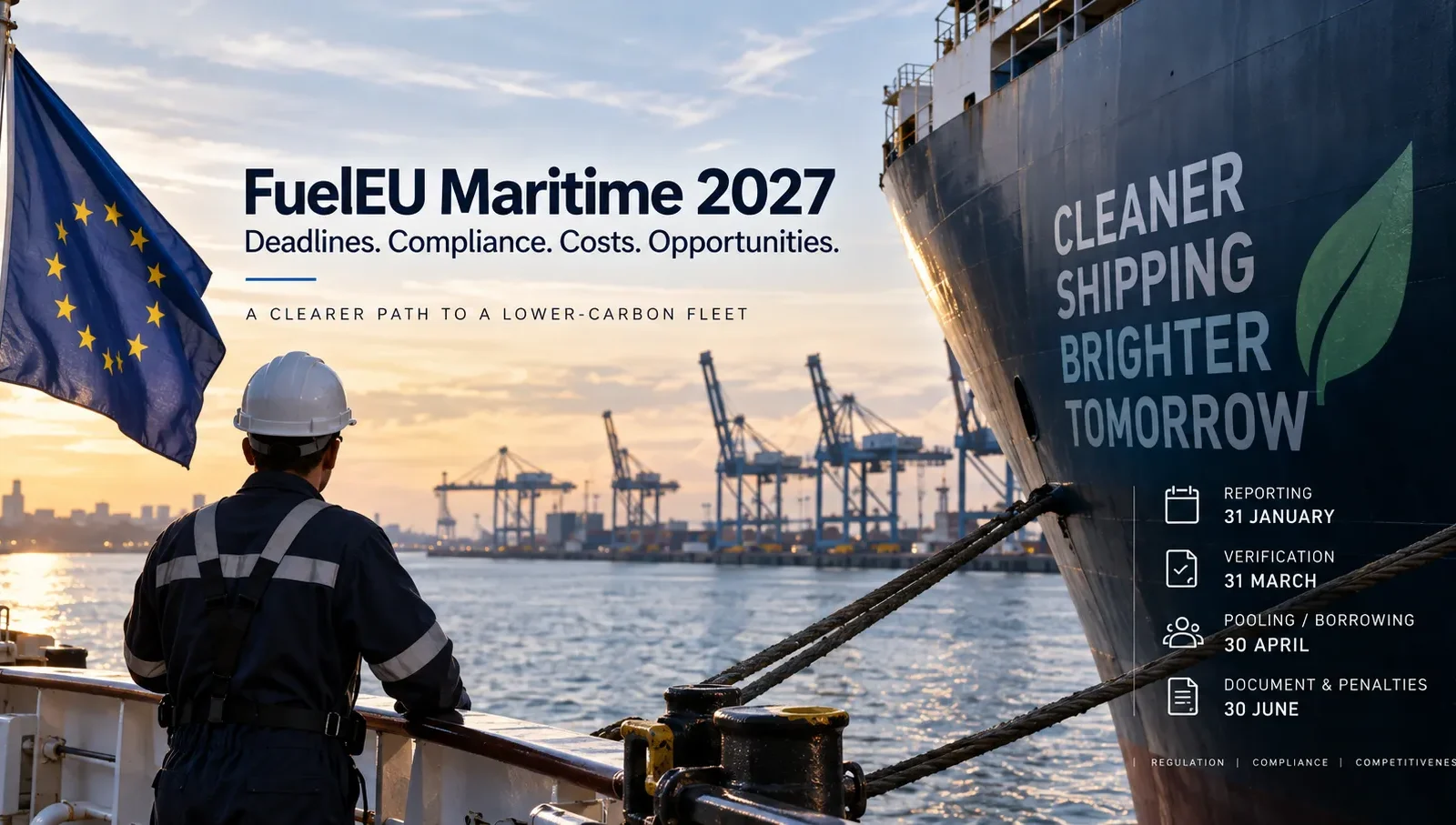
FuelEU Maritime 2027 opens with a 31 January reporting deadline for the 2026 reporting year. The verification cycle then moves through 31 March, 30 April and 30 June, while companies can use banking, borrowing and pooling to manage compliance balances before penalties become due.
Companies must provide the verifier with a ship-specific FuelEU report covering the 2026 reporting period, including the monitoring data and documentation required by Regulation (EU) 2023/1805.
FuelEU Maritime 2027 is not the start of a new regulation. FuelEU Maritime has applied since 1 January 2025. What makes 2027 important is that it is the verification year for emissions and energy data accumulated during the full 2026 reporting period.
That distinction matters because compliance is annual. Ships accumulate a greenhouse-gas intensity result from 1 January to 31 December. The following calendar year is then used for reporting, verification, flexibility decisions, penalty settlement and the issue of the FuelEU document of compliance.
- What FuelEU Maritime 2027 actually means
- The 2027 compliance timeline
- The 2% GHG-intensity target
- Ships and voyages in scope
- Why well-to-wake changes fuel economics
- How the compliance balance works
- Banking
- Borrowing
- Pooling
- FuelEU penalty formula
- Repeated deficits and penalty escalation
- Owner-charterer allocation
- Vessel sale and management changes
- FuelEU vs EU ETS
- Port-of-call and transhipment rules
- OPS obligations from 2030
- 2027 compliance checklist
- FuelEU Maritime 2027 FAQ
What Does FuelEU Maritime 2027 Mean?
The FuelEU Maritime Regulation limits the annual average greenhouse-gas intensity of energy used onboard ships in scope. It measures emissions on a well-to-wake basis, meaning the calculation looks beyond combustion onboard and also accounts for emissions associated with the production, transport and distribution of the energy used.
The regulation applies to commercial passenger and cargo ships above 5,000 GT, regardless of flag, when they trade within the geographical scope of the European Union framework.
The first reporting year was 2025. The second is 2026. The corresponding verification period is 2027.
That makes January to June 2027 a concentrated compliance window for shipping companies, verifiers, charterers and commercial teams.
FuelEU Maritime 2027: The Full Compliance Timeline
The company provides the ship-specific FuelEU report for the 2026 reporting period.
The verifier records the compliant FuelEU report, verification report and calculated compliance information in the FuelEU database.
Borrowed advance compliance surplus must be recorded following verifier approval, and the selected verifier must record the definitive composition and allocation of any pool.
After possible use of banking, borrowing or pooling, the verifier records the verified compliance balances in the FuelEU database.
A ship that still has a GHG-intensity deficit after the flexibility mechanisms enters the penalty stage under Article 23.
Penalties due must be paid and the verifier or competent authority issues the ship-specific FuelEU document of compliance where the regulatory conditions are satisfied.
The important commercial point is that 30 April is not simply an administrative date. It is the deadline around which pooling and borrowing decisions can determine whether a ship reaches 30 June with a penalty or with a compliant balance.
What Is the FuelEU GHG-Intensity Target in 2027?
FuelEU uses a reference value of 91.16 gCO₂e/MJ. The limit is reduced progressively over time.
| Period | Reduction from reference | Commercial meaning |
|---|---|---|
| 2025–2029 | 2% | First compliance phase; applies to the 2026 reporting year verified in 2027. |
| 2030–2034 | 6% | Material tightening from 2030. |
| 2035–2039 | 14.5% | Much stronger low-carbon fuel requirement. |
| 2040–2044 | 31% | Deep reduction phase. |
| 2045–2049 | 62% | High decarbonisation requirement. |
| 2050 onward | 80% | Long-term end-state target under the current regulation. |
For the 2026 reporting year, a 2% reduction from 91.16 gCO₂e/MJ corresponds to a target of approximately 89.34 gCO₂e/MJ.
This means 2027 should not be marketed internally as “a new 2027 target”. The operational target remains the 2025–2029 limit. What changes is the compliance history: companies now have another full reporting year of real voyage and fuel data, and repeated deficits start to matter more because penalties escalate when non-compliance continues across consecutive reporting periods.
Which Ships and Voyages Are Covered?
FuelEU applies to ships above 5,000 GT transporting passengers or cargo for commercial purposes, regardless of flag.
| Energy use | FuelEU scope |
|---|---|
| Energy used during a stay in an EU Member State port of call | 100% |
| Voyage between two EU Member State ports of call | 100% |
| Voyage between an EU port and a third-country port | 50% |
| Voyage between a third-country port and an EU port | 50% |
| Third-country to third-country voyage | Normally outside FuelEU scope |
The scope is therefore similar in shape to other EU maritime climate rules but not identical in every detail. Operators should calculate the FuelEU exposure using the regulation’s own voyage and port-of-call definitions rather than simply copying an EU ETS calculation.
Why Well-to-Wake Changes the Fuel Decision
FuelEU is fundamentally different from a simple fuel-consumption or tank-to-wake carbon rule.
The GHG intensity is calculated in grams of CO₂ equivalent per megajoule and considers CO₂, CH₄ and N₂O on a well-to-wake basis.
That means a fuel can look attractive when only stack CO₂ is considered but perform differently once upstream emissions, methane slip and the certified production pathway are included.
For fossil fuels, the regulation uses default values. For eligible biofuels, biogas, renewable fuels of non-biological origin and recycled carbon fuels, certified pathway data can become critical to the final compliance result.
For the wider operational mechanics, see World’s First Ship-to-Ship Ammonia Bunkering Completed in Japan.
How Does the FuelEU Compliance Balance Work?
The verifier calculates the ship’s annual average GHG intensity and compares it with the applicable target.
If actual GHG intensity is lower than the target, the ship generates a compliance surplus.
If actual GHG intensity is higher than the target, the ship generates a compliance deficit.
A positive balance can create value because it may be banked or allocated through a pool. A negative balance creates exposure that must be solved through operational performance, flexibility mechanisms or a FuelEU penalty.
FuelEU Banking: How a Surplus Can Be Carried Forward
Where a ship has a positive compliance surplus, the company may bank that surplus to the same ship’s compliance balance for the following reporting period.
The banking must be recorded in the FuelEU database and approved by the verifier. Once the FuelEU document of compliance has been issued, the surplus can no longer be banked for that verification period.
Banking is strategically useful because it allows a company to preserve over-compliance rather than losing it at year-end.
For a vessel expected to face more carbon-intensive employment in the following year, a banked balance can become a valuable risk buffer.
FuelEU Borrowing: Using Future Compliance Today
If a ship has a compliance deficit, the company may borrow an advance compliance surplus from the following reporting period.
Borrowing is not free.
The amount borrowed is added to the current compliance balance, but 110% of the borrowed amount is deducted from the ship’s balance in the next reporting period.
A ship uses borrowing to cover a deficit equivalent to 100 compliance units.
Following period: −110
The 10% uplift means borrowing shifts the problem forward and makes the next year’s starting position harder.
The regulation also limits borrowing. It cannot exceed the Article 20 cap linked to 2% of the applicable GHG-intensity limit and the ship’s energy consumption, and borrowing cannot be used for two consecutive reporting periods.
This is why borrowing can be a tactical tool, but it is a poor substitute for a long-term compliance strategy.
FuelEU Pooling: How One Ship’s Surplus Can Cover Another’s Deficit
Pooling is one of the most commercially significant features of FuelEU Maritime.
Two or more ships can combine compliance balances. The ships do not necessarily have to be controlled by the same company, provided the regulatory conditions and database validation requirements are met.
A ship cannot be included in more than one pool for the same compliance target in the same reporting period. Separate pools can be used for the GHG-intensity target and the future RFNBO subtarget where applicable.
By 30 April, the selected verifier must record the definitive pool composition and the final allocation of the total pool balance to each ship.
Simple pooling example
Vessel A compliance balance: −80
Vessel B compliance balance: +100
The pool is positive overall, so there is enough surplus in principle to neutralise Vessel A while keeping the allocation within the regulatory conditions.
This creates an internal and external market for compliance value. A low-carbon vessel can potentially generate a surplus that supports another vessel, provided the pool arrangement is commercially and contractually agreed.
How Is the FuelEU Maritime Penalty Calculated?
If a ship still has a negative compliance balance after the permitted flexibility mechanisms have been applied, a FuelEU penalty becomes due.
Annex IV links the penalty to an equivalent quantity of VLSFO, using 41,000 MJ per metric tonne and a factor of €2,400 per equivalent tonne of VLSFO.
The logic is important. The regulation does not simply impose a flat euro amount for each unit of GHG-intensity deficit. It translates the deficit into an energy-equivalent VLSFO quantity and then applies the €2,400 factor.
Companies should use the verified FuelEU database calculation for actual compliance. Spreadsheet examples are useful for commercial forecasting but should not replace the statutory calculation.
Repeated Deficits Can Become Progressively More Expensive
FuelEU explicitly increases the penalty where a ship has a compliance deficit for two or more consecutive reporting periods.
Where n is the number of consecutive reporting periods in which that ship is subject to a FuelEU penalty.
| Consecutive penalty year | Multiplier |
|---|---|
| 1st | 1.0× |
| 2nd | 1.1× |
| 3rd | 1.2× |
| 4th | 1.3× |
| 5th | 1.4× |
This is why 2027 matters strategically. Companies now have a second verification cycle approaching. A vessel that simply paid its way out of a deficit in the first cycle cannot assume the same approach remains commercially neutral forever.
FuelEU Maritime and Charterparties: Who Pays?
The regulation makes the company responsible for regulatory compliance and payment of FuelEU penalties. In regulatory terms, the company is the shipowner or another organisation or person, such as a manager or bareboat charterer, that has assumed responsibility for the ship’s operation under the ISM framework.
But the regulation also recognises that the commercial operator may be the party deciding the cargo, route, speed or fuel purchasing.
Article 23 therefore allows contractual arrangements under which the commercial operator reimburses the company for FuelEU penalties where the commercial operator is responsible for fuel purchase or operation of the ship.
This is the point where FuelEU becomes a charterparty issue.
BIMCO’s FuelEU Maritime Clause for Time Charter Parties 2024 addresses surcharge mechanisms, compliance balances and the use of banking, borrowing and pooling during time-charter employment.
BIMCO specifically gives charterers the ability, in qualifying charter periods and subject to the clause mechanics, to instruct owners on banking or pooling and in some circumstances borrowing. The contractual logic is designed to connect the compliance outcome with the party controlling the vessel’s fuel and commercial employment.
For the underlying commercial distinction between voyage, time, bareboat and COA structures, see Tide Signal’s Types of Charter Parties in Shipping.
Why Short Time Charters Can Be Difficult
The reporting period runs from 1 January to 31 December, but many time charters start or end mid-year.
That creates a practical mismatch between the annual regulatory balance and the charterer’s period of control.
Commercial parties need to decide how to price or reconcile:
- the compliance balance generated during the charter period;
- surplus created before delivery;
- deficit carried into the charter;
- banking decisions;
- pool participation;
- borrowing that affects the following year;
- redelivery exposure;
- and the eventual verified annual result.
A charterparty that only says “charterers pay FuelEU costs” may be too crude for a system where today’s borrowing can reduce tomorrow’s compliance balance by 110% of the amount used.
What Happens When a Ship Is Sold or Changes Company?
The regulation contains specific rules for transfer of responsibility from one company to another.
The transferring company must notify the relevant information for the period during which it operated the ship, and that information must be verified and recorded in the FuelEU database as close as practical to the transfer and no later than one month afterwards.
This makes FuelEU history relevant to:
- sale and purchase due diligence;
- management transitions;
- bareboat arrangements;
- long-term time charters;
- and redelivery negotiations.
A buyer, incoming manager or next charterer should understand whether a ship carries a banked surplus, a deficit history, a borrowing consequence or a pattern of penalties that can affect future compliance economics.
FuelEU Maritime 2027 vs EU ETS Shipping
FuelEU Maritime and the EU ETS are often discussed together because both affect European shipping decarbonisation. They are not the same regulation.
| FuelEU Maritime | EU ETS Shipping | |
|---|---|---|
| Main mechanism | Annual GHG-intensity limit | Emission allowance surrender |
| Measurement logic | Well-to-wake gCO₂e/MJ | Covered emissions translated into EUA liability |
| Flexibility | Banking, borrowing, pooling | Allowance acquisition and surrender |
| Main commercial variable | Fuel mix and compliance balance | EUA quantity and carbon price |
| 2027 relevance | Verification of 2026 FuelEU performance | Surrender cycle for 2026 ETS emissions |
Read Tide Signal’s full EU ETS Shipping 2026 guide for the September surrender cycle, 100% phase-in and the expanded ETS greenhouse-gas scope.
Commercially, the same bunker choice can affect both systems at once. A lower-carbon fuel can improve a FuelEU compliance balance while also changing the ship’s EU ETS exposure.
Port-of-Call Rules and the Container Transhipment Trap
FuelEU uses a specific definition of a port of call. A physical stop is not automatically a regulatory port of call.
Stops solely for bunkering, obtaining supplies, crew relief, dry-docking, repairs, distress, search and rescue, shelter from adverse weather or ship-to-ship transfer outside a port are excluded from the normal definition.
Containership stops at listed neighbouring container transhipment ports are also excluded.
The current FuelEU list identifies:
- East Port Said, Egypt
- Tanger Med, Morocco
This anti-evasion feature matters because a containership cannot necessarily alter the FuelEU voyage boundary simply by inserting a high-transhipment non-EU hub close to the Union.
Fuel Documentation Is Becoming a Commercial Asset
FuelEU performance depends on credible fuel-pathway evidence.
For non-fossil fuels, bunker documentation and sustainability certification can materially change the GHG factor that the verifier accepts.
A biofuel stem with an attractive headline price can therefore produce a poor regulatory result if the sustainability evidence is incomplete or the production pathway cannot be recognised under the applicable EU certification rules.
Commercial teams should increasingly evaluate:
- fuel price;
- lower calorific value;
- well-to-tank factor;
- tank-to-wake emissions;
- methane slip where relevant;
- sustainability certification;
- expected FuelEU balance;
- EU ETS effect;
- and pool or bank value.
How FuelEU Can Affect Voyage Economics
The regulation does not create a single standard “FuelEU cost per voyage”.
The commercial effect depends on the annual compliance position of the ship and on how the charterparty values a positive or negative balance.
A voyage burning a lower-GHG fuel may be more expensive at the bunker invoice level but can:
- reduce a FuelEU deficit;
- avoid a future penalty;
- generate a bankable surplus;
- create value for a pool;
- reduce EU ETS exposure;
- or protect the vessel from repeated-deficit escalation.
That means voyage estimation increasingly needs a carbon-regulation layer. Tide Signal’s Voyage Margin Calculator provides the commercial framework for comparing freight, bunkers and voyage expenses; FuelEU adds another compliance variable that operators may need to price separately.
What About On-Shore Power?
FuelEU also contains a zero-emission-at-berth regime, but the main OPS obligation is a later-stage requirement rather than a 2027 deadline.
From 1 January 2030, containerships and passenger ships moored at relevant AFIR-covered EU ports must connect to on-shore power supply and use it for their electrical demand at berth, subject to the regulation’s exceptions.
One important exception applies where the ship is moored for less than two hours.
OPS therefore belongs in long-term FuelEU fleet planning, but it should not be confused with the January–June 2027 verification cycle.
FuelEU Maritime 2027 Compliance Checklist
- Confirm complete 2026 voyage, port, fuel and energy data.
- Reconcile bunker delivery notes and sustainability certificates.
- Confirm verified fuel pathways for biofuels, RFNBOs or other non-fossil energy.
- Check methane-slip and machinery assumptions where relevant.
- Reconcile EU and non-EU voyage scope.
- Review any vessel transfer or company change during 2026.
- Estimate the ship’s preliminary FuelEU compliance balance.
- Identify banked surplus from the previous period.
- Identify any borrowing consequence carried into 2026.
- Review charterparty reimbursement and compliance-balance clauses.
- Decide whether a positive surplus should be banked.
- Assess whether a deficit can be solved by pooling.
- If considering borrowing, test the statutory cap and next-year 1.1 deduction.
- Do not borrow for a second consecutive reporting period.
- Complete pool counterparties, allocation and verifier arrangements.
- Ensure all participating companies validate multi-company pool data.
- Model the penalty if the ship remains in deficit.
- Model the higher multiplier if the deficit is consecutive.
- Confirm the final verified compliance balance.
- Confirm any FuelEU penalty due.
- Pay the penalty where required.
- Confirm the ship has a valid FuelEU document of compliance.
- Carry forward any approved banked surplus correctly.
- Feed the verified result into 2027 fuel and chartering strategy.
Seven FuelEU Mistakes That Can Become Expensive
1. Treating 2027 as a new reduction step
The 2% GHG-intensity reduction remains in force through 2029. The 2027 issue is the verification cycle for 2026.
2. Waiting until 30 June to think about a deficit
Banking, borrowing and pooling decisions need to be addressed earlier, with the decisive pool and borrowing deadline around 30 April.
3. Treating borrowing as free compliance
Borrowed surplus is deducted at 110% in the following reporting period.
4. Assuming all surplus can be used anywhere without restrictions
Pooling has statutory conditions, verifier requirements and database deadlines.
5. Ignoring the vessel’s compliance history at charter delivery or sale
Past balances and borrowing decisions can affect future commercial exposure.
6. Comparing fuels only by bunker price
Certified pathway, methane slip and well-to-wake intensity can change the regulatory value of the fuel.
7. Confusing FuelEU with EU ETS
One controls GHG intensity of energy; the other creates allowance liability for covered emissions.
FuelEU Maritime 2027: Frequently Asked Questions
What is the first FuelEU Maritime deadline in 2027?
The first major deadline is 31 January 2027, when companies must provide the verifier with the ship-specific FuelEU report for the 2026 reporting period.
What happens on 31 March 2027?
By 31 March, the verifier records the compliant FuelEU report, verification report and calculated compliance information in the FuelEU database.
What is the 30 April FuelEU deadline?
By 30 April, borrowing must be recorded after verifier approval and the selected verifier must record the definitive composition and allocation of a compliance pool.
What happens on 30 June 2027?
FuelEU penalties due must be paid by 30 June, and a valid FuelEU document of compliance must be issued where the regulatory requirements are satisfied.
What is the FuelEU target for the 2026 reporting year?
The annual GHG-intensity limit remains 2% below the 91.16 gCO₂e/MJ reference value, corresponding to approximately 89.34 gCO₂e/MJ.
Can a FuelEU surplus be carried into the next year?
Yes. A positive compliance surplus can be banked to the same ship for the following reporting period, subject to verifier approval and recording in the FuelEU database.
Can a ship borrow FuelEU compliance from the next year?
Yes, within the statutory limit. However, 110% of the borrowed amount is deducted in the following period and borrowing cannot be used for two consecutive reporting periods.
Can ships from different companies form a FuelEU pool?
Yes. Multi-company pools are possible, but the participating companies must validate the relevant pool details in the FuelEU database and the pool must meet the Article 21 conditions.
How much is the FuelEU penalty?
The GHG-intensity penalty uses a formula based on the verified compliance deficit, the ship’s actual GHG intensity, 41,000 MJ per equivalent tonne of VLSFO and a €2,400-per-tonne factor.
Does the FuelEU penalty increase every year?
If the same ship incurs a FuelEU penalty for two or more consecutive reporting periods, the penalty is multiplied by 1 + (n−1)/10, adding 10% for each additional consecutive penalty year.
Who is legally responsible for the FuelEU penalty?
The company remains responsible under the regulation. Contractual arrangements can provide for reimbursement by a commercial operator or fuel supplier in the circumstances recognised by Article 23.
Is FuelEU Maritime the same as EU ETS shipping?
No. FuelEU regulates the annual well-to-wake GHG intensity of energy used onboard. EU ETS requires surrender of emission allowances for covered maritime emissions.
Which neighbouring transhipment ports are excluded from the containership port-of-call definition?
The current FuelEU list identifies East Port Said in Egypt and Tanger Med in Morocco.
- European Commission — FuelEU Maritime regulatory hub and guidance
- European Commission — FuelEU Maritime Questions and Answers
- EUR-Lex — Regulation (EU) 2023/1805
- EUR-Lex — Implementing Regulation (EU) 2025/1127 on neighbouring container transhipment ports
- BIMCO — FuelEU Maritime Clause for Time Charter Parties 2024
- DNV — FuelEU Maritime overview and compliance guidance
Compliance note: This Tide Signal briefing is for maritime information and operational awareness. FuelEU exposure depends on the ship’s actual energy use, verified fuel pathways, vessel characteristics, voyage scope, contractual arrangements, company responsibility and applicable exemptions. Final compliance should be determined from verified data and the official regulation, database and competent-authority guidance.