Ammonia is moving from maritime decarbonisation theory into real ships, real bunkering operations and an emerging international safety framework. With the IMO holding a dedicated technical seminar on ammonia as marine fuel on 17 September during CCC 12 week, the industry’s focus is shifting from whether ammonia can power ships to how it can be produced, bunkered, burned and handled safely at scale.
The IMO Technical Seminar on the use of ammonia as marine fuel will take place at IMO Headquarters in London and will be streamed online. It is being held in the margins of CCC 12, 14–18 September 2026.
The timing matters.
Shipping has discussed ammonia as a future marine fuel for years. But by 2026, three pieces that previously existed mostly as separate development tracks are beginning to meet:
- ships capable of operating on ammonia;
- port and bunkering procedures tested under real operational conditions; and
- IMO safety and seafarer-training guidance.
That does not mean ammonia is ready to replace conventional bunkers across the global fleet.
It means the debate has entered a more difficult phase: implementation.
- Why ammonia matters now
- What CCC 12 actually means for ammonia
- What IMO will examine on 17 September
- IMO rules already in place
- New seafarer training requirements
- Ammonia-fuelled ships move into operation
- Ammonia bunkering moves beyond theory
- Why ammonia safety is different
- Does ammonia really eliminate emissions?
- The engine challenge
- What ports need before ammonia scales
- What this means commercially
- What shipping should watch next
- Ammonia marine fuel FAQ
Why ammonia as marine fuel matters now
Ammonia has one characteristic that makes it particularly attractive in the shipping decarbonisation debate: the ammonia molecule contains no carbon.
When ammonia is used as fuel, conventional carbon dioxide is therefore not produced from the ammonia molecule during combustion.
That does not automatically make every tonne of ammonia a zero-emission fuel.
The climate result depends heavily on how the ammonia was produced.
Ammonia made from fossil-energy pathways can carry substantial upstream greenhouse-gas emissions. Low-emission or renewable production pathways can have a dramatically different lifecycle profile.
This distinction is becoming commercially important because future maritime regulation increasingly looks beyond the funnel.
Tide Signal’s IMO Net-Zero Framework guide explains why lifecycle or well-to-wake GHG intensity could become central to how future marine fuels are valued under international regulation.
What does IMO CCC 12 actually mean for ammonia?
The IMO Sub-Committee on Carriage of Cargoes and Containers will hold its 12th session from 14 to 18 September 2026.
The ammonia seminar on 17 September is being organised by IMO’s Future Fuels and Technology Project in the margins of CCC 12.
That distinction matters.
It would be misleading to present CCC 12 as a meeting whose single purpose is to approve a new global ammonia-fuel code.
IMO’s published 2026 regulatory work programme indicates that CCC 12 is expected to continue major alternative-fuel work including the revision of guidance for ships using methyl/ethyl alcohols and consideration of amendments to the IGF Code for LNG-fuelled ships.
Ammonia, however, will have its own dedicated technical spotlight during the same week.
Alternative fuels are no longer moving through IMO as isolated technology projects. Methanol, ammonia, hydrogen, LNG, fuel cells, crew training, emissions measurement and port readiness are increasingly becoming parts of one broader regulatory transition.
CCC 12 week therefore provides a useful snapshot of where maritime alternative-fuel regulation has reached in 2026.
What IMO will examine at the 17 September ammonia seminar
The IMO’s official programme is unusually practical.
It does not focus only on long-term decarbonisation targets.
The sessions move through the complete operational chain:
↓
SUPPLY & INFRASTRUCTURE
↓
BUNKERING
↓
ENGINES & SHIP SYSTEMS
↓
CERTIFICATION
↓
SHIPBOARD OPERATION
↓
EFFLUENTS & EMISSIONS
↓
CREW & SAFETY
The provisional programme
The complete provisional programme is available in IMO Circular Letter No. 5189/Add.1.
What IMO rules already exist for ammonia-fuelled ships?
Shipping is not starting from a blank sheet.
IMO already lists several pieces of interim guidance covering ammonia.
MSC.1/Circ.1687 — ammonia as fuel
The Interim Guidelines for the Safety of Ships Using Ammonia as Fuel provide an international safety framework for ships using ammonia as fuel outside the ships already covered by the IGC Code.
The philosophy is risk-based.
The guidelines address the arrangement, installation, control and monitoring of machinery, equipment and fuel systems with the aim of reducing risk to:
- the ship;
- the crew;
- the environment; and
- safe operation.
They are closely aligned with the structure and safety philosophy of the IGF Code while recognising ammonia’s specific characteristics.
Ammonia cargo used as fuel
IMO’s current alternative-fuel safety guidance register also lists separate interim guidance for the use of ammonia cargo as fuel.
This is particularly relevant for gas carriers because vessels carrying ammonia can potentially use cargo as their own fuel under an appropriate safety and regulatory framework.
Seafarer training has now become part of the ammonia transition
The technological discussion can easily focus on engines, tanks and piping.
But ammonia changes the human-risk profile onboard.
In July 2026, IMO issued STCW.7/Circ.27, interim guidelines on training for seafarers serving on ships using ammonia as fuel.
The IMO’s energy-transition training programme now places ammonia alongside the broader effort to create harmonised competence standards for alternative-fuel ships.
That is significant because alternative-fuel safety cannot be engineered entirely into hardware.
Safe operation also depends on whether crew understand:
- fuel properties;
- exposure hazards;
- bunkering procedures;
- gas detection;
- ventilation;
- protective equipment;
- emergency isolation;
- leak response;
- maintenance precautions; and
- emergency procedures.
Ammonia-fuelled ships are moving from concept to operation
One of the clearest changes in 2026 is that ammonia propulsion is no longer represented only by concept designs and approvals in principle.
In June, Lloyd’s Register announced the delivery of the MGC ANTWERPEN, a 46,000 m³ midsize gas carrier built by HD Hyundai for EXMAR.
LR described the vessel as the world’s first ammonia dual-fuel gas carrier.
The ship can transport ammonia or LPG and operate using ammonia fuel.
It is also the first of a planned series of four vessels.
That matters for the wider industry because practical operating experience is one of the things regulation needs most.
Concept studies can model risk.
Operating vessels produce:
- real maintenance experience;
- real crew feedback;
- real engine data;
- real bunkering constraints;
- real fuel-system behaviour; and
- real emergency-procedure lessons.
Those lessons can then flow back into class rules, flag-State practice, training and future IMO requirements.
Ammonia bunkering is also moving beyond theory
A marine fuel cannot scale because an engine exists.
It must also be delivered safely to the ship.
That makes bunkering one of ammonia’s decisive operational tests.
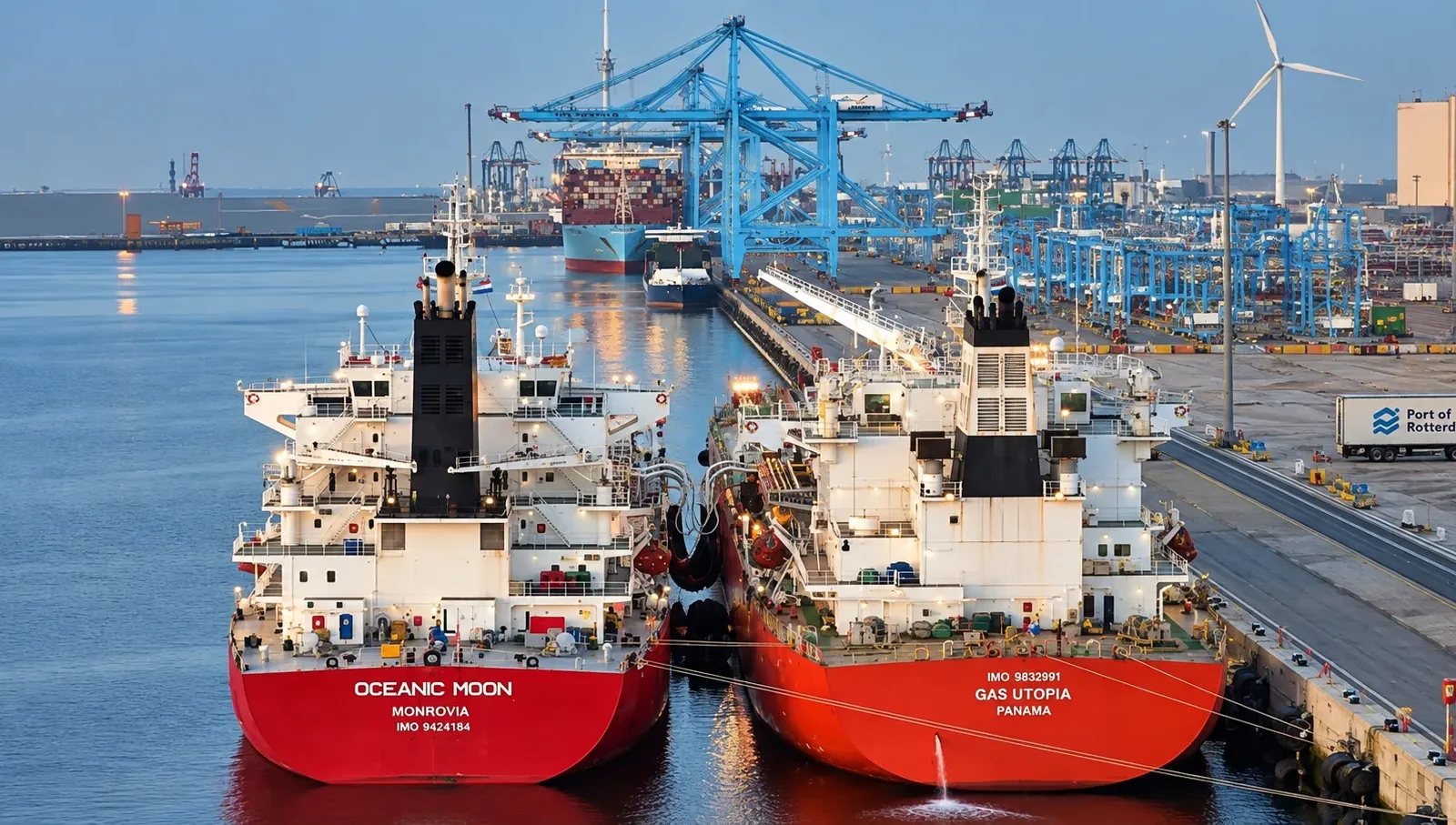
In April 2025, the Port of Rotterdam conducted a ship-to-ship ammonia transfer pilot involving approximately 800 m³ of liquid ammonia at -33°C.
The detailed project findings were published in May 2026.
The Port of Rotterdam says the demonstration showed that ammonia bunkering can be conducted safely when supported by strong planning, equipment, procedures and a regulatory safety framework.
But the most useful parts of the report are not the headline.
They are the operational lessons.
1. Existing LNG transfer equipment was not ideal
The project found that transfer equipment borrowed from LNG operations was cumbersome for ammonia service.
The conclusion was straightforward: purpose-designed ammonia equipment will be needed as operations mature.
2. Clearing ammonia from hoses was difficult
Removing residual ammonia from transfer hoses at the end of the operation proved to be a technical challenge requiring further development.
3. Dedicated bunker barges could simplify operations
The report found that using a seagoing ammonia carrier for bunkering introduces more complexity than a purpose-built or adapted ammonia bunker barge.
This is exactly the kind of detail that determines whether a future fuel becomes commercially scalable.
The industry does not need only a demonstration that ammonia can be transferred. It needs repeatable procedures that can be executed safely, efficiently and economically hundreds of times across different terminals and weather conditions.
For the conventional bunker process and the operational importance of fuel documentation, sampling and delivery controls, see Tide Signal’s Bunkering Operations guide.
Why ammonia marine fuel safety is different
Ammonia’s most obvious shipboard challenge is toxicity.
A leak is therefore not managed in exactly the same way as a conventional bunker spill.
The design philosophy has to consider human exposure as well as fire, machinery and environmental risks.
Important safeguards can include:
- segregated fuel systems;
- double-wall piping where required;
- gas detection;
- ventilation;
- controlled release arrangements;
- emergency shutdown systems;
- appropriate materials;
- personal protective equipment;
- safe escape and muster arrangements;
- fuel-system isolation; and
- strict maintenance procedures.
Lloyd’s Register identifies toxicity, leaks and potential corrosive damage among the principal safety concerns around ammonia as marine fuel.
The challenge is not impossible.
Shipping already has decades of experience transporting ammonia as cargo.
But using a substance continuously as fuel introduces new interfaces: engine-room systems, bunkering frequency, fuel preparation, maintenance, ventilation and routine crew exposure.
Does ammonia fuel really eliminate emissions?
This question needs a more precise answer than “yes” or “no”.
CO₂ at the ship
Ammonia contains no carbon, so burning the ammonia molecule does not generate conventional CO₂ from the fuel itself.
Lifecycle emissions
The upstream production pathway can still create substantial greenhouse-gas emissions.
For that reason, the commercial value of ammonia increasingly depends on whether the fuel is produced through a genuinely low-emission pathway.
This is one reason lifecycle-GHG rules under future IMO regulation matter so much. Tide Signal’s latest IMO Net-Zero negotiations analysis explains why fuel lifecycle methodology remains one of shipping’s unresolved regulatory questions.
NOx, N₂O and ammonia slip
Carbon dioxide is not the only emission that matters.
Ammonia combustion can create nitrogen-related emissions, including NOx, while nitrous oxide — N₂O — can materially affect the climate case if it is not properly controlled.
Unburned ammonia can also escape through the exhaust as ammonia slip.
This means that a successful ammonia engine needs more than the ability to produce power.
It must control the complete emissions profile.
The IMO’s Pollution Prevention and Response Sub-Committee has already begun adapting the NOx Technical Code to non-carbon fuels such as hydrogen and ammonia, while ammonia-containing effluent remains an active regulatory issue.
See the IMO PPR 13 summary.
The ammonia engine challenge
Ammonia does not behave like conventional marine diesel inside an engine.
Its combustion characteristics create technical challenges around ignition, combustion stability and emissions control.
Many proposed marine-engine configurations therefore use ammonia together with a smaller quantity of pilot fuel.
The engineering objective is not merely to make the engine run.
It must run:
- reliably across load ranges;
- with acceptable fuel consumption;
- with controlled NOx and N₂O;
- with minimal ammonia slip;
- without creating unacceptable maintenance exposure; and
- within an approvable safety architecture.
This is why the 17 September IMO programme includes separate sessions on both engine technology and engine certification.
An engine can be technically innovative yet still face a difficult route to shipboard approval if the complete installation cannot demonstrate an acceptable level of safety.
What ports need before ammonia can scale
The alternative-fuel transition is often discussed as if it were principally a newbuilding problem.
It is also a port-infrastructure problem.
A regular ammonia bunker market needs:
- reliable fuel supply;
- storage infrastructure;
- transfer equipment;
- bunker vessels;
- terminal procedures;
- permit systems;
- emergency-response capability;
- trained personnel;
- compatible ship/shore interfaces; and
- commercially viable fuel volumes.
If only a handful of ports can safely supply ammonia, a shipowner faces a routing problem even if the vessel itself is technically ready.
If ports build infrastructure before sufficient ship demand exists, they face an investment-risk problem.
This creates the familiar alternative-fuel chicken-and-egg challenge:
↕
FUEL SUPPLIERS NEED DEMAND
↕
PORTS NEED VOLUME
↕
SHIPYARDS NEED OWNER ORDERS
↕
OWNERS NEED REGULATORY CERTAINTY
What ammonia means commercially for shipowners
The decision to order an ammonia-capable ship cannot be reduced to an engine price.
Owners need to think about the whole asset.
| Decision area | Commercial question |
|---|---|
| Fuel availability | Will low-GHG ammonia exist in the ports and volumes required by the ship’s trade? |
| Fuel price | Can the fuel premium be recovered through charter rates or avoided compliance costs? |
| Tank arrangement | How much cargo space, deadweight or design flexibility is lost? |
| CAPEX | What premium is required for engines, tanks, piping, safety systems and class? |
| Crew | Can trained personnel be recruited and retained? |
| Bunkering | Can the ship obtain fuel safely without excessive deviation or waiting? |
| Regulation | How will IMO, EU ETS, FuelEU and future lifecycle-GHG rules value the fuel? |
| Residual value | Will the propulsion system remain commercially attractive over a 20–25 year asset life? |
This is why decarbonisation is already a finance issue rather than only an environmental one.
Tide Signal’s Shipping Finance and Carbon Risk analysis examines how future fuel flexibility, compliance exposure and asset employability can feed into financing and residual values.
Ammonia versus conventional marine fuel: the strategic trade-off
| Area | Ammonia | Conventional fuel |
|---|---|---|
| Carbon in fuel molecule | No | Yes |
| CO₂ from fuel carbon | No conventional CO₂ from ammonia molecule | Significant |
| Lifecycle result | Highly dependent on production pathway | High fossil lifecycle GHG |
| Toxicity risk | Major design and operational consideration | Different and generally more familiar hazard profile |
| Infrastructure | Marine bunkering network still developing | Mature global bunker network |
| Crew experience | Limited fuel-service experience | Extensive industry experience |
| Regulatory maturity | Interim framework developing | Established |
What shipping should watch during and after CCC 12 week
- Production: whether credible low-GHG ammonia supply can scale fast enough for deep-sea shipping.
- Bunkering: what Rotterdam’s full-scale demonstration says about repeatable commercial operations.
- Engines: progress on efficiency, certification, pilot fuel, NOx, N₂O and ammonia slip.
- Ship operation: early lessons from ammonia dual-fuel vessels entering service.
- Safety: how technical rules translate into onboard procedures.
- Training: how STCW.7/Circ.27 begins influencing company and flag-State training programmes.
- Effluent: how IMO develops rules for ammonia-containing waste streams.
- Ports: which major bunker hubs move from pilots to project-based or commercial supply.
- Lifecycle GHG: how IMO eventually values different ammonia production pathways.
- Economics: whether compliance value can close the price gap against conventional marine fuel.
Ammonia as marine fuel FAQ
Can ammonia be used as a marine fuel?
Yes. Ammonia can be used in specially designed marine propulsion systems, including dual-fuel engines. The first ammonia dual-fuel gas carrier entered service in 2026, while additional projects are under development.
Why is ammonia considered for shipping?
Ammonia contains no carbon and can offer very low lifecycle greenhouse-gas emissions when produced using sufficiently low-emission energy. It may therefore provide a pathway for reducing the climate impact of long-distance shipping.
Is ammonia marine fuel zero-carbon?
The ammonia molecule contains no carbon, so its combustion does not create conventional CO₂ from fuel carbon. However, the lifecycle GHG result depends strongly on how the ammonia is produced, transported and used.
Is ammonia dangerous on ships?
Ammonia is toxic and requires specialised containment, detection, ventilation, isolation, protective equipment and emergency procedures. IMO and classification societies are developing safety frameworks specifically for its use as marine fuel.
What are the IMO guidelines for ammonia fuel?
IMO’s current framework includes MSC.1/Circ.1687, the Interim Guidelines for the Safety of Ships Using Ammonia as Fuel, as well as separate guidance relevant to ammonia cargo used as fuel.
Do seafarers need special training for ammonia fuel?
IMO issued STCW.7/Circ.27 in July 2026 containing interim guidance for training seafarers on ships using ammonia as fuel.
What is ammonia bunkering?
Ammonia bunkering is the transfer of ammonia to a vessel for use as marine fuel. It can potentially use ship-to-ship, truck-to-ship or terminal-based arrangements depending on the port and vessel configuration.
Has ammonia bunkering been tested?
Yes. The Port of Rotterdam conducted a large-scale ship-to-ship ammonia transfer demonstration in 2025 and published detailed findings in 2026.
Does ammonia produce NOx?
Ammonia combustion can produce nitrogen-related emissions including NOx. Engine design, combustion control and after-treatment therefore remain important parts of ammonia propulsion development.
What is ammonia slip?
Ammonia slip refers to unburned ammonia escaping from a combustion or fuel system. It must be controlled because of ammonia’s toxicity and environmental impact.
What is CCC 12?
CCC 12 is the 12th session of the IMO Sub-Committee on Carriage of Cargoes and Containers, scheduled for 14–18 September 2026.
Is CCC 12 introducing new ammonia rules?
The ammonia technical seminar takes place in the margins of CCC 12. CCC 12 itself has a broader formal agenda covering cargoes, containers and alternative-fuel safety work. The seminar should not be described as a formal adoption session for a new ammonia-fuel code.
- IMO — Technical Seminar on the use of ammonia as marine fuel
- IMO — Provisional Programme, 17 September 2026
- IMO Future Fuels and Technology — Alternative Fuel Safety Guidelines
- IMO — MSC.1/Circ.1687, Interim Guidelines for Ships Using Ammonia as Fuel
- IMO — Preparing Seafarers for the Energy Transition
- Port of Rotterdam — Ammonia Bunkering Demonstration Report
- Lloyd’s Register — Delivery of MGC ANTWERPEN
- IMO — PPR 13: Non-carbon fuels, NOx and ammonia effluent work
Reporting status: 12 September 2026. The IMO ammonia seminar is scheduled for 17 September and CCC 12 for 14–18 September. Tide Signal will update this guide where substantive regulatory, technical or operational developments emerge. Interim guidance may evolve as IMO gains practical experience from ammonia-fuelled vessels.
Photo: Bob van Bruggen / IJsbreker.TV / Port of Rotterdam