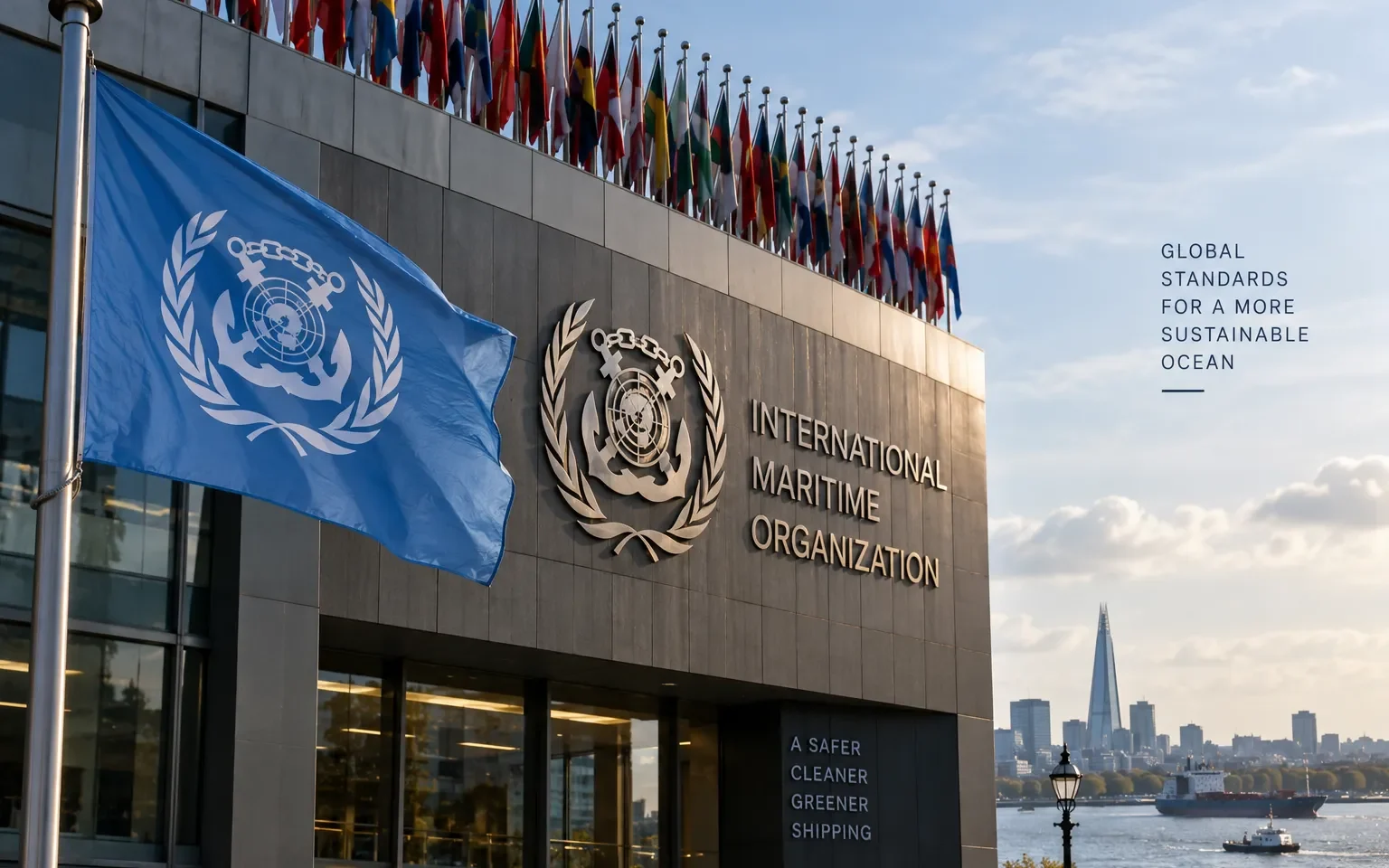
IMO Net-Zero talks 2026 ended on 4 September without the convergence needed to close the most important implementation questions around shipping’s proposed global carbon regime.
Nearly 1,200 participants registered for ISWG-GHG 22 in London. The group discussed proposals aimed at addressing concerns with the draft amendments to MARPOL Annex VI, but the supporting implementation guidelines were deferred to ISWG-GHG 23 on 23–27 November. Work on the lifecycle-GHG framework was also pushed to the same meeting because the group ran out of time.
The next regulatory sequence is now compressed into less than two weeks: ISWG-GHG 23 on 23–27 November, MEPC 85 on 30 November–3 December, and the possible resumption of the adjourned extraordinary MEPC session on 4 December, subject to what happens at MEPC 85.
For the shipping industry, the central issue is not whether the IMO has abandoned the Net-Zero Framework. It has not. The issue is that owners, charterers, fuel suppliers, lenders and yards are still planning against a draft whose core economic architecture is visible, but whose final implementation remains unsettled.
IMO NET-ZERO TALKS 2026 — WHERE THINGS STAND
| ISWG-GHG 22 | 1–4 Sep 2026 |
| Participants | Nearly 1,200 |
| Implementation guidelines | Deferred |
| Lifecycle-GHG work | Deferred |
| ISWG-GHG 23 | 23–27 Nov |
| MEPC 85 | 30 Nov–3 Dec |
| Extraordinary session | Potentially 4 Dec |
Important: no new global carbon tax took effect on 4 September. No ship acquired a new payment obligation because ISWG-GHG 22 ended. The $100 and $380 figures discussed below belong to the current draft text and are not yet a final legally binding 2026 charge.
IMO Net-Zero Talks 2026: What Happened at ISWG-GHG 22?
The official IMO summary of ISWG-GHG 22 says delegations considered proposals submitted to MEPC 84, MEPC 85, previous ISWG-GHG sessions and the September meeting itself.
The purpose was to address concerns raised over the draft MARPOL Annex VI amendments that contain the IMO Net-Zero Framework.
The Chair reported a willingness among delegations to make further progress and to work toward text that can be presented to MEPC 85. But that is not the same as final convergence.
Delegations were invited to continue consultations between meetings and submit concrete proposals that could produce greater alignment.
For commercial shipping, this means the negotiating text is still alive — but the final architecture remains politically and technically open.
What Was Not Settled This Week?
Three areas are especially important.
1. The framework amendments still need political convergence
The September meeting did not produce a final compromise that removes the concerns surrounding the draft MARPOL amendments.
2. The implementation guidelines were pushed to November
The group held only a preliminary exchange on the detailed guidelines because time became a limiting factor. All documents under that agenda item were deferred to ISWG-GHG 23.
3. The lifecycle-GHG agenda was also deferred
The IMO Life Cycle GHG Assessment framework is critical because the proposed regime measures fuel emissions on a well-to-wake basis rather than only at the ship’s exhaust.
That changes how fuels are compared.
A fuel can look attractive onboard but less attractive once production, processing, transport and upstream emissions are included.
The fact that this work remains open is commercially important for LNG, biofuels, methanol, ammonia, hydrogen-derived fuels and other pathways competing for long-term investment.
What Does the Current IMO Net-Zero Framework Draft Still Contain?
The current framework was approved in draft form at MEPC 83 in April 2025 as a new chapter of MARPOL Annex VI. The extraordinary adoption session in October 2025 was then adjourned for a year.
The official IMO Net-Zero Framework FAQ describes two linked elements:
- A global marine fuel standard requiring ships to reduce annual GHG Fuel Intensity over time.
- A global economic measure using GHG pricing to create a financial incentive for lower-emission operation and fuels.
The framework is intended to apply to oceangoing ships above 5,000 GT, which IMO says represent more than 85% of global shipping emissions.
For the full structure, targets and worked cost example, Tide Signal already maintains a separate evergreen explainer: IMO Net-Zero Framework: The $380 Shipping Cost That Could Reshape the Fleet.
This article focuses on the new September negotiations and what remains unresolved.
The $100 and $380 Shipping Carbon Prices Are Still Draft Numbers
One of the most commercially sensitive parts of the draft is the two-tier remedial-unit structure.
The current draft MARPOL text circulated by IMO sets an initial Tier 1 remedial-unit price of $100 per tonne of CO2-equivalent and a Tier 2 price of $380 per tonne of CO2-equivalent for the reporting periods identified in the draft as 2028–2030.
| Draft mechanism | Current draft price | Commercial meaning |
|---|---|---|
| Tier 1 remedial unit | $100/tCO2eq | Applies to the Tier 1 compliance deficit under the draft structure |
| Tier 2 remedial unit | $380/tCO2eq | One route for balancing the deeper Tier 2 deficit |
The current draft also allows Tier 2 deficits to be balanced using eligible surplus units transferred from other ships, banked units from earlier reporting periods, and/or Tier 2 remedial units.
That makes the system more complex than a flat “global carbon tax”.
It is a performance-based compliance market tied to the ship’s annual GHG Fuel Intensity and energy use.
The draft prices remain strategically important because they give owners a reference point for comparing the cost of conventional fuel against cleaner fuels, retrofits and future vessel designs.
But after the September meeting, they should still be treated as draft regulatory economics, not guaranteed future invoices.
Why the 2028 Dates in the Draft Need Caution
The circulated draft was written around reporting periods beginning in 2028.
However, the framework has not yet been adopted.
IMO’s own FAQ says MARPOL amendments would normally enter into force 16 months after adoption under the tacit acceptance procedure.
That creates an obvious timing issue.
If adoption occurs later than originally planned, the implementation calendar may need to be reconciled with the legal entry-into-force process.
For owners making 2027–2030 fleet plans, the prudent position is therefore not to assume that every date in the 2025 draft will survive unchanged.
The IMO Carbon Decision Calendar: November Could Be Decisive
| Date | Meeting | What to watch |
|---|---|---|
| 23–27 Nov | ISWG-GHG 23 | Implementation guidelines, lifecycle-GHG work, compromise proposals |
| 30 Nov–3 Dec | MEPC 85 | Whether the committee can translate technical work into political convergence |
| 4 Dec | Possible resumed extraordinary MEPC session | Potential next adoption step, subject to MEPC 85 discussions |
This timetable matters because investment decisions cannot be paused until regulation becomes perfect.
Shipyards are still selling slots. Banks are still pricing loans. Charterers are still signing long-term contracts. Fuel producers are still deciding which infrastructure deserves capital.
Regulatory uncertainty therefore has a real cost even before any carbon payment begins.
What Should Shipowners Do Before November?
The wrong response is to pretend the framework is already final.
The other wrong response is to ignore it until adoption day.
A more useful approach is to model several scenarios.
Map fuel use, age, CII exposure, retrofit options and likely remaining commercial life.
Test multiple fuel pathways instead of assuming one regulatory winner.
Stress-test debt service and asset value under higher compliance-cost assumptions.
Review who controls fuel, speed, route and compliance decisions under the contract.
Tide Signal’s CII in Shipping guide is useful here because it shows how operational choices already affect a ship’s carbon-intensity rating today, even though CII and the future GFI framework are not the same system.
Charterers May Become Central to Who Ultimately Pays
The draft framework explicitly recognises that operational responsibility can involve decisions over fuel, cargo, route and speed.
Those decisions do not always sit with the registered owner.
A time charterer may choose bunkers and commercial speed. A voyage charterer may influence voyage pattern and port exposure. A ship manager may control technical implementation. A registered owner may remain the regulated entity while commercial cost is negotiated elsewhere.
That makes contractual allocation one of the industry’s next major battlegrounds.
Tide Signal’s Types of Charter Parties explains why the same ship can move between very different allocations of fuel, voyage cost and commercial control.
The regulatory rule may be global. The invoice allocation will still be negotiated contract by contract.
Why Banks and Vessel Values Care Before the Rule Is Final
Shipping finance is forward-looking.
A lender financing a ship today is not only looking at the next twelve months of freight.
It is looking at:
- future fuel cost;
- efficiency;
- remaining economic life;
- charterability;
- retrofit potential;
- residual asset value;
- regulatory exposure.
If two similar ships have very different future compliance economics, their financing and resale values may diverge even before the rules fully take effect.
Tide Signal’s Shipping Finance in 2026: Why Carbon Exposure Is Becoming a Financial Risk explores that link between regulation, financing and asset value.
The practical risk is not only the cost of remedial units.
It is the possibility of owning an asset whose future chartering economics become less competitive than newer or more flexible tonnage.
Fuel Choice Is Still a Capital-Allocation Problem
The current draft uses well-to-wake GHG Fuel Intensity, which means shipping cannot evaluate future fuels on stack emissions alone.
That is one reason the lifecycle-GHG methodology matters so much.
Different production pathways for the same nominal fuel can produce very different lifecycle emissions.
The decision is therefore not simply:
“Which engine can burn methanol, ammonia or LNG?”
It is:
Which fuel pathway will be available, certifiable, economically viable and compliant across the commercial life of the ship?
This is also why alternative propulsion studies matter. Tide Signal’s analysis of the Maersk nuclear-powered UK–US corridor study shows how shipping is exploring radically different long-term energy options as regulation, fuel availability and vessel economics evolve together.
How Is the IMO Net-Zero Framework Different From CII?
| CII | Draft Net-Zero Framework |
|---|---|
| Already in force | Not yet adopted |
| Operational carbon-intensity rating | Fuel GHG intensity + economic compliance mechanism |
| A–E annual rating | Base/direct targets, deficits, surplus/remedial units |
| CO2-focused transport-work metric | Well-to-wake GHG approach including CO2eq |
Owners should therefore avoid treating the future IMO framework as “CII with a price”.
It is a different compliance architecture.
Can Owners Model the Commercial Impact Today?
Yes — but only as scenarios.
A simple commercial model can take:
- annual energy use;
- fuel GHG intensity;
- assumed target level;
- draft remedial-unit price;
- fuel premium for alternatives;
- retrofit CAPEX;
- expected charter differential;
and compare the outcomes.
At voyage level, Tide Signal’s Voyage Margin Calculator can be used to stress-test an additional voyage-cost assumption alongside freight, bunker and port costs. It is not an IMO compliance calculator, but it helps show how a future regulatory cost could feed into voyage economics.
Five Questions That Could Move Shipping in November
- Do member states converge on the core amendments? Without political convergence, technical guidance alone cannot settle the framework.
- How are the implementation guidelines finalised? Registry, verification, units, transfers and compliance processes will determine how complex the system is to operate.
- What happens to lifecycle-GHG accounting? Fuel pathways can gain or lose competitiveness depending on methodology.
- Do the $100 and $380 draft prices survive? These numbers already influence scenario planning even though they are not final.
- What becomes of the original 2028 timetable? Adoption timing and the 16-month MARPOL process may require the implementation calendar to be adjusted.
Tide Signal Analysis: The Delay Is Now Part of the Cost
The shipping industry usually talks about decarbonisation cost in dollars per tonne, fuel premiums and retrofit CAPEX.
There is another cost: uncertainty itself.
Owners ordering ships now are making decisions that can last twenty years.
Fuel suppliers need enough confidence to build production and bunkering infrastructure. Banks need to estimate residual values. Charterers need to decide whether long-term contracts should include carbon-cost pass-through mechanisms.
Every month without final rules makes those decisions harder.
That does not mean the IMO should adopt a weak system simply to create certainty.
It means the commercial value of a credible, implementable agreement rises as the timetable tightens.
The $380 figure attracts the headline. The real market risk is that owners still do not know exactly what compliance architecture will sit around it.
Frequently Asked Questions
Did IMO approve a global shipping carbon tax on 4 September 2026?
No. ISWG-GHG 22 was a negotiating and technical working-group meeting. No new global carbon payment became legally binding on 4 September.
What happened at ISWG-GHG 22?
Delegations discussed proposals addressing concerns with the draft Net-Zero Framework. The implementation-guideline documents and lifecycle-GHG work were deferred to ISWG-GHG 23 in November.
When is the next IMO Net-Zero meeting?
ISWG-GHG 23 is scheduled for 23–27 November 2026, immediately before MEPC 85 on 30 November–3 December.
What happens on 4 December?
The adjourned extraordinary MEPC session is scheduled to resume on 4 December, subject to discussions and confirmation at MEPC 85.
What are the $100 and $380 IMO prices?
They are the Tier 1 and Tier 2 remedial-unit benchmark prices in the current draft MARPOL text for the draft reporting periods 2028–2030. They are not yet final legally binding 2026 charges.
Is the IMO Net-Zero Framework already law?
No. The framework was approved in draft form at MEPC 83 in April 2025 but formal adoption was not completed at the October 2025 extraordinary session.
Which ships would the framework cover?
The current framework is designed for oceangoing ships above 5,000 GT, subject to the draft’s detailed scope and exclusions.
What is GHG Fuel Intensity?
GHG Fuel Intensity measures greenhouse-gas emissions per unit of energy on a well-to-wake basis, taking lifecycle emissions into account.
Is this the same as CII?
No. CII is an existing operational carbon-intensity rating. The draft Net-Zero Framework combines a fuel-GHG-intensity standard with an economic compliance mechanism.
Tide Signal Decarbonisation Reading Path
- IMO Net-Zero Framework — full mechanics, GFI targets and $100/$380 draft structure.
- CII in Shipping — the carbon-intensity regime already affecting ships today.
- Shipping Finance in 2026 — how carbon exposure can affect financing and asset values.
- Maersk Nuclear-Powered UK–US Route Study — how alternative propulsion may reshape long-term fleet strategy.
- Voyage Margin Calculator — stress-test additional voyage-cost assumptions.
- Types of Charter Parties — understand who controls fuel, route, costs and commercial decisions.
Primary Sources
- IMO — ISWG-GHG 22 Meeting Summary, 1–4 September 2026
- IMO — Net-Zero Framework FAQs
- IMO — Circular Letter No.5005, Draft Revised MARPOL Annex VI
- IMO — MEPC 83, Draft Framework Approval
- IMO — October 2025 Extraordinary Session Adjournment
Reporting status: 5 September 2026. The IMO Net-Zero Framework remains under negotiation. Draft prices, dates, thresholds and implementation mechanisms may change before adoption and entry into force. This article is maritime regulatory and commercial analysis, not legal, compliance or investment advice.