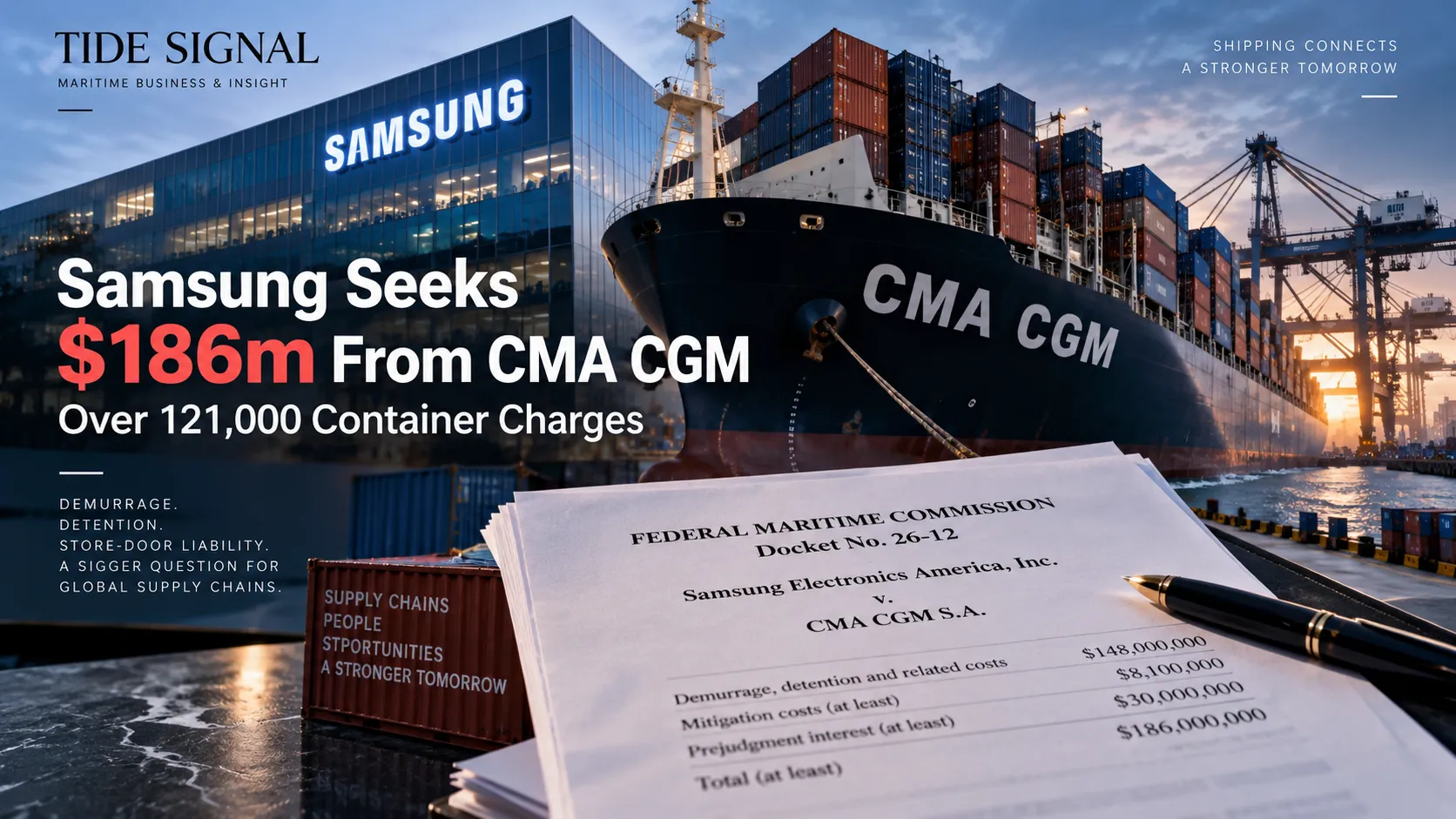
Samsung Seeks $186m From CMA CGM in one of the largest container-billing disputes now before the Federal Maritime Commission, with more than 121,000 demurrage, detention and related charges at the centre of the case.
Samsung Electronics America says CMA CGM repeatedly failed to complete the inland leg of prepaid store-door shipments during the severe US supply-chain disruption that began in 2020, then transferred demurrage, detention, rail-storage and mitigation costs back to Samsung.
The allegations are serious, but the legal position is equally important: CMA CGM has not been found liable. The claims come from Samsung’s verified complaint, and the FMC has not yet ruled on the merits.
The proceeding is FMC Docket No. 26-12. The complaint was served on 1 September 2026 and the case is moving through the Commission’s administrative process.
SAMSUNG v. CMA CGM — CASE SNAPSHOT
- Claimed reparations: at least $186m
- Demurrage, detention, rail storage and related costs: $148m
- Mitigation costs: at least $8.1m
- Prejudgment interest: at least $30m
- Demurrage charges: more than 26,000
- Detention-type charges: more than 94,000
- Total related charges: more than 121,000
- Proceeding: FMC Docket 26-12
Why Samsung Seeks $186m From CMA CGM
Samsung’s verified complaint filed with the Federal Maritime Commission seeks a cease-and-desist order and reparations for alleged Shipping Act violations.
The company calculates at least $186m in claimed damages, split across several categories.
| Claimed loss category | Amount |
|---|---|
| Demurrage, detention, rail storage and associated costs | $148m |
| Costs to perform or mitigate inland transport | At least $8.1m |
| Prejudgment interest | At least $30m |
| Additional losses | Not fully quantified |
Samsung says it attempted to resolve the dispute before filing at the FMC, including meetings during 2025 and 2026.
Legal status: the figures above are allegations and claimed damages. The FMC has not determined that CMA CGM violated the Shipping Act or owes Samsung the amount claimed.
What Store-Door Delivery Actually Means
The central commercial issue is not simply whether a container stayed too long at a terminal.
It is who had contractual responsibility for moving it inland.
In a typical port-to-port or container-yard move, the carrier performs the ocean leg and the shipper or consignee arranges the inland transport, depending on the agreed terms.
Store-door transportation goes further. Under the model described in Samsung’s complaint, the carrier issues a through bill of lading or sea waybill with an inland place of delivery and undertakes to arrange the transport beyond the discharge port.
| Transport structure | Typical inland responsibility |
|---|---|
| Port-to-port / CY | Shipper or consignee arranges inland movement, subject to contract |
| Store-door / through move | Carrier undertakes inland delivery under the through transport arrangement |
Samsung’s argument is straightforward: if CMA CGM sold and accepted prepaid store-door transport, Samsung says the carrier also assumed responsibility for arranging the inland movement and should not have shifted all delay-related costs back to the cargo owner when that network failed.
How More Than 121,000 Container Charges Built Up
The complaint describes a dispute spread across several years of US imports rather than a handful of invoices.
Samsung alleges:
- more than 26,000 demurrage charges;
- more than 94,000 detention-type charges;
- rail-storage costs;
- charges associated with chassis shortages and terminal congestion;
- costs after some store-door moves were allegedly treated as merchant-haulage or CY moves;
- empty-container return problems;
- duplicate, rebilled or disputed invoices.
That scale changes the case.
A dispute over several invoices can be a billing disagreement. A dispute involving more than 121,000 charges is an examination of how a transport and billing system allocated the cost of disruption.
The $186m is the headline. The 121,000 charges are the structural story.
What the Samsung Complaint Says Happened
The filing gives specific examples of how relatively ordinary inland disruptions allegedly turned into very large bills.
A single container allegedly generated $162,799 in rail storage
Samsung describes one store-door shipment from Busan to The Colony, Texas, that moved through Long Beach. According to the complaint, the inland store-door movement was later terminated and the container accumulated $162,799.38 in rail storage.
One rail-ramp episode allegedly created $3.75m in charges
Samsung also describes multiple containers arriving at an inland rail ramp in September 2021 but not being mounted on chassis for more than two weeks because of a chassis shortage.
The company attributes approximately $3.748m in charges to that episode.
Savannah and Houston cases added further six-figure exposure
The complaint includes three Savannah containers that allegedly accumulated $259,724.02 in demurrage, another six-container Savannah example involving $206,880, and eight Houston containers that allegedly produced $134,210 during a chassis shortage.
These examples remain allegations. Their importance is that they illustrate the practical question the FMC may have to address: should daily charges continue when the billed party lacks the practical ability to move the container?
Demurrage and Detention Are Meant to Move Cargo — Not Just Generate Charges
The FMC has long treated demurrage and detention through an incentive principle: the charges should encourage the movement of cargo and equipment.
The Commission’s official detention and demurrage guidance explains the regulatory framework surrounding these charges.
Samsung argues that many of the disputed invoices could not have served a meaningful incentive function because Samsung allegedly lacked control over chassis availability, rail transport, carrier-selected subcontractors or empty return locations.
This is the central operational issue behind the litigation.
The question is not simply:
Was the box late?
It is:
Could the party being billed realistically do anything to stop the charge from continuing?
Samsung Also Challenges Cargo and Credit Holds
Samsung’s complaint goes beyond D&D billing.
It alleges that CMA CGM used account suspensions, credit holds and cargo holds to seek payment of disputed balances, including situations where unrelated containers were affected.
One example cited by Samsung concerns a 2022 hold affecting 40 containers in New York/New Jersey while another disputed balance was being contested.
Samsung characterises those practices as unreasonable and coercive.
The FMC has not ruled on that claim.
For a large BCO, however, the commercial implication is obvious: a disputed invoice becomes much more serious if it can interrupt the release or movement of unrelated cargo.
The Case Is Also About the Quality of Container Invoices
Samsung alleges that some invoices failed to provide enough information to identify why a charge arose or who controlled the delay.
The complaint also alleges duplicate or rebilled charges and shortcomings in the dispute process.
That sits within a broader regulatory shift. The FMC’s Demurrage and Detention Billing Practices Rule strengthened invoice-content and dispute-process requirements in the United States.
Because Samsung’s allegations span several years beginning in 2020, individual charges can fall under different regulatory periods. That makes the evidentiary record more complicated than simply applying today’s rule retrospectively to every invoice.
The Shipping Act Question in FMC Docket 26-12
Samsung’s complaint relies heavily on Section 41102(c) of the Shipping Act, which requires covered carriers and other regulated entities to maintain just and reasonable practices connected with receiving, handling, storing and delivering property.
Samsung alleges two broad categories of misconduct:
- unreasonable demurrage, detention, rail-storage and related billing;
- unreasonable practices around inland transport, store-door conversion, cargo holds, invoicing and dispute resolution.
The FMC proceeding will determine whether the evidence supports those allegations and what relief, if any, is appropriate.
The official case documents can be followed through the FMC Reading Room.
Why the Case Is Bigger Than One Importer and One Carrier
Large beneficial cargo owners increasingly buy integrated logistics rather than a simple port-to-port ocean slot.
A single carrier product may cover:
origin → marine terminal → ocean vessel → US port → rail → drayage → distribution centre.
That integration is commercially attractive because it reduces the number of separate transport contracts a cargo owner needs to manage.
But it creates a harder liability question when the inland network fails.
If a container sits at a rail ramp because the carrier’s contracted network cannot provide a chassis, who should bear the resulting storage cost?
If the carrier cannot perform the store-door move it sold, can it later convert the shipment to merchant haulage and shift the cost to the shipper?
If a charge is disputed, how much information must the carrier provide before it can use a credit or cargo hold?
Those are the questions that make the case relevant to carriers, forwarders, BCOs, railroads, truckers, terminals and maritime lawyers.
Ocean Freight Is Only One Layer of the Container Bill
This case also shows why importers should not confuse an ocean freight benchmark with their total logistics exposure.
Tide Signal’s Container Shipping Rates 2026 page tracks current 40ft spot benchmarks across major trade routes.
Those rates help answer what the ocean movement costs.
They do not tell an importer what happens if the box remains at a terminal or rail ramp after free time expires.
That is the difference between freight cost and exception cost.
When disruptions last days or weeks, exception cost can overwhelm the original freight rate.
Container Demurrage Is Different From Voyage-Charter Demurrage
The word “demurrage” appears in different parts of shipping.
In a tanker or dry-bulk voyage charter, demurrage generally refers to liquidated compensation payable after agreed laytime expires.
In container logistics, demurrage generally refers to a container remaining at a terminal beyond free time. Detention generally refers to carrier equipment remaining outside the terminal beyond the allowed period before return.
Tide Signal’s Types of Charter Parties in Shipping explains the voyage-charter structure. The Samsung–CMA CGM dispute sits primarily in the container logistics and FMC regulatory framework.
What Importers Should Learn From Samsung v. CMA CGM
The claim is unusually large, but the operational lessons apply to much smaller cargo programmes.
Know exactly where the carrier’s responsibility ends
A booking that says store-door should be reviewed differently from a port-to-port or CY arrangement.
Identify who controls chassis and rail capacity
If the party paying a daily charge cannot control the resource causing the delay, disputes become far more likely.
Review free time and return options before cargo arrives
Demurrage and detention exposure can accelerate quickly once free time expires.
Document every failed pickup and empty-return attempt
Operational evidence can become critical when a charge is challenged months or years later.
Understand whether one disputed balance can affect other cargo
Credit-hold and cargo-release provisions can create much larger consequences than the original invoice.
The Commercial Lesson: Control and Cost Need to Be Aligned
The cleanest way to understand the case is through one word: control.
If one party controls the movement while another party absorbs the delay cost, the contract and billing structure need to explain that allocation clearly.
During the pandemic, container logistics became fragmented across terminals, railroads, chassis pools, truckers, warehouses and ocean carriers. Each handoff created another point where time could be lost.
Samsung is asking the FMC to decide whether CMA CGM transferred too much of the financial consequence of that disruption to the cargo owner while still carrying contractual responsibility for the inland movement.
If the case reaches a substantive ruling, it could influence how future store-door products are drafted, how major shippers document inland failures and how carriers handle D&D disputes.
What the Complaint Does Not Establish
- It does not establish that Samsung is entitled to $186m.
- It does not establish that every disputed charge was unlawful.
- It does not establish that every store-door obligation was breached.
- It does not establish that chassis shortages automatically make the carrier liable.
- It does not create a new FMC rule for every store-door shipment.
Those issues depend on evidence, contracts, tariffs, causation, billing records and applicable law.
What Happens Next?
The FMC has opened the proceeding and the case will move through administrative adjudication.
The Federal Register notice for Samsung Electronics America v. CMA CGM identifies the proceeding as Docket 26-12.
The next developments to watch include:
- CMA CGM’s formal response;
- orders from the administrative law judge;
- discovery and document production;
- the parties’ competing interpretation of store-door obligations;
- evidence on rail and chassis availability;
- the calculation of the claimed $186m;
- whether the case settles before a final decision.
Tide Signal Analysis: Samsung Seeks $186m From CMA CGM, but the Bigger Number Is 121,000
Samsung Seeks $186m From CMA CGM, but focusing only on the dollar amount misses the more important feature of the complaint.
The alleged problem occurred more than 121,000 times.
That turns a high-value commercial dispute into a test of a billing model.
Container lines have spent years expanding from ocean transport into integrated logistics. Store-door services are part of that strategy.
The advantage is obvious: one provider can coordinate a much larger part of the customer’s supply chain.
The risk is equally clear: the further the carrier extends its contractual role inland, the harder it becomes to separate the ocean service from the operational failures that happen beyond the terminal gate.
The FMC now has to examine where that responsibility sat in Samsung’s shipments and whether the charges that followed were lawful and reasonable.
When a carrier sells the journey to the door, the hardest question is not who touched the box last. It is who controlled the delay.
Frequently Asked Questions
Why does Samsung seek $186m from CMA CGM?
Samsung alleges that it paid or incurred large demurrage, detention, rail-storage and mitigation costs after CMA CGM allegedly failed to perform parts of prepaid store-door transportation. The FMC has not ruled on those allegations.
How many container charges are involved?
Samsung’s complaint refers to more than 26,000 demurrage charges and more than 94,000 detention-type charges, plus related costs — more than 121,000 charges in total.
Has CMA CGM been found liable?
No. The proceeding has begun, but the claims remain allegations. The FMC has not yet issued a final ruling on liability or damages.
What is store-door container shipping?
Store-door transportation is an integrated move in which the ocean carrier undertakes transport beyond the marine port to an inland delivery point under a through transport arrangement.
What is container demurrage?
Container demurrage generally applies when a container remains at a marine terminal beyond the applicable free period.
What is detention?
Container detention generally applies when carrier equipment is kept outside the terminal beyond the agreed free period before being returned.
Why is the FMC involved?
Samsung alleges that CMA CGM’s practices violated provisions of the US Shipping Act governing just and reasonable practices connected with cargo handling, storage and delivery.
Could the case affect other importers?
A ruling would apply to the dispute before the FMC, but its reasoning could influence how carriers and BCOs structure store-door contracts, billing procedures and disputes over inland delay.
Related Tide Signal Coverage
- Container Shipping Rates 2026 — current 40ft ocean freight benchmarks and the difference between a freight rate and the final logistics bill.
- Types of Charter Parties in Shipping — how maritime contracts allocate responsibility, time and cost.
- Voyage Margin Calculator — how transport costs change commercial margins and break-even economics.
Primary Sources and Further Reading
- Federal Maritime Commission — Samsung Electronics America v. CMA CGM, Verified Complaint, Docket 26-12
- Federal Register — Samsung Electronics America v. CMA CGM, Notice of Complaint and Assignment
- Federal Maritime Commission — Detention and Demurrage Guidance
- Federal Maritime Commission — Demurrage and Detention Billing Practices Rule
- Federal Maritime Commission — 2024 CMA CGM settlement in a separate billing matter
- Seatrade Maritime News — Samsung $186m complaint coverage
Reporting status: 4 September 2026. This article distinguishes Samsung’s allegations from findings by the Federal Maritime Commission. Tide Signal will update this report when CMA CGM files a substantive response or the FMC issues a material procedural or merits decision.