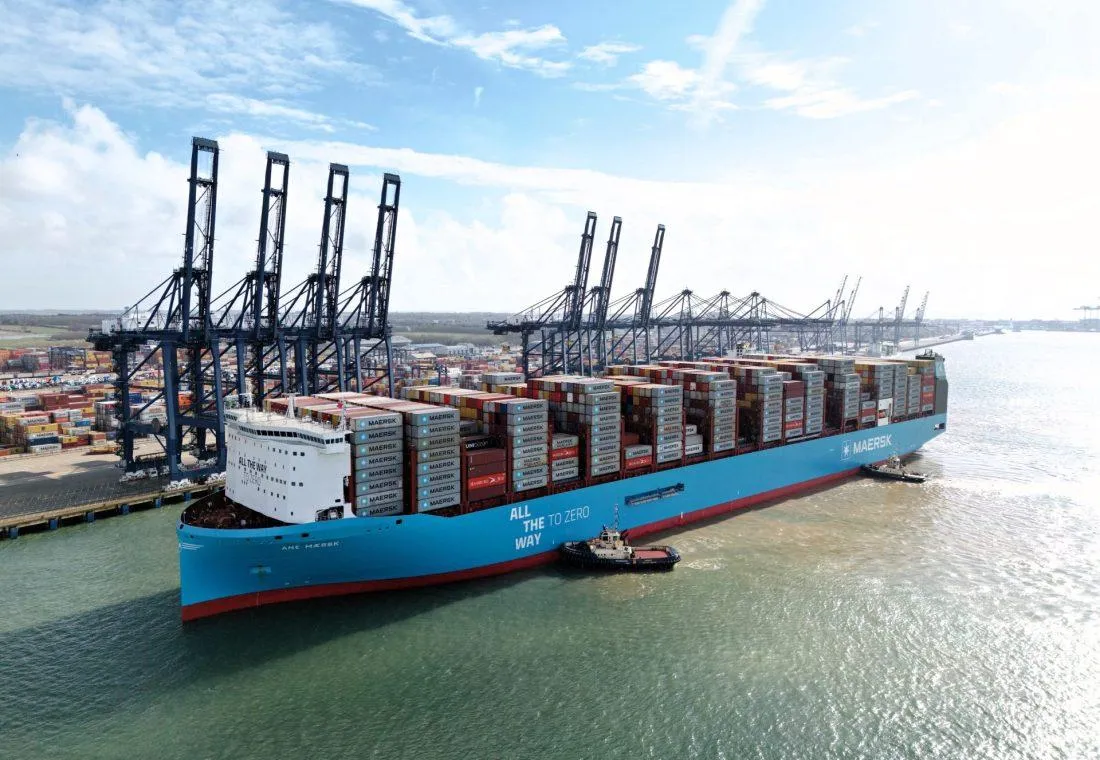
Maersk is exploring what it would take to make a nuclear-powered container route commercially possible between the United Kingdom and the United States. The “Pink Corridor” project, announced by Lloyd’s Register, A.P. Moller–Maersk, the Port of Felixstowe and the Port of Charleston, is not a ship order and it is not an approved liner service. It is an early-stage study into the regulatory, security, insurance and port-access barriers that would have to be solved before a nuclear-powered containership could operate across the Atlantic.
That distinction is the real story. The industry already knows that nuclear propulsion can work at sea. The harder question is whether a modern commercial shipping network can accept it: ports must be able to receive the ship, regulators must agree on safety and safeguards, insurers must understand the liability, emergency services must be prepared, and the vessel must remain commercially usable across jurisdictions.
STATUS — EARLY-STAGE STUDY
No vessel order · No reactor selected · No deployment date · No approved commercial nuclear-powered liner service
What Is the Nuclear-Powered “Pink Corridor”?
The Pink Corridor is a joint study built around a conceptual nuclear-powered container ship trading between Felixstowe in the UK and Charleston on the US East Coast.
According to Lloyd’s Register’s official announcement, the project is designed to identify the operational, security and safeguarding requirements that would need to be addressed before a nuclear maritime corridor could realistically be considered.
The work is focused on six areas that determine whether a nuclear-powered containership can move from concept to commercial operation:
- Port access for nuclear-powered merchant ships.
- Maritime and nuclear regulation across multiple authorities.
- Security and nuclear safeguards around the vessel and its fuel.
- Cyber resilience for safety-critical and connected systems.
- Emergency response at sea and during port calls.
- Insurance and liability regimes capable of covering a new risk profile.
The first phase is intended to identify practical gaps and future work. Its findings will help determine whether a second phase should examine engineering, legislation, regulation, security and safeguards in greater depth.
Why This Nuclear-Powered Project Matters More Than a Ship Concept
A nuclear-powered ship can be technically impressive and still be commercially unusable.
Container shipping depends on repeatability. A liner operator needs predictable port access, recognised certificates, clear emergency procedures, reliable insurance, trained personnel and a regulatory framework that does not break every time the ship crosses into a new jurisdiction.
That is why the Pink Corridor matters. It moves the discussion away from a reactor alone and toward the full operating system around the vessel.
For Maersk and other liner groups, the decisive question is not simply whether nuclear propulsion can provide energy at sea. It is whether a nuclear-powered containership can enter a port, work cargo, satisfy authorities, remain insured and continue its schedule without creating unacceptable regulatory or commercial uncertainty.
Tide Signal view: the key word in “Pink Corridor” is not only nuclear. It is corridor. The project is testing whether an entire trade lane can be made operationally and legally compatible with nuclear-powered merchant shipping.
1. Port Access Could Decide the Future of Nuclear-Powered Shipping
Port access is one of the most difficult practical questions.
A large containership does not operate in isolation. It enters dense commercial ports surrounded by terminals, tugs, pilots, cargo-handling equipment, port workers, local communities, emergency services and other vessels. A nuclear-powered ship therefore creates questions that extend far beyond the engine room.
Authorities would need clarity over where the vessel may berth, what security zones apply, which emergency plans are required, who has jurisdiction during the port call, what information must be exchanged before arrival and how the terminal should respond to abnormal conditions.
The involvement of Felixstowe and Charleston is therefore significant. The project is not being studied only from a naval architecture or classification perspective; two container ports are contributing the shoreside reality that any future nuclear-powered service would have to satisfy.
For wider operational context, Tide Signal’s Port State Control 2026 analysis shows how quickly a regulatory requirement can move from paperwork into real port-call exposure when documentation, equipment and crew readiness do not align.
2. Nuclear-Powered Ships Need a Modern Regulatory Framework
The international framework is not starting from zero. SOLAS Chapter VIII already contains basic requirements for nuclear ships and refers to the IMO Code of Safety for Nuclear Merchant Ships.
But the existing Nuclear Code dates from 1981 — long before today’s advanced reactor concepts, digital ship systems, modern cyber-security expectations and current decarbonization pressure.
That gap is now being addressed. At MSC 110, the International Maritime Organization tasked its Ship Design and Construction Sub-Committee with revising the Nuclear Code and reviewing amendments to SOLAS Chapter VIII. The IMO said the revision should reflect developments in nuclear technology and take relevant International Atomic Energy Agency standards into account.
The IMO’s MSC 110 summary is important because it shows that nuclear-powered merchant shipping is no longer being discussed only by technology developers. The global maritime rulemaking system is also examining how the safety framework needs to evolve.
For commercial deployment, that work will matter enormously. Owners and ports need more than technical confidence; they need rules that flag States, port States, class societies and insurers can interpret consistently.
3. Security and Nuclear Safeguards Change the Risk Model
Traditional ship security already deals with access control, restricted areas, cargo security, cyber threats and port-facility interfaces. Nuclear propulsion adds another layer because the power source itself becomes a security and safeguards issue.
A future nuclear-powered containership would require a clear framework for controlling access to sensitive systems, protecting nuclear material, maintaining safeguards, managing information and coordinating responsibility between maritime and nuclear authorities.
This is one reason the Pink Corridor has been tied to wider US–UK cooperation. The US–UK Technology Prosperity Deal explicitly identifies civil maritime applications of advanced nuclear energy, international standards and the potential establishment of a maritime shipping corridor between the two countries.
That government-level context matters. A nuclear-powered commercial route cannot be created by a shipowner and a reactor company alone. It requires regulatory recognition and state-level cooperation.
4. Cyber Resilience Becomes Part of Nuclear Safety
Cybersecurity is explicitly included in the Pink Corridor scope.
That is logical. Modern ships depend on connected navigation, communications, monitoring, automation, machinery management and shore-based support. In a nuclear-powered vessel, some digital systems may also sit close to safety-critical functions, making resilience, segregation, access control and recovery even more important.
The commercial issue is not only preventing a dramatic cyberattack. A nuclear-powered ship would need to prove that critical functions remain trustworthy when systems are degraded, communications fail, data is corrupted or a third-party platform becomes unavailable.
Tide Signal has already examined this wider shift in Maritime Cyber Risk in 2026: cyber risk is becoming an operational resilience issue, not simply an IT problem. Nuclear propulsion raises the consequences of that same principle.
5. Emergency Response Has to Work at Sea and in Port
Emergency response is another barrier that must be solved before normal commercial operation is realistic.
A nuclear-powered containership would need clearly defined procedures for incidents at sea, during pilotage, alongside a terminal and within port limits. Those procedures would have to connect the ship’s own emergency organisation with port authorities, national agencies, specialist responders and local emergency services.
Questions would include who takes command of the shoreside response, what monitoring equipment is required, what exclusion or control zones could be necessary, how information is shared and how drills are coordinated before a real incident occurs.
The challenge is not merely writing another emergency manual. The procedures must be credible to authorities in both countries and practical enough to work during a live commercial port call.
6. Insurance May Be the Commercial Gatekeeper
Insurance is where engineering, regulation and money meet.
The Pink Corridor specifically includes insurance regimes because a nuclear-powered ship introduces liability questions that do not fit neatly inside ordinary hull, machinery, cargo and P&I assumptions.
Underwriters would need to understand how conventional marine liability interacts with nuclear liability, how exposure is allocated during a port call, how accumulation risk is treated and where responsibility sits across the owner, operator, reactor technology provider, port and other parties.
This does not mean nuclear-powered shipping is uninsurable. It means that commercial deployment requires a risk structure insurers can define, model and price.
That financial dimension connects directly with Tide Signal’s analysis of carbon exposure and shipping finance. New propulsion choices are increasingly judged not only by fuel consumption or emissions, but by financing, asset value, regulatory exposure, insurability and long-term commercial flexibility.
The IMO Is Already Rewriting the Nuclear Shipping Rulebook
The most important regulatory development around nuclear-powered merchant shipping may be happening in parallel with the Pink Corridor.
The IMO’s decision to revise the Nuclear Code means the industry could eventually receive a more modern global safety framework for advanced nuclear technology at sea. The revision is expected to be technology-agnostic rather than built around one reactor concept.
That is important because developers are considering different advanced reactor pathways. A future maritime code needs to focus on safety outcomes and credible requirements without assuming that every nuclear-powered ship will use the same technology.
The Pink Corridor and the IMO process therefore address different parts of the same problem. IMO work can shape the international safety framework; the corridor study can test what that framework may need to look like in a real commercial route involving ports, a liner operator, class and national authorities.
Why Shipping Is Looking Again at Nuclear-Powered Propulsion
The renewed interest in nuclear-powered shipping is closely connected to the scale of the decarbonization challenge.
The 2023 IMO GHG Strategy aims for international shipping to reach net-zero greenhouse-gas emissions by or around 2050 and calls for greater uptake of zero or near-zero GHG technologies, fuels and energy sources.
Conventional decarbonization pathways each carry trade-offs. Methanol requires new low-carbon supply at scale. Ammonia creates toxicity and combustion challenges. Hydrogen creates storage and energy-density constraints. Biofuels face questions around feedstock, availability and lifecycle performance.
Nuclear power follows a different model. Instead of bunkering large volumes of chemical fuel throughout a vessel’s trading life, an advanced reactor could theoretically provide very high energy density and long endurance while avoiding direct CO₂ emissions from onboard fuel combustion.
That does not make nuclear automatically superior. Capital cost, reactor licensing, crew competence, maintenance, decommissioning, nuclear fuel-cycle impacts, public acceptance, security and liability could all materially affect the economics.
The important point is that nuclear-powered propulsion gives shipowners another strategic pathway to evaluate as the industry searches for scalable energy solutions.
For the wider emissions picture, Tide Signal’s CII in Shipping guide explains how carbon performance is already moving from a technical metric into commercial decisions involving operations, chartering and asset strategy.
Maersk Has Been Studying Nuclear Container Shipping Before
The Pink Corridor is not Maersk’s first involvement in the subject.
In 2024, Lloyd’s Register and CORE POWER launched a regulatory assessment study for a next-generation nuclear-propelled feeder containership, with Maersk joining the work through a joint development project. The project examined safety and regulatory requirements for applying advanced nuclear power to container shipping.
The 2024 Lloyd’s Register study helps put the new announcement in context. The Pink Corridor moves the discussion from a general regulatory assessment toward a defined theoretical trade lane with actual ports involved.
That is a meaningful progression, but it still does not amount to a vessel order.
What Has Not Been Announced
Readers should separate confirmed facts from speculation.
- Maersk has not announced an order for a nuclear-powered containership.
- No specific reactor has been selected for the Pink Corridor.
- No vessel size, yard or technical specification has been announced.
- No commercial start date has been published.
- No nuclear-powered Felixstowe–Charleston liner service has been approved.
- The first phase is a study intended to define requirements and future work.
This matters because a headline can easily turn a feasibility study into a fictional fleet programme. The real value of the announcement is different: major shipping, port and classification stakeholders are now examining what would have to change around the ship before deployment becomes possible.
What Happens Next for the Nuclear-Powered Corridor?
The initial phase should establish where the largest gaps sit and what a deeper second phase would need to investigate.
Three developments would materially change the story:
- A formal second phase covering deeper engineering, legal and regulatory work.
- Selection of a specific reactor or vessel architecture for more detailed assessment.
- A defined regulatory pathway for licensing, port access, safeguards and insurance.
Until one or more of those steps occur, the Pink Corridor should be treated as a serious early-stage framework study rather than confirmation of an imminent nuclear-powered Maersk service.
Tide Signal View: The Real Test Is Commercial Acceptance
Nuclear propulsion has the ability to generate attention because the technology sounds radical. But the Pink Corridor is interesting for a less dramatic reason: it is trying to make the surrounding system visible.
A nuclear-powered containership would need a chain of acceptance extending from reactor design and classification through flag State, port State, nuclear regulators, ports, terminals, emergency authorities, insurers and customers.
If any major link remains unresolved, the vessel may be technically capable but commercially constrained.
That is why this study deserves attention from more than engineers. Shipowners should watch the economics. Ports should watch access and emergency planning. Insurers should watch liability. Governments should watch regulation and safeguards. Charterers and cargo interests should watch whether the technology can eventually deliver predictable service without creating unacceptable disruption or cost.
The Pink Corridor does not prove that nuclear-powered container shipping is coming soon. It shows that the industry is beginning to ask the questions that would have to be answered before it could come at all.
Frequently Asked Questions
Is Maersk building a nuclear-powered containership?
No. The Pink Corridor announcement is an early-stage study. Maersk has not announced a nuclear-powered ship order, reactor selection or commercial deployment date.
What is the Pink Corridor?
The Pink Corridor is a study by Lloyd’s Register, Maersk, Felixstowe and Charleston examining the requirements for a theoretical nuclear-powered containership route between the UK and US.
Which ports are involved?
The project is centred on the Port of Felixstowe in the United Kingdom and the Port of Charleston on the US East Coast.
What are the main barriers to nuclear-powered commercial shipping?
The study focuses on port access, regulation, security and nuclear safeguards, cyber resilience, emergency response and insurance regimes.
Does IMO already regulate nuclear-powered ships?
Yes. SOLAS Chapter VIII contains requirements for nuclear ships and refers to the IMO Code of Safety for Nuclear Merchant Ships. IMO is also working on a revision of that older Nuclear Code and related SOLAS provisions.
Why is shipping interested in nuclear propulsion?
Nuclear propulsion could potentially provide high energy density and long endurance with very low direct propulsion CO₂ emissions from onboard fuel combustion. Its commercial viability, however, depends on regulation, cost, safety, security, insurance and port acceptance.
Related Tide Signal Coverage
- Maritime Cyber Risk in 2026: Why Digital Shipping Needs Operational Resilience
- Shipping Finance in 2026: Why Carbon Exposure Is Becoming a Financial Risk
- CII in Shipping: Meaning, Ratings and Commercial Impact
- Port State Control 2026: The Cargo Securing Checklist Ships Need
Official Sources and Further Reading
- Lloyd’s Register — Pink Corridor project announcement, 2 September 2026
- International Maritime Organization — MSC 110 and revision of the Nuclear Code
- International Maritime Organization — SOLAS, including Chapter VIII on nuclear ships
- UK Government — US–UK Technology Prosperity Deal
- Lloyd’s Register — LR, CORE POWER and Maersk nuclear container ship regulatory study
- International Maritime Organization — 2023 IMO GHG Strategy
Reporting status: 4 September 2026. Tide Signal will update this article if the Pink Corridor enters a second phase, a reactor or vessel concept is selected, or a commercial deployment programme is announced.