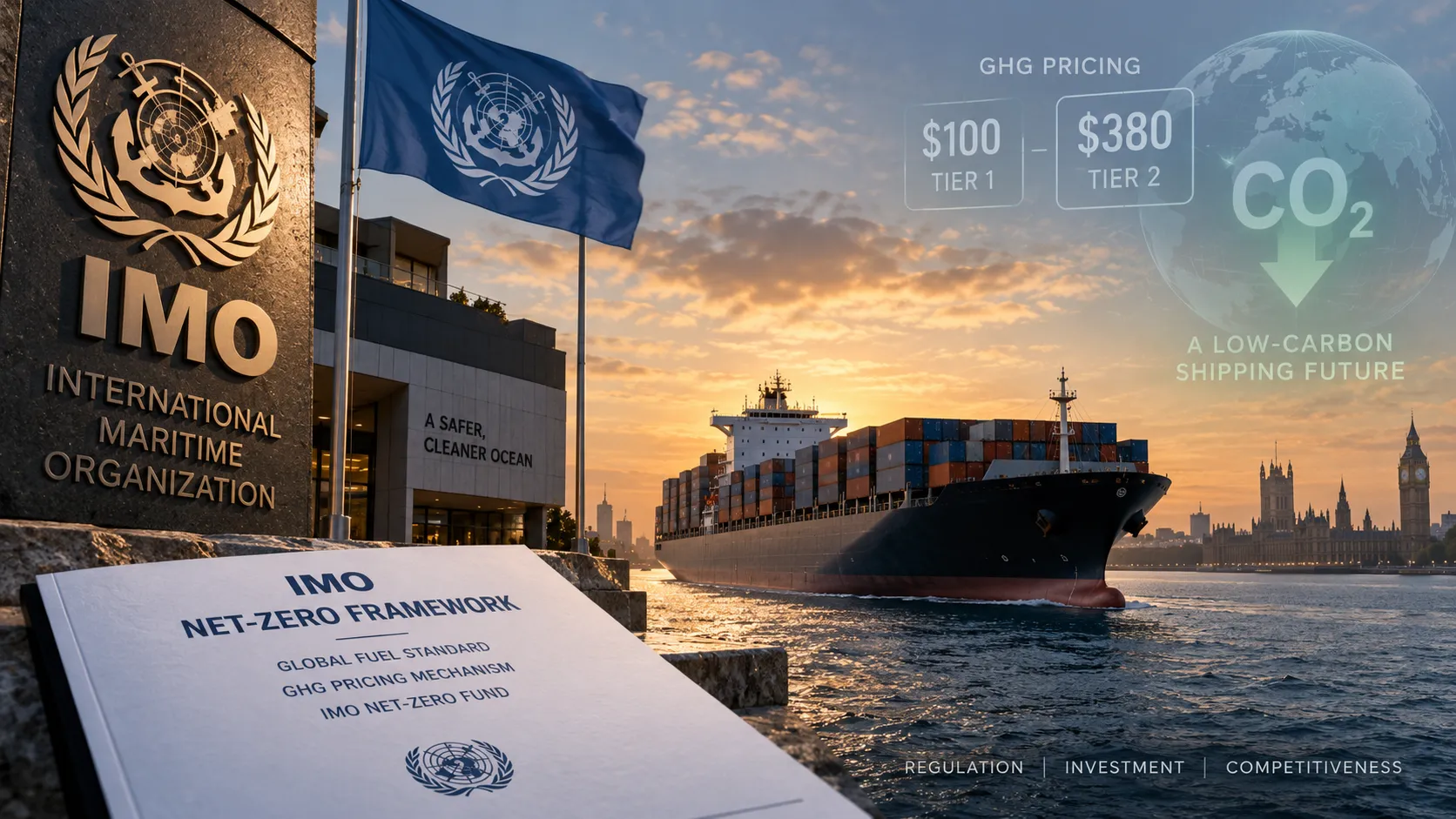
The IMO Net-Zero Framework is back at the centre of shipping’s regulatory agenda. More than 1,000 delegates are registered for the latest greenhouse-gas negotiations in London this week, with the industry moving toward a sequence of meetings that could determine whether a global marine fuel standard and GHG pricing mechanism finally move into law.
The numbers explain why owners, charterers, operators, bunker buyers and financiers are watching closely. Under the draft approved by the International Maritime Organization in 2025, ships that miss the required greenhouse-gas fuel-intensity targets could face remedial-unit prices of $100 per tonne of CO₂-equivalent at Tier 1 and $380 per tonne at Tier 2.
Those are not conventional carbon taxes charged against every tonne emitted. They sit inside a performance-based system built around the lifecycle GHG intensity of the energy used by a ship. A vessel that performs strongly can generate surplus units. A vessel above the targets can face a compliance deficit.
For a conventional ship with high annual fuel consumption, the commercial exposure can run into seven figures under a simplified application of the current draft.
4 SEPTEMBER 2026 — CURRENT STATUS
ISWG-GHG 22 is meeting in London from 1–4 September. The session is closed to media. At the time of publication, IMO had not yet released its post-session note. The next negotiating round is scheduled for 23–27 November, followed by MEPC 85 from 30 November–3 December. The adjourned extraordinary MEPC session is scheduled to resume on 4 December 2026, subject to confirmation at MEPC 85.
What Is the IMO Net-Zero Framework?
The IMO Net-Zero Framework is a proposed new chapter of MARPOL Annex VI designed to turn the IMO’s 2023 greenhouse-gas strategy into mandatory ship-level requirements.
Its architecture has two linked parts:
- a global marine fuel standard that progressively tightens the permitted lifecycle greenhouse-gas intensity of energy used on board; and
- a GHG pricing mechanism that creates financial consequences when a ship operates above specified fuel-intensity targets.
The framework was approved at MEPC 83 in April 2025, but approval was not the final legal step. The extraordinary Marine Environment Protection Committee session convened in October 2025 to consider formal adoption was adjourned for a year after governments failed to reach sufficient convergence.
IMO’s official Net-Zero Framework FAQ continues to describe the package as draft regulations awaiting adoption.
That legal distinction is important. Shipping is not yet operating under the new global GFI pricing system. The architecture exists in approved draft form, but the final text, implementation timetable and supporting guidelines remain subject to the 2026 process.
Why 4 December 2026 Could Become a Major Shipping Date
The current negotiating calendar creates three key stages before the end of the year.
| Date | IMO process | Why shipping is watching |
|---|---|---|
| 1–4 Sep 2026 | ISWG-GHG 22 | Current round addressing concerns, implementation guidelines and lifecycle-GHG rules. |
| 23–27 Nov 2026 | ISWG-GHG 23 | Final intersessional negotiations before MEPC 85. |
| 30 Nov–3 Dec | MEPC 85 | Expected to decide the immediate path forward and whether the extraordinary session resumes. |
| 4 Dec 2026 | Resumed MEPC/ES.2 | Potential return to formal adoption, subject to MEPC 85 confirmation. |
The IMO’s announcement for ISWG-GHG 22 says the group is considering proposals on how to address concerns with the draft MARPOL Annex VI amendments, alongside the implementation guidelines and lifecycle GHG assessment framework.
IMO’s own summary of MEPC 84 confirms that Member States may submit amendments and adjustments to the previously approved draft while negotiations seek broader convergence.
So December should not be presented as a guaranteed yes/no vote on an untouchable text. The framework remains the central basis for negotiations, but individual provisions can still become part of the bargain.
Which Ships Would the IMO Net-Zero Framework Cover?
Under the approved draft, the IMO Net-Zero Framework applies to oceangoing ships above 5,000 gross tonnage, subject to the exclusions and definitions in MARPOL Annex VI.
IMO says vessels in this size category account for more than 85% of CO₂ emissions from international shipping.
That places most large commercial ships directly inside the commercial discussion:
- containerships;
- bulk carriers;
- crude and product tankers;
- LNG and LPG carriers;
- large ro-ro and vehicle carriers;
- cruise ships;
- large general cargo vessels; and
- other internationally trading ships above the threshold.
The draft framework is therefore not a niche regulation for new green vessels. It is designed around the existing global fleet as well as new ships.
That is why the subject connects directly with Tide Signal’s analysis of carbon exposure as a financial risk in shipping. A regulatory cost that affects most large oceangoing ships can feed into cash flow, chartering strategy, retrofit decisions, residual values and newbuilding specifications.
How GHG Fuel Intensity — GFI — Works
The core metric is GHG Fuel Intensity, or GFI.
Instead of looking only at CO₂ released from a ship’s exhaust, the framework uses a well-to-wake approach. That means lifecycle emissions associated with producing, transporting and using the fuel are included in the assessment.
GFI is expressed in grams of CO₂-equivalent per megajoule of energy used on board:
gCO₂eq/MJ
The draft uses a reference GFI value of 93.3 gCO₂eq/MJ. Annual targets then reduce the allowed intensity relative to that reference.
There are two thresholds:
- Base target: the upper threshold that separates Tier 1 from the more expensive Tier 2 deficit.
- Direct Compliance target: the more stringent target a ship needs to reach to avoid a compliance deficit and potentially generate surplus units.
| Year | Base reduction | Direct Compliance reduction |
|---|---|---|
| 2028 | 4.0% | 17.0% |
| 2029 | 6.0% | 19.0% |
| 2030 | 8.0% | 21.0% |
| 2031 | 12.4% | 25.4% |
| 2032 | 16.8% | 29.8% |
| 2033 | 21.2% | 34.2% |
| 2034 | 25.6% | 38.6% |
| 2035 | 30.0% | 43.0% |
Those reduction factors come from the approved draft and are also set out in DNV’s technical summary of MEPC 83.
The framework therefore gets progressively tighter. A fuel strategy that looks manageable in an early compliance year may become materially more expensive as the targets fall.
How the $100 and $380 Shipping GHG Prices Work
The draft uses two levels of remedial units.
Tier 1
$100/tCO₂eq
Initial remedial-unit price in the current draft for the 2028–2030 reporting periods.
Tier 2
$380/tCO₂eq
Initial remedial-unit price for emissions intensity above the Base target.
If a ship’s attained GFI sits between the Direct Compliance and Base targets, it generates a Tier 1 deficit.
If its attained GFI is above the Base target, the ship can face both a Tier 1 deficit for the band between the two targets and a Tier 2 deficit for the portion above the Base target.
The legal formulas and the initial prices are contained in the IMO’s draft revised MARPOL Annex VI.
The money from remedial units would flow into an IMO Net-Zero Fund. The draft also allows ships in direct compliance to generate surplus units that can, within defined rules, be banked or transferred.
This creates something very different from a simple fine. It builds a compliance market around the relative GHG performance of ships.
What Could It Cost a Conventional Ship? A Simplified Example
The following calculation is deliberately transparent. It is not a forecast of a specific vessel’s legal liability and it assumes that the current draft architecture and price levels remain relevant after the 2026 negotiations.
Assume a hypothetical ship:
- uses energy equivalent to 20,000 tonnes of conventional fuel per year;
- has an illustrative lower heating value of 40.2 MJ/kg;
- has an attained GFI of 93.3 gCO₂eq/MJ for this simplified model;
- uses no surplus units;
- receives no zero/near-zero fuel reward; and
- is compared with the current draft’s 2028 target bands.
The draft 2028 thresholds translate approximately to:
- Base GFI: 89.6 gCO₂eq/MJ
- Direct Compliance GFI: 77.4 gCO₂eq/MJ
| Illustrative calculation | Approx. result |
|---|---|
| Tier 1 deficit | 9,752 tCO₂eq |
| Tier 1 cost at $100 | $0.98m |
| Tier 2 deficit | 3,001 tCO₂eq |
| Tier 2 cost at $380 | $1.14m |
| Total illustrative annual cost | ≈ $2.12m |
Under the same simplified assumptions, the scale changes almost linearly with annual energy consumption:
| Annual fuel-equivalent use | Illustrative compliance cost |
|---|---|
| 10,000 tonnes | ≈ $1.06m |
| 20,000 tonnes | ≈ $2.12m |
| 30,000 tonnes | ≈ $3.17m |
| 50,000 tonnes | ≈ $5.29m |
Important: these numbers are an illustrative Tide Signal calculation, not a published IMO cost estimate. Actual exposure would depend on the final legal text, implementation year, verified lifecycle GFI of each fuel, total energy used, surplus units, fuel certification, rewards and future price-review rules.
Even with those caveats, the example shows why the IMO Net-Zero Framework belongs in commercial discussions today. A seven-figure compliance line can affect fuel procurement, voyage economics, time-charter negotiations and the capital case for retrofits.
Tide Signal’s Voyage Margin Calculator provides a useful way to see how an additional voyage or fleet cost can change break-even economics, although the current tool is not an IMO GFI compliance calculator.
Is the IMO Net-Zero Framework a Global Carbon Tax?
IMO says no.
The phrase “global carbon tax” is attractive because it is simple, but it does not accurately describe the current architecture.
A conventional carbon tax normally applies a defined tax rate directly to emissions. The IMO proposal instead sets fuel-intensity performance targets. Ships above those targets have to balance deficits, while ships that outperform the more stringent target can generate surplus units and potentially qualify for rewards.
The money from remedial units is intended for the dedicated IMO Net-Zero Fund rather than national government budgets.
So the more accurate description is:
a global ship-fuel standard combined with a tiered GHG compliance-pricing mechanism.
That wording may sound less dramatic, but commercially it is more useful. The cost depends on how far the ship’s GFI sits from the required targets — not simply on the fact that the vessel emits CO₂.
Why Well-to-Wake Accounting Changes the Fuel Debate
Well-to-wake accounting prevents the market from looking only at the ship’s funnel.
A fuel can produce lower emissions onboard but still carry significant upstream emissions from extraction, production, processing or transport. Methane slip can also alter the lifecycle performance of some LNG pathways.
For shipowners, the relevant question becomes:
What is the verified lifecycle GHG intensity of the fuel I am actually buying?
That creates a new commercial role for fuel certification and documentation.
Under the draft, fuel GHG characteristics and sustainability information would be supported through recognized certification arrangements and a Fuel Lifecycle Label. The underlying data would then feed into annual ship GFI calculations.
This connects directly with the practical bunker chain. Tide Signal’s Bunkering Operations guide already explains why the Bunker Delivery Note, fuel specification, sampling and documentation are central operational records. Under a lifecycle-GHG regime, the commercial value of reliable fuel data becomes even greater.
Who Pays — Owner or Charterer?
This could become one of the most commercially difficult parts of the IMO Net-Zero Framework.
The legal compliance obligation and the commercial responsibility for creating the emissions exposure are not always held by the same party.
Under a time charter, a charterer can influence:
- the vessel’s employment;
- route;
- speed;
- cargo;
- bunker procurement; and
- the fuel ultimately consumed.
The owner, meanwhile, remains responsible for the ship’s statutory compliance structure.
The draft MARPOL text explicitly preserves the possibility of recovering costs connected with the ship’s “operational responsibility”, defined around decisions such as fuel used, cargo carried, route and speed.
That does not automatically settle a commercial dispute. Charterparties will still need clear allocation language, data-sharing rules, bunker-quality obligations and mechanisms for dealing with surplus or deficit value.
Tide Signal’s CII in Shipping guide examines a similar owner-charterer tension: one party can control operational decisions while another carries part of the long-term compliance consequence.
The IMO GFI system could make that tension more directly financial.
How Is This Different From CII, EU ETS and FuelEU Maritime?
Shipping companies already operate inside several carbon-related regimes. They do not all measure the same thing.
| Measure | Core mechanism | Commercial effect |
|---|---|---|
| CII | Annual operational carbon-intensity rating | Efficiency pressure, rating and chartering implications |
| EU ETS | Allowance-based carbon pricing for covered EU emissions | Direct carbon allowance cost |
| FuelEU Maritime | GHG-intensity requirement for energy used within EU scope | Fuel choice, pooling and compliance economics |
| IMO Net-Zero Framework | Global GFI targets + tiered pricing + surplus units | Potential global fuel and compliance cost across large international ships |
The strategic challenge is that an owner does not make fuel and investment decisions against one regulation at a time.
A newbuilding ordered today may trade through multiple regulatory systems over a 20- or 25-year life. The relevant question is therefore not simply whether the ship complies next year. It is whether the propulsion and fuel strategy remains commercially credible as several rules tighten together.
What Could the IMO Net-Zero Framework Do to Marine Fuels?
If the framework survives in a form close to the current draft, it creates a global demand signal for fuels with lower verified lifecycle GHG intensity.
That does not automatically identify one winning fuel.
Biofuels may offer an earlier pathway for some existing ships, but availability, feedstock sustainability, specification and lifecycle certification are critical.
Methanol can reduce lifecycle exposure when produced through low-GHG pathways, but conventional production does not automatically deliver the same result.
Ammonia could offer very low carbon intensity when produced with low-emission energy, while bringing major safety, toxicity, engine and infrastructure challenges.
LNG can perform differently depending on its lifecycle pathway and methane emissions; the framework’s well-to-wake approach makes upstream performance and methane slip commercially relevant.
Wind assistance, shore power and other onboard energy technologies can also influence total GFI calculations under the draft methodology.
And at the far end of the technology debate, shipping is again looking at propulsion concepts that break with the conventional bunker model altogether. Tide Signal’s report on Maersk’s nuclear-powered UK–US corridor study shows how decarbonization pressure is widening the range of technologies being evaluated by major maritime players.
The commercial winner may not be the fuel with the lowest theoretical emissions. It may be the option that combines acceptable lifecycle GFI, global availability, safe operation, competitive total cost and confidence that the ship will remain employable.
The Biggest Risk for Owners Is Regulatory Uncertainty
Shipping can price an expensive rule. It struggles more with a rule that has no settled shape or timetable.
The October 2025 adjournment created exactly that problem.
Shipowners still have to make decisions on newbuildings, retrofits, engines, tank arrangements and charter coverage while the global framework remains unresolved.
Engine manufacturers and fuel suppliers face the same uncertainty. Investment in a new technology is easier to justify when there is a durable global demand signal.
The IMO’s September meeting is therefore about more than drafting language. It is part of an effort to restore enough certainty for billions of dollars of private investment to move with greater confidence.
The industry also needs clarity on timing. The original draft contains price and target tables beginning in 2028, but adoption was delayed by a year. IMO’s formal procedure says MARPOL amendments normally enter into force 16 months after adoption, while industry analysis has pointed to 2029 as the earliest practical implementation period if adoption succeeds late in 2026.
For that reason, the 2028 figures in the draft should currently be read as the architecture of the approved text — not as a guarantee that ships will begin paying under the system on 1 January 2028.
What Would Change First Inside a Shipping Company?
The first impact would not necessarily be a payment to the Net-Zero Fund.
Before that stage, companies would need stronger control of fuel and energy data.
Owners and managers would need to know:
- the verified lifecycle GFI attached to each fuel pathway;
- annual energy use by vessel;
- projected distance from Base and Direct Compliance targets;
- potential surplus-unit value or deficit exposure;
- which party controls fuel procurement under the charter;
- how compliance costs are allocated contractually;
- whether pooling or unit transfers change the fleet-level strategy; and
- whether retrofit capital is cheaper than repeated compliance cost.
That turns decarbonization from a sustainability-reporting subject into a management-accounting problem.
It also reinforces the argument in Tide Signal’s Shipping Finance in 2026 analysis: carbon exposure increasingly belongs in the same discussion as cash flow, debt, asset value and future employability.
What Shipping Should Watch After ISWG-GHG 22
When the IMO publishes the official note from this week’s closed session, five areas deserve immediate attention.
- Core architecture: whether the global fuel standard and tiered pricing mechanism remain substantially intact.
- $100/$380 pricing: whether there is movement around the initial remedial-unit price structure.
- GFI trajectory: whether the Base and Direct Compliance reductions are changed.
- Implementation timing: whether delegates begin resolving the mismatch created by the one-year adoption delay.
- Fuel certification and lifecycle rules: how chain-of-custody, Fuel Lifecycle Labels and recognized certification schemes develop.
After that, attention shifts to ISWG-GHG 23 in late November and MEPC 85.
If the extraordinary session resumes on 4 December and adoption proceeds, the story moves immediately from political negotiation toward implementation planning.
If adoption is delayed again or the framework is materially rewritten, shipowners will face another period of uncertainty over fuel strategy and fleet investment.
Tide Signal Analysis: The $380 Figure Is Only the Beginning
The most clickable number in the IMO Net-Zero Framework is $380 per tonne of CO₂-equivalent.
But the real change is larger than one price.
The framework would create a global system in which the lifecycle quality of energy becomes part of a ship’s annual commercial position.
A conventional fuel does not simply have a bunker price. It can also carry a GFI position.
A low-GHG fuel does not simply cost more per tonne. It can reduce a compliance deficit or generate value elsewhere in the system.
A charterer’s speed and fuel decisions can affect an owner’s statutory and financial exposure.
A newbuilding specification can determine how much flexibility the owner retains as targets tighten.
That is the deeper shift.
The shipping industry has spent decades optimising the cost of moving a tonne of cargo from A to B. The IMO Net-Zero Framework would add another variable to that calculation: the lifecycle greenhouse-gas intensity of the energy used to move it.
Whether the final mechanism keeps today’s exact prices or not, the commercial direction is difficult to ignore. Fuel choice, carbon performance and voyage economics are moving closer together.
December could decide how quickly that becomes a global rule.
Frequently Asked Questions
What is the IMO Net-Zero Framework?
The IMO Net-Zero Framework is a proposed global shipping regulation combining a marine fuel GHG-intensity standard with a tiered emissions-pricing mechanism under MARPOL Annex VI.
Has the IMO Net-Zero Framework been adopted?
No. The framework was approved in draft form at MEPC 83 in April 2025, but the formal adoption meeting was adjourned in October 2025. Negotiations continue in 2026.
What are the $100 and $380 prices?
Under the current approved draft, Tier 1 remedial units are initially priced at $100 per tonne of CO₂-equivalent and Tier 2 remedial units at $380 per tonne for the draft’s 2028–2030 reporting periods.
Which ships would be covered?
The approved draft applies to internationally trading oceangoing ships above 5,000 GT, subject to the framework’s defined exclusions.
Is the IMO Net-Zero Framework a global carbon tax?
IMO says no. The system is based on ship-level GHG Fuel Intensity targets, tiered compliance deficits, remedial units, surplus units and a dedicated Net-Zero Fund rather than a uniform tax charged against every tonne of emissions.
When could the IMO Net-Zero Framework take effect?
The timing is not yet settled after the 2025 adoption delay. MARPOL’s procedure generally provides for entry into force 16 months after adoption, and industry analysis has identified 2029 as the earliest practical implementation period if adoption succeeds in late 2026.
What happens on 4 December 2026?
The adjourned second extraordinary session of the Marine Environment Protection Committee is scheduled to resume on 4 December, subject to confirmation by MEPC 85. It could become the next formal adoption stage for the framework.
Related Tide Signal Coverage
- CII in Shipping: Meaning, Ratings and Commercial Impact — how operational carbon performance already affects vessel management and chartering.
- Shipping Finance in 2026: Why Carbon Exposure Is Becoming a Financial Risk — the link between regulation, vessel value, finance and future cash flow.
- Bunkering Operations Explained — fuel delivery, BDNs, sampling, quality and the shipboard documentation chain.
- Voyage Margin Calculator — test how additional costs alter freight revenue, voyage margin and break-even economics.
- Maersk Explores Nuclear-Powered UK–US Container Route — why the decarbonization debate is widening beyond conventional marine fuels.
Primary Sources and Technical References
- International Maritime Organization — ISWG-GHG 22, 1–4 September 2026
- International Maritime Organization — MEPC 84 outcomes and 2026 negotiating timetable
- International Maritime Organization — IMO Net-Zero Framework FAQ
- IMO Circular Letter No. 5005 — Draft Revised MARPOL Annex VI
- DNV — Technical summary of the approved IMO GFI requirements
Reporting status: 4 September 2026. ISWG-GHG 22 is a closed session and IMO said it would publish a note after the meeting. Tide Signal will update this article when the official outcome is released. The financial example is illustrative and must not be treated as a vessel-specific compliance forecast.