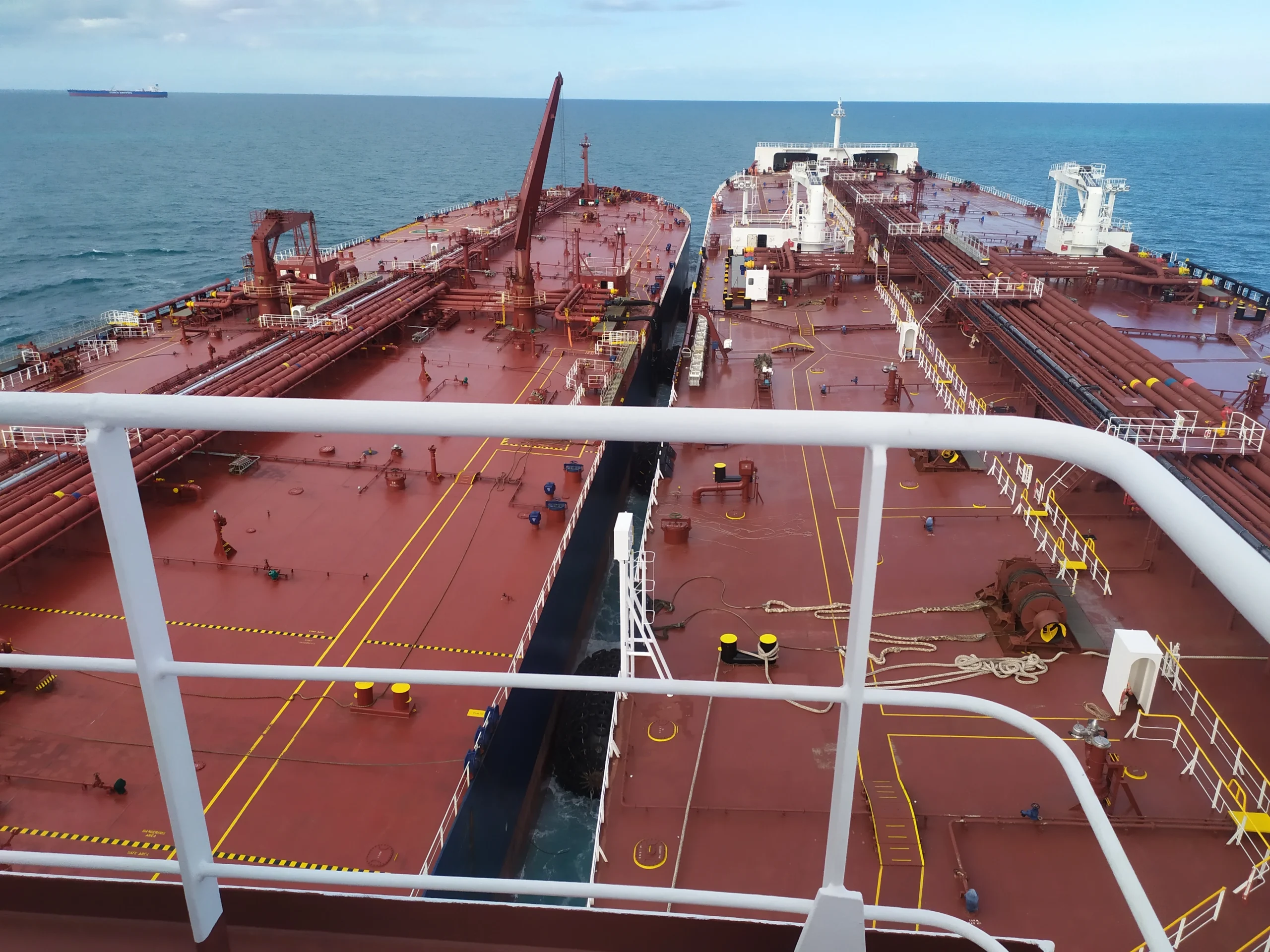
A ship to ship transfer is one of the most demanding coordinated operations in tanker shipping. Two vessels are brought alongside each other at sea, anchorage or in port so that liquid cargo can be transferred directly from one ship to the other. The operation may involve crude oil, petroleum products, chemicals, LPG or LNG, and every stage depends on compatibility, manoeuvring, mooring, fendering, cargo-system control, communications and environmental limits working together.
STS operations are routine in many trades, but routine does not mean simple. The highest-risk moments often occur before cargo starts and after it finishes: approach, berthing, mooring, unmooring and separation. Once the vessels are alongside, relative movement must remain within the capability of the fenders, mooring system and transfer hoses while cargo pressure, vapour control, static electricity, pollution prevention and emergency readiness are continuously managed.
The current industry reference is the Ship to Ship Transfer Guide for Petroleum, Chemicals and Liquefied Gases, Second Edition, published in 2025 by OCIMF, CDI, ICS and SIGTTO. It expands the practical scope across oil, chemical, LPG and LNG operations and adds updated human-factor, personnel-transfer, equipment and checklist guidance.
SHIP TO SHIP TRANSFER — QUICK VIEW
| Purpose | Direct cargo transfer between vessels |
| Typical cargoes | Oil, products, chemicals, LPG, LNG |
| Key control role | POAC / STS Superintendent as applicable |
| Critical equipment | Fenders, moorings, hoses, communications |
| Critical risk | Collision, spill, hose failure, excessive movement |
| MARPOL oil-tanker rule | Annex I, Chapter 8 where applicable |
What Is a Ship to Ship Transfer?
A ship to ship transfer, commonly shortened to STS operation, is the transfer of cargo between two vessels positioned alongside each other.
For tanker operations, the transfer commonly involves liquid bulk cargo. One vessel may act as the discharging ship and the other as the receiving ship. Depending on the operation, one vessel may remain at anchor while the other manoeuvres alongside, or both vessels may conduct a controlled manoeuvre under power before settling into the transfer condition.
The operation normally includes:
- pre-arrival planning and compatibility assessment;
- rendezvous and communications;
- approach manoeuvre;
- fender contact and berthing;
- mooring;
- hose and, where required, vapour connection;
- pre-transfer checks and conference;
- cargo transfer;
- topping-off and completion;
- draining and hose disconnection;
- unmooring and separation.
The cargo operation in the middle may last many hours. But operational risk exists across the entire sequence.
Why Are Ship-to-Ship Transfers Used?
STS transfer exists because the most commercially efficient ship is not always the ship that can physically reach the final loading or discharge point.
Common reasons include:
- Lightering: reducing the draft of a large tanker before entering a shallower port or channel.
- Reverse lightering: assembling a larger parcel by transferring cargo from smaller ships into a larger vessel.
- Transshipment: moving cargo between ships without routing the entire parcel through a shore terminal.
- Storage and distribution: transferring between trading, storage or shuttle units.
- Operational continuity: moving cargo when a direct port call becomes commercially or operationally difficult.
- Emergency or recovery situations: transferring cargo when vessel condition, routing or other constraints make direct continuation undesirable.
Recent energy-market disruption has shown how strategically important STS can become. LNG cargoes were transferred outside the Strait of Hormuz in 2026 as operators found ways to maintain downstream deliveries despite severe regional disruption. This is an exceptional commercial example, not a template for ordinary STS planning.
For the wider operational context, Tide Signal’s Strait of Hormuz live shipping analysis tracks how security, insurance and route access are affecting vessel movements.
Oil, Chemicals, LPG and LNG: STS Is Not One Identical Operation
The basic ship-to-ship concept is the same, but the cargo changes the technical risk.
| Cargo | Typical additional focus |
|---|---|
| Crude / petroleum products | Pollution prevention, closed loading, static, vapour, manifold and hose pressure |
| Chemicals | Cargo compatibility, toxicity, contamination, segregation and material compatibility |
| LPG | Pressure/temperature control, vapour handling, ESD integration and compatibility |
| LNG | Cryogenic hose systems, ESD, vapour return, boil-off management and very strict compatibility criteria |
The 2025 second edition of the joint STS Transfer Guide is important because it consolidates petroleum, chemicals, LPG and LNG into one current industry reference rather than treating modern STS practice as oil-only.
MARPOL Rules for Ship-to-Ship Oil Transfer
For oil cargoes, MARPOL Annex I, Chapter 8 provides the international pollution-prevention framework for applicable tanker STS operations at sea.
In broad terms, the chapter applies to oil tankers of 150 gross tonnage and above engaged in transfer of oil cargo between oil tankers at sea, subject to the chapter’s exclusions and definitions.
Key requirements include:
- an approved STS Operations Plan for ships in scope;
- the operation to be carried out in accordance with that plan;
- a suitably qualified person in overall advisory control;
- retention of STS records on board for three years;
- notification to the relevant coastal State at least 48 hours before scheduled STS operations in that Party’s territorial sea or exclusive economic zone, where the MARPOL requirement applies.
A useful technical summary submitted to IMO’s PPR 13 by ICS, OCIMF and SIGTTO sets out those Chapter 8 requirements and links them directly to the current 2025 industry guide.
Do not overgeneralise: MARPOL Annex I Chapter 8 is specifically an oil-cargo pollution-prevention regime. Chemical, LPG and LNG STS operations also require compliance with the applicable cargo codes, flag/coastal-State requirements, company SMS and industry guidance.
What Does the POAC Do in an STS Operation?
POAC means Person in Overall Advisory Control.
The role exists to provide coordinated advisory control over the STS operation. The POAC may be a suitably qualified Master, STS Superintendent or another appropriately qualified person depending on the operation and governing requirements.
The POAC does not erase the Master’s command responsibility for each vessel.
Practical POAC functions may include:
- reviewing ship compatibility;
- confirming the transfer area and environmental limits;
- coordinating the approach plan;
- confirming fender and mooring arrangements;
- ensuring communications are established;
- coordinating the sequence of operations;
- monitoring conditions against agreed limits;
- advising on suspension, unmooring or emergency action.
The safest STS operation has a clear decision structure. Ambiguity over who is advising, who is controlling a manoeuvre and who can order a stop is itself a risk.
Ship Compatibility: Can These Two Vessels Safely Work Together?
Before the ships approach each other, the operation must answer a basic question:
Are these two ships physically, operationally and commercially compatible for the planned transfer?
Compatibility review normally considers:
- length overall and hull geometry;
- parallel body;
- draft and freeboard;
- displacement difference;
- manifold position and height;
- mooring-fairlead and bitts arrangement;
- safe working load of fittings;
- fender size and position;
- hose length, diameter, pressure rating and certification;
- cargo-system compatibility;
- vapour return where applicable;
- crane / hose-handling capability;
- communications equipment;
- expected draft and freeboard changes during cargo transfer.
Freeboard difference is particularly important. The relative vertical position of manifolds, hoses, moorings and fenders can change substantially as one ship discharges and the other loads.
Choosing the STS Transfer Area
The transfer area must give the vessels enough room and enough environmental protection to complete the operation safely.
Typical considerations include:
- water depth and under-keel clearance;
- traffic density;
- safe manoeuvring room;
- anchoring suitability where relevant;
- weather and forecast reliability;
- wave and swell conditions;
- current and tidal stream;
- proximity to environmentally sensitive areas;
- availability of tugs and support craft;
- emergency response capability;
- coastal-State permissions and restrictions;
- security and geopolitical exposure.
A commercially convenient location is not automatically a safe STS location.
Ship to Ship Transfer Procedure: The Complete Sequence
STS operations are easier to understand when broken into operational phases.
| Phase | Main objective |
|---|---|
| 1. Planning | Compatibility, risk assessment, weather, equipment, permissions, roles |
| 2. Rendezvous | Establish communications, confirm condition and approach plan |
| 3. Approach / berthing | Bring the ships safely into fender contact with controlled relative movement |
| 4. Mooring | Create a stable two-ship configuration with controlled loads |
| 5. Connection | Connect cargo/vapour hoses and verify systems |
| 6. Transfer | Control pressure, rate, tank sequence, movement and communications |
| 7. Completion | Stop, drain, disconnect and secure transfer equipment |
| 8. Unmooring | Separate safely without losing control of relative movement |
Approach and Manoeuvring: Where STS Risk Becomes Physical
During approach, two very large moving masses are deliberately brought close enough to touch through a fender system.
The objective is controlled contact — not simply “getting alongside”.
The manoeuvring plan needs to consider:
- which ship is the manoeuvring vessel;
- which ship maintains constant heading or anchor position;
- approach speed;
- relative angle;
- wind and current set;
- tug assistance;
- rudder and engine response;
- abort points;
- visibility and communications.
A small error at long range can become a high-energy contact at the final metres.
Good planning therefore defines the approach before the ships are close enough for pressure to replace judgement.
STS Mooring: Two Moving Ships Become One Mooring System
Once alongside, the two vessels must behave as a stable pair while still responding differently to wind, current, swell, draft change and cargo movement.
The mooring arrangement must keep the ships within acceptable relative motion without overloading lines, winches, fairleads or bitts.
Important issues include:
- line lead and symmetry;
- line material and elasticity;
- safe working load of ship fittings;
- winch brake condition;
- freeboard difference;
- tide and draft change;
- snap-back and line-of-fire exposure;
- continuous tending as the transfer progresses.
Tide Signal’s Ship Mooring System Explained provides the deeper background on line functions, winches, fittings, load paths and snap-back risk.
The STS difference is that the “berth” is another ship — and it is moving.
STS Fenders: The Controlled Contact Zone
Large pneumatic fenders are commonly used to absorb berthing energy and keep the ships separated during transfer.
Fender selection and positioning depend on vessel size, relative freeboard, hull geometry and expected environmental loads.
Fenders need to be:
- correctly sized for the ships and operation;
- certified and inspected;
- positioned to protect the parallel body;
- secured against movement;
- monitored throughout transfer.
A fender is not simply a cushion. It is a structural interface between two ships.
If the fender system fails or moves out of position, hull contact can follow quickly.
Cargo Hoses and Vapour Hoses
Transfer hoses are the physical cargo connection between the two ships.
The operation needs to confirm:
- hose type and cargo compatibility;
- pressure rating;
- inspection and test status;
- flange standard and reducers;
- electrical continuity requirements where applicable;
- support and bend radius;
- allowance for relative ship movement;
- hose length at maximum and minimum freeboard difference;
- draining and disconnection method.
For LPG and LNG, vapour balancing and emergency-shutdown integration can become central to the transfer configuration.
The current 2025 STS Transfer Guide specifically expands guidance for cargo and vapour hoses and includes separate cargo-operation sections for oil, chemicals, LPG and LNG.
The Pre-Transfer Conference
Before cargo starts, both ships need a common operating picture.
The pre-transfer conference should resolve issues such as:
- cargo grade and quantity;
- tank sequence;
- initial, maximum and topping-off rates;
- maximum manifold pressure;
- communications channels;
- emergency signal;
- ESD procedures where applicable;
- vapour management;
- watchkeeping and responsible personnel;
- weather limits;
- mooring monitoring;
- pollution-response readiness;
- stop-work authority;
- emergency breakaway concept.
A checklist only works when both ships understand what each answer means operationally.
The 2025 industry guide reorganises its STS safety checklists into six sections spanning the full operation, including pre-transfer checks and additional LPG/LNG and vapour-balancing items.
During Cargo Transfer: What Is Being Monitored?
Once transfer starts, the operation moves from manoeuvring risk into cargo-control risk — while still retaining the mooring and environmental risks.
Continuous attention is needed on:
- transfer rate;
- manifold pressure;
- tank level and ullage;
- cargo temperature where relevant;
- vapour pressure;
- ship list and trim;
- draft and freeboard;
- mooring-line condition and load;
- fender position;
- hose movement;
- weather and sea conditions;
- communications;
- pollution watch.
The most important rule is simple:
If the agreed operating envelope no longer exists, the transfer should not continue merely because cargo is already moving.
STS Weather Limits: There Is No Universal Single Number
One of the most common STS questions is: “What is the maximum wind or wave height?”
There is no single universal limit that safely applies to every operation.
Limits depend on:
- vessel size and displacement;
- relative freeboard;
- fender capability;
- mooring arrangement;
- hose movement envelope;
- transfer location;
- swell direction and period;
- wind direction;
- current;
- availability of tugs;
- company and STS service-provider criteria.
The operation must work within pre-agreed environmental limits derived from the risk assessment, STS plan and service-provider procedures.
A rising wind speed is not the only warning. Long-period swell can create dangerous relative movement even when the local wind is moderate.
When Should an STS Transfer Be Stopped?
Transfer should be suspended or stopped when conditions move outside the agreed safe operating envelope.
Examples include:
- excessive relative vessel movement;
- hose strain or abnormal movement;
- fender failure or displacement;
- mooring-line failure or unsafe load development;
- fire or gas alarm;
- cargo leakage;
- unexplained cargo pressure loss;
- loss of primary and backup communications;
- power failure affecting safe transfer;
- loss of critical ESD functionality where applicable;
- weather exceeding agreed limits;
- significant unexplained cargo quantity discrepancy.
Stopping early can cost time. Stopping late can cost a ship.
Emergency Breakaway: Plan It Before You Need It
An emergency breakaway is the rapid but controlled process of stopping cargo transfer, making the cargo connection safe, releasing the vessels and establishing safe separation.
The challenge is that “rapid” and “controlled” can conflict.
A useful emergency plan should define:
- who orders the breakaway;
- the emergency signal;
- cargo-stop and ESD sequence;
- how hoses are drained or safely disconnected;
- mooring-line release sequence;
- tug actions;
- engine and steering readiness;
- safe separation direction;
- communications if the primary system fails;
- pollution-response actions.
Improvising this sequence after a fire, sudden weather change or mooring failure is exactly what the planning process is intended to avoid.
The Main Risks in Ship-to-Ship Transfer
| Risk | How it develops | Primary control |
|---|---|---|
| Collision | Poor approach control or excessive relative movement | Manoeuvring plan, fenders, abort criteria |
| Oil / cargo spill | Hose, flange, valve or tank-transfer failure | Inspection, pressure control, monitoring, spill readiness |
| Mooring failure | Overload, poor lead, incompatible lines, weather | Approved arrangement and continuous tending |
| Hose failure | Excessive strain, pressure or poor condition | Certification, support, movement envelope, pressure limits |
| Fire / explosion | Flammable atmosphere plus ignition source | Cargo procedures, ignition control, emergency readiness |
| Personnel injury | Lines, cranes, hoses, slips, transfer between ships | Human-factor controls, PPE, line-of-fire discipline |
| Loss of control | Communication or decision failure | Clear authority, common language, stop-work criteria |
The current STS Transfer Guide adds a dedicated human-factors chapter because many incidents are not caused by one failed piece of equipment. They develop through fatigue, assumptions, communication, workload, procedural drift and delayed decisions.
Personnel Transfer Between the Two Ships
Personnel transfer can add a separate risk layer to the operation.
The 2025 STS guide updates its personnel-transfer protocols and promotes a risk-based approach, including guidance derived from OCIMF work on transfer by crane between vessels.
Questions include:
- Is transfer actually necessary?
- What is the safest available method?
- Are the crane and lifting arrangements certified for the intended use?
- Are operators trained and competent?
- Are vessel movements within safe limits?
- Are communications and rescue arrangements ready?
“We always do it this way” is not a risk assessment.
STS, Sanctions and Dark-Fleet Risk
STS transfer itself is a legitimate and widely used maritime operation.
But it can also be used to obscure cargo origin, ownership chains or trading patterns.
That creates a separate compliance problem.
IMO’s Legal Committee has specifically discussed high-seas STS transfers involving older, poorly maintained or inadequately insured “dark fleet” tankers, alongside AIS manipulation and unclear ownership. IMO has warned that such practices can increase collision, pollution, liability and compensation risk.
For charterers, traders and service providers, due diligence may therefore need to include:
- counterparty identity;
- beneficial ownership;
- sanctions screening;
- cargo origin;
- insurance validity;
- class and flag status;
- AIS history;
- recent STS activity;
- vessel age and condition;
- service-provider reputation.
Tide Signal’s War Risk Premiums in Shipping guide explains how insurance and security conditions can reshape the commercial acceptability of a voyage even when the voyage remains physically possible.
STS Is Also a Port State and SIRE Issue
STS procedures do not live only in an operations manual.
Industry inspection systems such as SIRE examine whether officers and crew understand the vessel’s STS Operations Plan, whether the plan is available where needed and whether the operator’s SMS addresses STS-specific mooring and cargo operations.
The practical lesson is familiar: documentation, equipment condition and crew knowledge must describe the same operation.
Tide Signal’s Port State Control 2026 coverage makes the same broader compliance point — an approved document alone is weak evidence if the physical ship and responsible officers tell a different story.
Ship-to-Ship Transfer Checklist
This is a practical educational checklist, not a replacement for the approved STS Operations Plan, official industry checklists or ship-specific procedures.
Before the operation
- Confirm regulatory and coastal-State requirements.
- Confirm approved STS plan where required.
- Complete ship compatibility review.
- Complete STS-specific risk assessment.
- Confirm POAC / STS Superintendent and responsibilities.
- Confirm transfer location and environmental limits.
- Confirm fender type, size, certification and position.
- Confirm mooring arrangement and fitting capacities.
- Confirm cargo/vapour hose compatibility and certification.
- Confirm cargo-system and manifold compatibility.
- Agree communications and backup channel.
- Agree emergency and breakaway plan.
Before approach and mooring
- Brief bridge and deck teams.
- Confirm engine, steering and thruster readiness as applicable.
- Confirm tugs/support craft and communications.
- Verify weather, swell, current and forecast.
- Prepare mooring stations and line-handling teams.
- Confirm line-of-fire controls and PPE.
- Confirm abort criteria.
Before cargo transfer
- Verify all moorings and fender positions.
- Inspect and connect hoses correctly.
- Complete pre-transfer conference.
- Agree cargo sequence and quantity.
- Agree initial, maximum and topping-off rate.
- Agree maximum manifold pressure.
- Confirm tank, valve and venting lineup.
- Confirm ESD and vapour arrangements where applicable.
- Establish continuous deck and pollution watch.
During transfer
- Monitor manifold pressure and transfer rate.
- Monitor tank levels and quantity reconciliation.
- Monitor list, trim, draft and freeboard.
- Monitor fenders, hoses and moorings.
- Reassess weather and relative movement.
- Maintain communications.
- Stop on abnormal conditions — do not normalise them.
Completion and unmooring
- Reduce rate for topping-off as agreed.
- Stop pumps and isolate systems in the agreed sequence.
- Drain and depressurise hoses safely.
- Disconnect and secure cargo equipment.
- Confirm decks and manifolds are clean and safe.
- Brief the unmooring sequence.
- Confirm propulsion and manoeuvring readiness.
- Release lines in the agreed order.
- Establish safe separation before resuming independent navigation.
- Complete records and post-operation review.
Five Questions Every Officer Should Be Able to Answer Before STS
- What are our stop-work limits?
- Who can order the operation suspended?
- What happens if the primary communication link fails?
- What is the emergency breakaway sequence?
- How will draft and freeboard change the mooring and hose geometry during transfer?
If those answers are unclear before cargo starts, the operation is not ready.
Tide Signal Analysis: STS Safety Is Won Before the Ships Touch
The visible part of a ship-to-ship transfer is dramatic: two large vessels alongside, huge fenders between them, mooring lines working, hoses crossing the gap and cargo moving directly from ship to ship.
But the quality of the operation is decided earlier.
It is decided when the ships are matched.
When the weather limits are agreed.
When the fender system is selected.
When somebody identifies the point at which the approach must be aborted.
When the Masters and POAC agree who says “stop”.
When the emergency breakaway exists on paper and in the heads of the people who may need to execute it.
The cargo transfer is only the middle of an STS operation. The operation succeeds because the approach, mooring, equipment, people and emergency plan were ready before the first tonne moved.
Ship to Ship Transfer: Frequently Asked Questions
What is a ship to ship transfer?
A ship to ship transfer is the direct movement of cargo between two vessels positioned alongside each other at sea, anchorage or in port.
What does STS mean in shipping?
STS means ship-to-ship. In tanker operations it normally refers to direct transfer of liquid bulk cargo between two vessels.
What is a POAC in STS operations?
POAC means Person in Overall Advisory Control. The POAC coordinates and advises the STS operation in accordance with the applicable plan and procedures, while each Master retains responsibility for their own vessel.
What equipment is used for ship-to-ship transfer?
Typical STS equipment includes pneumatic fenders, mooring lines, cargo hoses, vapour hoses where required, hose-handling equipment, communications equipment and pollution-response equipment.
Is ship-to-ship transfer regulated by MARPOL?
Yes for applicable oil-tanker STS operations. MARPOL Annex I Chapter 8 regulates prevention of pollution during transfer of oil cargo between oil tankers at sea. Other cargoes are also subject to their applicable codes, national rules, flag/coastal-State requirements and industry guidance.
Which oil tankers need an STS Operations Plan?
MARPOL Annex I Chapter 8 applies to oil tankers of 150 gross tonnage and above engaged in STS transfer of oil cargo at sea, subject to the chapter’s exclusions. Ships in scope must carry an approved STS Operations Plan.
How much notice is required before an STS operation?
For applicable MARPOL Annex I operations within the territorial sea or exclusive economic zone of a Party, the coastal State is to be notified at least 48 hours in advance of the scheduled operation, subject to the Convention’s provisions and local requirements.
What is the biggest risk in an STS operation?
There is no single universal biggest risk. Collision during approach/separation, cargo spill, mooring failure, hose failure, fire and loss of control through communication or human-factor breakdown are all major hazards.
What weather limit applies to STS transfer?
There is no single universal wind or wave limit for every STS operation. Limits depend on the ships, fenders, moorings, hoses, location, support arrangements and the approved risk assessment and procedures.
Can LNG be transferred ship to ship?
Yes. LNG STS is conducted using specialised cryogenic transfer and vapour-management systems, strict compatibility assessment and LNG-specific emergency and safety procedures.
Is bunkering the same as STS cargo transfer?
No. Bunkering can be conducted ship-to-ship, but MARPOL Annex I Chapter 8’s STS oil-cargo rules specifically exclude bunkering from that chapter’s scope. Tide Signal’s Bunkering Operations guide covers the separate ship-fuel transfer process.
Continue Through Tide Signal Academy
- Ship Mooring System Explained — lines, winches, fittings, load paths and snap-back.
- Bunkering Operations — planning, transfer, sampling, quantity and spill prevention.
- War Risk Premiums in Shipping — how security and insurance reshape voyage approval.
- Is the Strait of Hormuz Open? — live operating context for Gulf shipping and energy flows.
- Maritime Cyber Security — communications, GNSS/AIS and operational resilience.
- Types of Charter Parties — the commercial contracts behind vessel employment and risk allocation.
- Port State Control 2026 — why documents, equipment and officer knowledge must align.
Official and Industry Sources
- OCIMF / CDI / ICS / SIGTTO — Ship to Ship Transfer Guide, Second Edition (2025)
- International Chamber of Shipping — Second Edition STS Guide Announcement
- ICS / OCIMF / SIGTTO — PPR 13/INF.7 Summary of MARPOL Chapter 8 and 2025 STS Guide
- IMO — Ship-to-Ship Transfers and Dark-Fleet Risk
- OCIMF — Current STS Safety Checklist Supporting Document
Educational note: This guide is for maritime learning and operational awareness. It does not replace the vessel’s approved STS Operations Plan, SMS, cargo code, flag or coastal-State requirements, the current STS Transfer Guide, Masters’ judgement, POAC advice, manufacturer instructions or site-specific procedures.