Market RecordUpdated · 25 September 2026Container Shipping
Intra-Asia container rates have reached a fifth consecutive all-time high, with Drewry’s Intra-Asia Container Index rising 6% to $1,491 per 40ft container. The latest move is being driven by a combination of pre-Golden Week demand, typhoon-related congestion, operational disruption and constrained effective vessel capacity across key Asian trades.
The headline index move is significant, but the route-level numbers show an even more fragmented market. Shanghai–Laem Chabang climbed 22% to $1,609 per 40ft, while Shanghai–Jakarta rose 12% to $2,300. At the same time, Drewry reported average vessel waiting times of 83 hours in Shanghai and 38 hours in Ningbo in week 38.
Quick market answer
Why are Intra-Asia container rates rising? Drewry points to pre-Golden Week demand, reduced effective capacity, typhoon-related port disruption, congestion and wider geopolitical pressure. The key issue is not simply the number of vessels in the fleet; it is how much usable capacity remains available once ships lose time waiting at ports, schedules slip and cargo is pushed onto fewer reliable sailings.
$1,491Drewry IACI composite per 40ft container
+6%weekly increase in the composite index
5 weeksconsecutive all-time highs
83 hoursaverage Shanghai vessel waiting time reported for week 38Inside this market analysisThe fifth recordWhat is the IACI?Route ratesEffective capacityPort congestionJakarta fireGolden WeekMiddle East effectIACI vs WCINew capacityWhat it means for shippersWhat to watchFAQ
Intra-Asia Container Rates Reach a Fifth Straight Record
Drewry’s latest assessment, published on 24 September 2026, puts the Intra-Asia Container Index at $1,491 per 40ft container, up 6% week on week.
This is the fifth consecutive week in which the composite has recorded an all-time high.
One week earlier, the IACI stood at $1,402 per 40ft and had already reached a fourth consecutive record. The latest increase therefore extends a trend that has persisted through September rather than representing a one-week spike.
The primary source is Drewry’s Intra-Asia Container Index — 24 September.
The important signal is persistence. A single weekly jump can reflect a temporary booking rush. Five consecutive record highs indicate that the regional network has not yet restored enough effective capacity to absorb the combined effects of demand, weather disruption, congestion and schedule instability.
What Is the Drewry Intra-Asia Container Index?
The Drewry Intra-Asia Container Index, or IACI, is a weekly benchmark of spot freight rates across major Asian container trades.
Drewry says the index consists of 18 route-specific indices plus a composite index, with all rates reported in US dollars per 40ft container. The benchmark includes routes linking Shanghai with ports across Northeast Asia, Southeast Asia, South Asia and the Middle East, together with selected return legs.
Examples include:
- Shanghai–Busan;
- Shanghai–Ho Chi Minh City;
- Shanghai–Jakarta;
- Shanghai–Singapore;
- Shanghai–Laem Chabang;
- Shanghai–Tanjung Pelepas;
- Shanghai–Jawaharlal Nehru Port;
- Shanghai–Jebel Ali;
- Busan–Shanghai;
- Jakarta–Shanghai;
- Laem Chabang–Shanghai;
- Yokohama–Shanghai.
Drewry notes that the freight rates exclude origin and destination terminal handling charges. The index should therefore be treated as a freight-market benchmark, not as a complete door-to-door logistics cost.
Which Intra-Asia Container Routes Are Rising Fastest?
The latest route movements show that the pressure is strongest on selected China-origin trades rather than being perfectly uniform across the region.
| Route | 24 Sep rate | Weekly move | Market signal |
|---|---|---|---|
| Shanghai → Laem Chabang | $1,609 / 40ft | +22% | Sharp China–Thailand tightening ahead of Golden Week. |
| Shanghai → Jakarta | $2,300 / 40ft | +12% | Higher rates alongside short-term Jakarta terminal disruption. |
| Shanghai → Jebel Ali | $8,712 / 40ft | +2% | Third consecutive weekly increase amid Middle East tension. |
| Busan → Shanghai | $136 / 40ft | +6% | Return-direction rate remains far below China-origin lanes. |
| Laem Chabang → Shanghai | $205 / 40ft | +6% | Shows major directional imbalance within the regional market. |
The directional gap is commercially important. Shanghai–Laem Chabang at $1,609 and Laem Chabang–Shanghai at $205 are not two versions of the same market. They reflect different cargo demand, equipment flows and capacity pressure in each direction.
For procurement teams, the composite alone is not enough. An average Intra-Asia index can rise 6% while an individual lane rises 22%. Route-specific exposure therefore matters more than the headline benchmark when budgeting actual shipments.
Why Effective Capacity Matters More Than Fleet Size
The current market demonstrates the difference between nominal vessel capacity and effective capacity.
A fleet can contain the same number of ships and still offer less usable capacity if vessels are:
- waiting outside congested ports;
- arriving late after weather disruption;
- missing connections at transshipment hubs;
- recovering schedules after terminal incidents;
- rerouted around geopolitical risk;
- burning additional voyage time through operational delays.
Port delay → vessel loses schedule time → fewer reliable weekly slots → effective capacity tightens → spot freight can rise
That mechanism helps explain why Intra-Asia rates can move sharply even though the global containership fleet itself has not suddenly contracted.
Tide Signal examined the same principle in Asia Port Congestion 2026, where weak schedule reliability at major Asian hubs showed how delay can propagate through feeder connections, equipment positioning and subsequent port calls.
Shanghai and Ningbo Waiting Times Remain Elevated
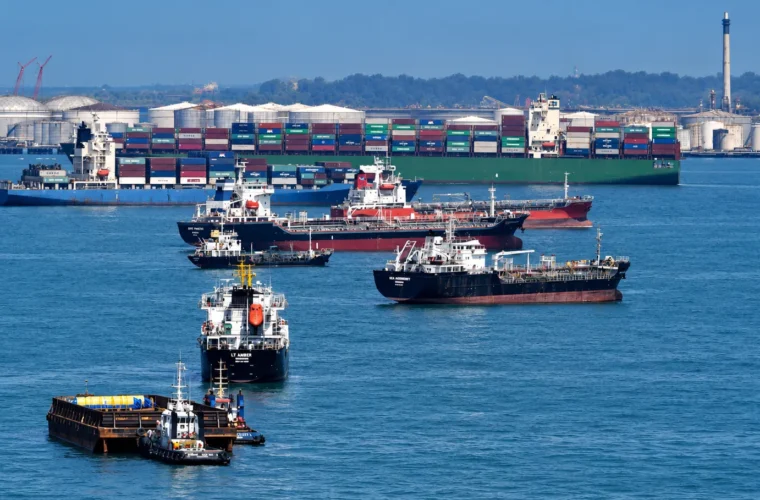
Drewry says storm-related disruption and persistent congestion continued to affect operational efficiency at Chinese ports in week 38.
Average vessel waiting times reached:
- 83 hours in Shanghai;
- 38 hours in Ningbo.
Drewry noted an eight-hour increase from the previous week in its latest commentary.
Those delays matter well beyond the vessels physically waiting at anchorage. A late Shanghai departure can miss a transshipment connection, shift a feeder window or arrive into another hub at the same time as vessels delayed by the same weather system.
The commercial effect is therefore cumulative.
For the cost mechanics of waiting time, berth uncertainty and missed schedules, read Tide Signal’s Port Delays Turn Waiting Time Into a Commercial Risk.
Jakarta’s NPCT1 Fire Adds a Short-Term Operational Shock
Drewry also highlighted the 21 September fire at New Priok Container Terminal One (NPCT1) in Tanjung Priok, Jakarta as a source of short-term operational disruption.
Indonesian police told ANTARA that 51 ISO tank containers and one dangerous-goods container were burned in the incident. NPCT1 said there were no fatalities and that the cause remained under investigation.
The terminal later said operations were being restored in stages following safety checks.
That timing overlaps with the sharp increase in Shanghai–Jakarta freight, which rose 12% to $2,300 per 40ft in Drewry’s latest assessment.
Correlation is not causation. The Jakarta fire is one operational factor in a much broader regional market. The latest rate increase also reflects Golden Week demand, constrained capacity, port delays and wider network disruption. The cause of the NPCT1 fire had not been established when this article was updated.
See ANTARA’s NPCT1 investigation update for the local source.
Golden Week Is Adding Demand Before China’s October Holiday
Drewry explicitly identifies a spike in demand ahead of China’s Golden Week as one reason China-to-Southeast and South Asia spot freight strengthened this week.
The timing is particularly tight in 2026 because China’s Mid-Autumn Festival holiday falls on 25–27 September, leaving only three normal weekdays before the National Day holiday begins on 1 October.
That can create a short pre-holiday rush as exporters attempt to move cargo before factory and logistics staffing reduces.
The demand effect is temporary by nature. Once Golden Week begins, cargo production can slow sharply, which is why the post-holiday market will be one of the most important tests of whether record Intra-Asia rates can hold.
Why Middle East Risk Is Appearing Inside the IACI
The IACI is broader than only Southeast and Northeast Asian coastal trades. Drewry’s route basket also includes Shanghai–Jebel Ali and Shanghai–Jawaharlal Nehru Port.
That makes current Middle East instability visible inside the benchmark.
Shanghai–Jebel Ali rose another 2% to $8,712 per 40ft, marking a third consecutive weekly increase according to Drewry.
Higher bunker costs and geopolitical disruption can affect vessel deployment, voyage economics and schedule reliability. Even where the physical route is not directly disrupted, carriers can face higher operating cost and reduced network flexibility.
IACI vs World Container Index: Two Container Markets Moving Differently
The divergence between the Intra-Asia market and Drewry’s broader World Container Index is one of the strongest signals this week.
On 24 September:
- IACI: up 6% to $1,491 per 40ft, a fifth consecutive record;
- WCI: down 1% to $4,468 per 40ft.
The absolute index levels are not directly comparable because the two benchmarks cover different route baskets. What matters is the direction: global East–West freight eased slightly while the Intra-Asia composite continued to tighten.
On the World Container Index, Shanghai–Rotterdam fell 4% to $3,485 and Shanghai–Genoa fell 5% to $3,835, while Transpacific rates remained much stronger.
Tide Signal tracks those East–West benchmarks separately in its Container Shipping Rates hub and Transpacific Container Rates analysis. Keeping the search intents separate prevents the Intra-Asia story from becoming another generic container-rate page.
Could New Intra-Asia Capacity Cool the Market?
Drewry expects Intra-Asia freight rates to stabilise in the coming weeks.
One reason to watch capacity closely is the planned launch of a new NCX service by X-Press Feeders, Pacific International Lines and Namsung Shipping in late October.
Drewry says the four-week rotation is expected to cover:
- Xingang;
- Qingdao;
- Xiamen;
- Singapore;
- Port Klang;
- Penang;
- Nansha.
The service is expected to use four vessels in the 2,500–3,600 TEU range.
Additional scheduled capacity can help, but it will not automatically unwind rates if port congestion and schedule disruption continue absorbing vessel days.
What Record Intra-Asia Rates Mean for Shippers
For importers and exporters
Companies shipping within Asia should avoid budgeting from a single regional average. The route-level spread is too large.
Procurement teams should compare:
- spot rate by exact origin-destination pair;
- all-in surcharges and terminal costs;
- transshipment versus direct-service options;
- schedule reliability;
- free time and detention exposure;
- alternative departure ports;
- Golden Week cargo-ready timing;
- cost of delay versus cost of a higher freight rate.
For carriers and feeder operators
High regional rates can improve revenue, but the operating environment is expensive and unstable. Delayed ships burn more fuel, disrupt crew and berth planning, and can require costly schedule recovery.
Adding capacity into a disrupted network also carries risk: if Golden Week demand falls faster than congestion clears, additional ships can arrive just as the spot market begins to normalise.
For forwarders
The immediate value is not simply finding the lowest rate. It is finding capacity that is likely to perform.
When schedule reliability deteriorates, a cheaper booking with a weak connection or high rollover risk can produce a higher total logistics cost than a more expensive but operationally stronger option.
What to Watch Next in the Intra-Asia Container Market
| Indicator | Why it matters |
|---|---|
| Next Drewry IACI | Shows whether the fifth record becomes a sixth or the market begins to stabilise. |
| Post-Golden Week bookings | Will reveal how much September demand was front-loaded before the holiday. |
| Shanghai / Ningbo waiting times | Falling delays would release effective vessel capacity back into the network. |
| Typhoon activity | Further port closures or weather delays could extend the capacity squeeze. |
| Jakarta terminal recovery | Normalisation at NPCT1 removes one short-term source of disruption on Indonesia trades. |
| Shanghai–Laem Chabang | After a 22% weekly increase, this lane is a useful test of China–Southeast Asia pressure. |
| Shanghai–Jebel Ali | Provides a freight signal for how Middle East risk is feeding into Asian container networks. |
| NCX service launch | Additional late-October capacity could improve network options in China–Singapore–Malaysia trades. |
Tide Signal analysis: the key question is no longer whether demand is strong. It is whether Asian ports and regional services can restore enough usable vessel time to convert nominal fleet capacity back into reliable weekly slots. If waiting times fall after Golden Week, rates can stabilise quickly. If congestion persists, the index can remain elevated even after the holiday demand rush fades.
Related Tide Signal IntelligenceContainer Shipping Rates — Current Costs by RouteTranspacific Container Rates Near Record Highs as Asia–US Freight Surges Above $11,000Asia Port Congestion 2026: Shanghai Reliability and Network DelaysPort Delays Turn Waiting Time Into a Commercial RiskSuez Canal Shipping Returns — Why Faster Asia–Europe Transits Could Trigger the Next Port Congestion Wave
Intra-Asia Container Rates FAQ
What are current Intra-Asia container rates?
Drewry’s Intra-Asia Container Index reached $1,491 per 40ft container on 24 September 2026, up 6% week on week. Individual routes vary widely around that composite.
Why are Intra-Asia container rates rising?
Drewry identifies a combination of Golden Week demand, typhoon-related disruption, port congestion, constrained effective capacity and wider geopolitical pressure.
What is the Drewry IACI?
The Drewry Intra-Asia Container Index is a weekly benchmark built from 18 route-specific spot freight indices across major Asian trades, with rates quoted in US dollars per 40ft container.
How much is Shanghai to Laem Chabang?
Drewry assessed Shanghai–Laem Chabang at $1,609 per 40ft on 24 September, up 22% from the previous week.
How much is Shanghai to Jakarta?
Drewry assessed Shanghai–Jakarta at $2,300 per 40ft, up 12% week on week.
How congested are Shanghai and Ningbo?
Drewry reported average vessel waiting times in week 38 of 83 hours in Shanghai and 38 hours in Ningbo.
Did the Jakarta terminal fire affect container shipping?
Drewry cited the September 21 NPCT1 fire as a source of short-term operational disruption. Indonesian authorities said 51 ISO tanks and one dangerous-goods container burned. The cause remained under investigation.
Will Intra-Asia rates keep rising after Golden Week?
That is not certain. Drewry expects rates to stabilise in the coming weeks. Post-holiday demand, port waiting times, weather and new vessel capacity will determine whether the current record run continues.
Is the IACI the same as the World Container Index?
No. The IACI focuses on selected intra-Asian and related regional routes. The World Container Index covers major East–West container trades. Their absolute levels should not be compared as if they measure the same route basket.
Primary Sources and Verification
- Drewry — Intra-Asia Container Index, 24 September 2026 — composite IACI, route-level rates, port waiting times, Golden Week demand, congestion and capacity commentary.
- Drewry — Intra-Asia Container Index, 17 September 2026 — previous $1,402 composite and fourth consecutive record for week-on-week context.
- Drewry — World Container Index, 24 September 2026 — global WCI comparison and latest East–West route benchmarks.
- ANTARA — NPCT1 investigates dangerous-goods container fire — Jakarta terminal incident, investigation status and official terminal comments.
Updated 25 September 2026. Drewry updates the IACI weekly. Intra-Asia freight can change quickly around Golden Week, weather disruptions and port congestion. Tide Signal should refresh the route table and headline index after the next Drewry assessment rather than create a competing URL.