Eighteen leading maritime nations have issued an unusually stark warning that the rules underpinning global shipping are coming under sustained pressure from wars, attacks on commercial vessels, disruption at strategic chokepoints and the expansion of a vast shadow fleet operating beyond much of the traditional shipping system.
The intervention comes from the Consultative Shipping Group, or CSG, whose members include Greece, Japan, South Korea, Singapore, Denmark, Norway, the United Kingdom and other major maritime economies.
What makes the statement remarkable is not simply its language.
It is the fact that the group has rarely spoken publicly at all.
According to the Financial Times, this is the CSG’s first public intervention since the organisation was established more than six decades ago.
Its message is that shipping should stop treating recent disruption as a succession of unrelated crises.
The battle over the Strait of Hormuz, attacks on civilian shipping, sanctions-driven changes in tanker trading, the rise of the shadow fleet and growing fragmentation of international maritime rules are increasingly part of the same structural problem.
The significance of the CSG warning is not that international maritime law has disappeared. UNCLOS, IMO conventions and flag-state obligations remain in force. The problem is that shipping is increasingly operating in situations where legal rights, physical access, insurance availability and geopolitical reality no longer align neatly.
18 Maritime Nations Warn Global Shipping Rules Are Under Pressure
The warning on global shipping rules comes from one of the industry’s least visible but longest-established international policy groups.
The Consultative Shipping Group brings together the maritime administrations of 18 countries that broadly support open, competitive and non-discriminatory access to international shipping markets.
According to the Danish Maritime Authority, the current members are:
- Belgium
- Canada
- Denmark
- Finland
- France
- Germany
- Greece
- Italy
- Japan
- Republic of Korea
- Netherlands
- Norway
- Poland
- Portugal
- Singapore
- Spain
- Sweden
- United Kingdom
Denmark currently holds the chairmanship and secretariat function of the group.
The CSG’s traditional purpose has been relatively technical: protecting open access to maritime markets, resisting discriminatory shipping policies and promoting globally compatible regulation.
That makes the decision to issue a public warning particularly significant.
Why the CSG’s First Public Intervention in Decades Matters
The CSG is not a campaigning organisation built around public statements.
Its work has historically taken place through government discussions, meetings with regulators and engagement with international maritime institutions.
The Financial Times reported that the latest intervention is the group’s first public statement since it was established more than 60 years ago.
That tells the shipping industry something about the level of concern.
The CSG is effectively arguing that the operating assumptions on which international shipping has relied for decades are being tested simultaneously.
Commercial vessels have traditionally operated within a system in which states may disagree politically or militarily while merchant shipping continues to move under widely recognised international rules.
That separation is becoming harder to maintain.
The Problem Is Bigger Than One War or One Chokepoint
A central element of the CSG warning is that recent disruptions should no longer be viewed purely as isolated shocks.
Shipping has dealt with crises before.
Wars end. Ports reopen. Congestion clears. Freight markets normalise.
But the current period is different because several foundations of maritime trade are under pressure at the same time.
Commercial ships are becoming direct or indirect targets of military action.
Strategic waterways are being used as geopolitical leverage.
Sanctions have contributed to the creation of parallel tanker markets.
Insurance, financing and ship-management systems are becoming increasingly fragmented.
And major trade routes are simultaneously exposed to security, climate and infrastructure disruption.
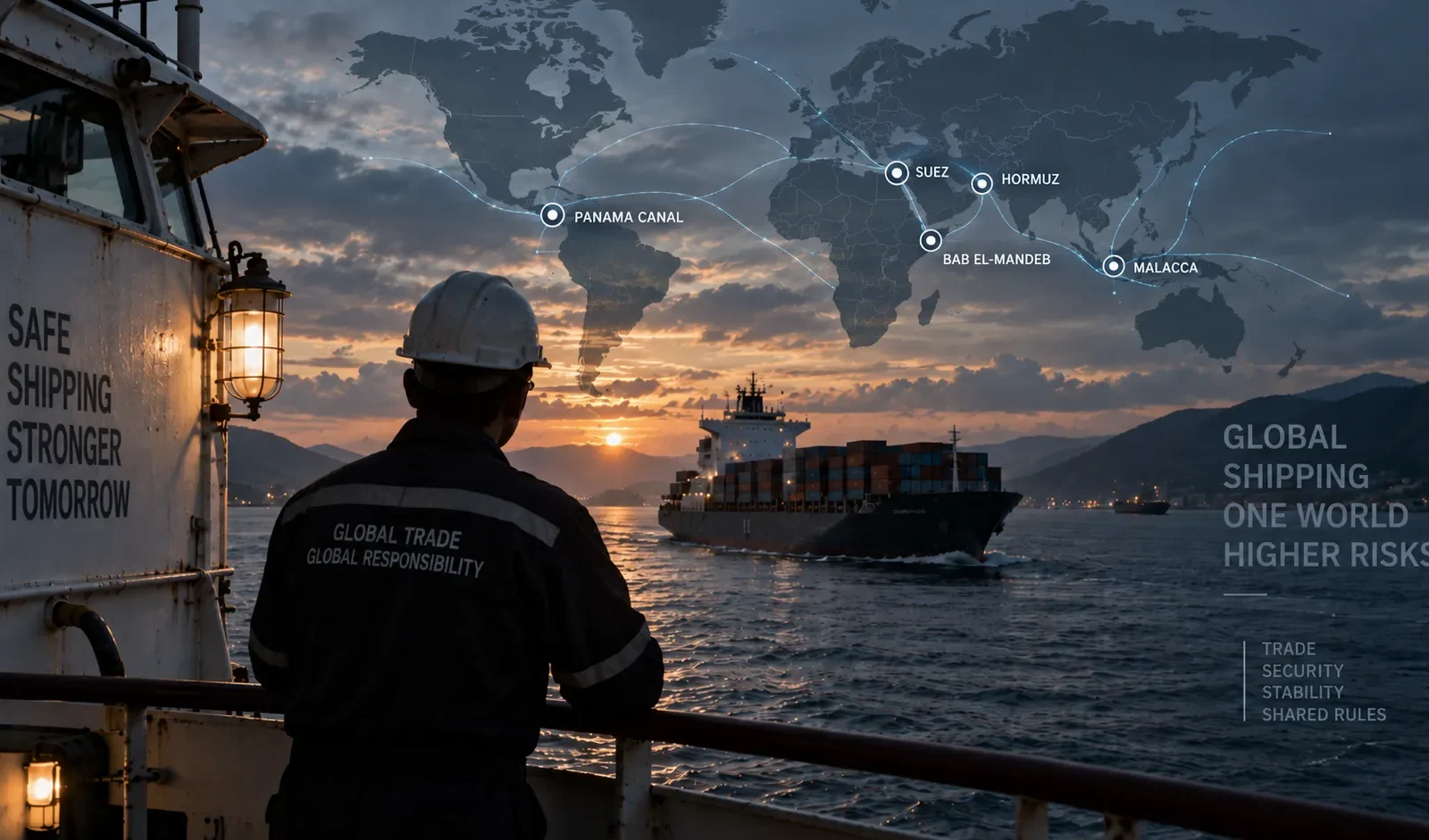
Tide Signal’s Maritime Chokepoints analysis explains why interruptions at Hormuz, Suez, Bab el-Mandeb, Malacca or Panama can quickly move from a regional problem into a global fleet-capacity issue.
Hormuz Has Become the Clearest Test of Freedom of Navigation
The Strait of Hormuz has become the most immediate demonstration of the problem described by the maritime nations.
The waterway is one of the world’s most important energy-export corridors and a legally recognised strait used for international navigation.
Under Part III of the United Nations Convention on the Law of the Sea, ships enjoy a right of transit passage through international straits.
Article 38 establishes that right, while Article 44 provides that states bordering such straits should not hamper transit passage or suspend it.
The legal principle is clear.
The operational situation can be much less straightforward.
War, naval threats, attacks, political negotiations, insurance restrictions and owner risk assessments can reduce traffic even where the legal right of navigation remains formally intact.
Tide Signal is following the real traffic picture in its Strait of Hormuz shipping monitor.
IMO Has Already Reaffirmed the Right of Transit Passage
The International Maritime Organization has also moved to defend the existing framework.
In July, the IMO Council reaffirmed navigational rights and freedoms following attacks on civilian commercial vessels in and around Hormuz.
The Council said transit through straits used for international navigation should not be threatened, impeded or suspended and specifically stated that passage through Hormuz should remain free of tolls and charges in accordance with international law.
That distinction is central to the current debate.
International shipping does not necessarily need a completely new legal architecture.
It needs confidence that the architecture already in place will continue to be observed and enforced.
Commercial Vessels Are Becoming Part of Geopolitical Conflict
Historically, merchant ships have frequently continued operating through periods of severe diplomatic tension.
The commercial vessel was not entirely removed from geopolitics, but international shipping benefited from an assumption that civilian trade should remain comparatively neutral.
Recent conflicts have weakened that assumption.
Commercial ships have been attacked, detained, diverted or exposed to military action because of their ownership, flag, cargo, trading history or perceived association with particular states.
The result is that a ship’s risk profile is increasingly determined by more than its technical condition and voyage.
Operators now need to consider:
- beneficial ownership;
- flag;
- charterer;
- cargo origin;
- cargo destination;
- previous port calls;
- sanctions exposure;
- nationality of commercial counterparties;
- insurance restrictions;
- and political affiliation perceived by hostile actors.
Those factors can alter voyage acceptance before the ship even sails.
Saudi Attacks Show How the Risk Map Can Expand
The problem is not confined to ships physically inside Hormuz.
Recent attacks on energy infrastructure in southern Saudi Arabia demonstrate how quickly maritime risk can spread beyond the original chokepoint.
Tide Signal’s coverage of the latest Houthi attacks on Saudi energy facilities examines the significance of threats to Red Sea infrastructure at a time when Gulf routes are already under pressure.
If alternative routes and terminals become exposed at the same time, the industry’s theoretical routing flexibility begins to shrink.
War Risk Is Already Turning Geopolitics Into Voyage Cost
The legal and geopolitical debate becomes commercially tangible through insurance.
A shipping route does not need to close for its economics to change.
If underwriters reassess the probability of attack, additional war-risk premiums can rise.
Owners may then require reimbursement through charterparty provisions, increase freight expectations, impose additional conditions or refuse the voyage entirely.
The issue is explored further in Tide Signal’s analysis of Gulf shipping losses and war-risk exposure.
In other words, the erosion of predictability becomes a shipping cost before it becomes a legal crisis.
The Shadow Fleet Is Creating a Parallel Shipping System
The second major structural issue identified in the CSG warning is the rapid expansion of the so-called shadow fleet.
The term generally describes vessels — particularly tankers — trading sanctioned or high-risk cargo outside much of the conventional Western insurance, finance, ownership and service network.
The Financial Times, citing TankerTrackers.com, reported that the shadow tanker fleet has grown to more than 1,500 vessels, approaching one-fifth of the global tanker fleet.
The exact definition and number vary between data providers because there is no single internationally accepted test for what constitutes a shadow-fleet vessel.
But the direction is clear.
A substantial parallel tanker market now exists.
Why the Shadow Fleet Is More Than a Sanctions Issue
The political debate surrounding the shadow fleet normally focuses on sanctions circumvention.
For shipping, the operational questions go much further.
A vessel operating outside traditional insurance, classification, ownership-transparency and financing structures can create additional uncertainty regarding:
- pollution liability;
- P&I cover;
- collision claims;
- wreck removal;
- maintenance standards;
- flag-state oversight;
- beneficial ownership;
- ship-to-ship transfers;
- and the ability to recover costs after a casualty.
The risk does not disappear because a vessel moves outside the conventional system.
The risk is redistributed.
Governments Are Already Expanding Shadow-Fleet Sanctions
Western governments continue to tighten restrictions on vessels and companies associated with Russia’s shadow fleet.
The European Union’s latest measures illustrate how the regulatory perimeter is widening beyond individual cargoes.
In August, the EU extended restrictions to companies providing bunkering and other services to shadow-fleet vessels and added another 41 vessels to its services ban.
That approach illustrates another form of fragmentation.
A ship’s commercial accessibility can increasingly depend on which legal regime, port, insurer, bank, service provider or jurisdiction it encounters.
Two Shipping Systems Are Starting to Coexist
The long-term concern is the emergence of two increasingly separate maritime ecosystems.
One operates largely within traditional IMO, flag-state, classification, P&I, banking and sanctions-compliance structures.
The other relies more heavily on alternative insurers, opaque ownership chains, high-risk flags, non-Western financing and trading networks designed to reduce exposure to sanctions enforcement.
For compliant operators, this creates a competitive as well as regulatory problem.
Companies investing in safety, insurance, environmental compliance and transparent corporate structures carry costs that vessels operating outside those structures may avoid.
If the gap grows too large, regulation can begin to divide the market rather than establish a common minimum standard.
Panama Shows That Not Every Shipping Threat Is Geopolitical
The structural pressure on global shipping is not limited to war and sanctions.
Climate and infrastructure constraints can affect the same network.
The Panama Canal restrictions in 2026 provide a different example.
The Canal remains open, but reduced rainfall has tightened booking capacity and increased the commercial value of predictable transit access.
The cause is completely different from Hormuz.
The shipping consequence is familiar: constrained access, waiting, rerouting and higher uncertainty.
Chokepoints Are Becoming Commercial Leverage
For decades, maritime chokepoints were treated largely as geographical facts.
They were places where traffic concentrated because geography left ships with limited alternatives.
Today they are increasingly commercial and geopolitical variables.
A restriction at Hormuz affects tanker and LNG flows.
Red Sea instability affects access through Bab el-Mandeb and Suez.
Low water affects Panama.
Congestion or disruption in Malacca can affect Asia-Europe and intra-Asian flows.
Once access to a chokepoint becomes uncertain, distance effectively increases.
That changes vessel availability even if the physical fleet has not changed.
Longer Routes Reduce Effective Fleet Capacity
Rerouting is often described as a safety decision.
Commercially, it is also a supply decision.
A vessel travelling thousands of additional nautical miles remains occupied for longer.
That removes vessel-days from the market.
The direct consequences can include:
- higher bunker consumption;
- more sea days;
- higher emissions;
- larger crew and operating exposure;
- delayed cargo delivery;
- reduced fleet productivity;
- and potentially stronger freight requirements.
Tide Signal’s Voyage Estimation in Shipping explains how additional distance, time, bunkers and port or transit costs translate into commercial voyage economics.
Why Global Shipping Rules Matter to Freight Markets
Rules can appear abstract until they stop being predictable.
For a chartering desk, the value of an international maritime framework is that it reduces uncertainty.
An owner knows broadly where the vessel may trade.
A charterer knows whether cargo can move through a route.
An insurer can price the exposure.
A bank can assess the asset and its counterparties.
A port can determine whether the vessel can legally receive services.
When those assumptions fragment, every participant begins adding a risk premium.
That risk premium eventually appears in freight.
Container Shipping Is Exposed Too
The shadow fleet debate is overwhelmingly tanker-focused, but fragmentation of maritime routes affects liner shipping as well.
Container networks depend on reliability.
A weekly service is constructed around a chain of port calls, transit windows, terminal capacity and vessel positioning.
Rerouting one service can affect multiple subsequent calls.
If disruptions remain prolonged, carriers may need additional ships simply to maintain the same weekly frequency.
That interaction between route disruption and available capacity is one reason geopolitical changes can feed into container shipping rates even when global cargo volumes themselves have not changed dramatically.
More Than 80% of World Trade Depends on Maritime Transport
The stakes extend far beyond shipowners.
UN Trade and Development estimates that maritime transport moves more than 80% of goods traded worldwide by volume.
That includes energy, grain, metals, manufactured goods, vehicles, chemicals and the intermediate products that feed global production chains.
Shipping therefore functions as infrastructure for the world economy.
When maritime trade becomes more expensive or less predictable, the impact moves through inventories, industrial production, energy prices and consumer costs.
Why Greece Is Part of the Warning
Greece’s participation in the statement is commercially significant.
Greek interests operate one of the world’s largest internationally trading merchant fleets and have particularly large exposure to tankers and bulk carriers.
These are precisely the sectors most directly affected by sanctions, commodity flows, chokepoint disruption and changing insurance conditions.
For Greece, a system based on free access to international markets is therefore not an abstract diplomatic preference.
It is central to the economics of operating a globally deployed fleet.
What “Global Shipping Rules Are Breaking Down” Actually Means
The headline needs an important qualification.
International shipping law has not ceased to exist.
UNCLOS remains in force.
IMO conventions remain in force.
SOLAS, MARPOL, STCW, COLREG and other international instruments continue to regulate vessels around the world.
Flag states, port states, classification societies, insurers and regulators continue to operate.
The CSG warning is therefore better understood as a warning about erosion, fragmentation and enforcement, rather than the literal disappearance of maritime law.
Rights may exist on paper while physical conditions make exercising them commercially difficult.
Rules may be internationally agreed while a growing section of the fleet operates outside parts of the conventional compliance system.
That gap between law and operational reality is the issue.
The IMO System Depends on Common Rules
International shipping is unusual because one vessel can be owned in one country, registered in another, managed from a third, crewed internationally, insured elsewhere and trade between dozens of jurisdictions.
National regulation alone cannot efficiently govern such a system.
That is why globally compatible IMO standards matter.
If states increasingly replace multilateral rules with competing national requirements, compliance complexity rises quickly.
A vessel could theoretically be compliant under one regime but restricted under another.
The result is higher cost and less predictable market access.
Shipping Companies Will Need More Due Diligence
For owners and operators, the practical result of fragmentation is greater due-diligence burden.
Before accepting employment, commercial teams increasingly need to check not only the cargo and freight but the entire transaction chain.
- Counterparty ownership and control
- Sanctions exposure
- Cargo origin and destination
- Vessel trading history
- Flag-state restrictions
- Port-entry restrictions
- P&I and war-risk cover
- Banking and payment channels
- Route security
- Chokepoint accessibility
- Previous ship-to-ship activity
- Beneficial ownership transparency
The commercial cost of that work ultimately forms part of the cost of operating a vessel.
Who Is Most Exposed?
| Stakeholder | Main Exposure |
|---|---|
| Shipowners | Route access, insurance, sanctions and vessel employability |
| Charterers | Cargo delivery, freight premiums and contractual risk allocation |
| Insurers | War risk, pollution liability and opaque ownership |
| Banks | Sanctions compliance and asset/counterparty exposure |
| Ports | Access decisions, services and regulatory compliance |
| Cargo interests | Delivery reliability, logistics cost and supply-chain continuity |
What the Shipping Industry Should Watch Next
The CSG statement is a warning, not a forecast that international maritime trade is about to stop.
The important question is whether the pressures driving the warning intensify or begin to stabilise.
- Whether unrestricted transit through Hormuz can be restored
- Whether commercial vessels remain targets in regional conflicts
- Changes in war-risk insurance premiums
- Further sanctions targeting shadow-fleet vessels and service providers
- Port-state treatment of shadow-fleet tonnage
- Growth or contraction of the parallel tanker market
- IMO action defending freedom of navigation
- Changes in Red Sea and Bab el-Mandeb traffic
- Panama Canal capacity and water restrictions
- Any increase in national or discriminatory shipping rules
The Commercial Takeaway
The strongest part of the CSG warning is its diagnosis.
The shipping industry’s recent problems are increasingly connected.
A missile attack changes insurance.
Insurance changes voyage economics.
A chokepoint restriction changes routing.
Routing changes effective fleet capacity.
Sanctions create alternative trading networks.
Alternative networks weaken the universality of traditional insurance and regulatory systems.
Each development reinforces the next.
That is why the intervention by 18 maritime nations matters more than another headline about a single ship, sanction package or blocked route.
It is a warning that the environment in which shipping operates is changing from a broadly common global system toward a more fragmented one.
International law still exists.
The IMO framework still exists.
Merchant ships still move more than 80% of world trade by volume.
But the industry’s ability to assume that a legal right automatically translates into safe, insured and commercially predictable passage can no longer be taken for granted.
For owners, charterers, insurers and cargo interests, that loss of predictability may become one of the defining commercial risks of global shipping in 2026.
Is the Strait of Hormuz Open? — Current traffic conditions through the Gulf’s critical energy chokepoint.
Maritime Chokepoints Explained — Hormuz, Suez, Malacca and the commercial consequences of disruption.
Gulf Shipping Losses & War Risk — How conflict moves into insurance and vessel employment.
Houthi Attacks Disrupt Saudi Energy Facilities — The expanding Red Sea energy and tanker risk.
Panama Canal Restrictions 2026 — Transit capacity, waiting time and water constraints.
Container Shipping Rates — Freight markets, capacity and network disruption.
Voyage Estimation in Shipping — How rerouting, bunker consumption and voyage time affect commercial returns.
Global Shipping Rules: Frequently Asked Questions
What is the Consultative Shipping Group?
The Consultative Shipping Group is an international group of 18 maritime administrations that support open, competitive and non-discriminatory access to global shipping markets.
Which countries are members of the CSG?
Belgium, Canada, Denmark, Finland, France, Germany, Greece, Italy, Japan, the Republic of Korea, the Netherlands, Norway, Poland, Portugal, Singapore, Spain, Sweden and the United Kingdom.
Why is the CSG statement significant?
The Financial Times reported that it is the group’s first public intervention since it was created more than 60 years ago, underlining the seriousness of its concern over the fragmentation of global shipping.
Are international shipping rules actually collapsing?
International maritime law and IMO conventions remain in force. The warning concerns increasing fragmentation, geopolitical pressure and situations in which established legal rights are becoming harder to exercise safely and predictably in practice.
What is freedom of navigation?
Freedom of navigation is a core principle of international maritime law. UNCLOS establishes rights governing navigation on the high seas and transit passage through straits used for international navigation.
What is the shadow fleet?
The term generally refers to vessels, particularly tankers, that trade sanctioned or high-risk cargo outside significant parts of the traditional Western insurance, finance and service network. Definitions vary between governments and data providers.
Why does the shadow fleet create risk?
Concerns include opaque ownership, uncertain insurance arrangements, sanctions exposure, vessel condition, pollution liability and difficulties recovering losses following a casualty.
How could weaker global shipping rules affect freight rates?
Higher war-risk premiums, rerouting, longer voyages, reduced effective vessel availability, sanctions compliance and additional due diligence can all increase the cost of moving cargo and influence freight markets.
- Financial Times — Maritime nations warn that global shipping rules are under pressure
- Danish Maritime Authority — Consultative Shipping Group and member countries
- International Maritime Organization — Protection of vital shipping lanes and freedom of navigation
- United Nations — UNCLOS Part III: Straits Used for International Navigation
- UN Trade and Development — More than 80% of global goods trade moves by sea
- Council of the European Union — Measures targeting Russia’s shadow fleet
Tide Signal distinguishes the CSG’s warning about erosion and fragmentation of the maritime rules-based system from the legal status of existing international conventions. UNCLOS and IMO instruments remain in force. Shadow-fleet estimates vary by source and methodology.