Alternative fuel spill response is moving from a future-fuels discussion into a practical shipping-safety problem. IMO’s latest Research and Development Forum identified continuing knowledge and capability gaps around pollution incidents involving LNG, LPG, methanol, ammonia, hydrogen, biofuels and e-fuels — fuels whose behaviour can require very different emergency strategies from conventional oil.
The IMO forum concluded in Singapore on 22 September 2026. Regulators, scientists, industry representatives and emergency responders examined spill behaviour, modelling, risk assessment, emergency response, post-spill action and international cooperation.
Why is alternative fuel spill response different? Because there is no single “green fuel spill”. Ammonia introduces major toxicity and corrosiveness concerns; hydrogen has very high flammability; LNG and LPG bring cryogenic or pressurised-gas hazards; methanol is a low-flashpoint liquid; and biofuels can behave differently depending on formulation.
IMO Says Alternative-Fuel Spill Preparedness Still Has Critical Gaps
IMO’s Research and Development Forum, “From Fossil to Future: Marine Pollution Preparedness in the Age of Alternative Fuels”, focused directly on the response problems created by the maritime energy transition.
IMO says the forum addressed critical knowledge and capability gaps in responding to spills involving alternative marine fuels.
The discussions covered:
- spill fate and behaviour;
- atmospheric and water-column modelling;
- risk assessment and preparedness;
- emergency response;
- post-spill actions;
- international cooperation and coordination.
Read the official IMO post-event update and the IMO R&D Forum page .
Why One Generic Spill-Response Playbook Will Not Work
Traditional oil-spill response has decades of operational experience behind it. Alternative fuels challenge that model because their physical and chemical properties differ sharply.
ITOPF notes that biofuels, LNG, methanol, ammonia and hydrogen have highly variable fates and behaviours when released.
EMSA likewise warns that alternative fuels introduce new safety risks arising from their distinct chemical properties and can require more sophisticated safeguards, equipment and skills.
A method suitable for a persistent oil slick may be ineffective — or unsafe — for a toxic vapour cloud, a cryogenic release or a rapidly dispersing gas.
Alternative Marine Fuels: How the Hazard Profile Changes
| Fuel | Key response issue | Operational consequence |
|---|---|---|
| Ammonia | Toxicity and corrosiveness | Respiratory protection, detection, exposure control and medical readiness become central. |
| Methanol | Low-flashpoint liquid | Ignition control, isolation, leak detection and fuel-specific fire response matter. |
| LNG | Cryogenic liquid and vapour generation | Cold exposure, gas dispersion, ignition control and exclusion zones can dominate early response. |
| LPG | Pressurised or refrigerated flammable gas | Containment failure can create rapidly changing flammable zones. |
| Hydrogen | Very high flammability | Detection, ventilation, shutdown and ignition-source control are critical. |
| Biofuels | Properties vary by product | The actual fuel specification matters more than the broad “biofuel” label. |
| E-fuels | Category includes very different molecules | Response planning must use the exact fuel chemistry. |
Ammonia Spill Response: Toxicity Changes the Emergency
Ammonia is one of the clearest examples of why the fuel transition changes emergency response.
EMSA identifies toxicity and corrosiveness as major safety and operational challenges for ammonia as marine fuel.
Practical preparedness can therefore require:
- rapid leak detection;
- toxic-hazard exclusion zones;
- respiratory and chemical protective equipment;
- controlled ventilation;
- emergency isolation;
- medical readiness for exposure;
- clear ship-shore communication.
The central question may not simply be how to stop the leak. It can be whether personnel can safely approach the affected area at all.
See Tide Signal’s Ammonia as Marine Fuel guide for the wider regulatory and safety pathway.
Methanol Spill Response: A Liquid Fuel With a Different Risk Profile
Methanol is a liquid fuel, but it is not operationally equivalent to conventional marine fuel oil.
Its low flashpoint changes ignition risk, hazardous-area management and firefighting requirements. Its behaviour after release also differs from the persistent slick associated with heavy fuel oil.
Shipboard preparedness therefore needs strong leak detection, isolation, ventilation, ignition-source control and fuel-specific emergency procedures.
Read Tide Signal’s IMO Methanol and Fuel-Cell Shipping Rules .
LNG and LPG Spill Response: Cryogenic and Vapour Hazards
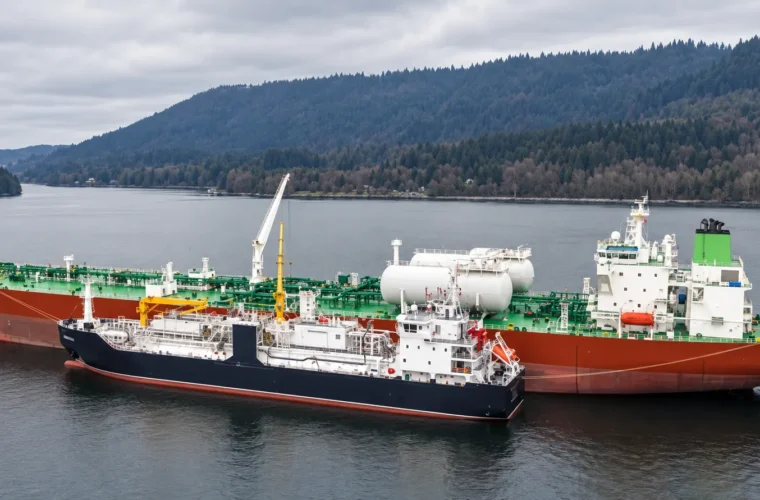
LNG and LPG create another response model because both are gases at ambient conditions and are carried in liquefied form.
A release can involve:
- rapid phase change;
- vapour generation;
- low-temperature contact hazards;
- flammable gas zones;
- ignition-control requirements;
- rapidly changing exclusion areas.
The initial emergency may therefore be dominated by atmospheric hazard control rather than conventional mechanical pollutant recovery.
Hydrogen Spill Response: Detection and Ignition Control Become Critical
EMSA describes hydrogen’s flammability as higher than that of natural gas.
That places strong emphasis on:
- gas detection;
- ventilation;
- safe shutdown;
- isolation;
- ignition-source control;
- crew understanding of release behaviour.
For responders, the central hazard may be a rapidly changing flammable atmosphere rather than visible pollution on the sea surface.
Biofuels and E-Fuels: The Label Is Not Enough
Some biofuels can behave similarly to conventional hydrocarbons, while others can differ in toxicity, persistence and biodegradation.
E-fuels are even broader as a category. The method used to produce the fuel does not tell an emergency responder exactly how the final molecule will behave after release.
What Ships Should Prepare Now
- Identify the exact fuel hazards. Crew should understand toxicity, flammability, temperature, pressure and exposure characteristics.
- Validate detection systems. Sensors, alarms and response procedures must match the actual fuel.
- Review shutdown and isolation. Personnel should know what happens automatically and what requires manual intervention.
- Match PPE to the scenario. Conventional firefighting PPE may not be sufficient for toxic or corrosive exposure.
- Build fuel-specific drills. A generic bunker-spill drill is not enough.
- Define safe approach and re-entry criteria. The master and emergency team should know when personnel must remain outside the affected area.
- Coordinate with shore responders. Ports and emergency services should know what fuel is onboard before an incident occurs.
- Keep casualty data immediately available. Fuel identity, quantity, tank condition, pressure, temperature and SDS information should be accessible.
Tide Signal’s SOLAS Chapter II-2 Fire Safety guide explains the wider onboard fire-safety framework.
Ports and Terminals Need Fuel-Specific Response Capability Too
The risk does not stop at the ship’s manifold.
Bunkering creates a ship-shore interface involving transfer equipment, emergency shutdowns, terminal personnel, adjacent vessels and local emergency services.
Ports preparing for alternative-fuel traffic should know:
- which fuels are handled and in what quantities;
- where emergency isolation points are located;
- what gas and vapour detection capability is available;
- which PPE is immediately accessible;
- how atmospheric monitoring will be conducted;
- what medical and firefighting resources are compatible with the fuel;
- which authority leads the response if the release crosses the ship-shore boundary.
Crew Competence Is Part of the Same Safety Gap
On 23 September 2026, IMO separately reported on work examining evolving competence and training requirements for seafarers using ammonia, methanol, hydrogen, batteries and onboard carbon capture.
The event brought together IMO, EMSA, the World Maritime University, administrations, industry and maritime education providers.
The issue matters because technology can reduce risk only if crews understand:
- fuel properties;
- normal and abnormal system behaviour;
- alarms;
- bunkering controls;
- emergency shutdown;
- PPE limitations;
- evacuation;
- first response.
See the official IMO seafarer competence update .
How Spill Response Fits With SOLAS, MARPOL and Training Rules
| Framework | Main role |
|---|---|
| SOLAS / IGF safety framework | Ship design, fuel-system safety, fire protection and onboard operational safety. |
| MARPOL | Pollution prevention and control across established pollutant categories. |
| STCW / competence work | Seafarer knowledge, training and competence. |
| Spill-response preparedness | What ship and shore teams do after an uncontrolled release occurs. |
For the wider environmental framework, see MARPOL Annexes Explained and SOLAS Convention Explained .
SpillAsia 2026 Keeps the Issue Live Through September 25
The IMO forum was held alongside SpillAsia 2026 at Suntec Singapore.
SpillAsia runs from 23 to 25 September 2026 and brings together regulators, marine-spill specialists, technology providers and industry participants.
The programme includes multiple streams focused on prevention, preparedness, response, restoration and new technology.
See the official SpillAsia 2026 conference programme .
Alternative-Fuel Spill Response vs Conventional Oil Spill Response
| Issue | Conventional oil | Alternative fuels |
|---|---|---|
| Visible pollution | Often creates a persistent visible slick | Some fuels may vaporise, dissolve or disperse rapidly |
| Response focus | Containment, recovery and shoreline protection | Can shift toward toxic, flammable, cryogenic or vapour hazard control |
| PPE | Mature oil-response standards | May require respiratory or chemical protection |
| Detection | Visual observation can be important | Gas or vapour detection may be essential |
| Responder approach | Often centred on access to the pollutant | Safe approach may be limited by toxic or flammable atmosphere |
| Experience base | Decades of operational experience | Protocols and experience are still developing for several fuels |
What This Means for Shipowners and Managers
Fuel choice increasingly changes more than propulsion technology and emissions accounting.
It can also change:
- crew-training requirements;
- PPE inventory;
- gas-detection systems;
- drill design;
- bunkering procedures;
- port compatibility;
- emergency-response agreements;
- insurance and risk review;
- casualty-management assumptions.
What to Watch Next
| Development | Why it matters |
|---|---|
| IMO follow-up work | Shows whether forum findings move into guidance, protocols or regulatory development. |
| Fuel-specific response guidance | Converts research into practical detection, PPE, exclusion-zone and response procedures. |
| STCW competence developments | Determines how crew training evolves as alternative fuels enter service. |
| Ammonia-fuelled vessel deployment | Operational experience will test assumptions around leak and exposure management. |
| Port bunkering procedures | Ship-shore emergency compatibility becomes more important as fuel volumes increase. |
| Incident and near-miss data | Real events will shape modelling, drills and responder procedures. |
Alternative Fuel Spill Response FAQ
What is alternative fuel spill response in shipping?
It is the preparedness and emergency-response process for releases involving fuels such as LNG, LPG, methanol, ammonia, hydrogen, biofuels and e-fuels.
Why is IMO focusing on alternative-fuel spills?
IMO says knowledge and capability gaps remain in spill behaviour, modelling, risk assessment, emergency response and post-spill actions as new fuels enter wider use.
Why is ammonia spill response difficult?
Ammonia introduces major toxicity and corrosiveness hazards, making detection, respiratory protection, safe approach and medical preparedness especially important.
Is methanol spill response the same as an oil spill?
No. Methanol is a low-flashpoint liquid with different fire and environmental behaviour from conventional fuel oil.
What makes LNG spill response different?
LNG is stored at cryogenic temperature and can rapidly vaporise after release, creating low-temperature, vapour-dispersion and flammable-atmosphere hazards.
What is the main hydrogen safety concern?
Hydrogen’s very high flammability makes detection, ventilation, isolation and ignition control central to emergency preparedness.
Do crews need new training for alternative fuels?
Yes. IMO and EMSA are actively examining competence and training requirements for ammonia, methanol, hydrogen and other new technologies.
What was the IMO R&D Forum in Singapore?
It was a two-day forum held on 21–22 September 2026 examining spill behaviour, modelling, preparedness, emergency response and international cooperation for alternative marine fuels.
Primary Sources and Verification
- IMO — R&D Forum advances global preparedness for alternative fuel pollution incidents
- IMO — Marine Pollution Preparedness for Alternative Fuels
- IMO — Strengthening Seafarers’ Competence for Alternative Fuels
- EMSA — Safety of Alternative Fuels
- EMSA — Safety of Ammonia for Use in Ships
- EMSA — Safety of Hydrogen for Use in Ships
- ITOPF — Alternative Fuels: A Shift in the Response Paradigm?
- SpillAsia 2026 Conference Programme