Academy · Regulation · Technology
The MASS Code is the first global IMO safety framework written specifically for Maritime Autonomous Surface Ships. It changes the regulatory conversation from “can a ship navigate without a conventional bridge team?” to a much harder question: how can autonomous and remotely operated functions be designed, approved, certified and supervised so that they deliver a level of safety, security and environmental protection expected of a conventional ship?
Adopted by the IMO Maritime Safety Committee in May 2026 as resolution MSC.595(111), the non-mandatory MASS Code took effect on 1 July 2026. It covers cargo ships within its SOLAS-based scope and introduces a goal-based framework for autonomous functions, remote operation, human oversight, Remote Operations Centres, certification, risk assessment, software, connectivity, navigation, cybersecurity, manning, watchkeeping and emergency response.
The Code is a major milestone, but it is deliberately transitional. IMO is using the non-mandatory framework to build operational experience before developing a binding instrument. That makes 2026–2030 an important period for shipowners, shipyards, class societies, technology suppliers, flag States, seafarers and ports that expect autonomous or remote operations to move from trials into commercial use.
What Does MASS Mean?
MASS stands for Maritime Autonomous Surface Ship. The Code defines a MASS as a ship that, to a varying degree, can operate independently of human interaction.
That definition is broader than the popular image of an unmanned ship crossing an ocean without human involvement. A MASS can still have people on board. It can also use different modes of operation during different voyage phases.
The critical distinction is functional: autonomous or remotely operated technology must augment or replace functions that would otherwise be conducted or controlled by onboard crew.
Automation alone does not make a ship autonomous
A conventional merchant ship may already use autopilot, track control, ECDIS route monitoring, automatic engine control, dynamic positioning, alarms and highly automated machinery. Under the IMO framework, that does not automatically make the vessel a MASS.
To qualify, the relevant autonomous or remote technology must fall within the Code’s approval framework, and the ship must successfully complete the approval process and hold the appropriate MASS certification.
This distinction matters commercially. “AI-enabled,” “highly automated” and “autonomous” are not interchangeable regulatory labels.
When Did the MASS Code Enter Into Effect?
The IMO Maritime Safety Committee adopted the International Code of Safety for Maritime Autonomous Surface Ships at MSC 111 in May 2026 through resolution MSC.595(111). Governments were invited to give effect to the Code from 1 July 2026.
The Code is technology-neutral and goal-based. It is not built around one brand of autonomous navigation software, one sensor architecture or one Remote Operations Centre model. Instead, it establishes safety goals, functional requirements and expected performances that a MASS system must satisfy.
That approach is important because autonomy technology is evolving faster than prescriptive equipment lists can realistically be amended.
Which Ships Does the 2026 MASS Code Apply To?
The Code applies to cargo ships to which SOLAS Chapter I applies, including associated Remote Operations Centres, when autonomous or remote systems are used and the Administration considers that compliance with other applicable instruments is impracticable or insufficient for those functions.
In practical terms, IMO’s public guidance describes the principal population as SOLAS cargo ships, generally cargo ships of 500 GT and above engaged on international voyages.
The Code does not apply to cargo high-speed craft covered by SOLAS Chapter X or to warships, naval auxiliaries and other government ships used only on non-commercial service.
IMO also invites Governments to apply the Code, as far as practicable, to MASS below 500 GT.
The MASS Code Is Supplementary to SOLAS — Not a Replacement
One of the most important principles in the Code is that autonomous ships do not escape the existing maritime rulebook.
The MASS Code is supplementary to other applicable IMO instruments. Where SOLAS, COLREG, STCW, the ISM Code, the ISPS Code or another mandatory instrument already provides an adequate requirement, the autonomous ship remains subject to it.
The problem arises where conventional rules assume that a human being is physically on the ship to perform a task. Autonomous or remote operations can make that assumption impracticable. The MASS Code provides a structured method for addressing that gap without abandoning the safety objective behind the original rule.
For the base convention, see Tide Signal’s SOLAS Convention explained. For the navigation layer specifically, see SOLAS Chapter V: Safety of Navigation.
How the MASS Code Is Structured
The Code contains 24 chapters organized into three main parts.
| Part | Purpose | Key subjects |
|---|---|---|
| Part I | Introduction and application | Purpose, principles, scope, structure and definitions. |
| Part II | Principles for MASS and MASS functions | Certification, approval, risk assessment, operational context, system design, software, safe management, security, alerts, manning and maintenance. |
| Part III | Goals and functional requirements for specific operations | Navigation, connectivity, remote operations, structure, fire safety, search and rescue, cargoes, anchoring/towing/mooring, machinery and electrical installations. |
The 24 chapters
| Chapter | Subject | Why it matters |
|---|---|---|
| 1–4 | Purpose, application, Code structure and definitions | Establishes what a MASS is and when the framework is used. |
| 5 | Surveys and certificates | Introduces MASS Safety and MASS ROC certification. |
| 6 | Approval process | Creates the route from concept and gap analysis to testing and approval. |
| 7 | Risk assessment | Requires hazards created by autonomous and remote operations to be systematically addressed. |
| 8 | Operational context | Defines ConOps, Operational Envelope, ODD, fallback states and modes of operation. |
| 9 | System design | Addresses robustness, redundancy, cybersecurity, data quality, logging and interoperability. |
| 10 | Software principles | Covers reliability, safety, explainability, accountability, controllability and bias. |
| 11 | Management of safe operations | Extends the safety-management concept across the ship and ROC. |
| 12 | Maritime security | Addresses security controls, remote operations, access and communications. |
| 13 | Alert management | Controls how alerts are generated, prioritized and handled across remote or autonomous functions. |
| 14 | Manning, training and watchkeeping | Defines safe manning, remote-operator competence and watchkeeping principles. |
| 15 | Maintenance | Ensures autonomous and remote systems remain testable, maintainable and reliable. |
| 16 | Safety of navigation | Applies SOLAS/COLREG principles to autonomous and remote navigation. |
| 17 | Connectivity | Treats communications links as safety-critical infrastructure. |
| 18 | Remote operations | Addresses operation of ship functions from outside the vessel. |
| 19 | Structure, subdivision, stability and watertight integrity | Maintains conventional ship-safety goals under different operating models. |
| 20 | Fire protection, detection and extinction | Deals with prevention and response when fewer or no crew may be on board. |
| 21 | Search and rescue | Ensures MASS can interact safely with the global SAR system. |
| 22 | Carriage of cargoes | Addresses cargo-related functions where human presence may differ from conventional ships. |
| 23 | Anchoring, towing and mooring | Extends safe control to operations that traditionally rely heavily on onboard personnel. |
| 24 | Machinery and electrical installations | Addresses reliability and operation of essential technical systems. |
MASS Safety Certificate: Autonomous Does Not Mean Uncertified
Under the non-mandatory Code, every MASS should hold a valid MASS Safety Certificate after the required initial or renewal survey.
The certificate is accompanied by a MASS Record containing information that is central to the vessel’s approved operating model, including:
- the Concept of Operations;
- survey requirements associated with the systems covered by the Code;
- a task-allocation summary;
- the regulatory gap analysis; and
- the approved Remote Operations Centres associated with the ship.
The MASS Safety Certificate is additional to the ship’s relevant SOLAS certificates. It does not replace them.
Surveys are intended to verify not only equipment installed on the vessel but the functionality and connectivity between the MASS and any associated ROC. That is a significant regulatory change: part of the safety-critical operational system may physically exist ashore.
Remote Operations Centres Become Part of the Safety System
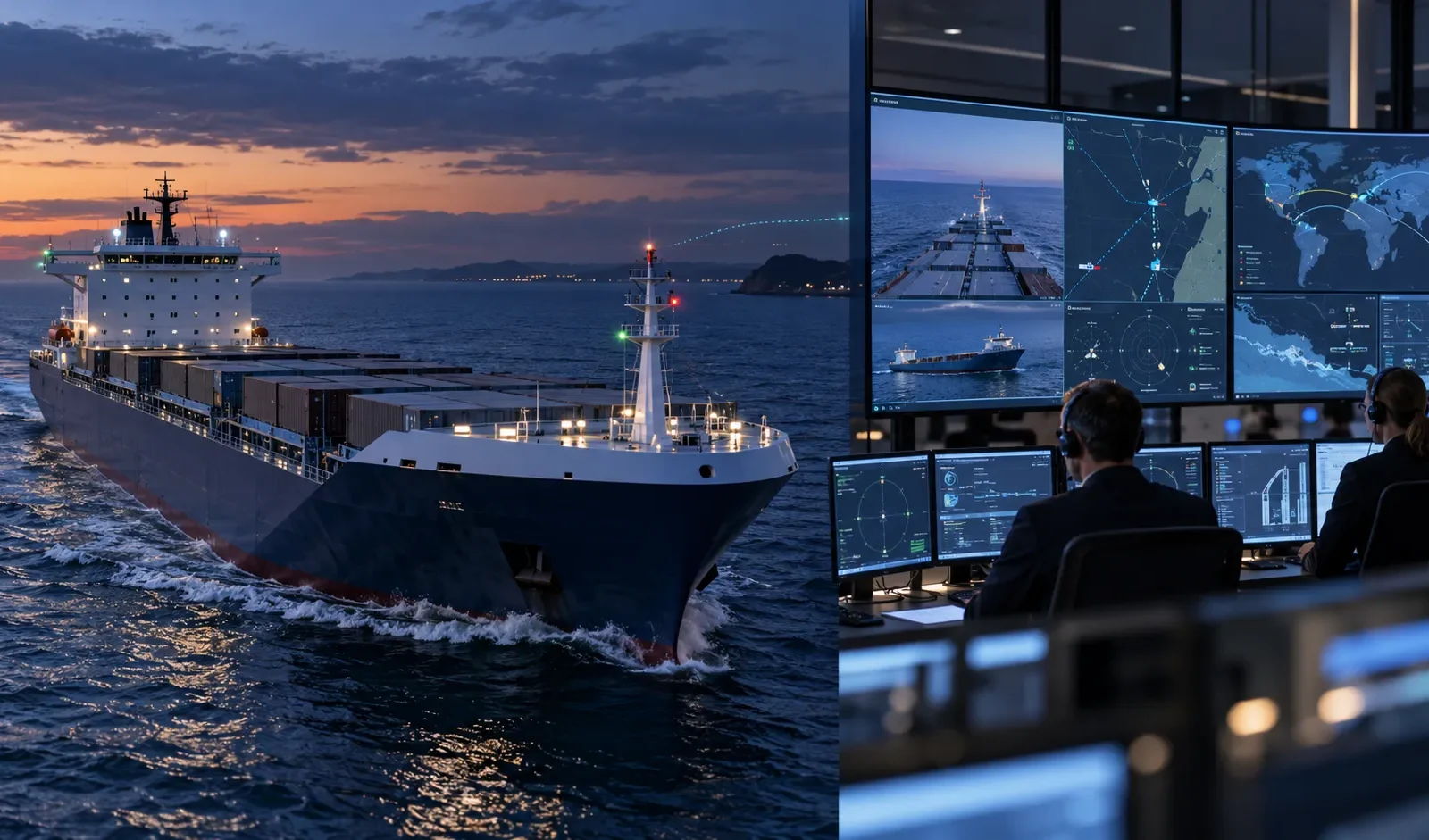
A Remote Operations Centre (ROC) is a location away from the ship from which some or all MASS functions can be monitored or operated.
The MASS Code treats the ROC as much more than an office with screens and a satellite link.
For each MASS it operates, the ROC should hold a valid MASS ROC Certificate issued after survey. The accompanying ROC Record includes operational restrictions and accepted connectivity infrastructure and performance.
The ROC must be compatible with the ship it operates. Its control stations, power, connectivity, alert handling, procedures, cybersecurity and human staffing become part of the approved operational architecture.
The Human Master Does Not Disappear
The MASS Code is explicit on one issue that has generated years of debate: there should be a human master responsible for the MASS regardless of its mode of operation.
The master may be physically on board or located at a Remote Operations Centre. However, where crew or other persons are on board, the Code says the master should be physically present on the ship to ensure the safety of personnel and operations.
A MASS may have more than one master during a voyage as operational responsibility changes, but only one master should be responsible at a given time.
Where command is transferred to or within a ROC, the system must provide enough time, information and procedures for the incoming master to establish situational awareness before taking responsibility.
Human intervention remains a design requirement
The Code requires human oversight and control rather than assuming the autonomous system will always be left alone to decide.
A master must have the means to intervene when necessary. Where a remote operator or onboard crew member takes control from an autonomous system, they must receive sufficient information and time to establish situational awareness before assuming control.
This is particularly important during degraded conditions. Automation can perform extremely well inside its validated operating domain, but maritime risk often becomes critical precisely when conditions move outside the expected envelope.
Remote Operators: STCW Competence Still Matters
Remote operation does not reduce watchkeeping to general IT support.
The MASS Code says remote operators used to meet safe-manning requirements should be qualified and competent at a level not less than that required by the STCW Convention and Code for their assigned tasks, duties and responsibilities.
They also need additional training for remote operations, familiarity with the specific MASS and ROC, and competence in the systems and procedures they will control.
Remote watchkeeping must also account for:
- adequate numbers of qualified operators;
- handover and situational-awareness time;
- clear authority between onboard and remote personnel;
- fatigue and hours of rest;
- emergency response;
- the possibility of controlling more than one ship from one ROC.
The Code even allows an Administration to treat a ROC as a location directly associated with the bridge or machinery space for watchkeeping purposes, so that STCW principles may be applied to remote operators.
Minimum Safe Manning Still Exists — It Changes Location
A common misconception is that “autonomous” automatically means “zero manning.” The Code does not say that.
A MASS and its associated ROC must be sufficiently and effectively manned for the approved operating model. The resulting Minimum Safe Manning Document can allocate defined capacities to onboard crew, remote operators or a combination of both.
The correct number and location of people therefore depend on the functions, modes of operation, automation level, fallback strategy and approved Concept of Operations.
The commercial question is not simply “how many seafarers can be removed?” It becomes “where must competent humans remain in the system to keep the ship safe under normal, degraded and emergency conditions?”
Concept of Operations: The Document That Explains How the Ship Really Works
The Concept of Operations (ConOps) is one of the foundation documents in the MASS framework.
It describes how the vessel is intended to operate, which functions are autonomous, which are remote, which remain conventional, where human supervision sits, what connectivity is required and how the operating modes change through the voyage.
A credible ConOps needs to describe the operational system, not simply the technology product.
For example, an autonomous navigation system may be used in open ocean, remote navigation may be used during selected phases, and onboard crew may take direct control for port arrival. The safety case must address those transitions as carefully as the individual modes themselves.
Operational Envelope and Operational Design Domain
The MASS Code formalizes two concepts that are central to autonomous-system safety: the Operational Envelope (OE) and the Operational Design Domain (ODD).
Operational Envelope
The Operational Envelope describes the overall capabilities and limitations within which the MASS can operate safely as an integrated ship.
It can include:
- geographical operating area;
- communications and connectivity coverage;
- traffic conditions;
- weather and environmental limits;
- limitations for different modes of operation;
- division of functions between humans and systems;
- foreseeable degraded states.
Operational Design Domain
The ODD applies more specifically to an autonomous or remotely operated system or function. It defines the conditions in which that system is designed and validated to operate safely.
Examples can include maximum wind or wave conditions, visibility, water depth, geographical boundaries, traffic complexity, sensor availability, communications performance and the extent of required human interaction.
The autonomous system must be able to determine whether it remains within its ODD.
Fallback States: What Happens When Autonomy Can No Longer Continue?
No safety case should assume that sensors, software, communications and hardware will remain perfect throughout a voyage.
The MASS Code therefore requires defined fallback concepts.
If a function moves outside its ODD, or the vessel can no longer remain within its Operational Envelope, the ship must have a planned response that moves it toward a predefined safer state.
Depending on the vessel and location, that could involve slowing down, holding position, transferring control to a remote operator, moving to a different navigation mode, activating redundancy, requesting assistance or following another approved contingency action.
The exact fallback response is ship-specific. The principle is universal: loss of normal autonomous capability must not be allowed to become an unmanaged emergency.
Autonomous Navigation Still Has to Obey SOLAS and COLREG
Chapter 16 of the MASS Code deals with safety of navigation and explicitly connects MASS operations with relevant SOLAS requirements and the COLREG.
The Code identifies four major navigation sub-functions that can be autonomous or remotely operated:
- voyage planning;
- situational awareness;
- collision and grounding avoidance;
- route execution and monitoring.
An Autonomous Navigation System must be able to function in its approved Operational Envelope and integrate safely with other ship systems. If it fails, the MASS must be capable of safe operation by alternative means.
Voyage planning remains under human responsibility
The Code does not simply allow software to generate an arbitrary route and sail it.
Where an autonomous or remote navigation system develops or modifies the voyage plan, the plan must be presented in a form that allows the master to review and approve it. The system must also have access to the nautical and hydrographic information necessary to plan safely.
That connects directly with SOLAS Chapter V voyage-planning principles. Tide Signal’s SOLAS Chapter V guide explains the wider framework for passage planning, ECDIS, AIS, radar and the master’s professional judgement.
Situational awareness becomes a system requirement
An autonomous navigation system has to continuously perceive and process information needed for safe navigation and predict how the situation may develop.
That is far more demanding than detecting objects. The system must build a coherent operational picture from sensors and data while understanding its own capability and limitations.
This also explains why sensor integrity matters so much. GNSS spoofing, bad AIS data, degraded radar detection or incorrect environmental inputs can undermine the quality of an automated decision. Tide Signal’s GNSS spoofing and resilient-navigation guide covers the risk of trusting compromised digital position information.
Connectivity Becomes Safety-Critical Equipment
For a remotely operated ship, communications are not simply an administrative service. Connectivity can be part of the control loop.
If the ROC needs real-time situational awareness or the ability to intervene, loss of bandwidth, excessive latency, interference, equipment failure or cyberattack can directly affect navigation and machinery control.
The MASS Code therefore treats connectivity as a dedicated safety function.
The approved arrangement needs to consider performance and quality of service, network availability, redundancy, failure detection, cyber protection and what the vessel will do when the required connection cannot be maintained.
“Remote” does not mean “permanently online at any cost”
A robust MASS cannot depend on an unrealistic assumption of perfect communications everywhere.
The Operational Envelope must reflect actual connectivity coverage. The ship and its autonomous systems also need safe responses for connection degradation and loss.
This is one reason autonomy and remote control are different concepts. A genuinely autonomous function may continue inside its validated operating domain without immediate human command, while a remotely controlled function depends directly on a communications path to the human operator.
Cybersecurity Is Built Into MASS System Design
Cyber risk becomes even more serious when digital systems do not merely advise the crew but directly control navigation, propulsion or safety functions.
Chapter 9 includes security and cybersecurity as system-design principles. The wider Code also addresses access control, communications, software security, data management, logging and remote operations.
The attack surface can include:
- shipboard operational technology;
- navigation sensors and position inputs;
- satellite and terrestrial connectivity;
- ROC control stations;
- remote maintenance connections;
- software updates;
- authentication and access systems;
- third-party data services.
A conventional bridge can sometimes continue manually after a network failure. A highly remote vessel may have a much greater dependence on secure digital infrastructure. That makes resilience, segmentation, recovery and fallback capability fundamental to the safety case.
For the wider regulatory and operational picture, see Tide Signal’s Maritime Cyber Security in 2026.
Software Must Be Explainable, Controllable and Testable
The Code dedicates an entire chapter to software principles. That reflects an important regulatory reality: a physical ship can meet structural and machinery standards while still becoming unsafe because of software behavior.
The MASS framework addresses:
- reliability;
- safety and security;
- transparency and explainability;
- accountability;
- robustness;
- controllability;
- unintended bias;
- the requirement to operate within a defined ODD.
For AI-enabled systems, explainability does not necessarily mean every algorithm must be simple. It means the overall safety architecture must allow operators, designers and authorities to understand system capabilities, limitations and the basis for safety-relevant behavior sufficiently to approve and manage it.
Data Quality Is a Safety Issue, Not an IT Detail
Autonomous systems can only be as reliable as the information they use.
Incorrect position data, misidentified targets, outdated hydrographic data, bad sensor calibration or poor synchronization can all cause a technically functioning algorithm to produce an unsafe result.
The MASS Code therefore includes data management and quality within system design.
This links directly with a broader shipping problem Tide Signal has examined in Maritime Data Quality: The Hidden Barrier to Digital Shipping. In an autonomous ship, unreliable data is no longer just a reporting or efficiency issue. It can enter the vessel’s decision-making loop.
Alert Management Changes When One Operator Can See Multiple Ships
Remote operations create a new human-factors problem: a ROC may supervise more than one ship.
The MASS Code therefore includes alert-management provisions for task stations handling multiple MASS.
Alerts must be structured so that operators understand which ship is affected, which task requires attention and whether control must be transferred. Emergency conditions must allow dedicated human operators — including the master — to take control when necessary.
This is not just a software-interface issue. Poorly designed alert architecture can create the same overload and alarm-fatigue problems already seen on conventional bridges and engine control rooms, potentially at greater scale.
MASS Safety Management Extends Beyond the Ship
The ISM Company intending to operate a MASS should adapt its Safety Management System to address autonomous and remote operations.
The SMS must cover both the ship and relevant ROCs, including:
- division of tasks and responsibilities;
- watchkeeping arrangements;
- remote-control procedures;
- emergency response;
- connectivity failures;
- software and hardware change management;
- maintenance;
- cybersecurity;
- handover of control and command.
The Code also provides an alternative management structure for ROC operations where applicable, including dedicated ROC safety-management certification concepts.
The operational lesson is clear: autonomous shipping cannot be managed as a technology department sitting outside the ship-management system.
Fire Safety, Search and Rescue and Machinery Become Harder Without Crew
Autonomy does not remove physical ship hazards.
Fire can still start in machinery spaces, electrical equipment, batteries or cargo areas. Flooding can still occur. Engines and steering systems can still fail. Mooring equipment can still malfunction. People in distress may still need assistance.
What changes is the response model.
A ship with reduced or no crew cannot rely on the same manual firefighting, damage-control, lookout, maintenance or rescue actions available on a conventional vessel. The design therefore has to compensate through prevention, detection, redundancy, remote awareness, automated response or other approved controls.
This is why the MASS Code includes dedicated chapters for fire safety, search and rescue, cargo operations, anchoring/towing/mooring and machinery/electrical installations rather than treating autonomy as a navigation-only topic.
For conventional life-saving arrangements, see Tide Signal’s SOLAS Chapter III guide.
How the MASS Approval Process Works
The approval framework is one of the Code’s most important features because a MASS can depart from assumptions embedded in conventional ship rules.
The process requires the applicant and Administration to understand the ship’s actual functions, identify regulatory gaps, assess risk, define alternative solutions, verify the design and validate the vessel in realistic operation.
At a high level, the approval case needs to answer five questions:
- What will the ship do autonomously or remotely?
- Which conventional rules become impracticable or insufficient because of that operating model?
- What risks are introduced by the alternative arrangement?
- What design and operational controls keep risk acceptable?
- How will the ship, software, ROC, connectivity and human operators be verified in the real world?
This is fundamentally different from treating autonomy as an equipment retrofit.
Why Classification Societies Will Matter
Although the flag Administration remains central to statutory approval, classification societies and recognized organizations are likely to play a major technical role in verifying complex systems, software assurance, machinery redundancy, remote control architecture, cybersecurity and survey arrangements.
The Code allows MASS certificates and ROC certificates to be issued by an Administration or an organization recognized by it in accordance with the relevant SOLAS framework.
For owners, this means autonomy needs to be designed into the statutory and class strategy early. Leaving the approval conversation until sea trials would create major commercial risk.
MASS and the Human Element: Jobs Will Change Before They Disappear
The Code does not treat humans as a temporary inconvenience to be designed out of the system.
Human oversight is one of its core principles.
The likely near-term development is therefore not a sudden shift from conventional ships to fully unmanned fleets. IMO itself expects gradual evolution: selected functions may become remotely operated or autonomous while crews remain on board, before more advanced operational models appear.
That creates new roles and competence requirements:
- remote masters;
- remote deck and engineering operators;
- ROC supervisors;
- autonomous-system specialists;
- connectivity and cyber specialists;
- software assurance personnel;
- shore-based maintenance and emergency-response teams.
For seafarers, the question is therefore not simply whether technology will reduce headcount. It is how professional maritime judgement will be transferred into hybrid ship/shore operating systems.
Are Fully Unmanned International SOLAS Cargo Ships Operating Commercially Today?
According to IMO’s current 2026 guidance, there are no commercially operating, internationally trading SOLAS cargo ships that operate autonomously or under remote control at present.
Trials have shown that larger remote and autonomous vessels are technically feasible, but commercial global deployment still faces regulatory, technical, legal, communications, insurance, port-interface and human-factors challenges.
That is precisely why the Experience-Building Phase matters.
The MASS Experience-Building Phase
The 2026 Code is intended to generate practical experience before IMO makes the regime mandatory.
The current roadmap provides for MSC 112 in December 2026 to develop the framework for the MASS Experience-Building Phase (EBP).
Experience from administrations and industry can then expose issues that are difficult to predict from paper design alone: handover workload, connectivity failures, sensor limitations, fatigue in ROCs, third-party interaction, port operations, cybersecurity events and edge cases in autonomous navigation.
That evidence is expected to inform the next mandatory version.
Roadmap to a Mandatory MASS Code
May 2026: MSC 111 adopts the non-mandatory MASS Code through resolution MSC.595(111).
1 July 2026: Governments are invited to give effect to the non-mandatory Code.
December 2026: MSC 112 is expected to develop the framework for the MASS Experience-Building Phase.
2028: IMO plans development of the mandatory MASS Code using experience from the non-mandatory Code, EBP and relevant sub-committees; a new SOLAS chapter is to be considered.
By 1 July 2030: target adoption of the first mandatory MASS Code.
1 January 2032: target entry into force of the mandatory regime.
What Shipowners Should Be Doing Now
For owners not planning autonomous vessels, the Code may still appear distant. But some of the underlying requirements are already relevant to increasingly automated conventional ships.
Owners considering MASS projects should begin with the operating concept rather than buying technology first.
- Define which functions will be autonomous, remote or conventional.
- Identify the intended operating area and environmental limitations.
- Engage the flag Administration and class/recognized organization early.
- Develop the ConOps and regulatory gap analysis.
- Design the human oversight and command structure.
- Define safe manning for ship and ROC.
- Build connectivity, redundancy and fallback capability into the architecture.
- Treat cybersecurity and software assurance as safety disciplines.
- Plan verification and validation under normal, degraded and emergency conditions.
- Integrate the ROC into the Safety Management System.
What Shipyards and Equipment Manufacturers Need to Understand
The MASS Code moves autonomous shipping away from isolated “smart ship” features toward an integrated safety case.
A shipyard cannot simply install autonomous-navigation hardware and leave responsibility to the software supplier. Equipment manufacturers cannot validate their products only in laboratory conditions while ignoring the vessel’s Operational Envelope. Connectivity providers cannot be treated as ordinary telecom vendors where loss of service may affect control of the ship.
System integration becomes part of compliance.
That means future autonomous projects will need tighter coordination among naval architects, yards, automation suppliers, bridge-system OEMs, communications providers, software developers, class, flag authorities and ship managers.
What Ports and VTS Will Need to Solve
Autonomous ships still need to interact with ports, pilots, VTS, tugs, mooring teams and terminals.
The MASS Code cannot solve every shore-interface issue on its own. That is why IMO’s Facilitation Committee is separately examining MASS issues under the FAL framework, with particular attention to the ship-port interface.
Future operational questions include:
- how a port identifies who has command of the ship;
- how VTS communicates with a remote bridge team;
- how pilotage is conducted on a vessel with no conventional onboard bridge team;
- who handles lines, gangways and emergency access;
- how customs, immigration and port clearance interact with reduced crewing;
- how emergency responders board or control the vessel if the ROC loses contact.
Autonomy therefore changes the entire maritime operating chain, not just the vessel.
MASS Code vs SOLAS, COLREG, STCW, ISM and ISPS
| Instrument | Main role | How it relates to MASS |
|---|---|---|
| MASS Code | Autonomous and remote ship functions | Supplementary framework for design, operation, certification, human oversight, ROCs and autonomous-system risk. |
| SOLAS | Safety of life at sea | Remains the base mandatory safety framework for applicable ships. |
| COLREG | Collision prevention | Autonomous navigation still has to achieve compliant and safe collision-avoidance behavior. |
| STCW | Training, certification and watchkeeping | Forms the competence baseline for many onboard and remote operational roles. |
| ISM Code | Safety management | SMS must extend to autonomous/remote operations and relevant ROCs. |
| ISPS Code | Maritime security | MASS and relevant ROCs remain part of the security framework, supplemented by MASS-specific measures. |
| UNCLOS | International law of the sea | The MASS framework must operate consistently with international law. |
Common MASS Code Misunderstandings
“The Code makes fully crewless international shipping legal from July 2026.”
No. The 2026 Code is non-mandatory and supplementary to existing legal instruments. The ship still needs flag approval and compliance with all applicable rules.
“Any ship with AI is a MASS.”
No. Enhanced automation alone does not qualify a ship as a MASS. The relevant technology must support or replace functions normally performed or controlled by onboard crew within the MASS approval framework.
“A MASS does not need a master.”
Incorrect. The Code requires a human master responsible for the safe operation of the MASS at all times.
“Remote operators can be ordinary IT technicians.”
Not for regulated ship-operational duties. The Code ties remote-operator competence to STCW-level qualification for assigned responsibilities, supplemented by remote-operation training and familiarization.
“Autonomous navigation means COLREG no longer applies.”
Incorrect. The navigation chapter explicitly preserves the relevant SOLAS and COLREG safety framework.
“The mandatory MASS Code is already in force.”
No. IMO’s current roadmap targets adoption by July 2030 and entry into force on 1 January 2032.
Practical MASS Readiness Checklist
This checklist is a professional awareness tool, not a substitute for the MASS Code, flag-State approval or project-specific class requirements.
- Has the intended autonomous/remote function been clearly defined?
- Is there a complete Concept of Operations?
- Have applicable conventional regulations and regulatory gaps been mapped?
- Has a formal risk assessment covered normal, degraded and fallback states?
- Is the overall Operational Envelope clearly defined?
- Does each safety-critical autonomous function have a defined ODD?
- Can the system recognize when it moves outside the ODD?
- Is there a safe fallback response?
- Can a qualified human establish situational awareness and take control?
- Is the master’s authority and location defined for every operating mode?
- Are remote operators appropriately qualified, trained and familiarized?
- Are ROC manning, fatigue and watchkeeping arrangements approved?
- Is connectivity performance included in the safety case?
- Is loss of connectivity tested?
- Are cyber threats included in the safety architecture?
- Are software updates subject to controlled change-management and revalidation?
- Are data quality and sensor integrity monitored?
- Can navigation continue safely if the autonomous system fails?
- Are ship and ROC included in the SMS and emergency drills?
- Are certificates, records and approved operating limitations available and current?
Frequently Asked Questions
What is the MASS Code?
The MASS Code is the IMO International Code of Safety for Maritime Autonomous Surface Ships. It provides a goal-based framework for the design, approval, operation and certification of cargo ships using autonomous or remotely operated functions.
Is the MASS Code mandatory in 2026?
No. Resolution MSC.595(111) adopted the first MASS Code as a non-mandatory instrument. Governments were invited to give effect to it from 1 July 2026 while IMO builds experience for a future mandatory Code.
When did the MASS Code take effect?
The non-mandatory MASS Code took effect on 1 July 2026 following its adoption by MSC 111 in May 2026.
Which ships does the MASS Code cover?
The Code applies primarily to cargo ships to which SOLAS Chapter I applies, together with associated Remote Operations Centres, subject to the detailed application provisions. Governments are encouraged to apply it as far as practicable to MASS below 500 GT as well.
Does a MASS need a master?
Yes. The Code states that a human master should be responsible for the safe operation of a MASS at all times. The master may be on board or at a ROC depending on the operating model, but if crew or persons are on board the Code says the master should be physically present on the ship.
What is a Remote Operations Centre?
A ROC is a location away from the ship from which some or all MASS functions can be operated. Under the Code, a ROC becomes part of the approved and surveyed safety architecture and should hold a MASS ROC Certificate for each MASS it operates.
Do remote operators need STCW qualifications?
The Code says remote operators used for safe-manning functions should be qualified and competent to a level not less than that required under STCW for their assigned tasks, with additional remote-operation training and familiarization.
What is the difference between an Operational Envelope and an ODD?
The Operational Envelope describes the overall capabilities and limitations of the MASS as an integrated ship. The Operational Design Domain defines the safe operating conditions for an individual autonomous or remotely operated system or function.
Does the MASS Code replace SOLAS?
No. It supplements SOLAS and other applicable IMO instruments where autonomous or remote operations create gaps or require an alternative safety approach.
When will the mandatory MASS Code enter into force?
IMO’s current roadmap targets adoption of a mandatory MASS Code by 1 July 2030, with entry into force on 1 January 2032. Those are target dates within an ongoing regulatory process.
Key Takeaways
- The MASS Code is the first global IMO safety framework dedicated to autonomous and remotely operated surface ships.
- The non-mandatory Code was adopted as MSC.595(111) in May 2026 and took effect on 1 July 2026.
- It applies primarily to SOLAS Chapter I cargo ships and their associated Remote Operations Centres under the detailed application provisions.
- Enhanced automation alone does not make a ship a MASS.
- A qualifying MASS should hold a MASS Safety Certificate and operate under an approved Concept of Operations.
- Remote Operations Centres are brought into survey, certification, safe manning and safety-management processes.
- A human master remains responsible for the ship regardless of the mode of operation.
- Remote operators performing regulated operational roles remain subject to competence, training and watchkeeping expectations rooted in STCW.
- Operational Envelope, ODD and fallback-state concepts are central to proving that autonomous systems remain inside known limits.
- Cybersecurity, connectivity, software integrity and data quality become direct safety issues.
- Autonomous navigation remains subject to the relevant SOLAS and COLREG framework.
- IMO’s roadmap targets a mandatory Code by July 2030 and entry into force on 1 January 2032.
Official Sources and Further Reading
- IMO Resolution MSC.595(111) — International Code of Safety for Maritime Autonomous Surface Ships (MASS Code)
- IMO — First global Code for autonomous ships adopted, 22 May 2026
- IMO — Autonomous Shipping FAQ
- IMO — Autonomous Shipping (MASS)
- IMO — MSC 111 Highlights
- IMO — MSC 110 and MASS roadmap
- IMO — SOLAS Convention overview
Editorial verification: Tide Signal reviewed the adopted MASS Code, resolution MSC.595(111), IMO’s autonomous-shipping guidance and the current regulatory roadmap as available on 22 September 2026. Vessel-specific application should always be confirmed with the flag Administration, recognized organization/class and the latest IMO instruments.